Executive Summary: Who Wins in 2026?
You're comparing Easyship, Shipstation, and Shippo because they're the names everyone knows. But what if the very category of 'standalone shipping software' is holding your brand back? In 2026, the most successful brands aren't just printing labels cheaper; they're turning shipping operations into a customer retention engine.
If you're running an easyship vs shipstation vs shippo evaluation to fix a shipping operation that strains a little more with every growth spurt, here's the conclusion before the detail. There is no single winner. The right tool depends on where your complexity actually lives.
Most people reach this page mid-evaluation, often building a recommendation for a VP or CEO who wants two things: a defensible choice and a lower shipping bill. This breakdown is written to survive that scrutiny; every figure below was checked against each vendor's own published pricing and product pages in September 2026. One disclosure upfront: AfterShip publishes this comparison and sells a competing post-purchase platform, covered in its own section below.
The quick verdict, by use case:
- Simple, high-volume domestic shipping: ShipStation.
- Complex international shipping with duties and taxes: Easyship.
- Startups and developers who want a clean API: Shippo.
- Scaling DTC brands focused on customer experience and efficiency: an integrated post-purchase platform like AfterShip.
These three dominate most shortlists, but they sit inside a wider field of top multi-carrier parcel management solutions. The sections below grade each one honestly: where it wins, and where it quietly costs you.
The Scorecard: Easyship vs. Shipstation vs. Shippo At a Glance
Before the nuance, here is the objective comparison. The figures below are the published 2026 numbers for each tool, with no spin and no fourth column.
| Criteria | Easyship | ShipStation | Shippo |
|---|---|---|---|
| Plans / pricing | Free / Plus $29 / Premier $69 / Scale $99 (annual −20%) | Starter $14.99 / Standard $29.99 / Premium $349.99 at 50 shipments/mo; bands published (Starter $79.99 at 1,000, $174.99 at 5,000) | Free Starter / Pro from $17/mo billed annually ($19 monthly), 1-200 labels/mo / Premier custom |
| Carriers | 550+ couriers | 200+ | 40+ |
| International | Duty/tax all plans; Tax & Duty at checkout = Premier+ | Domestic-strong | Limited |
| API | Yes | API at Standard+ | Developer-friendly, all plans |
| G2 rating | 4.4/5 (178) | 4.3/5 (581) | 4.2/5 (77) |
A scorecard tells you what each tool lists. It doesn't tell you what each one feels like at 10,000 orders a month. Two tools can look identical on a spec sheet and diverge completely once real order volume, user counts, and international mix hit them. That's what the next three sections cover.
When Does ShipStation Make Sense?
ShipStation is the incumbent, and for good reason. It connects to more marketplaces, carts, and carriers than almost anything else on this list, and most operations teams already know the interface. If your business lives in a multi-channel world across Amazon, eBay, Walmart, and your own store, that integration depth is genuinely hard to replace.
Pricing is tiered and banded by shipment volume. The headline numbers, Starter at $14.99/mo, Standard at $29.99/mo, and Premium at $349.99/mo, are the 50-shipments-a-month entry points. Standard includes 10 users and unlocks API access, which fits most growing operations. The higher bands are published too: Starter is $79.99/mo at 1,000 shipments and $174.99/mo at 5,000, and Standard is $149.99/mo at 1,000. Price the band you actually ship, not the entry number.
Where ShipStation earns its reputation is automation and warehouse workflow. Batch label printing, automation rules, and rate comparison are deep and well-tested, which is what a high-volume domestic operation needs on a busy Monday.
The trade-offs show up as you grow. Each seat beyond the included ten is an add-on cost, and at a scaling operation those seats multiply faster than you expect. The workflow that feels familiar to veterans can also read as dated to newer hires.
Across its 581 G2 reviews (4.3 out of 5), mid-market sellers repeatedly describe outgrowing ShipStation, citing a dated interface and the friction of per-user and volume-based pricing. That theme is consistent enough to weigh seriously if you're scaling fast.
Choose ShipStation if:
- You ship high domestic volume across many sales channels.
- Your team values a familiar workflow and the widest integration list.
Think twice if:
- Your user count is climbing and per-seat costs are creeping up.
- International orders, duties, and taxes are becoming a daily headache.
When Is Easyship the Right Choice?
Easyship is the cross-border specialist. It connects to 550+ couriers and calculates import tax and duty on every plan, which removes one of the biggest sources of friction in international orders. That courier range gives it genuinely strong international and regional coverage across hard cross-border lanes. From the Premier tier up, it can also display tax and duty at checkout, so shoppers see the landed cost before they pay.
Its pricing is often misread as a flat per-shipment fee. It isn't. The model is a subscription tier (Free, Plus at $29/mo, Premier at $69/mo, or Scale at $99/mo), plus postage, plus a per-label fee only when you ship on your own linked courier account, plus metered overage on the advanced API. Map your real order mix before you compare sticker prices, because that combination is where the true cost lives.
The duty handling matters more than it sounds. Pre-collecting duties at checkout (DDP) instead of surprising the customer on delivery (DDU) is one of the more reliable ways to cut refused international parcels and the support tickets that follow.
Here's the honest part. If complex international is more than half of your orders, Easyship leads this category outright, and its 4.4/5 rating across 178 G2 reviews reflects that focus. For a side-by-side, we keep a direct comparison of features and pricing for Easyship that goes line by line.
Choose Easyship if:
- Cross-border is a large or growing share of your orders.
- You need duty and tax calculation, DDP/DDU options, and checkout-level landed cost.
Think twice if:
- You ship almost entirely domestic, since you'll pay for international depth you won't use.
Who Is Shippo Best For?
Shippo is the startup and developer choice. Its free Starter plan covers 30 labels a month, Pro runs from $17/mo billed annually ($19 monthly) and covers 1-200 labels a month, and higher volume moves to custom Premier pricing. With a developer-friendly API on every plan and 40+ carriers, it's the cleanest, cheapest way to get programmatic label printing live.
The ceiling appears as you scale. Automation rules are lighter, branding options are minimal, and the feature set that feels generous at 200 orders a month feels thin at 5,000. Most mid-market brands outgrow it within a year, which its 4.2/5 across 77 G2 reviews echoes: great to start, quickly outpaced. In practice that means lighter automation rules, minimal branding, and reporting and workflows that a fast-scaling brand outgrows. None of it blocks a 200-order store, but all of it slows a 5,000-order one.
Choose Shippo if:
- You're early-stage or API-first and want simple, low-cost label generation.
- Your shipping needs are mostly domestic and rules-light.
Think twice if:
- You need advanced automation, branded post-purchase touchpoints, or you're already scaling past a few thousand orders a month.
So that's the honest easyship vs shipstation vs shippo verdict for the label itself: pick by your dominant constraint, whether that's domestic volume, cross-border complexity, or developer simplicity. But the printed label is only the first ten minutes of a customer's experience. If your costs keep piling up after the package ships, even the right pick here solves only part of the problem.
The Real Question: Is "Shipping Software" a Solved Problem?
Printing a label is a commodity. Easyship, ShipStation, and Shippo can all generate the same carrier label for within pennies of each other, and the discounts they advertise mostly come from the same carrier programs. If the only job is cheaper labels, you've already solved it, and the choice barely matters.
The costs that actually move your P&L in 2026 sit downstream of the label. Three of them dominate: carrier-cost optimization, WISMO, and returns.
Carrier-cost optimization is the quiet one. Picking the cheapest viable service per parcel across zones and weights saves real money, but only if something watches every shipment, not just the label at the moment of purchase.
WISMO inquiries, the "where is my order" tickets, are one of the largest recurring line items in ecommerce support, and the volume spikes hardest during peak. A standalone shipping tool can bolt on a tracking page and notification emails, but those run as separate modules against separate records, so nothing joins the shipment, the notification, and the support ticket on one order.
Returns are larger still. The National Retail Federation put 2024 returns at 16.9% of total retail sales, roughly $890 billion. Every one of those returns still has to be received, inspected, and either refunded or converted into an exchange, and none of that work happens at the label. We catalog the rest in our rundown of common shipping problems and solutions in 2026.
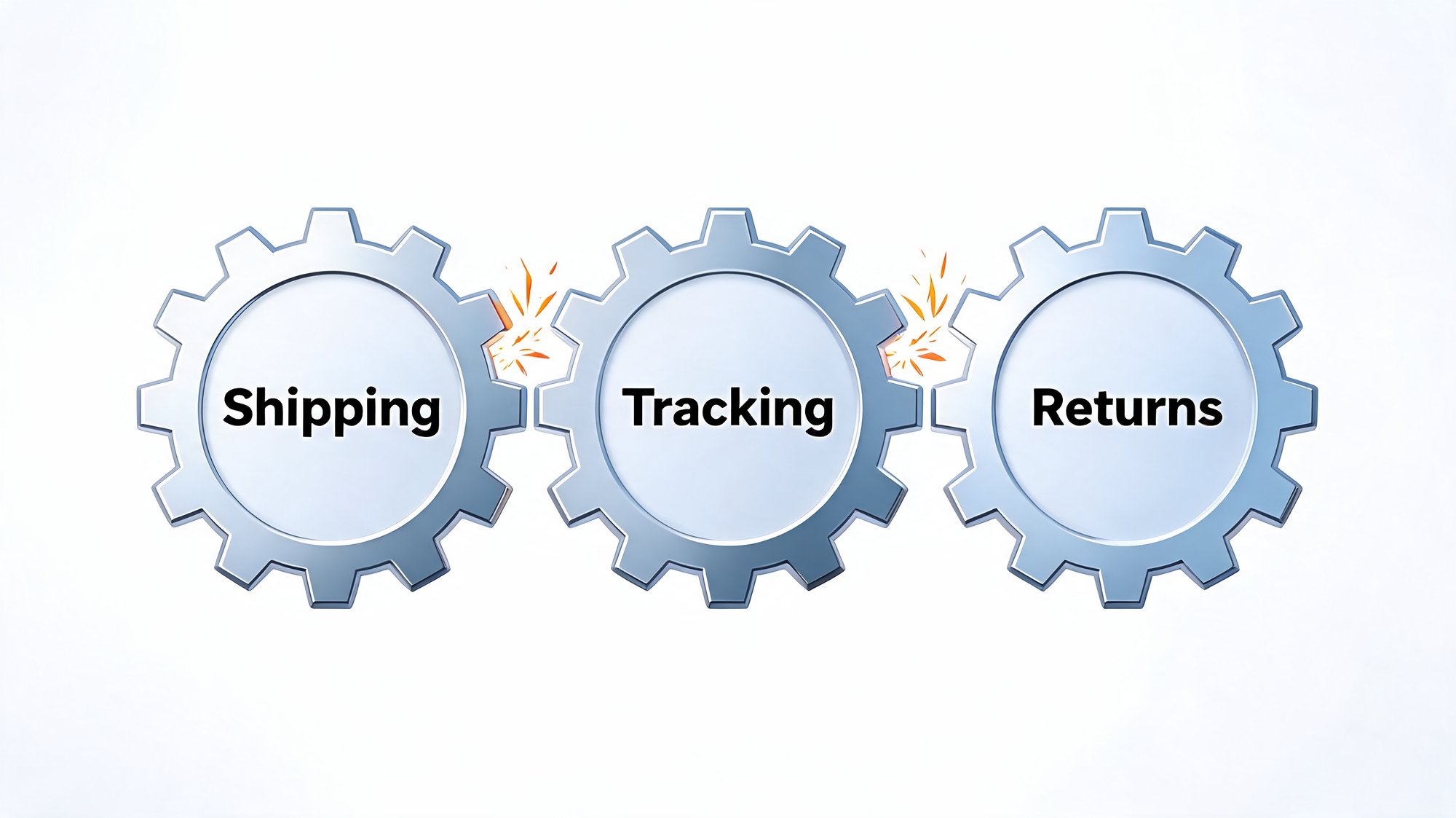
Here's the structural problem. Shipping, tracking, and returns usually run on three separate tools that don't share data, so each one solves its own slice and none of them sees the whole journey.
The Alternative: The Integrated Post-Purchase Platform
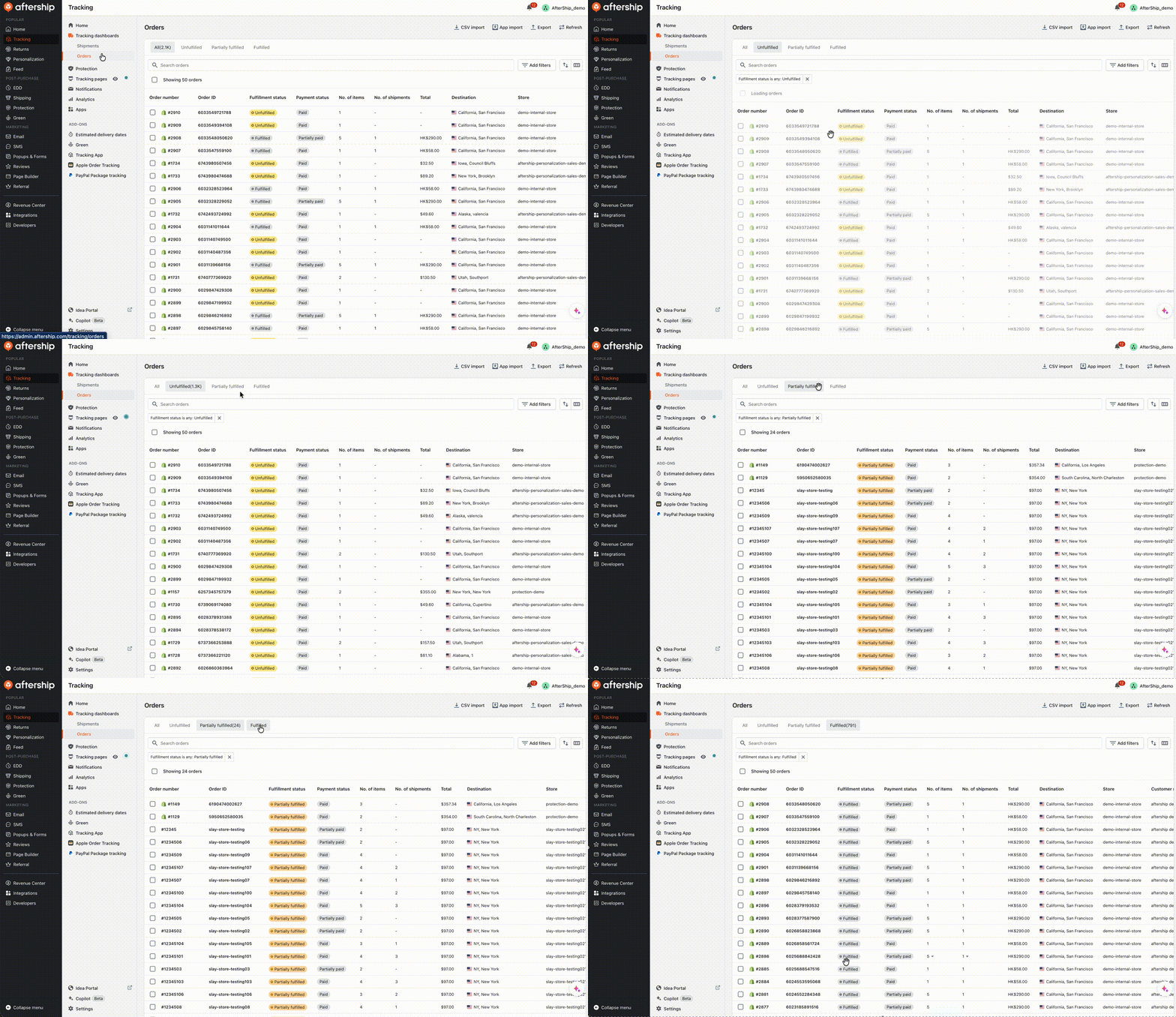
The fix isn't a better label printer. It's treating shipping, tracking, and returns as one system built on a single order record.
That's the model behind AfterShip Shipping. Shipping data feeds branded tracking and proactive notifications, which cut WISMO before a ticket is ever opened. That same order data then powers exchange-first returns that recover revenue instead of refunding it. Because every notification points back to a branded tracking page, the same flow that prevents a support ticket also creates a repeat-visit touchpoint you own. Each step makes the next one smarter, which a disconnected stack can't do.
The proof is in named results, not slogans. MyDeal cut pre-delivery WISMO tickets by 25% and trimmed average transit time by 25% after moving tracking to AfterShip. On returns, Fellow resolved cases 52% faster, from 14.46 days down to 7.52, and recaptured more than 20% of return revenue. AfterShip's own benchmarks cite up to 95% EDD prediction accuracy, up to 65% fewer WISMO inquiries, and 50% of return revenue retained through exchanges (product-level figures).
On cost, AfterShip Shipping connects 100+ carriers. On AfterShip's direct channel (aftership.com/pricing/shipping) it publishes a Free tier covering 10 shipping labels a month, then Essentials at $9/mo, Pro at $69/mo, and Enterprise custom, with roughly 18% off on annual billing. Like several competitors (Easyship advertises the same figure), it markets up to 91% off retail rates, so read that as table stakes, not a differentiator.
To be fair, AfterShip Shipping does not publish a checkout-level duty and tax display to match Easyship's Premier DDP/DDU feature. If checkout-level landed cost is your core need, Easyship still leads there. AfterShip's advantage was never a longer feature list on any single tool. It's that shipping, tracking, and returns run on one data layer, with one login and one source of truth.
AfterShip vs. The Specialists: A New Comparison
So the honest comparison in 2026 isn't really easyship vs shipstation vs shippo anymore. It's an integrated platform against the stack you would assemble to match it: a shipping tool, a tracking tool, and a returns tool, stitched together by hand.
Take a representative point stack of ShipStation for shipping, Malomo for tracking, and Loop for returns. The entry-level public prices stack up quickly before volume billing: ShipStation at $29.99/mo on its 50-shipments-a-month band, Malomo around $99 scaling toward $400 (legacy, as-captured pricing from gomalomo.com in February 2026; Malomo was acquired by Redo and post-acquisition tiers are not disclosed), and Loop at $155 to $340, Shopify-first with a 12-month lock-in plus return-volume and label fees that vary. Treat every figure here as directional, not a precise quote, since high volume on all four routes to custom pricing.
The point isn't that AfterShip is the cheaper sticker. It usually isn't expressed as one number, because each product is billed separately and high volume is custom. The point is what you stop paying for in coordination: three contracts, three renewals, three data silos, and the staff hours to reconcile them. The real overhead is human, not just financial: when a delayed package becomes a return, a stitched stack makes three tools argue about who owns the customer.
| Criteria | AfterShip | ShipStation + Malomo + Loop |
|---|---|---|
| Total Cost of Ownership | ✓ One vendor; each product billed separately, high volume custom; consolidation, not a low sticker | ✗ Three separate bills, each on its own entry band before volume billing; each scales independently |
| Data Cohesion | ✓ Shipping, tracking, returns on one order record | ✗ Three tools, three data silos; no shared record |
| Customer Experience Control | ✓ Branded tracking + exchange-first returns from one system | ✗ Fragmented touchpoints coordinated across three vendors |
| Operational Overhead | ✓ One login, one renewal | ✗ Three contracts/renewals to reconcile; Loop adds a 12-month lock-in |
The four lines that matter for this decision are total cost of ownership, data cohesion, customer experience control, and operational overhead. On a spec sheet, the point stack can match most individual features. On those four lines, a single platform is structurally ahead, and that's the comparison your recommendation should actually make. The choice stops being which label tool to buy and becomes whether to keep buying point tools at all. For the ranked options, see Easyship alternatives for a scaling brand.
Simplify shipping and order fulfillment across Shopify, TikTok Shop, and your carrier network.
Book a demoFrequently Asked Questions
These are the questions buyers ask most when running an easyship vs shipstation vs shippo comparison.
Is ShipStation or Shippo cheaper?
At low volume, Shippo is cheaper: its Starter plan is free for up to 30 labels a month and Pro is from $17/mo billed annually ($19 monthly), covering 1-200 labels a month, with higher volume on custom Premier pricing. ShipStation starts at $14.99/mo (Starter), then $29.99 (Standard, which includes 10 users and API access), and $349.99 (Premium) at the 50-shipments-a-month band, rising as shipment volume climbs, so it costs more but includes deeper automation and broader multi-channel integrations.
What are the best ShipStation alternatives?
It depends on the gap you're filling. Easyship is the strongest alternative for international (550+ couriers, duty and tax on every plan), Shippo for API-first or SMB teams (40+ carriers), and an integrated platform like AfterShip if you want shipping, tracking, and returns in one system.
Does Shippo or ShipStation offer a free plan?
Shippo offers a free Starter plan for up to 30 labels per month. ShipStation has no perpetual free plan; its lowest tier is the paid Starter at $14.99/mo. AfterShip Shipping publishes a free tier on its direct channel too, covering 10 shipping labels a month, with Essentials from $9/mo above it.
Is Easyship better than ShipStation for international shipping?
For complex international, yes. Easyship connects 550+ couriers, calculates duty and tax on all plans, and can display tax and duty at checkout from the Premier tier up, while ShipStation is domestic-strong with 200+ carriers. If cross-border is more than half your orders, Easyship leads.
What is the best shipping software for ecommerce in 2026?
There's no universal best; it depends on your constraint. Shippo suits API-first startups, Easyship suits cross-border brands, and ShipStation suits high-volume domestic sellers. For scaling DTC brands that want shipping connected to tracking and returns, an integrated platform like AfterShip (Shipping from $9/mo on its direct channel, 100+ carriers) is the stronger long-term choice.
The Final Verdict: Choosing Your Shipping Strategy for 2026
The right call depends on what you're actually solving for.
- Choose Shippo if you're an API-first startup that needs a simple, low-cost label tool and little else.
- Choose Easyship if complex international is more than half of your orders; its duty, tax, and courier coverage lead that lane.
- Choose ShipStation if you're a domestic-heavy US brand with high volume that isn't yet prioritizing the post-purchase experience.
- Choose AfterShip if you're a scaling DTC brand that wants operational efficiency and customer experience to come from the same system.
One honest limitation: AfterShip Shipping is built around the whole post-purchase journey, so a 10-order-a-month store that only wants a bare label will use a small fraction of it. The free tier covers 10 labels a month if that is genuinely all you need.
But that's a short-sighted way to choose if you plan to grow. The brands that win in 2026 aren't the ones with the cheapest label. They're the ones who turned shipping, tracking, and returns into a single retention engine. AfterShip Shipping starts at $9/mo on its direct channel and connects 100+ carriers, and the real return comes from what you build on top of it.