Choosing a shipping API lays the foundation for your post-purchase infrastructure. Shippo and EasyPost both cover labels, rates, and carrier tracking. The cost that decides this choice is how many separate post-purchase integrations, and data stores, your team will build, reconcile, and maintain as the product grows. AfterShip puts its shipping, tracking, returns, and warranty APIs behind one developer portal and one authentication scheme.
A Shippo vs EasyPost API decision usually starts with labels and rates. Teams that want to compare multi-carrier shipping software at the product level can start broader, but an architecture review needs a longer view. The real choice is between a shipping integration and a platform whose shipping, tracking, returns, and warranty APIs sit behind one developer portal.
Executive Summary: Shippo vs. EasyPost vs. AfterShip
If you have five minutes before an architecture review, these four criteria settle most shortlists: paradigm, fit, core job, and the catch.
| Criterion | Shippo API | EasyPost API | AfterShip API |
|---|---|---|---|
| Paradigm | Multi-carrier shipping API and web app | Multi-carrier shipping API | Shipping API in one developer portal with AfterShip's tracking, returns, and warranty APIs |
| Best For | Teams that need labels, rates, and carrier tracking, billed by plan or per API call | Teams that need labels, rates, and carrier tracking, billed per label after a free allowance | Teams that want shipping, tracking, returns, and warranty APIs behind one developer portal and one authentication scheme |
| The Catch | Documents return labels, not a shopper-facing returns portal | Partners out returns to third parties | Production Shipping API starts on the Pro plan, which includes the Labels and shipping rates API and the Carrier accounts API |
| Core Job | Labels, rates, address validation, and tracking | Labels, rates, tracking, and electronic customs data | Labels and rates, with carrier selection informed by AfterShip tracking data |
All three cover the shipping calls a developer writes first: rates, labels and carrier tracking. The difference shows up in what sits next to those calls. AfterShip puts them behind the same developer portal and authentication scheme as its tracking, returns, and warranty APIs, so the next post-purchase integration starts from the same setup.
Round 1: Documentation, SDKs, & Developer Experience
Developers judge an API by how quickly its documentation answers a question. A useful Shippo API review, or an EasyPost one, starts with four checks: reference clarity, SDK quality, sandbox behavior, and how versions change.
Add a fifth check for every vendor: idempotency. Ask how a retried request avoids buying the same label twice, then test that path in the sandbox.
Here is what each vendor documents, drawn from Shippo's API documentation, EasyPost's API documentation and AfterShip Shipping's API documentation:
- Official SDKs. EasyPost lists seven official libraries (.NET, Go, Java, Node.js, PHP, Python, Ruby), all with 2026 releases. Shippo lists five. AfterShip Shipping's currently maintained public SDK is Java (v3.2.0, released 17 July 2026).
- Versioning. Shippo pins API versions with the
Shippo-API-Versionheader and states it will never force an upgrade. - Changelogs. EasyPost's release notes were last updated 29 August 2026. AfterShip Shipping's changelog is actively maintained, with its latest entry on 4 September 2026.
AfterShip Shipping is a REST API with a sandbox. Requests are signed with as-signature-hmac-sha256 or as-signature-rsa-sha256 alongside as-api-key. Build that signing step into your HTTP client once, and every service that calls the API follows the same pattern.
It publishes 10 requests/second per organization and 14 webhook delivery attempts. Those documented numbers let you size workers and retry logic before you write the first call.
Round 2: Core API Capabilities & Feature Depth
Feature depth matters only where it changes your code path. A startup printing a few domestic labels needs different endpoints than a platform batching thousands of international shipments.
Label Generation
Simple use cases need one call that returns a label. Complex ones need batching, and batch limits shape your job design.
Shippo's API covers labels, rates, address validation and tracking.
Shippo creates up to 10,000 labels in one batch request. EasyPost recommends keeping batches under 1,000 shipments. AfterShip Shipping documents its label endpoints, with the production Labels and shipping rates API on the Pro plan.
Rate Shopping
Rate shopping decides how many carrier accounts one request can compare. For a single-carrier merchant this barely matters; for a marketplace it sets your fan-out.
EasyPost rates across at most 60 carrier accounts per rate request. AfterShip Shipping documents rate endpoints, and its Carrier accounts API sits on the Pro plan for connecting your own carrier accounts.
Address Validation
Bad addresses turn into returned parcels and support tickets, so validation belongs before label purchase. Shippo includes address validation in its API. Whichever vendor you evaluate, confirm that validation runs before label purchase and check which countries it covers.
International Shipping
Cross-border volume adds customs data and duty terms to every shipment.
EasyPost transmits customs information electronically to carriers when supported.
Its help center explains DDP, DAP and DDU. Map your duty terms to documented fields before launch.
The label, rate and customs calls you write here are only the first post-purchase integration. AfterShip Shipping documents its label and rate endpoints alongside its tracking, returns, and warranty APIs.
Round 3: Performance, Reliability, and Scalability
High-volume teams need three answers before launch: how fast they can call the API, how they will know it is healthy, and what happens to events their own systems miss. In any shipping API aggregators comparison, those answers decide how much defensive code you write.
Rate limits and error handling. Each vendor states its rate limits in its own units. Shippo sets per-minute limits by endpoint and returns a 429 on overage. EasyPost allows five requests per second on index endpoints, with a load-based limiter on top. AfterShip Shipping allows 10 requests/second per organization, returns rate-limit headers, and offers custom rate limits on Enterprise.
Latency and uptime. The three status pages publish different signals over different windows, so read each one on its own terms. Shippo's status page, status.goshippo.com, publishes API response time for the day, week and month. EasyPost's, www.easypoststatus.com, publishes 90-day uptime bars and error-rate metrics. AfterShip's page shows its uptime metrics for the day, week and month.
AfterShip commits to 99.9% monthly Service Uptime in its SLA (with service credits if it is not met), and its status page reports Shipping API uptime independently.
Webhooks. Missed events are where webhook validation earns its place: verify every payload, acknowledge fast, and make handlers safe to replay. Shippo retries twice on 408, 429 or 5XX and expects a 2XX within three seconds. EasyPost retries up to six times and requires a response within seven seconds.
AfterShip Shipping makes 14 delivery attempts with exponential backoff, which gives a consumer that goes offline for a deploy more chances to catch up.
Round 4: The True Cost: Pricing Models & TCO
A pricing page answers one question: the platform fee at your volume. Each vendor answers it with a different model. Shippo bills by plan, with API access included on its Pro plan, or per API call. EasyPost bills per label after a monthly free allowance, and adds a monthly fee plus a per-label fee when you bring your own carrier accounts. AfterShip Shipping is a subscription priced by label volume, published up to 300,000+ labels a year in both monthly and annual billing.
Shippo's API pricing states "no setup fees or hidden fees". EasyPost's Billing & Payments article states "There are no setup fees" and lists "no contracts or volume minimums for the first 3,000 labels per month" on its Wallet plan.
| Labels / month | Shippo | EasyPost | AfterShip Shipping |
|---|---|---|---|
| 10,000 | Pro $199 (5,001-10,000 band; includes API) | Free Access (Wallet): 3,000 free labels, then $0.08/label = $560 | Pro $259 |
| 20,000 | Above Pro's 10,000/mo ceiling: Premier (contact sales) or API Starter at $0.07/label | Free Access (Wallet) $1,360; BYOCA $20/mo + $0.08/label = $1,620 | Pro $469 |
Add-on charges land in two places: tracking, and the carrier accounts you bring yourself. Both sit outside the platform fee at every vendor.
| Add-on | Shippo | EasyPost | AfterShip Shipping |
|---|---|---|---|
| Tracking | $0.02 per unique tracking number created outside Shippo | A tracker is created with every purchased label; standalone Tracking API $0.01-$0.03 per shipment; Advanced Tracking $0.03 per shipment | AfterShip Tracking is a separate product with its own pricing page, in the same developer portal and authentication scheme as AfterShip Shipping |
| Own carrier accounts | Own-carrier labels free on the Pro and Premier plans | BYOCA $20/month plus $0.08 per label, with no free label allowance | Connect your own carrier accounts through the Carrier accounts API, included on the Pro plan |
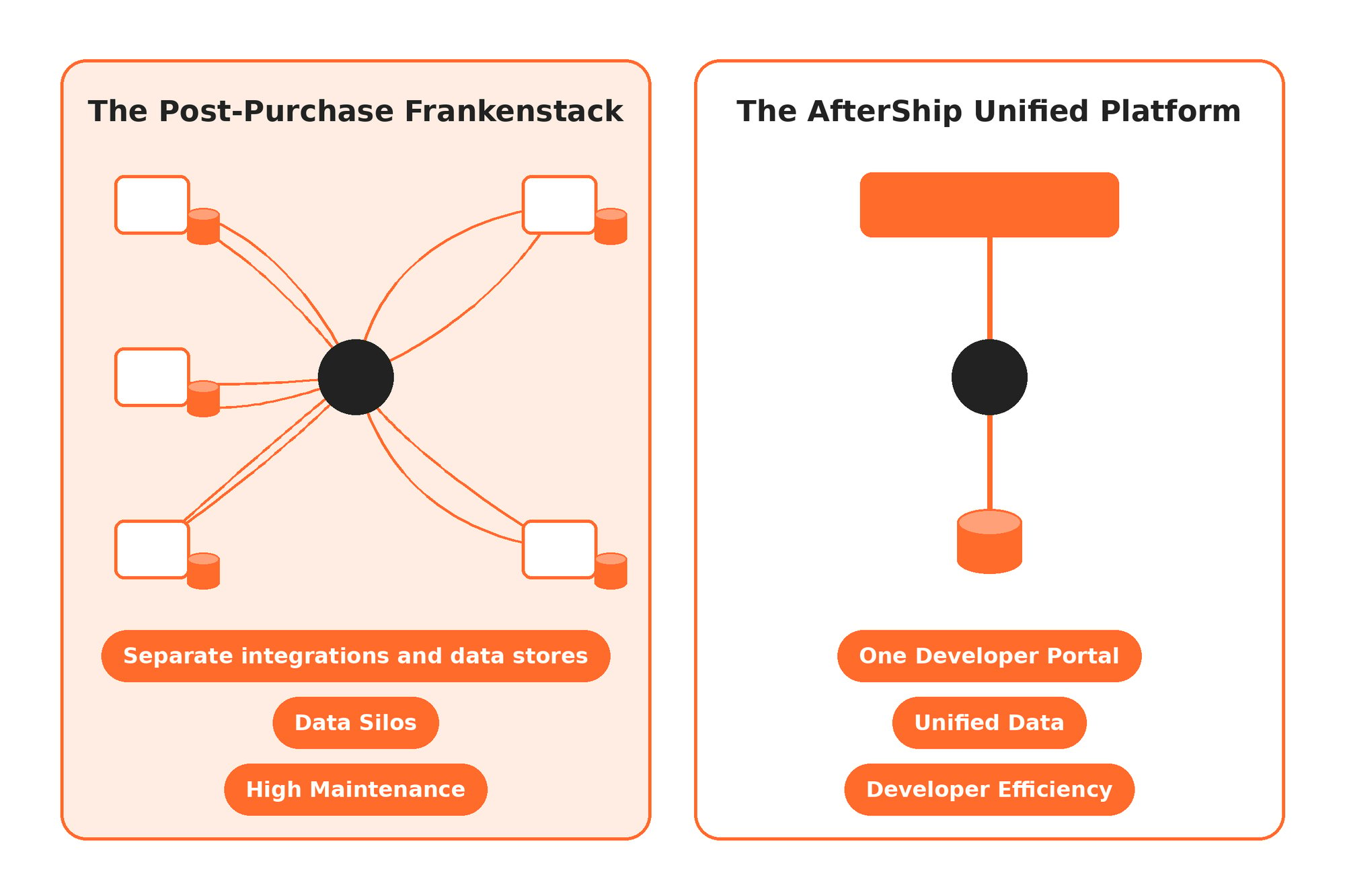
A price table cannot show how many separate post-purchase integrations your team will build, reconcile, and maintain over the product's life. That count is the part of total cost of ownership (TCO) your engineers carry: each integration brings its own authentication, webhooks, data store and upgrade path. AfterShip's shipping, tracking, returns, and warranty APIs share one organization, with each product billed separately.
The Verdict: When to Choose Shippo vs. EasyPost
The right choice depends on which post-purchase jobs your system will need beyond the label.
Choose Shippo or EasyPost if:
- you need labels, rates and carrier tracking, and will not need a shopper-facing returns portal from the same vendor
- you want label volume billed per API call rather than by plan
Choose AfterShip if:
- you want shipping, tracking, returns, and warranty APIs in one developer portal
- your webhook consumers need a long delivery retry window
- you want carrier selection that avoids services with a high exception rate on a lane, using AfterShip tracking data
The Real Question: Why Maintain Separate Post-Purchase Integrations?
Every post-purchase job your product takes on adds an integration your team has to own. Labels come first, then tracking events, returns and warranty claims, and each connection brings its own credentials, webhooks, data store and upgrade path.
Shippo and EasyPost are mature, well-established APIs with large install bases. Most growing systems also need tracking and returns data joined to shipping data, and AfterShip's shipping, tracking, returns, and warranty APIs sit behind one developer portal and one authentication scheme.
The scope each vendor documents shows where those joins fall. Shippo and EasyPost cover labels, rates, and carrier tracking. Neither documents a shopper-facing returns portal: EasyPost partners out returns to third parties, and Shippo documents return labels rather than a returns portal.
The long-term cost is reconciliation. A label, its tracking events and the return that follows can sit in separate integrations with separate data stores, and your engineers keep them matched for the life of the product.
On AfterShip, a team adding returns or warranty works within the same organization and authentication scheme it already uses for shipping.
A Modern Alternative: AfterShip's Shipping, Tracking, Returns, and Warranty APIs
Teams planning for tracking, returns and warranty work can start with AfterShip Shipping as the entry point. AfterShip offers shipping, tracking, returns, and warranty APIs in one developer portal. All four share one organization and one authentication scheme.
AfterShip Shipping is newer to the shipping-API space but built on the infrastructure behind AfterShip's tracking platform. That tracking data already informs label decisions: Smart Carrier Recommendation, available on every AfterShip Shipping plan, excludes services with a high exception rate for a shipment's origin and destination, based on AfterShip tracking data. It is off by default, so you turn it on when your lanes call for it.
Developers comparing EasyPost API alternatives, or shortlisting the best multi-carrier shipping APIs, can apply one test: what else sits behind the same developer portal and authentication scheme? Each AfterShip product is billed separately, so you add tracking, returns or warranty only when your product needs it.
Our verdict on a leading developer-grade logistics tracking API covers the tracking side in depth. With AfterShip Tracking, StackCommerce was able to reduce WISMO tickets by 71% year over year, with 99% shipment tracking visibility and a 90% on-time delivery rate, according to AfterShip's StackCommerce customer story.
Start with shipping, and the next API your product needs is already in the same portal.
Getting Started with AfterShip's API
Four steps take a developer from the documentation to production labels:
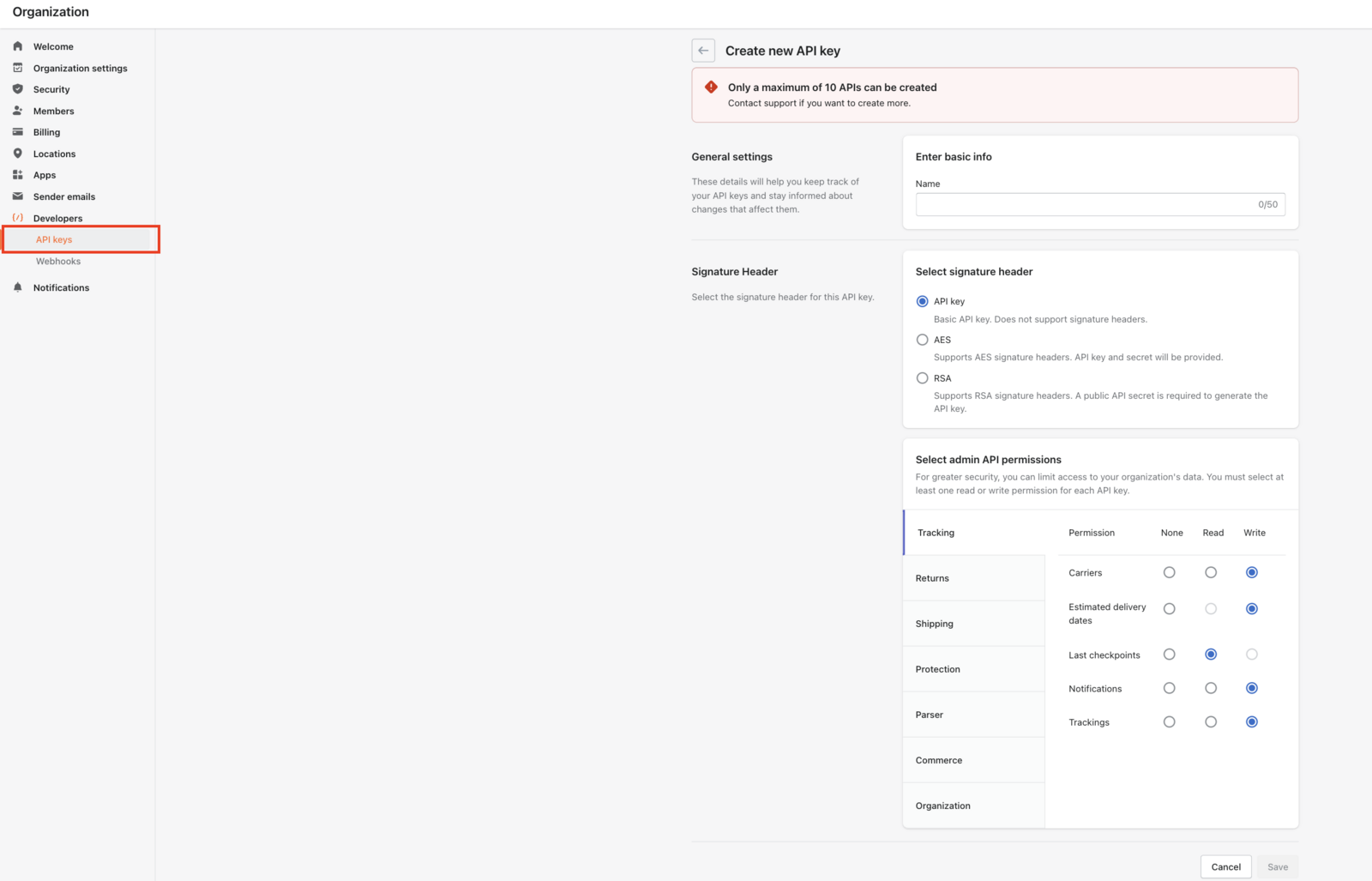
- Explore the API documentation at aftership.com/docs.
- Sign up for a free account and explore the sandbox, where generating labels is not charged.
- Move to the Pro plan for the production Shipping API, which includes the Labels and shipping rates API and the Carrier accounts API.
- See the full platform in action at aftership.com/contact-sales/shipping.
The sandbox lets you prove your integration before any production label is bought.
Simplify shipping and order fulfillment across Shopify, TikTok Shop, and your carrier network.
Book a demoFinal Verdict: Build for Tomorrow, Not Just Today
Your shipping API choice decides how many post-purchase integrations your team will maintain later. Shippo and EasyPost cover labels, rates, and carrier tracking. For a broader business perspective, a brand-level comparison of AfterShip and Shippo covers the questions outside the API.
AfterShip's shipping, tracking, returns, and warranty APIs, behind one developer portal and one authentication scheme, address the separate post-purchase integrations a growing system otherwise builds and maintains.
Frequently Asked Questions
Which API has better documentation, Shippo or EasyPost?
Both publish API documentation and official client libraries, so the better fit depends on your stack. Check that your language has an official library, how each vendor handles API versioning, and how recently its release notes changed. Then run your own label flow against each API before you commit.
How do Shippo, EasyPost, and AfterShip handle API rate limits?
Each vendor sets limits in its own unit. Shippo sets limits per minute by endpoint and returns a 429 when you exceed them. EasyPost sets limits per second on index endpoints, plus a load-based limiter. AfterShip Shipping sets its limit per organization, with custom rate limits on Enterprise. Compare them in each vendor's own units rather than converting them to one scale.
What is the total cost of ownership for Shippo vs EasyPost?
Total cost of ownership combines the published platform fees at your volume with the engineering cost of every integration you build and maintain. Shippo bills by plan or per API call, EasyPost bills per label after a monthly free allowance, and AfterShip Shipping is a subscription priced by label volume. Over the life of a product, the number of separate post-purchase integrations your team keeps running is the cost a price table does not show.
Why maintain fewer separate post-purchase integrations?
Each integration brings its own credentials, webhooks and data store, and your team has to keep shipping, tracking and returns records matched across them. AfterShip puts its shipping, tracking, returns, and warranty APIs behind one developer portal, one organization and one authentication scheme, so each new post-purchase API starts from the setup your team already has.