Your Shopify store is scaling, and Loop was the right call when you made it. But the renewal is coming with a 6 percent uplift attached, tracking is a second subscription, everything outside Shopify is a custom implementation, and Shopify has a new requirement for returns apps landing in December. You are not looking for another returns app. You are looking for the platform you take into the next three years.
Be clear about what this article is not. Loop Returns is a good product. It holds 4.7/5 from 408 merchants on the Shopify App Store, its exchange flow is one of the most polished Shopify-native experiences in the category, and its changelog of 10 March 2026 reads "All conditions and actions available on all Loop plans." Brands do not usually leave Loop because it let them down. They leave because the shape of the business changed underneath it: more channels, more SKUs, more countries, and a returns rate the National Retail Federation puts at 19.3 percent of online sales. That is a graduation, not a complaint.
Why Scaling Brands Graduate from Loop Returns
The commitment structure, not the price
Loop's Terms of Service, last updated 3 March 2026, set out the commercial frame most teams do not read until renewal season. Subscriptions renew automatically, stopping that renewal requires 60 days written notice, card payments carry a 2.9 percent convenience fee, and the agreement covers "non-refundable fees specified in the Order Form." On termination, "all undisputed fees will be immediately due within ten (10) business days." Then the clause that catches people: "An annual increase of 6% will occur upon the completion of each Term."
As of August 2026, loopreturns.com/pricing lists Essential at $155 per month and Advanced at $340 per month, above a free Loop Core plan. Checkout+ is listed separately, with a free plan of its own.
None of this is hidden or unusual for B2B SaaS. But it means a decision you make this quarter carries into the next Term on its own, with a 6 percent step-up built into each renewal.
Everything outside Shopify is a custom implementation
Loop's homepage says "Originally built for Shopify. Now available on all platforms." The FAQ on Loop's own site is more specific: "Shopify brands can go live out of the box, often in 15 to 45 days. Other platforms can use Loop through a custom implementation, with slightly longer timelines."
That is an honest sentence, and worth reading carefully. Checked in August 2026, WooCommerce, BigCommerce and custom platforms appear only inside Loop's API integration guides; Salesforce Commerce Cloud appears in a May 2024 press release. As of August 2026, Loop publishes no native connector, timeline or cost for any non-Shopify platform, and no split of responsibility between Loop and your engineering team. If your 18-month roadmap includes a second storefront, a marketplace or a wholesale channel off Shopify, that is a scoping conversation you cannot have from public information.
Tracking is a second product and a second renewal
Loop Returns and Track by Loop are separate Shopify apps with separate subscriptions. Track by Loop still lists Wonderment as its developer. Delivery Promise, webhooks and API access, and split shipment support sit on its Plus tier at $449 per month. If Redo is the other name on your list, that comparison is in Loop or Redo for Shopify returns.
The point is not that two subscriptions cost more than one. It is that you are buying two separately listed Shopify apps with two subscriptions, two renewal dates and two release histories, one of which still lists Wonderment as its developer of record.
Two narrow, documented ceilings
Both come from Loop's own help documentation, and both are narrow rather than sweeping. On bundles, Loop's help centre reads: "Loop is unable to restock a product from a partial bundle return. If the entire bundle is being returned, it can be restocked since the bundle SKU was the only SKU linked to the order." So the ceiling is specifically the partial return, which matters if you sell kits, sets or curated bundles.
On multiple labels, Loop's documentation reads: "This feature is currently only compatible with merchants who use EasyPost for their shipping service," alongside "BETA: Available via Ship By Loop, reach out to [email protected] to join." Loop generates multiple labels; it does so through a partner or an opt-in beta rather than natively on every account. If you ship furniture or equipment that regularly needs two boxes back, ask which of those two paths applies to you before you renew.
Neither Loop app carries Built for Shopify, and a Shopify deadline lands in December
On 17 June 2026, Shopify's developer changelog stated that "Returns and exchanges apps and Subscription apps with buyer-facing self-service experiences must use the Customer Account API for customer authentication," effective 1 December 2026, and that apps failing to meet it are "at risk of losing Built for Shopify status."
As of 15 August 2026, neither Loop Returns nor Track by Loop carries the badge, so there is no badge for Loop to lose. It is not an AfterShip exclusive - ReturnZap carries it too - but it is not common either: most apps in this list do not have it. What it means is that authentication architecture is now a dated, published requirement, and a fair question to put to every vendor you evaluate this year.
1. AfterShip Returns: The Best Loop Alternative for Growth
AfterShip Returns holds 4.7/5 on the Shopify App Store across 1,393 reviews, roughly 3.4 times Loop's review volume at the same score. Pricing is published: Essentials at $19 per month or $192 per year for 20 returns per month, $0.50 per additional return; Premium at $119 per month or $1,188 per year for 100 returns per month, $1.00 per additional return; Enterprise on request. Existing customers are not re-tiered, and overage is alerted rather than blocked, so no hard spend cap stops returns processing mid-month.
Platform reach beyond Shopify
The architectural difference is API-first design. AfterShip Returns exposes a full returns API and webhooks, so a return is a first-class object your OMS, warehouse, data warehouse and CX desk can all read, rather than an export somebody schedules. On top of that, AfterShip publishes native support across 25 platforms, naming Shopify, Salesforce Commerce Cloud, Magento 2, BigCommerce and Amazon Seller Central. Set that against what Loop publishes: as of August 2026, no native non-Shopify connector, and its own FAQ describing other platforms as a custom implementation. The difference is not how many platforms appear in marketing copy. It is that one vendor documents the path and the other scopes it privately.
Radically reduce costs with granular automation
Rules are where returns cost either compounds or collapses. AfterShip Returns lets you build conditional logic that maps to how your catalog behaves: route by destination zip code so returns land at your nearest warehouse, block returns on items carrying a final_sale product tag, give VIPs a 60-day window while first-time buyers get 30, and apply separate handling to multi-item and bulky returns. AfterShip Returns accepts individual item returns from bundled purchases, refunding either the prorated item value or the bundle's average item price.
AfterShip Returns publishes auto shipping label generation with 69 carriers worldwide without additional software, and 300K+ drop-off sites available to shoppers. The number of carrier accounts you can connect is set by plan: three on Essentials, five on Premium, unlimited on Enterprise. No mandated third-party shipping provider sits between you and a second label. The rules reach into fulfilment too: AfterShip Returns can "create RMAs on 3PL platforms, such as ShipBob and ShipHero, upon return request approval," so the warehouse sees the return at the moment it is approved rather than when the box lands.
Reporting sits alongside all of it: advanced pre-built dashboards covering return reasons, transit reports and on-time delivery, and, as the AfterShip Returns analytics page puts it, the ability to "identify key return reasons, including color, quality, and size for products and their variants." That is the SKU-level and variant-level detail that turns a returns report into a merchandising decision.
Marc Nolan cut time spent on returns by 97 percent and roughly doubled the share of returns resolved as exchanges, from 25 percent to 49 percent, worth "$125k in the last 90 days" according to Director of Operations Nikolas Callas. (Customer story published 24 March 2022.)
Unify your entire post-purchase stack
This deserves an honest sentence before the pitch: each AfterShip product is its own subscription. Returns, Tracking, Shipping and AI EDD are billed separately. What consolidates is the vendor relationship and the data layer, not the invoice.
That still matters more than it sounds. One vendor means one security review, one contract negotiation, one escalation path. It also means your returns, tracking and shipping data sits with one vendor behind one integration, rather than being reconciled across three. AfterShip Returns and AfterShip Order Tracking both carry Shopify's Built for Shopify badge. The equivalent Loop stack is two apps with two renewals, where the tracking product carries no badge and gates Delivery Promise at $449 per month.
Coffee equipment brand Fellow cut average return resolution time from 14.46 days to 7.52 days in under six months on AfterShip Returns and recaptured over 20 percent of that revenue through exchanges and store credit. Digital Product Manager Stephen Davis Hernandez: "The automation rules on AfterShip Returns are amazing. Being able to optimize that resolution as much as possible has been fantastic."
Built for the next three years
Shopify has deprecated its legacy customer accounts, and AfterShip Returns already supports Shopify's new customer-account sign-in, the authentication path the 1 December 2026 requirement is built around. In AfterShip's own words: "Signed-in shoppers can start a return directly from their account, no order number or verification needed." That is live today rather than a roadmap item, which is the thing worth asking every vendor on your shortlist about this quarter. AfterShip carries the Built for Shopify badge on both AfterShip Returns and AfterShip Order Tracking; Loop carries it on neither of its two apps.
AfterShip Returns and Loop Returns, Side by Side
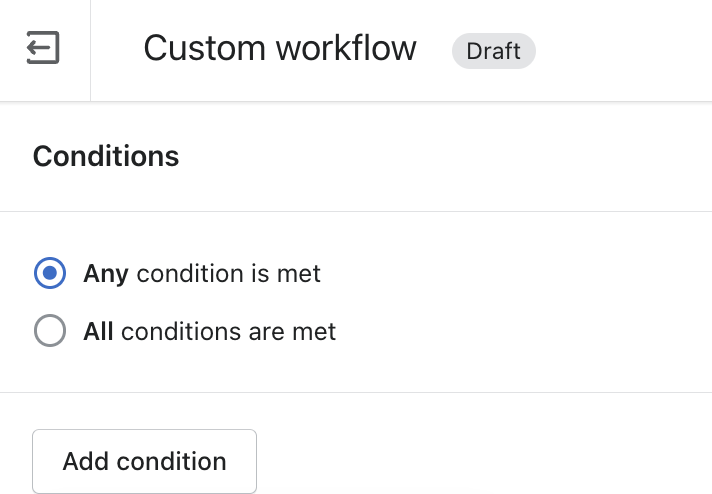
Start with the parity, because it is real. Both platforms are rated 4.7/5 by Shopify merchants, and both handle the core returns and exchange workflow well: portals, policies, conditional rules, exchange offers, store credit incentives, refund processing. Loop's changelog of 10 March 2026 states that "Merchants on every Loop plan will now have access to every condition and action in Workflows," so anyone telling you Loop cannot do rules has not opened Loop this year. Plenty of brands are happy on Loop and should stay. We keep our direct feature-by-feature comparison with Loop separately; what follows is only the narrow set of differences documented on both sides.
| Criteria | AfterShip Returns | Loop Returns |
|---|---|---|
| Partial bundle return, restocking a single item | Accepts individual item returns from bundled purchases; refunds the prorated item value or the bundle's average item price | "Loop is unable to restock a product from a partial bundle return" |
| Multi-box or multi-label generation | Generated across AfterShip's own returns carrier network: auto shipping label generation with 69 carriers worldwide without additional software. No mandated provider; return rules for multiple and bulky items | "This feature is currently only compatible with merchants who use EasyPost for their shipping service," plus "BETA: Available via Ship By Loop, reach out to [email protected] to join" |
| Exchange order value and tax | Variant exchange order created at its real value; any price difference charged through Stripe or Shopify checkout | Exchange orders carry a loop-discount, and "AvaTax will look at the subtotal, after discounts are applied, and use that value to set tax values within their system"; Loop "recommends disabling loop-discount and creating the exchange order at full value" |
| Built for Shopify | Carried on both AfterShip Returns and AfterShip Order Tracking | Carried on neither Loop Returns nor Track by Loop |
| Tracking | Separate AfterShip subscription, same platform and vendor | Track by Loop, a separate app and subscription; Delivery Promise on the Plus tier at $449 per month |
| Contract and renewal | Each product a separate subscription; existing customers are not re-tiered; overage is alerted, not blocked | Automatic renewal, 60 days written notice, non-refundable fees, "An annual increase of 6% will occur upon the completion of each Term" |
One caveat on the tax row, because it is easy to overstate. Creating the exchange order at its real value is a mechanism difference, not a guarantee: an even exchange with no price difference still presents a zero-value order to any tax engine. What changes is that the value your tax engine reads is not the output of a discount applied on top of a full-price line, which is the pattern Loop's own AvaTax guidance flags when it notes that AvaTax "will look at the subtotal, after discounts are applied."
6 Other Strong Loop Returns Alternatives to Consider in 2026
Ratings, review counts and Built for Shopify badge status below were captured on 15 August 2026 and move quickly. Re-check before you shortlist.
2. ReturnGO
What it is: A returns and exchanges platform with strong exchange-first logic and a well-regarded portal. Rated 4.8/5 across 358 Shopify reviews.
Who it is for: Brands that want deep exchange incentive mechanics at a mid-market price point.
Verified numbers: Premium at $147 for 110 returns, Pro at $297 for 300 returns. No Built for Shopify badge.
Key limitation for scaling brands: Owned by Global-e since 31 July 2025, a strategic fact rather than a flaw, and worth noting without a gotcha: Loop itself lists Global-E as an integration partner. The missing badge ahead of the December requirement is the more practical consideration.
3. ReturnZap
What it is: A focused returns app with a strong satisfaction score. Rated 4.9/5 across 102 Shopify reviews, with the Built for Shopify badge.
Who it is for: Small to mid-sized Shopify brands that want clean returns automation at a low price and do not need a multi-channel platform.
Verified numbers: Pro at $39 per month and Advanced at $69 per month, each from 50 returns.
Key limitation for scaling brands: The published tiers start at 50 returns a month, far below what a brand at this size generates, so this reader is off the published ladder on day one and into a custom quote. Platform scope is also narrower than the multi-channel options here.
4. Return Prime
What it is: A broadly capable returns and exchange app from Appsdart Solutions, rated 4.8/5 across 725 Shopify reviews.
Who it is for: Shopify brands that want a well-reviewed app across a wide pricing range, including a free entry tier.
Verified numbers: Start, free to install; Grow from $19.99; Thrive AI at $79.99; Scale at $149.99.
Key limitation for scaling brands: Shopify only, so it does not solve the multi-channel problem this reader is buying for. If your reason for leaving Loop is the non-Shopify roadmap, this is a lateral move.
5. Redo
What it is: A returns platform from Redo Tech, Inc. Its returns product is free to the merchant; its other modules - checkout optimization, email and SMS, and fulfilment - are paid. Rated 5.0/5 across 671 Shopify reviews.
Who it is for: Brands that want returns coverage without a returns subscription line item, and are comfortable evaluating a platform whose commercial model is structured differently from the rest of this list.
Verified numbers: Returns free to the merchant; Checkout Optimizer $10/month; Email and SMS $10/month; Fulfillment $99/month.
Key limitation for scaling brands: The commercial model is genuinely different rather than merely cheaper, so it needs its own evaluation rather than a like-for-like comparison against subscription platforms. And it carries no Built for Shopify badge ahead of the December requirement.
6. Rich Returns
What it is: A returns automation app from AppHub LLC covering portals, rules and prepaid labels. Rated 4.8/5 across 72 Shopify reviews.
Who it is for: Brands that want a low-cost returns app with a straightforward tier ladder.
Verified numbers: Standard $19, Professional $39, Premium $99, Enterprise from $199.
Key limitation for scaling brands: A small review base, at 72. Rich Returns also advertises prepaid labels from 50+ carriers, a figure reached partly through aggregators, while its own pricing page names six. Treat it as a Rich Returns claim rather than a direct carrier integration count.
7. Happy Returns
What it is: A UPS company built around physical returns, where shoppers drop off items box-free and label-free. Happy Returns' homepage publishes "10,000 Return Bar locations", though other pages on the same site print "nearly 10,000", "10,000+" and "Nearly 8,000"; AfterShip's returns page separately cites "More than 9,000 Return Bars from Happy Returns supported in the U.S." as the subset its integration reaches, so a brand on AfterShip Returns keeps Return Bar drop-off. It shows 3.1/5 from 23 reviews on its Shopify listing, a small base for a product sold mainly direct through UPS, and no Built for Shopify badge.
Who it is for: US-heavy brands whose returns problem is logistics and shopper convenience rather than workflow. A physical drop-off network on that scale, backed by UPS, is a distinct axis no other platform in this list replicates on its own.
Verified numbers: One published plan on the Shopify listing, "Plus" at $500 per month with a 14-day free trial and a note that shipping charges may apply.
Key limitation for scaling brands: At $500 per month, it is the highest entry price in this field by a wide margin, and the value is concentrated in physical network coverage rather than returns workflow. Evaluate it against your return-volume geography rather than a feature list.
How to Choose the Right Returns Platform for Your Brand's Next Chapter
Most evaluations go wrong by comparing feature grids, and at this stage the grids are close. Ask these four questions instead and let the answers do the elimination.
Are you selling on marketplaces or outside Shopify in the next 18 months? If yes, ask every vendor for a named connector, a timeline and a responsibility split in writing. "Custom implementation" is not disqualifying, but you now own a scoping project you had not budgeted.
Is your renewal on a committed term with an uplift clause? Read your own contract before anyone's pricing page. A 6 percent step-up and a 60-day notice window change what cheaper means over three years, and they set your real decision deadline, which is earlier than you think.
Do you need tracking and returns under one vendor, or are two subscriptions fine? Two subscriptions are fine for plenty of brands. The question is whether you need the two datasets joined. If your CX team reconciles delivery events against return windows by hand, you do.
Does your tax engine see your exchange orders at their real value? Pull three recent exchange orders and check what value reached your tax engine. Test an exchange with a price difference rather than an even swap, because an even swap with no price difference reads as zero on any platform. A five-minute test that catches a class of problem most demos will not surface.
For a fuller framework, see our guide to building a framework for choosing the right eCommerce returns software.
Making the Switch: What Migrating Off Loop Actually Involves
This is the section your VP will read, so here it is without the gloss.
What you get depends on the tier. White-glove, Solutions Architect-led migration is an Enterprise capability. On Premium you get guided onboarding, support, and full API and webhook access for self-serve configuration. If a vendor tells you every plan comes with a dedicated architect, ask them to put the tier in writing.
Moving historical return records into AfterShip is a services-assisted task, not a self-serve import. It is handled during the migration itself, covering customer data, workflows and reports, and as of August 2026 there is no self-serve importer for it. AfterShip's own returns export covers the last 365 days. If you need a longer archive preserved, raise it in the first scoping call, not in week three.
Your policies and automation rules are recreated, not imported. Every conditional rule you built in Loop gets rebuilt during onboarding. For most brands that is a benefit, because it is the only time anyone audits two years of accreted rules, but it is real work and belongs on the project plan.
The migration model is four steps: Plan, Migrate, Test, Scale. Plan maps your current post-purchase system. Migrate is the assisted data move. Test is configuration and preview before any shopper sees it. Scale is duplicating settings as volume and geography grow.
Expect to run both systems in parallel for a while. This is Loop's own migration advice, given to merchants moving onto Loop: "Complete the returns in prior system before fully cancelling service (Loop recommends leaving your prior system active 30-60 days after going live with Loop, if possible)." It is standard hygiene in either direction, not a penalty, and it is how open returns are handled: existing cases finish where they started, new cases start on the new platform. Budget for it honestly, because for those weeks you are paying two vendors, and Loop's fees are non-refundable. The cheapest version of this switch is one timed to land near your Loop renewal date rather than started mid-term.
Someone has to touch your theme. Onboarding can advise on removing a previous vendor's storefront snippets, but the Shopify theme edit is done by you or your agency. Loop's Terms are explicit that on termination "Merchant must remove them from its Sites," so this is a task either way.
As of August 2026 AfterShip publishes no SLA for migration timing. Going live on a basic configuration is a matter of days. A full migration with rebuilt rules, tested exchange flows and assisted data transfer is realistically a few weeks at this size.
Frequently Asked Questions about Loop Returns Alternatives
The questions below are the ones that decide the timeline and the budget.
Will I lose my return history if I move off Loop?
Not if you plan for it. Moving historical return records into AfterShip is a services-assisted task handled during the Migrate step, covering customer data, workflows and reports; as of August 2026 there is no self-serve importer for it. AfterShip's own returns export covers the last 365 days. If you need a longer archive preserved, raise it during scoping rather than after cutover.
How long does a migration off Loop actually take?
As of August 2026 AfterShip publishes no SLA for migration timing, so treat any figure as typical rather than promised. Going live on a basic configuration is a matter of days. A full migration with rebuilt rules, tested exchange flows and assisted data transfer is realistically a few weeks at 1,000 to 50,000 orders a month. Budget separately for the 60 days written notice Loop's Terms require to stop an automatic renewal, and for the parallel-run window, during which you are paying both vendors.
Will my exchange rules carry over automatically?
No. Policies and automation rules are recreated during onboarding rather than binary-imported. Most teams treat this as the audit they have been postponing, since rules accreted over two years rarely all still earn their place. Bring a written list of your current conditions and actions to the first onboarding session and the rebuild goes quickly.
What happens to returns that are already open when I switch?
You run both systems in parallel briefly. This is Loop's own advice to merchants migrating onto Loop, which recommends "leaving your prior system active 30-60 days after going live with Loop, if possible", and it is standard practice in either direction. Returns already in flight finish where they started; new returns start on the new platform. Plan the storefront cutover around your average resolution time so the parallel window stays short.
Does AfterShip Returns work outside Shopify?
Yes. As of August 2026 Loop publishes no native non-Shopify connector, and its own FAQ describes other platforms as a custom implementation. AfterShip publishes native support across 25 platforms, naming Shopify, Salesforce Commerce Cloud, Magento 2, BigCommerce and Amazon Seller Central, and the returns API and webhooks let a custom storefront run the same returns logic. On Shopify specifically, AfterShip Returns already supports the new customer-account sign-in behind Shopify's 1 December 2026 requirement, and carries the Built for Shopify badge on both AfterShip Returns and AfterShip Order Tracking.
Where to Start
The useful next step is not a demo. Pull your Loop contract, find your notice window, and run the exchange-order tax test on three recent orders. That gives you a real deadline and one concrete data point. When you are ready to look properly, start on AfterShip Returns Essentials at $19 per month and rebuild a couple of your rules to see how the logic maps. Essentials is a testing tier; at the volumes described here you would run on Premium or above, and the onboarding and data-migration support described in the previous section sits at those tiers. Either way, talk to our team about what a migration plan looks like at your volume.
Returns automation that enhances the returns and exchanges experience, reduces costs, and retains more revenue.
Book a demo