You're stuck. Your Shopify store is growing, but so are your returns. You've heard Loop is great for exchanges, and Redo is an easy way to cover return costs. Which one is right? The answer might be neither.
Somewhere between 500 and 5,000 orders a month, returns become a line item. NRF's 2025 Retail Returns Landscape, published 15 October 2025, put returns at 19.3% of online sales by value. That is a share of money, not a count of parcels, and not a forecast of your return volume.
Get your own number. Pull the last three months and count returns processed, not orders shipped. That is what tells you whether automation buys you anything, and the first number any vendor will ask for.
Answer the Loop vs Redo question properly. The cost of choosing wrong is not this quarter's invoice, but where your returns data ends up eighteen months from now, when your catalogue is bigger, your team is not, and your answers are somewhere you cannot reach.
What is Loop Returns?
Loop is a returns product built for Shopify. Its proposition is converting returns into exchanges, so revenue stays with you instead of walking out as a refund. If you are weighing that exchange-first model against a full post-purchase platform, we lay out the trade in the honest verdict for Shopify returns managers.
That fits brands with high variant-exchange potential. A dress in the wrong size or a sneaker in the wrong colour is a swap rather than a lost sale, which is why apparel is Loop's clearest match. There is also a detailed breakdown of AfterShip vs Loop if you want the side-by-side.
Here is what Loop's own surfaces document:
- Automated return policies, carrier rate shopping and configurable workflows (Loop's pricing page, captured 15 August 2026)
- Bonus credit, which tops up a shopper's store credit to make an exchange more attractive than a refund (Loop's pricing page, captured 15 August 2026)
- Cross-border shipping available on all Loop plans, covering 478 return lanes (Loop's help centre, captured 15 August 2026)
What is Redo?
Redo is a returns, shipping and tracking platform, and its returns model is not a software subscription. Shoppers pay a fee at checkout that funds return coverage (Redo's help centre, captured 15 August 2026), and Redo publishes the merchant-facing returns portal as free, with Redo covering return label costs (Redo's pricing page, captured 15 August 2026).
That word "free" has a defined scope. The free tier covers the returns portal and claims, while other modules are charged per use, including Checkout Optimizer and Email and SMS, with Returns AI Agents at custom pricing (Redo's pricing page, captured 8 August 2026). At enterprise scale the pricing question widens to three vendors, which we take up in the enterprise returns comparison for 2026.
Redo's reporting goes past a claims queue:
- Return-reason trends and product-level insights, down to product and variant, in one dashboard (Redo's returns page, captured 15 August 2026)
- Conversational querying of that post-purchase data (Redo's returns page, captured 15 August 2026)
Redo suits merchants who want no software line item and are comfortable putting an optional fee in front of shoppers. You can also see how AfterShip compares directly to Redo.
One product is organised around keeping the sale, the other around removing the cost. What your returns operation looks like in eighteen months will be shaped by a question neither of them asks.
Loop vs Redo: Head-to-Head for Shopify Stores
Both products handle the mechanics of a return competently. The contrast that matters sits in the commercial and operational model each one is built on, so the table below compares models rather than price tags.
| Criteria | Loop Returns | Redo | AfterShip Returns |
|---|---|---|---|
| Commercial model | Subscription with a published starting price (Loop's pricing page, captured 15 August 2026) | Returns portal published as free, with Checkout Optimizer and Email and SMS charged per use and Returns AI Agents at custom pricing (Redo's pricing page, captured 8 August 2026). Coverage funded by a shopper-paid fee at checkout (Redo's help centre, captured 15 August 2026) | Subscription with an included monthly returns quota and a published per-return overage rate |
| Primary goal | Converting returns into exchanges | Covering the cost of a return after it happens | Preventing returns before fulfilment, and resolving the rest on your own rules |
| Portal and workflow control | Workflows and bonus credit (Loop's pricing page, captured 15 August 2026) | Workflows and automation (Redo's returns page, captured 15 August 2026) | Twelve workflow actions, with multi-condition workflows on Premium and Enterprise |
| Analytics | Insights (Loop's pricing page, captured 15 August 2026) | Product-level insights down to product and variant, return-reason trends, and conversational querying of post-purchase data (Redo's returns page, captured 15 August 2026) | SKU-level return-reason analytics by product and variant at Premium; custom reporting at Enterprise |
| International returns | Cross-border shipping on all plans, 478 return lanes (Loop's help centre, captured 15 August 2026) | Label generation for Canada, the UK, Australia and 200-plus further countries (Redo's international returns page, captured 15 August 2026) | 310,000+ drop-off locations covering 95% of customers worldwide, with carrier entitlement of three, five or unlimited by plan |
| Where the post-purchase data lives | Returns and tracking sold as two subscriptions, priced on separate tabs (Loop's pricing page, captured 15 August 2026) | Tracking, returns and international returns acquired across three companies in five months in 2026 | Tracking, Returns, Shipping and Warranty are first-party on one data model |
| Best for | Brands that want a returns product built for Shopify with depth on exchanges | Brands that want no software line item and are comfortable with a shopper-paid fee | Brands that want returns, tracking, shipping and warranty connected as they grow |
The Loop and Redo columns answer the comparison you came for. The row on where the post-purchase data lives is not a returns question at all, which is why a comparison of two returns tools usually leaves it out.
The Question Neither Comparison Answers: Where Does Your Post-Purchase Data Live?
Both companies assembled their current product range recently, and both did it by buying. Redo announced the acquisition of Malomo on 11 February 2026, ReturnLogic on 1 May 2026 and ReturnBear on 23 June 2026, adding tracking, returns and international returns to the platform.
Loop's positioning has moved the same way. Its Shopify App Store listing now leads with the line "Loop is the operations platform built for retention" (captured 15 August 2026).
AfterShip's tracking, returns, shipping and warranty tools are first-party, built on one data model and in market for years. Some competitors have assembled their post-purchase suites recently through acquisitions, and are still integrating them onto a single platform.
A returns tool that cannot see delivery data cannot tell you which returns started as a delivery problem. It files the parcel that arrived nine days late and the sweater that arrived in the wrong size under the same heading, and you end up treating a carrier issue as a product issue.
The Connected Choice: Meet AfterShip Returns
AfterShip Returns is a complete returns and exchange solution that runs alongside Tracking, Shipping, Warranty and AI EDD as first-party products on one data model. The return, the shipment that preceded it and the warranty claim that may follow it sit on the same record, rather than in three systems you reconcile by exporting spreadsheets.
On the mechanics, AfterShip Returns does what this category expects: an exchange engine, configurable workflows, coverage through Return Care, and AI-assisted exchange recommendations. Every one of those writes to the same place your tracking and warranty data already lives, which is what the rest of this comes down to.
That connection shows up in operating time before it shows up in a feature list. If you are on Shopify, this is how AfterShip Returns works on Shopify.
Fellow, the coffee equipment brand, cut average returns resolution time from 14.46 days to 7.52 after moving to AfterShip Returns, and recaptured over 20% of revenue through exchanges and store credit. "With AfterShip Returns, the bottleneck of manual returns processing is gone, and exchanges are ready to be shipped as soon as a return has been received," says Stephen Davis Hernandez, Digital Product Manager.
AfterShip Returns carries 1,393 reviews on the Shopify App Store (captured 15 August 2026), against roughly 671 for Redo and 408 for Loop (both captured 15 August 2026), and is Built for Shopify certified. Brands running Wonderment alongside Loop have a third option, which we lay out in what replaces a Wonderment and Loop pairing.
That is the alternative: the returns tooling you would expect, wired into the data that explains why the returns happened.
How AfterShip Solves for Growth (Without the Enterprise Price Tag)
Connectedness only matters if it changes what your team can do on a Tuesday. Six capabilities do that work, and the plan gating is stated where it applies.
- Returns reach. Shoppers can drop a return at any of 310,000+ locations, covering 95% of customers worldwide. Carrier entitlement scales with the plan: three carriers, then five, then unlimited.
- Cheapest-route selection. Rate shopping is table stakes at this level. AfterShip runs it in real time against package size and return location, so the label you buy is the cheapest one that actually fits the parcel and the destination.
- 3PL depth. On approval, AfterShip creates the RMA directly on your 3PL platform, including ShipBob and ShipHero, then updates the return status automatically when the warehouse receives the parcel.
- Prevention before coverage. Redo's model pays for a return after it happens; AfterShip lets shoppers fix the order before it ships, so the return never happens. Order Edits sits on Premium and above inside the Tracking plus Returns licence rather than on a Returns-only plan, so factor both products into what you price. A return you prevent costs nothing to cover.
- AI exchanges. AfterShip's AI exchange recommendations read the return reason, the shopper's comments, your catalogue and live inventory, and only surface a suggestion when confidence is high, which is how AfterShip reports up to a 25% lift in revenue retained through exchanges.
- Analytics. AfterShip gives you SKU-level return-reason analytics, colour, size, quality, by product and variant, and, because returns share a data model with tracking, shipping and warranty, you can see how delivery experience and product issues drive returns, not just count them.
Two of those carry tier conditions worth reading twice, and both shape what data from your return analytics can tell you. SKU-level analytics are a Premium capability, and a custom report builder sits at Enterprise, so plan around what your tier actually includes.
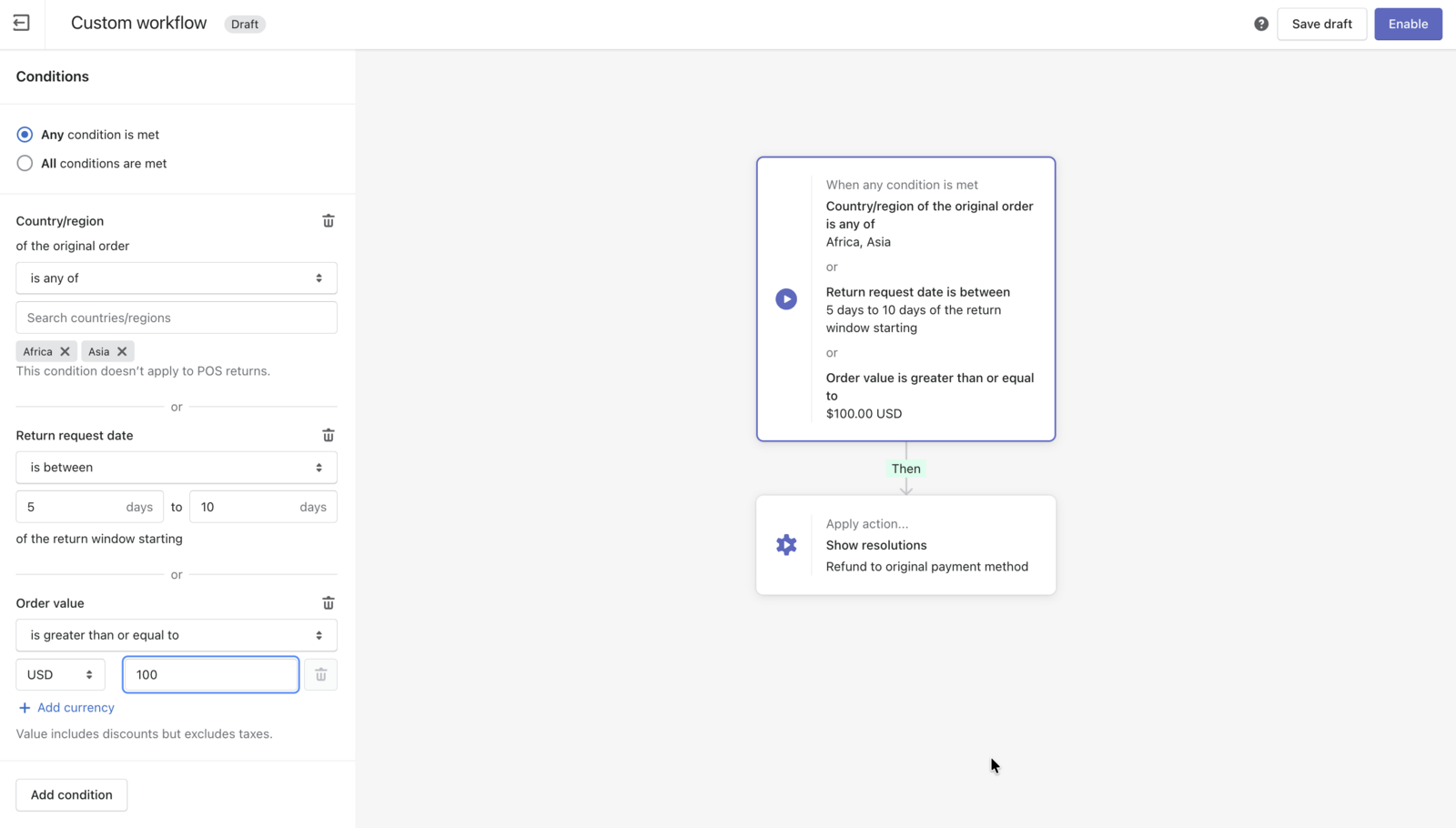
The rule editor is where that gating shows up in practice. Multi-condition workflows, the kind that weigh where an order shipped, how long the shopper has had it and what it was worth before deciding what they are offered, are available on Premium and Enterprise.
What AfterShip Costs, and the Offset That Changes It
Start with returns per month. That number, not your order count, decides the tier.
Essentials is published for growing stores under 100 returns a month, and it includes 20 of them. Premium is published for established brands at 100 to 400 returns a month, and it includes 100. Read both halves of each of those, because the advertised band and the included quota are different numbers, and every return past the quota is billed at a published per-return rate.
Above 400 returns a month, AfterShip is custom-quoted, and per-unit economics improve with volume. Do not model your bill by multiplying the overage rate by your monthly return volume. That is not the number you will be quoted, and it is not the number you should budget.
What you can compare is disclosure. AfterShip publishes the plan price, the included quota and the per-return rate. Loop publishes a starting price, and no included quota or per-return rate appears on its pricing page (Loop's pricing page, captured 9 August 2026). One of those you can model before you sign. The same modelling question on shipping rates rather than returns is examined in what a rate comparison should let you model.
If you're only processing a handful of returns a month, a free portal like Redo's will cost less than any paid platform, and we won't pretend otherwise. AfterShip Returns is a subscription. What you're paying for is depth and connectedness: automation, SKU-level analytics, and returns that share a data model with tracking, shipping and warranty.
There is also an offset, and it comes with conditions. Return Care is available on Returns Premium and above, requires an AfterShip Protection subscription on the same store, is Shopify only, and excludes Warranty features on the models that zero the platform fee. Protection onboarding availability varies by market, so check current coverage. For qualifying Shopify brands, Return Care can bring the Returns platform fee to zero, funded by an opt-in fee shoppers pay at checkout, so the cost gap can close entirely as you grow.
The Verdict: Your Best Returns App for 2026
Loop for brands that want a returns product built for Shopify with depth on exchanges. Scaling brands that want the wider field get seven options in the seven options for a scaling Shopify brand.
Redo for brands that want no software line item and are comfortable with a shopper-paid fee at checkout.
AfterShip Returns for brands that want returns, tracking, shipping and warranty connected as they grow.
If your returns are climbing faster than your headcount, and the answers you need keep turning out to live in a different system from the one you are looking at, AfterShip Returns is the one that already has them in the same place. Our ranked picks across the whole category are in our category-wide ranking for 2026.
Frequently Asked Questions (FAQ)
Is Loop Returns better than Shopify's native returns?
Shopify's built-in returns handle the basic request-and-refund loop. Loop adds automated return policies, configurable workflows and exchange incentives on top of it (Loop's pricing page, captured 15 August 2026). If returns are still occasional, native returns may be enough. Once you are processing them daily, any dedicated platform here saves more time than it costs.
How does Redo's pricing work?
Redo publishes the merchant-facing returns portal as free and covers return label costs (Redo's pricing page, captured 15 August 2026), funded by a fee shoppers pay at checkout (Redo's help centre, captured 15 August 2026). Other modules are charged per use, including Checkout Optimizer and Email and SMS, with Returns AI Agents at custom pricing (Redo's pricing page, captured 8 August 2026). The trade is a software line item for a fee your shoppers see.
Can AfterShip Returns reduce my return rate?
It can act on two of the causes rather than just processing the result. Order Edits lets a shopper correct the order before it ships, so a wrong size never becomes a return; it sits on Premium and above inside the Tracking plus Returns licence. SKU-level return-reason analytics then show which products and variants drive returns, so you can fix the listing, the sizing guide or the supplier instead of handling the same return again next month.
Which returns app should a Shopify brand at 500 to 5,000 orders a month choose?
Count your returns per month first, because that is what sets your tier on AfterShip Returns. If exchanges are the whole job and your catalogue is stable, Loop fits. If you want no software line item and your shoppers will accept a checkout fee, Redo fits. If you expect returns, tracking, shipping and warranty to run as one operation as you grow, AfterShip Returns is built that way from the start.