Loop was the right call when you made it. Your team knows the admin, your policies are configured, and returns stopped being the thing that ruined Mondays.
Three things have changed since then. Delivery-date promises, the capability your merchandising team keeps asking about, now sit on a second Loop subscription at its top tier. Outbound shipping was never in scope and still is not. And your renewal carries an automatic increase whether or not your volume moves.
None of that makes Loop a bad product. It makes your next decision a different question from the one you answered two years ago. You are not shopping for a better returns app. You are choosing which post-purchase stack you carry into the next three years.
Which means a Loop Returns vs AfterShip decision is not a returns bake-off. Both platforms process returns well, and a feature war between them ends in a draw you would spot on your own admin screen. What separates them is what each one includes at the price you already pay, and what each one costs to own once the renewal lands. That is what this comparison settles, and a deep-dive comparison of the two products sits alongside it for the feature-level view.
| Criteria | AfterShip | Loop |
|---|---|---|
| Delivery-date promises | Included in Order Tracking Premium, $70/month monthly or $59/month billed annually, 500 shipments | Delivery Promise on Track by Loop Plus, $449/month, on top of a Loop Returns subscription |
| Outbound shipping labels | AfterShip Shipping generates outbound labels across Shopify, Shopify Plus, TikTok Shop, BigCommerce and WooCommerce | Ship by Loop rate-shops return labels across a published 100+ carriers. Return labels only |
| Exchange checkout | Merchant chooses Stripe or Shopify checkout | Stripe required for Instant Refund, Instant Exchange, Native Exchanges and Loop POS |
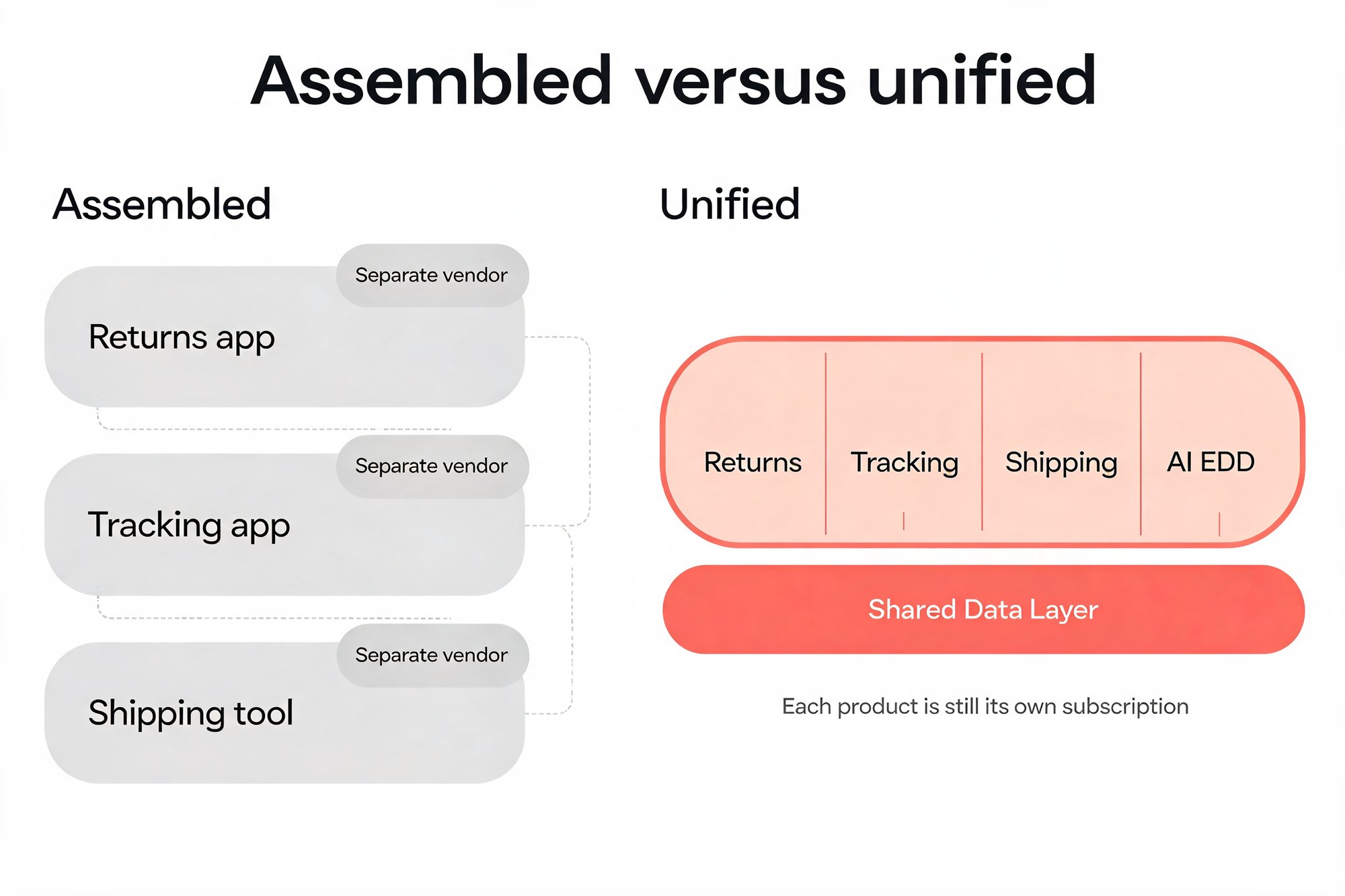
| Platform shape | Returns, Tracking, Shipping and AI EDD on one data layer, one vendor. Each product is its own subscription | Loop Returns and Track by Loop are separate Shopify apps with separate subscriptions and separate renewals |
| Returns plan pricing | Essentials $19/month, Premium $119/month monthly or $99/month billed annually at 100 returns. Premium uncapped, no contact-sales | From $155/month (loopreturns.com/pricing, 8 August 2026). Terms provide for an automatic 6% increase at the end of each term |
| Built for Shopify | AfterShip Returns and AfterShip Order Tracking both carry the badge | Neither Loop Returns nor Track by Loop carries the badge |
What Changes When Post-Purchase Stops Being One Job
Post-purchase stops being one job the moment delivery estimates, outbound labels and returns each answer to a different subscription.
That is what assembling a stack looks like from the inside, and none of it is a failure on anyone's part. It is the ordinary arithmetic of buying capability one module at a time.
- Delivery-date promises became a separate purchase. Loop's delivery estimate is not part of a Loop Returns subscription. It sits at the top tier of a second Loop app, so the capability arrives as a new line item rather than a setting you switch on.
- Outbound shipping sits outside the scope. Loop's shipping module rate-shops return labels. Generating the label that sends the original order out is a different job, handled somewhere else in your stack.
- Two apps mean two of everything around them. Two subscriptions, two Shopify listings, two help centres and two renewal cycles, each with its own quota and its own anniversary date.
- The renewal moves without you. Loop's terms provide for an automatic 6% increase at the end of each term, with written notice required to stop it. Your software cost rises in a flat year.
Any one of these is manageable on its own.
Together they are why operations teams stop asking which returns app is better and start choosing the right returns software from a platform view instead. The question shifts from features to what sits inside the subscription you are already paying for.

The Same Capability, Two Very Different Prices
If you want AI-generated delivery dates, the two platforms do not ask you for a comparable amount of money in a comparable way.
On AfterShip, delivery estimates come with Order Tracking Premium. That plan is $70 per month billed monthly, or $59 per month billed annually, and it covers 500 shipments. The estimate is not an upgrade path. It is what the tier does.
On Loop, delivery estimates are Delivery Promise, and Delivery Promise is available on Track by Loop Plus at $449 per month. Track by Loop is a second Shopify app alongside Loop Returns, so that figure lands on top of whatever you already pay for returns. If Redo is on the list too, the pricing comparison continues in Loop and Redo on Shopify returns.
Both numbers come from the same kind of surface, each product's Shopify App Store listing, and both were checked on the same day, 8 August 2026. You can open the two listings and read the tier names yourself.
Be precise about what this does and does not prove. It is not a claim about whose prediction is more accurate. Loop publishes accuracy and carrier-coverage figures for its own delivery estimates, and nothing here disputes them.
The difference is packaging. On one platform the delivery promise is included in a tier you already need for tracking. On the other it is gated behind the top tier of a second subscription, bought separately, renewed separately, and quoted against a different shipment quota.
That gap is the single largest structural difference between the two stacks, and you can verify it before you speak to either sales team. It is also why AfterShip merchants set delivery expectations at checkout without raising a second purchase order to do it.
Where Loop Is Genuinely Good
Yes, there is something, and it is worth naming precisely rather than waving at.
For a straightforward size swap, Loop's Shopify-native exchange portal is a better out-of-the-box experience. The shopper picks the replacement size, the flow holds together, and the merchant configures very little to get there. Teams who adopted Loop early often adopted it for exactly that, and it still holds up.
So the question in front of you is not whether that flow works. It does.
The question is what else has to be true about your post-purchase operation over the next three years, and how much of it your current packaging asks you to buy separately. That is where the two platforms stop resembling each other.
Returns, Tracking and Shipping on One Data Layer
What you gain from one vendor is one data model underneath several jobs at once.
The same data that drives a tracking page also drives the return, the exchange, and the label that ships the replacement. No integration sits between them, and no reconciliation job exists to keep two systems agreeing about the same parcel. AfterShip is a comprehensive returns management solution running on the same stack as tracking, shipping and AI EDD.
That shows up most clearly at the two edges of the journey, which is exactly where the platforms diverge.
Outbound shipping, not just return labels
Ship by Loop's own headline is about finding the best return label rates, and it rate-shops those labels across a published 100+ carriers. The return leg is the job it is built for.
The label that sends the original order out is a different job. AfterShip Shipping creates shipping labels certified by carriers, across Shopify, Shopify Plus, TikTok Shop, BigCommerce and WooCommerce.
This is a difference of scope. Loop's navigation carries a Shipping module and that module does what it says it does. The distinction is which direction the parcel is travelling.
Practically, it decides where a seam falls. If outbound fulfillment already sits with a separate shipping app or your 3PL, adding returns to that arrangement adds one more handoff to maintain.
That handoff costs nothing on a normal week. It gets expensive on the day a carrier misses a pickup and nobody can say whether the delay belongs to the outbound leg, the return leg, or the gap between the two systems recording them. On AfterShip, outbound and reverse labels are generated against the same underlying data you are already tracking, so that question has one answer.
One vendor, one data layer
Loop Returns and Track by Loop are two Shopify apps, with the two of everything already covered above. The Track by Loop listing still names Wonderment as its developer, which is a fair record of how the tracking app arrived rather than a comment on how it performs today.
On AfterShip, returns, tracking, shipping and AI EDD run on one platform against one data model. Say the commercial part out loud before your procurement team finds it: each AfterShip product is its own subscription. What consolidates is the vendor relationship, the data layer and the support path. Not the number of line items on your invoice.
That distinction is worth holding onto, because it is the version of the platform argument that survives a finance review. One vendor to renew with, one data model underneath, one place where a shipment, a return and a delivery estimate agree with each other.
It also decides who you call when they disagree. A single platform gives you one place to look and one team answering for what the data says. Two apps give you two help centres and a conversation about whose record is correct, held while a customer waits.
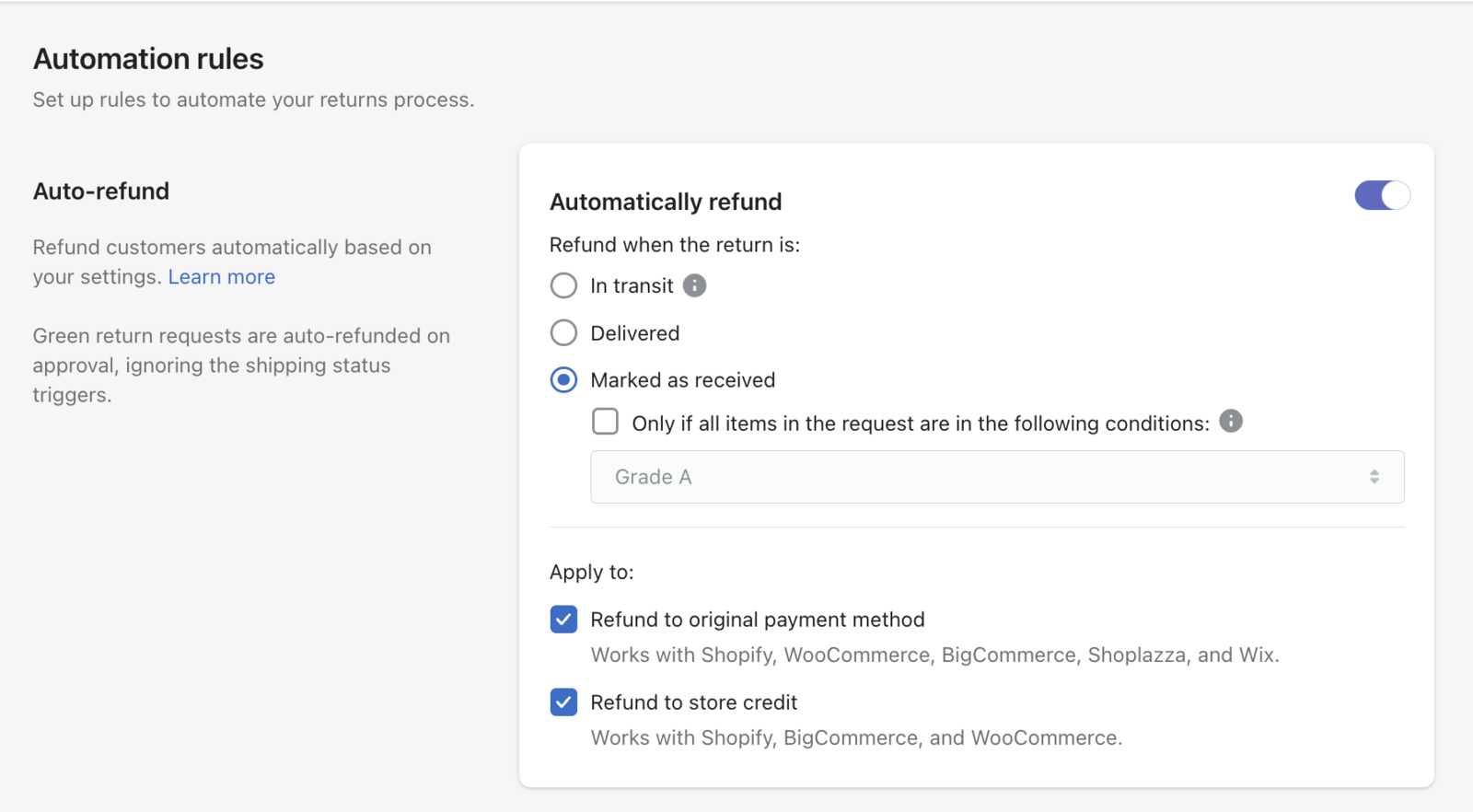
Exchanges, and What Your Finance Team Sees
Whether you must use Stripe for exchanges is a real question, and the two platforms answer it differently.
AfterShip supports both Stripe and Shopify checkout for exchanges, so you can hold an exchange until the return arrives (Stripe) or keep the transaction native to Shopify reporting (Shopify checkout). Your choice. Some platforms require Stripe for native exchanges, which routes that payment data outside Shopify. Loop's documentation lists Stripe as required for Instant Refund, Instant Exchange, Native Exchanges and Loop POS.
None of this is an argument against Stripe.
AfterShip's own Help Center recommends Stripe checkout for exchanges, and for the same reason Loop gives: it holds the exchange order until your conditions are met, so a replacement does not ship before the return is on its way back. When ship-before-receipt is the behaviour you want, Stripe is the right rail on either platform.
What differs is whether that rail is a decision or a prerequisite.
Ask your controller how they currently close the month on exchange orders. What finance wants at month-end is a single reconciliation path for exchange revenue, and the say in which one it is. If the answer coming back is that they would rather see those orders sitting in Shopify reporting alongside every other order, then choosing Shopify checkout has to be something you can select. On AfterShip, it is.
What Migrating Off Loop Actually Involves
Days to connect the app and go live on the basics, and realistically a few weeks to do it properly.
Be clear-eyed about what does not travel with you. Your returns policies and automation rules are recreated in AfterShip during onboarding. They are not imported from Loop. If you have spent two years tuning conditional logic by product type, return reason and destination, budget time to rebuild it rather than expecting a migration tool to lift it across.
Historical returns records move with assistance rather than through a self-serve importer, and AfterShip's own export covers the last 365 days. Start that conversation early and decide what you actually need on the other side.
A Premium plan gets you guided onboarding plus full API and webhook access, which is the practical route for a brand at this stage. A dedicated Solutions Architect and a named CSM sit at the Enterprise tier. Plan the project on the assumption that your own team owns it, with onboarding guiding the work rather than running it.
While you are modelling the cost of the move, one option is worth putting on the table. A qualifying merchant can opt into Return Care, which puts Returns Premium at no subscription cost. It requires an AfterShip Returns Premium-or-higher plan and an AfterShip Protection subscription on the same Shopify store, it is Shopify only, and Protection onboarding can currently be completed by US merchants only. The mechanics are plain: shoppers pay a small opt-in fee at checkout, that fee funds free returns, and the merchant keeps the profits and the control, with AfterShip taking no revenue share. If your store does not meet all three conditions, price Returns at its list plan and treat this as unavailable.
The exit itself is ordinary project hygiene. Loop's terms require you to remove Loop from your sites on termination, and there is no parallel run afterwards, so close out your in-flight Loop returns before the contract ends and then cut over cleanly.
Put one date in your calendar now. Loop's terms, last updated 3 March 2026, require 60 days written notice to stop automatic renewal. That window tends to open and close while a team is still evaluating, so work backwards from your renewal date.
The Verdict
It comes down to how much of the post-purchase job you want a single vendor to own.
If a polished Shopify exchange flow is the whole job, and delivery-date promises and outbound shipping are somebody else's problem, Loop does that well and the disruption of switching is not worth it to you. That is a legitimate answer.
If delivery-date promises, outbound labels and returns need to sit under one vendor on one data model, that is what AfterShip is built as. The delivery-promise line alone separates a capability included in the tracking tier you already need from a second subscription at its top tier, as the comparison table above sets out. AfterShip also generates the outbound labels that fall outside a return-label scope.
For a sense of what that consolidation is worth in practice, look at how Fellow cut returns resolution time by 52%, converted almost 15% of refunds into exchanges, and recaptured over 20% of their revenue through exchanges and store credit.
Your Loop renewal will arrive with an increase attached whether or not this was a good year. Decide it on what will still matter when your next peak season lands: which vendor owns the delivery promise, the outbound label and the return, on one data model, under one relationship. AfterShip is built to hold all three.
Returns automation that enhances the returns and exchanges experience, reduces costs, and retains more revenue.
Book a demoFrequently Asked Questions
Will I lose my returns history if I switch from Loop?
Not lose it, but plan for it. Historical records move with assistance during onboarding rather than a self-serve importer, and AfterShip's export covers the last 365 days. Your returns policies and automation rules are recreated in AfterShip rather than imported from Loop, which most teams find is a useful moment to retire rules they had quietly stopped using.
Do I have to use Stripe for exchanges on AfterShip?
No. AfterShip supports both Stripe and Shopify checkout for exchanges, so you can hold an exchange until the return arrives by using Stripe, or keep the transaction native to Shopify reporting by using Shopify checkout. Some platforms require Stripe for native exchanges, which routes that payment data outside Shopify. On AfterShip it stays a decision your finance team gets to make.
How long does migrating off Loop realistically take?
Connecting the app and going live on the basics takes days. A full migration with rebuilt automation rules, tested exchange flows and assisted data transfer is realistically a few weeks for a Shopify Plus brand at this volume. The binding constraint is usually contractual rather than technical: Loop's terms require 60 days written notice to stop automatic renewal, so work backwards from your renewal date.
Is AI-powered delivery date prediction included, or is it a separate purchase?
On AfterShip it is included in the Order Tracking tier that covers your shipment volume, with no separate delivery-estimate purchase to make. On Loop, the equivalent capability sits on the top tier of Track by Loop, a second subscription running alongside Loop Returns. For a brand weighing both platforms, that packaging difference is the clearest single line in the comparison, and it settles in AfterShip's favour before the feature discussion starts.