Beyond the Portal: What a Smooth Return Actually Costs You
Your returns process is costing you more than return labels. The teams pulling repeat purchases out of returns are not doing anything mysterious. They measure three things you probably do not.
Most returns budgets stop at postage, restocking labour and write-downs. That is the cheapest part. NRF found in 2025 that about 71% of consumers say they are less likely to shop with a retailer again after a poor returns experience, up from 67% a year earlier, and NRF's 2025 Retail Returns Landscape projected $849.9B in total returns for the year, with 19.3% of online sales coming back.
Three costs follow.
- CX overhead. Each where-is-my-return ticket costs an agent a manual lookup across carrier site, helpdesk and order record.
- Lost repeat purchase. A refund closes the relationship. An exchange or store credit keeps it open.
- Operational drag. Manual approvals, reconciliation and label chasing scale with volume, so peak costs you unplanned headcount.
That is the bill. "Smooth" is too vague a word for what stops it arriving, whether you are comparing two vendors or scanning the top return portals on the market.
The 3 Pillars of a Smooth Returns Experience in 2026
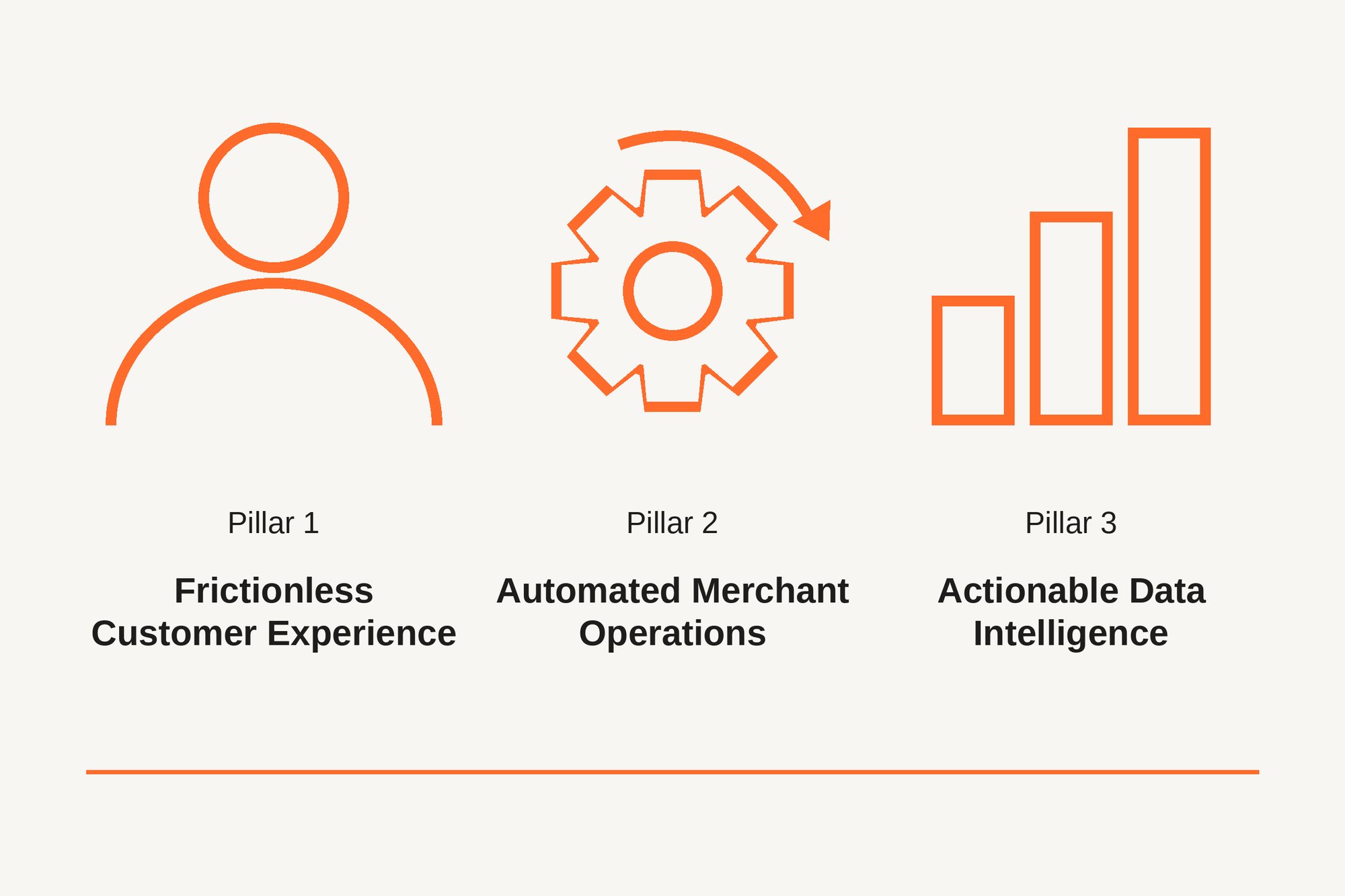
Smoothness becomes measurable when you break it into three parts. Treat these as the evaluation criteria for the rest of this article, and for the platform you are running right now.
Pillar 1: frictionless customer experience. How little effort the return takes from the shopper's side. Portal branding and domain, how she starts the request, whether she needs a printer, how far she travels to drop the parcel, and how easy it is to pick an exchange over a refund.
Pillar 2: automated merchant operations. How much of the work disappears without a person touching it. Routing to the right warehouse or vendor, approval rules, refund release, and how much of your actual policy you can express without filing a support ticket.
Pillar 3: actionable data intelligence. What the platform tells you afterwards, and whether that answer changes a decision. Return reason grouping at the SKU level, retained revenue, and whether returns data can see the delivery data that explains a good share of it.
The first two pillars are where most buying conversations spend their time. The third is where the smoothest returns experience is actually won, because it is the pillar that changes what you stock, how you describe it, and what you promise at checkout.
The Contenders: Who You Are Actually Comparing
Three platforms turn up on most mid-market shortlists, and comparing them feature for feature will mislead you.
- Narvar Shield is the returns product in Narvar's enterprise line, listed on the Shopify App Store as Narvar Return and Exchange. It sits alongside Promise, Secure, Track, Notify and Assist as six separately purchased products, and Narvar publishes no price.
- Loop Returns is a returns-first solution built for Shopify, strong on the returns flow itself. Tracking is a second Loop subscription, renewed separately.
- AfterShip Returns is the returns product inside a complete post-purchase suite, on one data layer with AfterShip Tracking.
Sample size tells you more than the score here. On the Shopify App Store, checked 19 August 2026, Narvar Return and Exchange carries 4.6 out of 5 across 18 reviews, Loop Returns 4.7 out of 5 across 408, and AfterShip Returns 4.7 out of 5 across 1,393. AfterShip Returns also carries the Built for Shopify badge.
The next three sections take one pillar each.
Pillar 1: Who Delivers the Most Frictionless Customer Experience?
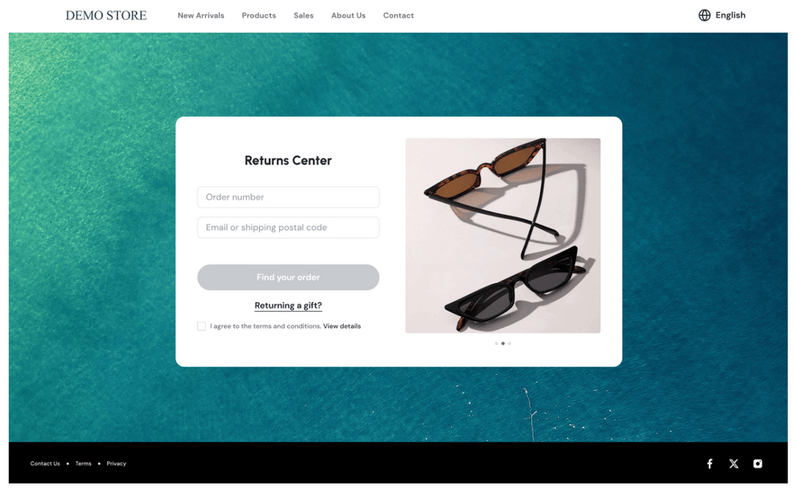
All three platforms sell a branded returns portal with your logo, your colours and a custom domain. That is table stakes in 2026, and none of the three loses a deal on it.
What separates them is which return methods a shopper can actually reach on the plan you would buy.
AfterShip Returns includes printerless QR returns on its entry plan, and Green returns, where a low-value item stays with the customer, sits on the same tier. Loop places its retention-oriented return methods on its Advanced tier. The shopper never sees which plan you bought. She only sees whether she needs a printer.
Drop-off convenience is the other half of the shopper's effort, and here the published numbers are close enough to read as context. For returns, AfterShip publishes a network of 310,000+ drop-off locations and support for 70 carriers, both stated on aftership.com/returns as of 19 August 2026. Narvar advertises over 200,000 locations.
The pillar is decided further up, at the point where a shopper either finds the method she wants on your plan or gives up and picks a refund, and AfterShip Returns puts the printerless QR and Green returns paths in front of her from the entry tier.
Pillar 2: Which Platform Best Automates Merchant Operations?
Start with what the competition genuinely does.
Narvar publishes multi-warehouse routing, return-to-vendor routing and nearest-location routing. Loop runs its workflow engine on every plan, its Klaviyo integration carries 17 events across all plans, and Loop returns data sits natively inside the Gorgias admin your team already has open.
Loop Returns is at parity with AfterShip Returns on the shopper-facing returns flow and on core workflow automation. Its portal, exchange options, store credit and rule engine are all credible, its workflow engine now runs on every plan, and it publishes named customer outcomes. A brand whose entire requirement is the returns flow on Shopify will be well served by it, which is roughly how Shopify Plus merchants approach this. At enterprise scale the same three come out differently, as we set out in the enterprise returns verdict on AfterShip, Narvar and Loop.
The difference appears when returns data has to answer a question that only delivery data can answer.
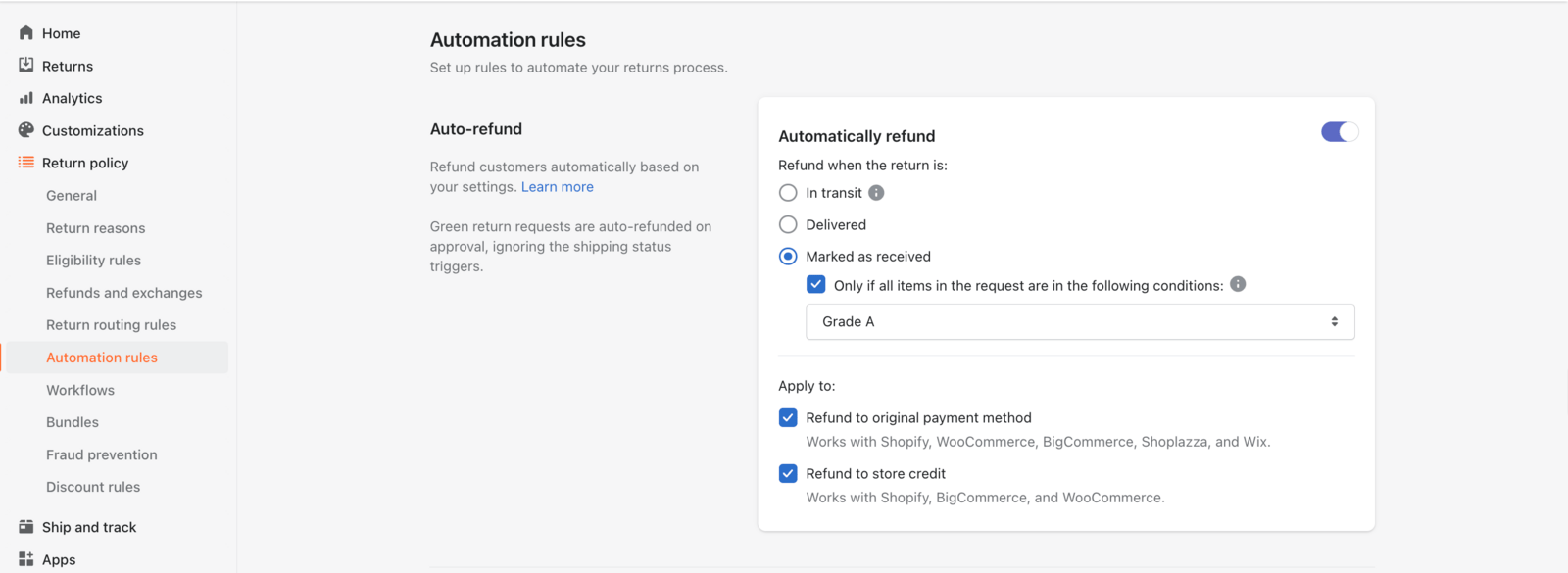
An automation rule is limited by the fields it can read. A rule firing on return reason and order value is a different instrument from one that can also read where the parcel is and how late it ran.
Automate what you can see. The ceiling on Pillar 2 is a Pillar 3 question, and it is the fields AfterShip Returns can read that decide where that ceiling sits.
Pillar 3: Who Provides the Most Actionable Returns Intelligence?
Every platform in this category reports on return reasons. The useful question is what else the report can see, and whether the answer changes a decision you are about to make.
Returns intelligence requires returns data and delivery data on one platform. A spike in returns on one SKU reads as a product defect until you can see that the affected orders all shipped on the same lane and arrived four days late. AfterShip Returns analytics groups reasons at the SKU level and reports retained revenue, so the exchange you saved is measured next to the refund you did not.
Loop sells returns and tracking as two subscriptions, and its delivery-date capability sits on the highest tracking tier. Joining the two takes two contracts, two renewal dates and two internal approvals before anyone runs the analysis.
AfterShip Returns and AfterShip Tracking are separately billed products too. What differs is the shape underneath them, because both run on one data layer under one vendor, so the join is a configuration step rather than a second purchase.
The outcomes that follow are the ones worth taking into the meeting. Marc Nolan moved exchanges from 25% to 49% of returns while refunds fell from 75% to about 50%, recovered $125k through exchanges in 90 days, and cut returns handling from roughly 35 hours to one hour. Pelagic Gear saw an 18% lift in purchases driven from the return portal and a 12% decrease in return contact tickets.
“It's just so easy and effortless for me to check in on things and work with the returns portal. I don't have to worry about it anymore.”
Nikolas Callas, Director of Operations
Read their story →Those are benchmarks you can hold your own numbers against, which is what separates a returns dashboard from returns intelligence. On the pillar that decides this comparison, AfterShip Returns reads returns and delivery data off the same layer, which is what turns a return reason into a decision you can act on.
The Verdict: Which Returns Platform for Your DTC Brand?
There is no ranking here, because these three platforms are not built for the same brand. Match the shape of the vendor to the shape of your business and the shortlist decides itself. Read the three below as descriptions of a buyer, not as tiers of quality, and notice which one describes the brand you are growing into rather than the one you run today.
Narvar Shield fits a large retailer with the procurement runway to run a sales-led evaluation and the budget to match. That is a different shape of business from the one described at the top of this article, and the mismatch is about fit, not capability.
Loop Returns fits a Shopify-only brand whose priority is the returns flow itself and that does not need delivery data joined in. It works provided you are comfortable with retention features at the Advanced tier and tracking as a second subscription.
AfterShip Returns fits the scaling mid-market DTC brand that wants entry-tier return methods without gating, named outcomes it can benchmark against, and returns data sitting on the same platform as delivery data.
Commercial transparency is the row most shortlists skip, and it is the one your finance lead will ask about first. Loop and AfterShip both publish their returns tiers. AfterShip states an annual return allowance against each tier, on monthly and annual billing. Narvar publishes no price at any volume, and corp.narvar.com/pricing returns a 404, so the first figure you see will arrive from a sales conversation. If you want a detailed side-by-side comparison of features and pricing before the meeting, that exists too.
One caution before the table. These rows reflect what each vendor published as of 19 to 24 August 2026. Packaging changes, so re-read the pricing pages the week you decide, and treat anything you cannot find on a public page as a figure you will negotiate rather than one you can budget.
| Criteria | AfterShip Returns | Narvar Shield | Loop Returns |
|---|---|---|---|
| Portal customisation and branding | Branded shopper portal | Branded shopper portal | Branded shopper portal |
| Return methods | Printerless QR returns and Green returns included on the entry plan. 310,000+ drop-off locations and 70 carriers, returns-scoped, published on aftership.com/returns as of 19 August 2026 | Advertises over 200,000 drop-off locations | Retention-oriented return methods sit on the Advanced tier |
| Automation rules engine | Conditional rules across return reason, order value and delivery state, with auto-approve, routing and auto-refund triggered on delivery status | Publishes multi-warehouse, return-to-vendor and nearest-location routing | Workflow engine runs on every plan |
| Returns intelligence | Reason grouping at SKU level and retained-revenue reporting, reading returns and delivery data off one layer under one vendor | Returns analytics within Shield, which is sold separately from Track | Returns analytics on every plan. The delivery-date capability sits on the highest tracking tier, sold as a second subscription |
| Commercial transparency | Published on aftership.com/pricing/returns: Essentials starting at $16 per month and Premium at $99 per month billed annually, $19 and $119 billed monthly, with annual allowances of 240 and 1,200 returns | Publishes no price at any volume. corp.narvar.com/pricing returns a 404 | Essential "starting at $155 per month" and Advanced "starting at $340 per month" on loopreturns.com. Track by Loop Plus $449 per month on its Shopify App Store listing |
Read the last row twice. It tells you how much of this evaluation you can finish before anyone books a call, and with AfterShip Returns you can do that arithmetic tonight.
Beyond Returns: Why One Data Layer Beats Two Invoices
One data layer, not two invoices to reconcile. That is the whole platform argument, and it survives the fact that AfterShip Returns and AfterShip Tracking are billed separately.
Three things become possible when returns and delivery run on the same data.
Returns data informs delivery estimates. When a lane consistently runs late and consistently produces returns, the estimate a shopper sees before she buys can account for it, which is cheaper than processing the return afterwards.
Delivery data drives proactive returns communication. A parcel that arrived four days late is a different customer conversation from one that arrived on time, and the message can reflect that without an agent noticing first.
The return can be handled while the parcel is still moving. Refund release on a carrier scan, exchange stock reserved before the item lands, a damaged-in-transit claim opened from the delivery record rather than the customer's word for it. Each of those pulls days out of the resolution window your CX team is measured on, and none of them is possible if the return system finds out about the delivery from a customer email.
None of that requires a second vendor relationship. It requires the two data sets to sit close enough together that a rule can read both, which is what a complete post-purchase suite gives you and what a two-vendor stack asks you to build yourself.
Returns automation that enhances the returns and exchanges experience, reduces costs, and retains more revenue.
Book a demoFrequently Asked Questions
What will each platform actually cost me, and what can I find out before talking to sales?
The answer differs by vendor, and the difference is itself useful. Loop and AfterShip both publish their returns tiers. AfterShip publishes a stated annual return allowance against each tier on both billing bases, so you can size a plan against your own return volume before you contact anyone. Narvar publishes no price at any volume, and corp.narvar.com/pricing returns a 404, so the first figure you see will come from a sales conversation. Check the comparison table above for the published tiers, then re-read each pricing page the week you decide, because packaging changes.
How do the three platforms handle international returns?
All three support international returns, so this should not be the criterion that decides your shortlist. The question that does separate them is narrower: which return methods an international shopper can reach on the plan you would actually buy. AfterShip Returns puts its return methods on the entry tier, so opening a new market does not mean moving up a plan to keep the same shopper experience.
Do Gorgias and Klaviyo integrations decide the choice between these three?
No, and treating them as a deciding criterion will cost you a better decision elsewhere. All three platforms connect to both, so a shared partner integration is table stakes rather than a differentiator. The useful version of the question is how much of the return context reaches an agent without leaving the helpdesk, which is a data-layer question before it is an integration one, and that is the question AfterShip Returns is built around.