You've launched in new countries, but your post-purchase experience is still run the way it was in one. Now you're comparing parcelLab and AfterShip, not just for features, but for a partner to manage global complexity. One scales through services. The other is one self-serve platform you can run across 20 countries. Here's the verdict.
The fracture is predictable. WISMO tickets, the "where is my order" contacts, arrive in five languages and get answered well in two. A market launch stalls on an unsupported local carrier. In the Descartes 2025 home delivery study, 66% of consumers surveyed had experienced a delivery problem.
How each one solves it decides whether your team ships a change next week or files a request for it.
You need an answer that survives a CFO asking what happens in year two. This article takes the regional and localization half of the AfterShip vs parcelLab for global brands decision, and it sits alongside AfterShip vs parcelLab vs Narvar, compared.
The Verdict, Upfront: Who is parcelLab vs AfterShip for?
Choose parcelLab if you are an enterprise that wants a hands-on operational partner making changes for you, with documented depth that is weighted toward Europe. Choose AfterShip if you are running post-purchase across many regions and you want your own team making those changes.
The dividing line is rarely order volume. Two countries and twelve are different operations, and only the second pays for every change routed through someone else's queue.
That is an operating-model decision. parcelLab scales through services: a team that knows your account, configures it, and holds it consistent on your behalf. AfterShip scales through self-serve: one platform where your CX lead rewrites tracking page copy, your ops lead switches on a carrier for a new market, and your localization owner updates the returns portal, in every country you sell in, without a ticket in between.
Neither model is a compromise. They are priced, staffed, and built for different rates of change.
AfterShip provides a unified platform for global tracking, returns, and shipping. AI EDD sits on the same platform, the ground covered in our full head-to-head verdict on AfterShip vs parcelLab.
The criteria below are the ones that move the answer for a brand selling in 20 countries, rather than the ones that fill out a generic evaluation grid.
| Criteria | AfterShip | parcelLab |
|---|---|---|
| Global carrier network | 2,000+ carriers (AfterShip directory, 14 October 2026), listed by destination country so you can verify your exact lanes | Advertises 550+. Documentation organised around European markets plus the USA and a global bucket |
| Multi-language localization | Three surfaces from one platform: tracking page 34+ languages, notifications keyed to order language, returns portal 18. Your team edits all three | Order Status page documents over 25 languages, plus AI email translation |
| Platform breadth | Tracking, Returns, Shipping and AI EDD on one post-purchase suite | Named modules spanning tracking, communication and returns |
| API and change control | Published APIs. Copy, language and carrier changes are self-serve for your team | Publishes REST, SFTP and email ingestion. A defined set of changes routes through support |
| Proven at high volume | SmartBuyGlasses across four regions; THE ICONIC and Rakuten France at enterprise volume | European enterprise deployments, run through its managed-service model |
| Ideal customer profile | Brands running post-purchase across many regions whose own team makes the changes | Enterprises with a settled market footprint that want changes managed for them |
Read those rows as a description of two operating models rather than a feature scorecard. One answers how much you want handled for you. The other answers how fast your own team needs to move. If you are adding markets faster than you are adding headcount, AfterShip is the platform that keeps pace with you.
Deep Dive: Why AfterShip is Built for Global Complexity
Two things break first when a post-purchase stack crosses borders. The carriers you can see, and the language your customer reads.
Both are also where the operating-model difference stops being abstract. A missing carrier and a bad translation are each a small change. What matters is who makes it and how long it waits.
Carrier Network Breadth & Depth
On AfterShip vs parcelLab carrier integrations, a launch rarely fails on the big integrators. It fails on the regional courier that moves 30% of your volume in the market you entered nine weeks ago, the one your platform has never heard of.
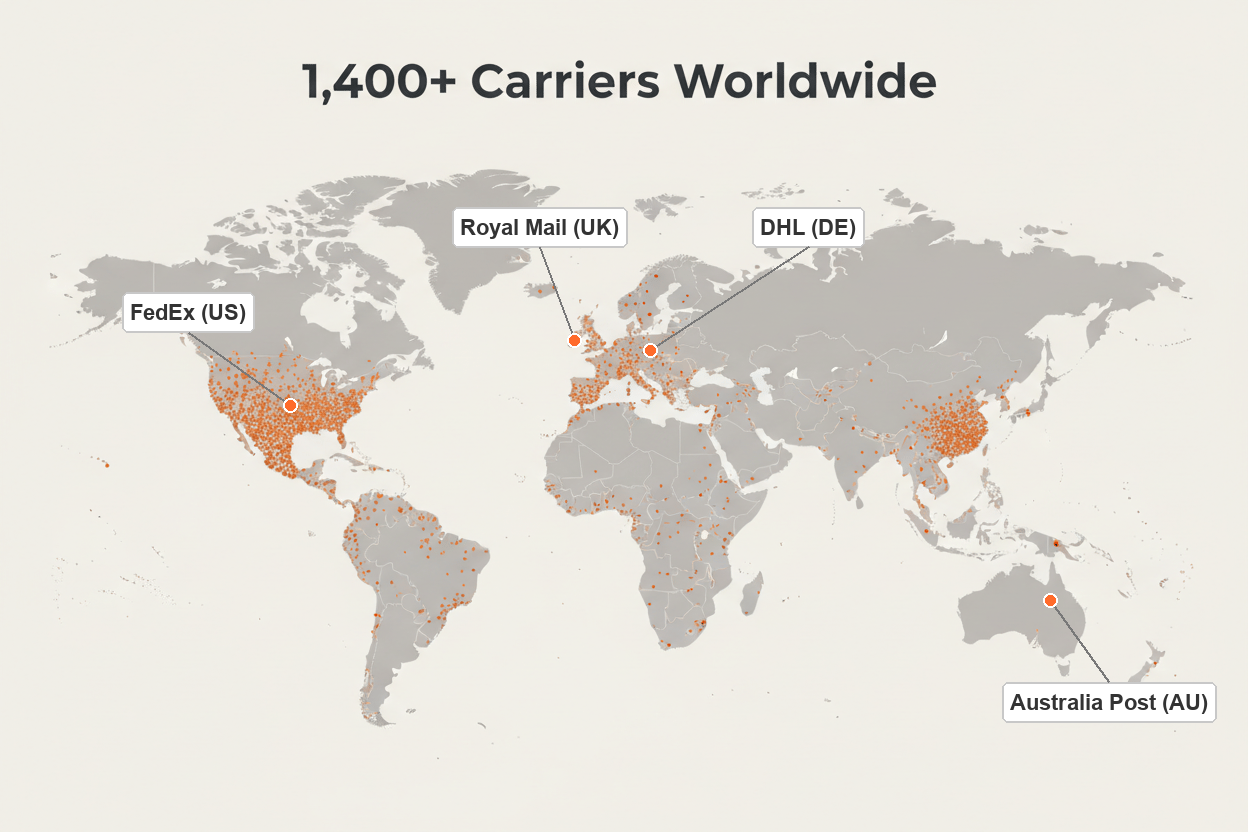
AfterShip's carrier directory lists 2,000+ carriers with per-country coverage across regions. Filter it by destination and the depth is visible market by market: 160 carriers deliver into the UK, 159 into the Netherlands, 128 into France, 127 into Germany, 116 into Italy and 112 into Spain, as of 25 August 2026. A carrier that serves both France and the Netherlands is counted under each, so the figures describe depth per destination and do not add up to a Europe total. For the mid-market comparison of those two specifically, see how the two rate on carrier coverage.
2,000+ carriers worldwide, with more than 100 delivering into each of the UK, the Netherlands, France, Germany, Italy and Spain.
Depth outside Europe separates a platform that follows you into new regions from one you outgrow. The directory covers APAC with carriers including Japan Post and Australia Post, Latin America with carriers including Brazil Correios and Estafeta, and the EU with Royal Mail, DHL, DPD and PostNL.
parcelLab publishes carrier documentation of its own, organised by about eleven European markets plus the USA and a global bucket, with no APAC or Latin America section. Its directory lists 38 ship-from countries, and parcelLab advertises 550+ carriers.
That structure tells you where a vendor's carrier work has concentrated so far. It is not a statement about which couriers they can technically reach. What you are buying is whether the coverage you need is already there on the day you launch, or whether it becomes a project with a timeline attached to it. FreightWaves reported in March 2026 that customs compliance and carrier reliability keep adding complexity to moving goods across borders.
Coverage only helps if the data behind it is consistent. AfterShip's core tracking capabilities standardise status across that network through one API, so a delay in Osaka and a delay in Lisbon arrive in your systems as the same event type, with the same fields, and your exception rules work identically in both markets. That consistency is what lets one CX playbook serve every region instead of one per country.
Do the check yourself before you sign anything. Verify your specific carriers in the AfterShip directory for your exact routes. It is the fastest way to see how much of your network is already covered.
True Multi-Language Localization
Translation is the easy part. The difficulty is that a waiting customer crosses three separate surfaces before their order arrives, and in most stacks a different team owns each one.
The branded tracking page supports 34+ languages, keyed to ISO 639-1 codes, with browser-language detection. Your CX or brand owner edits that page in the platform, and the change is live in every market at once.
Notifications work from each customer's order language. On Shopify that value populates automatically. On other stacks you pass it to AfterShip through the API, and any order without a language falls back to your store default. Notification copy is manually translated by default, with AI Translation on Premium and Enterprise that does not translate dynamic content. Multilingual notifications are available on paid plans (Essentials, Premium and Enterprise); confirm the plan for your account.
The returns portal supports 18 languages with a default fallback and no browser detection. Your localization owner maintains it from the same admin as the other two surfaces.
parcelLab documents "over 25 languages" on its Order Status page and offers AI email translation of its own. Both platforms translate. What differs is how many surfaces your own team can change without help, and how fast a bad string in your fourteenth market gets fixed.
Three surfaces, one admin, one team correcting all of them the same afternoon: that is what AfterShip gives a brand scaling across continents, and it stops a WISMO queue in six languages from becoming six separate queues.
Where parcelLab Shines (and Its Limits for Global Scale)
parcelLab has earned its standing. It has a strong reputation for hands-on, consultative service, especially with German and DACH enterprises, and for operational rigour. Our own head-to-head page says the same thing in fewer words: parcelLab "is strong on cross-border and localized enterprise experiences".
What that buys is real. A team that knows your account, configures it with you, and holds the experience consistent while your own people work on something else. parcelLab is a strong post-purchase solution for European-centric enterprise brands.
It is also a deliberate design, not an accident of staffing. In parcelLab's own published reply to a reviewer: "some changes are intentionally managed with support". Managed change protects brand consistency and data integrity, which is exactly what an enterprise with a fixed set of markets wants from a vendor.
The trap: choosing a model that scales through services for an operation that needs to change copy, languages and carriers in 20 countries without a ticket.
The moment your roadmap adds markets faster than your vendor can absorb requests, that same protection becomes a queue. Twenty markets means twenty versions of every string, carrier rule and notification trigger, each eventually needing a small change on a Tuesday. AfterShip's answer is to hand that work to the people who already own the outcome, so the number of markets stops being the thing that sets your pace.
Comparing the Intangibles: API, Scalability, and Ecosystem
Both vendors publish APIs. parcelLab documents REST, SFTP and email ingestion, and AfterShip documents its own tracking and returns endpoints. Nobody on your engineering team is blocked by either. The line that matters to an evaluator is narrower: which changes your team makes itself, and which ones become a request that somebody else schedules.
One honest note on setup. The fastest no-code path into AfterShip is Shopify-native, and on Salesforce Commerce Cloud, Magento, SAP or a custom stack the pre-purchase EDD widget and some exchange flows deploy through the API instead. That is a setup-path difference rather than a capability ceiling: the same capabilities ship on the same platform, the route is a documented API integration instead of a toggle, and it is one-time work your developers do once per stack, not an ongoing vendor dependency.
Procurement is where the two models separate again. parcelLab contracts through a master services agreement with its SLA "available upon request", so the terms and the service commitment both arrive through a negotiation. AfterShip publishes self-serve plans alongside Enterprise, which means most of your evaluation can happen before a contract cycle starts. That is a question of how quickly you can begin, not of what anything costs, and the same pattern shows up in how AfterShip compares for enterprise retailers.
Ecosystem depth follows the same logic. Klaviyo, Gorgias and Attentive are table stakes on both sides, so the comparison worth running is on event depth: which post-purchase events reach your ESP and your helpdesk, and how much of that mapping your team controls without a support ticket. If a 3PL sits in the middle of your stack, AfterShip's solutions for logistics partners run on the same platform.
Scale is easiest to answer with brands already running this way. A mid-market reviewer on G2 (September 2025) put it this way: "The integration with Shopify was straightforward, and the dashboard is very easy to navigate even for non-technical team members."
“This greatly saves our time responding to customers' WISMO requests.”
Operations Team
Read their story →Lovisa runs AfterShip Personalization across its own store network. THE ICONIC in Australia and Rakuten France run AfterShip Tracking at enterprise volume; both are name-level proof of scale, not outcome claims.
The Final Verdict: A Strategic Choice, Not a Feature Choice
If you are weighing parcelLab alternatives, apply one rule to your own roadmap. Count the markets you will be selling in eighteen months from now, count how often your copy, languages and carriers change, and name the person who makes those changes. Verify your carriers in the directory first. If that person sits on your team and the market count keeps climbing, AfterShip is the platform built for how you actually work.
Proactive shipment tracking that delights your customers, reduces WISMO tickets, and optimizes your delivery performance.
Book a demoparcelLab vs AfterShip FAQ
Which has better carrier integrations for Europe?
AfterShip's carrier directory is the deeper of the two for Europe on published evidence, and it lets you verify that depth for your own routes. It is organised by destination country, so you can check per-destination depth for the exact lanes you ship, including the smaller domestic couriers that carry real volume in a single market. parcelLab's published carrier documentation is organised around a set of European markets plus the USA and a global bucket, which tells you where its integration work has concentrated. Shortlists of the best delivery experience platforms for EU markets compare on carrier depth, and that is where the directory matters. Either way, the practical step is the same: check your carrier list against the AfterShip directory before you commit to anything.
Is AfterShip or parcelLab better for luxury brands?
Luxury post-purchase depends on consistency: the same brand voice, in the right language, on the tracking page, in the notification and in the returns portal. AfterShip localizes all three surfaces from one platform, so a brand team can hold that standard in every market without rebuilding it country by country. parcelLab suits a European luxury enterprise that would rather have that consistency managed on its behalf. If your brand sells across continents and your own team owns the experience, SmartBuyGlasses is the closer model: one platform holding the standard across Asia Pacific, Europe, Africa and the Americas.
What is the pricing difference for enterprise plans?
Neither vendor publishes a price at enterprise volume. AfterShip publishes its self-serve plans openly and moves to custom pricing above roughly 5,000 shipments a month, so you can size most of the decision before you speak to anyone. parcelLab contracts through a master services agreement, with its SLA available upon request, terms that renew automatically for twelve-month periods, and ninety days' written notice required to exit. The difference that shows up in procurement is not the number on the quote. It is how much of the platform you can evaluate, and how quickly you can start, before a contract cycle begins, and that is where AfterShip's published plans put you ahead.