You added Route so lost packages stopped coming out of your margin. What that did not change is where the claim goes, whose brand sits on the tracking page, or who decides how the customer is made whole. Both platforms let the shopper fund protection at checkout; what separates them is who owns the claim once something goes wrong. This article compares AfterShip and Route on exactly that.
If you are shopping for a Route insurance alternative, or weighing services like Route against each other, the useful question is not whose coverage costs less. It is whose system the claim runs on, and what your own stack can see once it does. Most comparisons of e-commerce shipping insurance providers argue terms and premiums. This one argues custody. That is a structural choice, and it surfaces in your support queue, your reporting, and your customer's last impression of you long after the premium line has stopped mattering.
What You Give Up When Protection Sits Outside Your Platform
Your post-purchase stack already holds one version of the truth about an order. Shipping created the label, tracking holds every checkpoint, returns and warranty hold what happened after the parcel arrived.
Protection is the one record that does not join them when it lives on a separate platform. A shopper files a lost-package claim on the provider's app. Your tracking record still reads delivered, your returns tool has no idea a claim exists, and the agent who picks up the ticket is reconciling three systems by hand. The claim resolves against data your other tools cannot see, so a carrier lane that keeps failing reads as a run of unrelated one-off claims rather than a pattern you could act on.
None of that is a fault in the provider. It is the cost of separation.
The second cost is someone else's code running in your checkout. Any third-party checkout widget adds an integration surface, and that surface is yours to own when it misbehaves. Menagerie Cosmetics, a merchant who had used the app for more than four years, wrote on the Shopify App Store on 24 March 2026 that after granting collaborator access for installation, the widget "broke my checkout button", sending customers to a file instead of the checkout page for long enough to hurt sales.
The third cost is one the provider documents itself. Route's Customer Marketing Kit tells merchants to add claim-filing information to their contact page, in its own words, "to decrease Route related contact volume to your team". That is Route's own guidance, and it tells you where those contacts land: with your team, answering for a process that runs somewhere else.
Each of the three is survivable alone. Together they describe a protection layer that sits beside your operation rather than inside it.
A Smarter Approach: Own the Claim, Not Just the Coverage
Delivery anxiety and a lost-package dispute are the same moment viewed twice. The customer needs an answer, and the brand either gives it or hands the customer to someone else who will.
Protection is usually bought as a line item against loss. What it actually decides is who your customer talks to on the worst day of the order, and which system remembers it afterwards.
Holding that moment rests on three things, and none of them is the insurance policy itself.
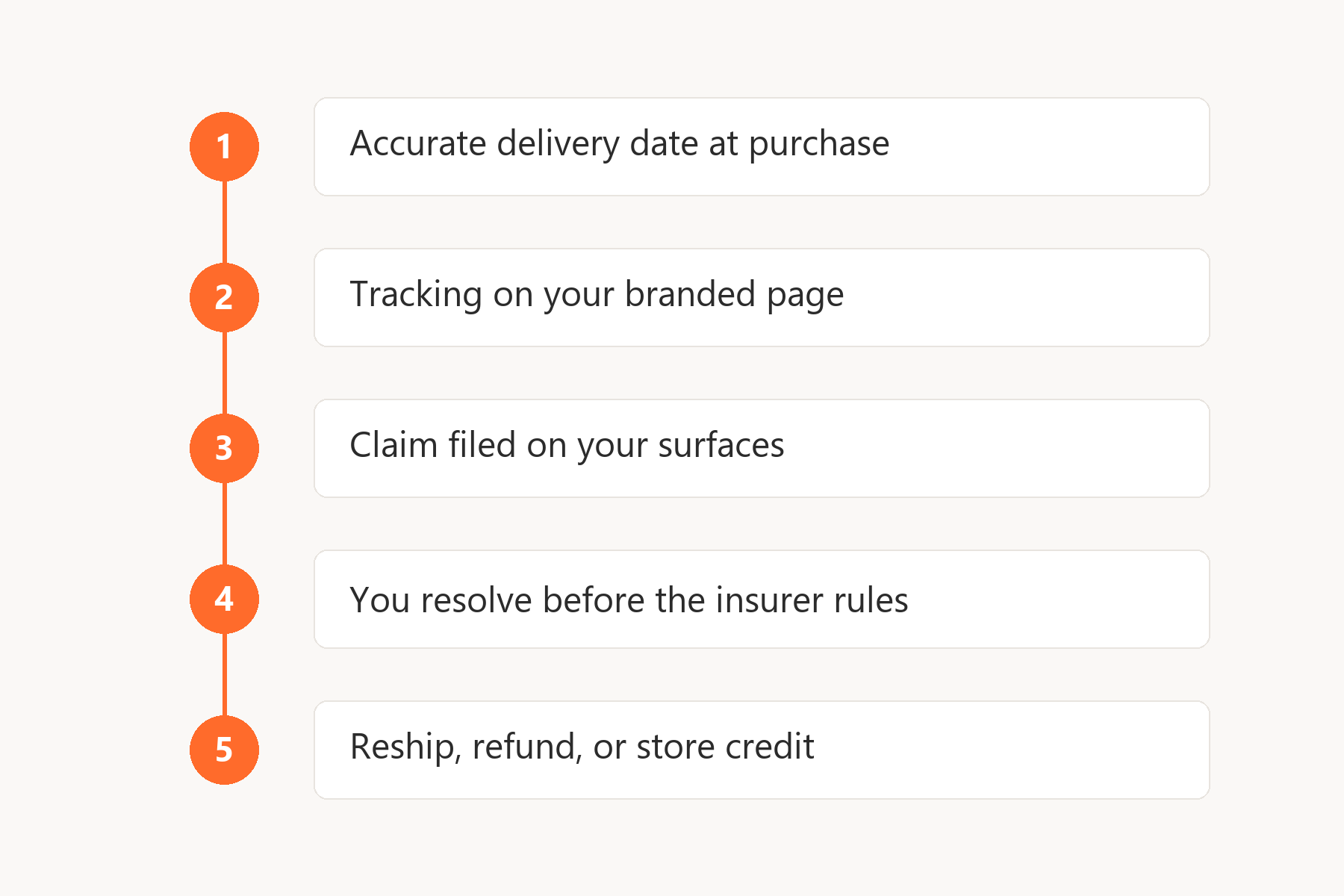
- Proactive, branded tracking. Proactive tracking notifications reduce customer delivery anxiety and support tickets. Each one arrives under your name rather than a third party's. The shopper who checks a status page five times before a delivery date should be checking yours.
- Accurate delivery promises set at purchase. A date the shopper can trust removes the uncertainty that produces the ticket in the first place. A WISMO contact, meaning "where is my order", is usually not really about the parcel. It is about a promise that was never specific enough to reassure anyone.
- Issue resolution that stays on the brand's surfaces. Filing, status and outcome all happen on pages you control, with returns and warranty on the same order record rather than in a separate system you reconcile against later.
Judge post-purchase experience platforms on those three rather than on the premium table. That is the standard worth applying to any Route insurance alternative you are weighing, and it is the standard the rest of this comparison uses.
How AfterShip Keeps the Claim on Your Surfaces
Those three pillars run on two products.
AfterShip Tracking. A branded tracking page keeps the customer inside your ecosystem rather than a carrier's, and it is the surface where a WISMO ticket stops being written. The AI-powered delivery estimate it sets at purchase does the earlier half of the same job: a shopper given a date they can trust has less reason to check, and less reason to write in when the parcel runs a day late. Branded tracking pages are worth designing rather than accepting as a default, because this is the page your customer will open more times than your product page.
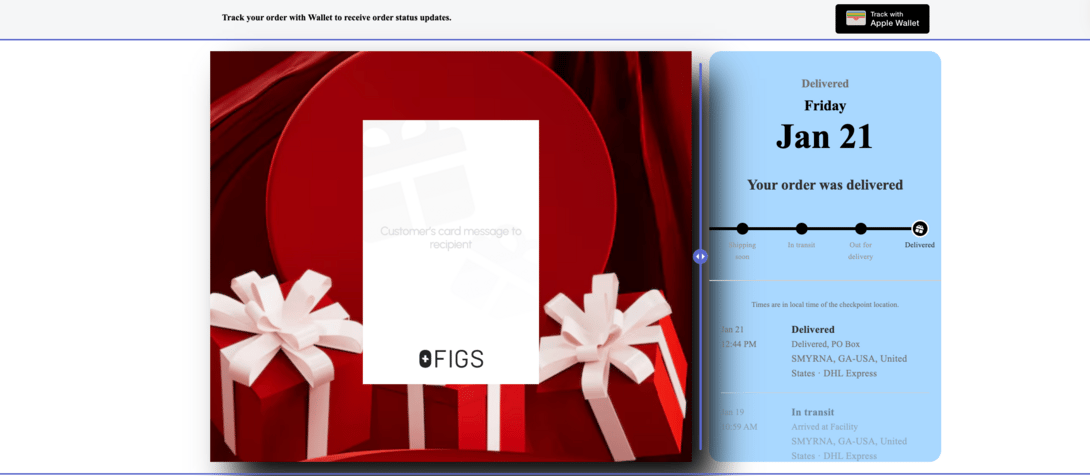
AfterShip Protection. AfterShip Protection is powered by InsureShield, and UPS Capital Insurance Agency adjudicates the claims. Both facts are worth knowing and neither is the differentiator. The differentiator is where the claim happens.
Your customer files from your surfaces: an email you sent, a branded claim page, or the branded tracking page they were already looking at. You manage coverage and every claim from one centralized Protection portal, so the merchant view and the customer view are the same claim rather than two systems describing it differently. We walk through both claim flows step by step in how Route and AfterShip each handle a claim.
The control is not cosmetic. You can resolve a claim before the insurer has ruled, and you choose the remedy: a reship, a refund to the original payment method, or store credit. AfterShip Protection keeps issue resolution within your brand's ecosystem. That decides whether the customer experiences a company that looked after them or a company that handed them on. For the head-to-head behind that, see Route set against AfterShip.
Because protection resolves against the same order record as the rest of the suite, claim exceptions get rules and reporting rather than a queue. A lane or a product line that keeps generating claims arrives as something you can write a rule against, not as a stack of tickets your team works one at a time.
AfterShip vs. Route: A Strategic Comparison
Five criteria decide this, and each one is checkable on both vendors' own documentation rather than on either vendor's marketing.
TAVCO, 5 out of 5 on the Shopify App Store, 18 September 2025: "Keeping our customers updated on shipping status has greatly reduced the amount of calls that we receive and help drive up our return customer rate."
| Criteria | AfterShip | Route Protect |
|---|---|---|
| Where the claim is filed and tracked | Your own surfaces: an email you sent, a branded claim page, or the branded tracking page. You manage coverage and every claim from the Protection dashboard. | Route's platform. Merchants review claims in Route's Claims tab, which shows status and per-claim detail. |
| Who can act on a claim, and when | You can resolve before the insurer rules. Set a value threshold and claims below it settle immediately, and you choose reship, refund to the original payment method, or store credit. | Route assesses and issues the resolution. Merchants can file on a shopper's behalf and challenge a denial; Route's published flow has no merchant approval step before it decides. |
| Who settles the customer | The brand settles its own customer, in the remedy it chose, on its own timetable. | Route settles the shopper directly. |
| Funding model and published cost | Shopper-funded by default with no monthly software fee, merchant-funded if you prefer. Premiums start at $1 per $100 of declared value on AfterShip's Protection pricing page, and AfterShip states that it notifies the brand before any rate change. | Shopper-funded by default with no monthly software fee, merchant-funded if you prefer. Route's newsroom publishes 1.5% to 5% of retail value on orders of $100 or more. |
| Technical integration | Configured inside AfterShip Tracking alongside your tracking pages and notifications, so protection shares one order record with the rest of the suite. | Installs as a Shopify app that adds Route's own widget to your checkout. |
The five rows are not five separate arguments. Four of them describe custody from different angles: who receives the claim, who may act on it, who settles the customer, and what each side publishes about what it costs. On all four, AfterShip's answer is your own stack. For the row-by-row detail, see the full side-by-side comparison.
Is Shipping Protection Profitable for Merchants? The Real ROI
Protection is not a revenue line, and it is worth being straight about that on both sides: neither platform publishes a merchant revenue share on protection premiums.
So the return is not income. It is the cost of resolving the orders that go wrong, and that cost moves with who does the resolving.
Speed is the first mechanism, and two numbers describe it because two different parties act. AfterShip's Protection page publishes an average approval time of four days, which is the insurer's side. The merchant does not have to wait for it: set a value threshold and claims below it settle immediately.
An anonymized AfterShip Protection customer, a US jewelry brand running 4,000+ coverages a month, resolves over 60% of claims the same day. Source: AfterShip customer story.
The second mechanism is direct: AfterShip pays up to 20% of the merchandise list value toward the incremental cost of re-shipping, which is the expense most merchants absorb quietly. The third is that the resolution itself stops being manual work, once you can automate refunds for delivery issues against the same order record the claim already sits on.
On structure, the wider shipping, tracking, returns, and warranty suite is available on standard SaaS pricing, while Protection itself is free-to-use software with a per-order premium and no subscription tier.
One caveat worth knowing before you model it. AfterShip's insurer sends claim-paid amounts to AfterShip at the beginning of the following month, so a merchant who reships or refunds the customer the same day is fronting that cost from working capital for a few weeks. That gap is what instant in-house resolution costs. Your customer is made whole on your timetable instead of waiting on a third party's payout, and you keep the moment that decides whether they order from you again.
The Verdict: Which Model Fits Your Stage
Both models protect the order, as do most competitors to Route package protection. What separates these two is who runs the claim, and that is what decides which one fits the way you operate.
Choose AfterShip Protection if:
- you want the claim to begin and end on pages you control: an email you sent, your own branded claim page, or your branded tracking page
- you want to act before the insurer has ruled, and to decide yourself whether the customer is reshipped, refunded or credited
- you want protection resolving against the same order record as shipping, tracking, returns, and warranty rather than reconciled across tools
- you are at the volume where claim exceptions, rules and reporting stop being handled by hand
- you want a published premium and advance notice before it changes
- you want a named, licensed adjudicator you can check for yourself
Choose Route if:
- you want protection live the day you install it, with no application step
- you are content for the claim to be filed, tracked and settled on the provider's own platform
The dividing line is speed to install against control of the outcome. If protection is a line item you want handled off your plate, the second list is the honest answer. If it is part of how you keep the customers you already paid to acquire, the claim belongs on surfaces you control.
Getting Started: Migrating from Route to AfterShip
Shopify apps for order protection install in minutes. Leaving one is easy to run well and easy to run badly, and most of the difference is ordering.
- Qualify with AfterShip first. AfterShip Protection is not live on install. It requires an application, and the published eligibility is a US business entity, a USD store currency, Shopify or Shopify Plus, and a claim ratio at or under 3%. Check this before you plan anything else, because it is the one step that can stop the move outright.
- Get Route's in-flight claim handling in writing. Route publishes nothing on what happens to claims for orders protected before a merchant leaves. The answer belongs in an email from your account contact rather than in your assumptions, and claims already filed and orders still in transit are two separate questions.
- Read your Route Service Order. The agreement runs month to month unless a Service Order sets a term. Where a term exists, stopping auto-renewal takes 60 days of written notice, which means the calendar can matter more than the decision does.
- Then remove Route's code and stand up AfterShip. Branded tracking first, then notifications, then your Protection rules. Code removal is the last step rather than the first, because steps 2 and 3 are considerably easier to settle while you are still their customer. Your own surfaces go live before theirs come down.
Frequently Asked Questions
Is AfterShip Protection self-funded or backed by an insurer?
It is insurer-backed. The insurer is InsureShield, and claims are adjudicated by UPS Capital Insurance Agency, a licensed agency you can look up independently. AfterShip does not underwrite the coverage or rule on claims. What it owns is everything around the ruling: where your customer files, what they see while the claim is open, and whether you resolve it before the insurer finishes.
Who pays for AfterShip Protection?
By default your shopper does, as a premium added at checkout. You can fund it yourself instead, which some brands do for higher-value orders or VIP segments. The software carries no monthly fee, so what you are deciding is who absorbs a per-order premium.
Can I use AfterShip just for tracking and not protection?
Yes. AfterShip Tracking is its own product and does not depend on a protection programme. Branded tracking pages, notifications and delivery estimates all work without it. Protection is separate and carries its own application step. Starting with tracking is a reasonable sequence: get the post-purchase surfaces right first, then add protection once your claim volume justifies administering it.
What happens to my Route claims if I switch?
Route does not publish what happens to claims for orders protected before a merchant leaves, so treat it as an open question and get the answer in writing before you remove any code. Ask separately about claims already filed and orders still in transit, because they are different cases. On the AfterShip side, every claim from the day you go live sits in your own Protection portal.