What changed is your volume. On Rich Returns the automation that handles exceptions unlocks at the $99 Premium tier and stops at ten rules. AfterShip Returns puts that automation on its entry plan and runs shipping, tracking, returns, and warranty on one data layer, so a return can react to what actually happened in transit.
If you are searching for a rich returns alternative, the trigger is usually a good month. More orders means more returns, more exceptions, and more of your policy that has to run without you touching it. At that point the Shopify returns app you chose at 500 orders is being asked to do a different job.
NRF and Happy Returns put 2025 online returns at 19.3% of sales. At that share, returns are a daily operations surface. That reframes choosing the right eCommerce returns software around two questions: where each capability sits in the pricing structure, and how much of the order journey the tool can actually see.
Why Scaling Shopify Brands Are Looking for a Rich Returns Alternative
At 500 orders a month, a returns policy fits inside a few rules and a short carrier list. At 5,000, the exceptions are the job. Wrong size, damaged in transit, final sale, international, high value, the customer who has sent back four of their last six orders. Each one wants a different outcome, and each one you route by hand costs an agent ten minutes you no longer have.
Four pressure points tend to arrive together.
- Rule complexity hits a ceiling. Advanced Rules on Rich Returns unlock at the $99 Premium tier and cap at ten. Ten covers a policy. It does not cover a policy plus seasonal exceptions plus a wholesale channel plus the edge cases your CX lead keeps flagging.
- International labels sit on the top plan, through one shipping platform. Cross-border return labels run through a single shipping platform, and only on the highest tier. If your growth is coming from Canada, the UK or the EU, the capability you need is priced at the ceiling rather than the middle.
- Broad carrier reach runs through an account you maintain. Past the direct integrations, wider carrier options and your own negotiated rates come through a third-party platform account, EasyPost, Shippo or ShipStation, that you open, pay for and administer. That is a second vendor relationship, and a second place for a label to fail.
- The return and the delivery live in different systems. The return itself is handled. The delivery that caused it sits in another tool, so a return reason can never be read against what actually happened to the parcel.
Each of these is a question about where a capability sits and what it costs to reach it. That is a scaling decision, and it is worth making once.
Introducing AfterShip: More Than a Returns App, It's a Post-Purchase Platform
AfterShip is not a like-for-like swap for a returns app. It is the layer underneath one.
The suite covers shipping, tracking, returns, and warranty, and all four run on the same data. AfterShip Tracking already knows the parcel ran three days late, sat in a depot over a weekend, or picked up a damage exception on the scan. AfterShip Returns reads that the moment the customer opens a claim. For the tracking-side comparison, see the tracking options we rank for 2026.
A return stops being a form and becomes an event with context. A late delivery can route to an exchange with expedited shipping rather than a refund. A damaged arrival can skip the photo request. The automation is not guessing at intent, because the platform already holds the evidence.
Our own roundup of returns tools puts AfterShip Returns among one of the best returns platforms for eCommerce. What earns it that place is mostly what sits underneath the returns module. Merchants who start out looking for a rich returns alternative usually finish by evaluating the whole post-purchase stack, because that is where the returns outcome is decided.
AfterShip vs. Rich Returns: A Head-to-Head Comparison for 2026
Shortlists of rich returns competitors tend to run on feature checklists. An AfterShip vs Rich Returns decision comes down to nine criteria at your volume: pricing at entry and at scale, where automation unlocks and how deep it runs, portal control, resolution options, label generation at home and cross-border, what the analytics can see, and what else runs on the same platform.
| Criteria | AfterShip Returns | Rich Returns |
|---|---|---|
| Entry price | $19/month, 20 returns included, $0.50 per extra return. Annual $16 | $19/month, 10 returns included, $1.00 per extra return. Annual $15 |
| Published price at scale | Per-volume ladder, then Custom and Contact sales above it. Return Care, a consumer-funded option, on Premium and above | Four tiers; top-tier price not displayed on its own pricing page. No consumer-funded option |
| Automation rules | Eligibility, routing and automatic approval from Essentials; multi-step conditional approval flows higher up, conditioned on reason, item, value and live delivery status | Advanced Rules from Premium ($99), capped at 10 |
| Branded portal | No-code branding; return reason library with sub-reasons, comments and image uploads; 17 languages; pre-return questions, custom domain and auto-translation from Premium. No code-level control | No-code branding; custom shopper questions; multi-language portal text; custom domain tier-gated; typeface cannot be changed. No code-level control |
| Carriers and labels | Labels generated in-app at negotiated rates; 3 / 5 / 31+ connected carrier accounts by plan; discounted USPS return labels in-app; label-free drop-off | 3 direct carrier integrations; broader reach and own contracts only through a third-party platform account the merchant opens and maintains |
| International | Routing rules select the return method by originating country or region; international labels generated in-app, no separate platform account | Policy varies by order country through Advanced Rules; international labels through one shipping platform only, and gated to the top tier |
| Analytics | Return reasons, top returned and exchanged products, return label costs by carrier, retained revenue ratio, inbound return ASNs | Return reasons, top returned and exchanged products, label costs |
| Resolution options | Refund to original payment, exchange, store credit | Refund to original payment, exchange, store credit |
| Post-purchase suite | shipping, tracking, returns, and warranty on one data layer | Returns and exchanges, plus a warranty feature from Premium |
AfterShip includes returns automation from its entry plan, scaling to multi-step conditional flows.
AfterShip's pricing has its own ceiling. The per-volume ladder runs only so far; above it every plan reads Custom and Contact sales, so a brand at the top of this range cannot self-serve a price. Below that point it prices to your actual volume rather than four fixed tiers, and at entry the two platforms are level.
The Verdict: Why AfterShip is the Smarter Choice for Growth
Both platforms will process a return and issue a label. What separates them at this volume is how much judgement the system can apply on its own, and how much of the order it can see while applying it.
Two questions settle it: how much of your returns policy has to run without a human, and whether the return needs to know what happened to the parcel.
Choose AfterShip Returns if:
- your returns policy needs more than ten rules
- you issue international return labels and would rather not open and maintain a separate shipping-platform account to do it
- your warehouse needs inbound return notifications it can plan receiving labour against
- you want the return itself to react to what happened in transit, because returns and tracking sit on one data layer
Choose Rich Returns if:
- your decision turns on the lowest published annual entry rate and nothing else
If you are weighing more than one option, see how AfterShip compares with Loop Returns. The best e-commerce return management platforms are the ones that still fit after your volume changes, and at 500 to 10,000 orders a month the returns policy tends to grow faster than the plan it was bought on. That is what the four items above have in common.
What Shopify Merchants Say About Getting Set Up
Configuration time and support responsiveness are what make operations leads hesitate about changing returns platforms. Both are hard to judge from a feature page, which is why merchant reviews carry weight here.
The work is real: a branded portal, resolution rules, carrier connections and a first automation. What decides whether that takes days or weeks is usually how quickly someone answers your questions. A Shopify merchant reviewing AfterShip Returns on the App Store put it plainly on 6 March 2026:
"The setup process has been very straightforward thanks to the extremely helpful support from Dhanush."
CARPE OMNIA, Shopify App Store, 6 March 2026
Straightforward setup with a named person answering questions is what AfterShip onboarding is built to deliver, and it is the part a feature table cannot show you.
Go Beyond Returns: What the AfterShip Suite Adds
AfterShip runs shipping, tracking, returns, and warranty on one platform. Grouped by pillar, here is what that adds to a returns decision.
Tracking. The return starts on a page the customer has already visited.
- A branded tracking page carries your brand assets and a product recommendation area, so the post-purchase moment stays yours.
- Proactive delivery notifications fire on transit events rather than on a fixed schedule, so a delay reaches the customer before a where-is-my-order ticket does.
- Delivery estimates are calculated inside the same tracking layer, which is what makes them readable by the returns rules downstream.
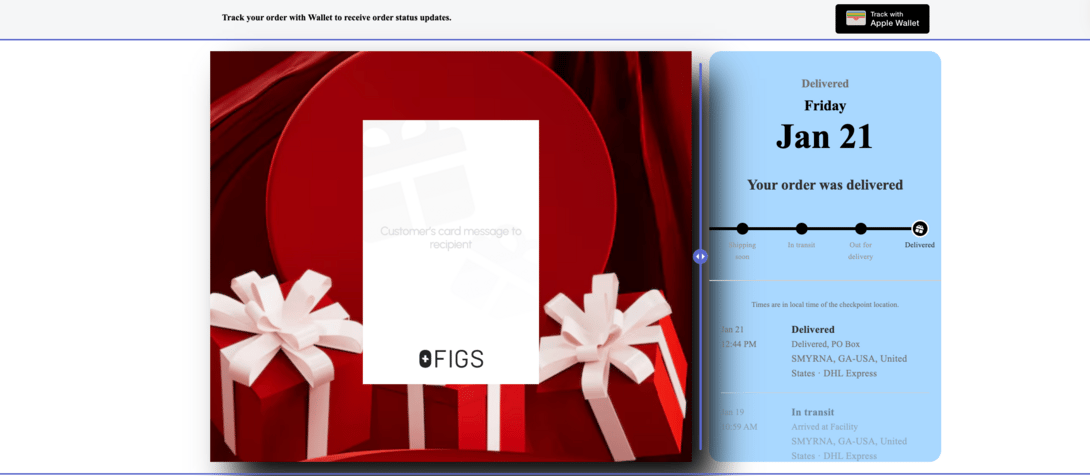
Shipping. Return labels are generated in-app at negotiated rates, on the same platform the return was raised in. There is no separate shipping-platform account to open, fund or administer, and no second dashboard to check when a label fails on a Sunday. Rates and label generation sit in the same place you already manage returns, which keeps the reconciliation on one bill.
Returns. Rich Returns reports on returns too. What differs is the data underneath the report.
- Return reasons can be read against what actually happened to the parcel, so "arrived damaged" and "arrived late" separate cleanly instead of pooling into one bucket.
- Retained revenue ratio shows how much of a refund request converted into an exchange or store credit.
- Inbound return ASNs, advance shipping notices for returns, give the warehouse notice it can plan receiving labour against.
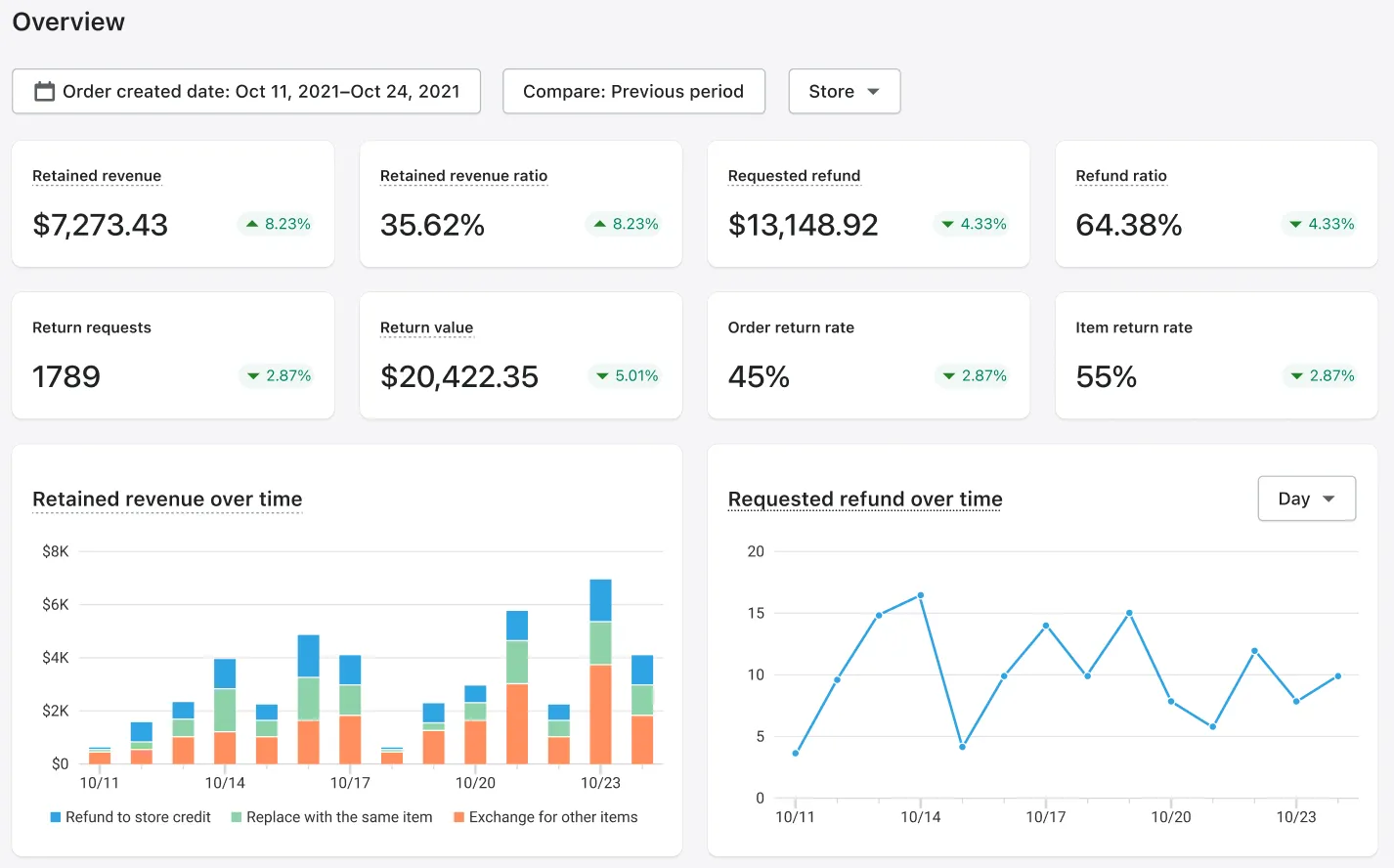
You can dive deeper into our return analytics from there.
Warranty sits on both sides of this comparison. Rich Returns carries a Warranties row from Premium, and AfterShip runs warranty on the same data as tracking and returns, so a claim inherits the delivery history it belongs to.
Getting Started with AfterShip Returns
Four steps put a working returns portal in front of customers.
- Start a 7-day free trial. Enough runway to test rules against real return reasons.
- Connect your Shopify store. Orders, customers and fulfilment history sync across, and those are what the eligibility rules read, so a return window can key off the fulfilment date rather than the order date. On Premium and Enterprise, with a Tracking plan, the window can key off the delivery date instead, which is this whole argument in one setting: the clock starts when the parcel actually arrived.
- Configure your branded returns portal. AfterShip offers a branded, no-code returns portal in 17 languages. Set your reason library, your sub-reasons, and whether shoppers can add comments or upload images.
- Set your first automation rule. Start with the exception you handle by hand most often. A wrong-size return routed automatically to store credit is a good first one. Rules compound quickly from there, and each one is a category of ticket your team stops touching.
Two migration mechanics are worth doing in this order.
Export your Rich Returns history before you uninstall the app. Its documentation states that export is available only while the app is installed, so the record leaves with it.
Then run both apps in parallel through cut-over. Its own transition guidance recommends leaving the previous app running until the replacement is configured, which also means no live return is stranded between two systems while you finish setting up.
Replacing a different returns app?
The same move applies if Rich Returns is not the app you are leaving:
- Leaving ReBound instead? Start with AfterShip vs Rebound Returns.
- Outgrowing Return Prime? Compare Return Prime alternatives.
- Moving off Return Magic? See Return Magic alternatives and how to plan the migration.
- Running exchanges on Return Rabbit? Weigh AfterShip as a Return Rabbit alternative.
Returns automation from the entry plan, on the same data layer as your tracking.
Book a demoFrequently Asked Questions
Is AfterShip Returns more expensive than Rich Returns?
At entry the two are level: both start at $19 a month. The included volume differs, with AfterShip covering 20 returns against Rich Returns' 10, and the overage differs too, at $0.50 per additional return against $1.00. Billed annually the two land within a dollar of each other, $16 for AfterShip against $15 for Rich Returns, which is the one figure where Rich Returns is lower. At 500 to 10,000 orders a month you are well past the included allowance on either plan, so the overage is the rate that actually compounds across a year.
How long does it take to migrate from Rich Returns to AfterShip?
There is no published time estimate worth relying on, so plan by the mechanics instead: export before you uninstall, and run both apps in parallel through cut-over, both covered in the steps above. On the AfterShip side the work is connecting Shopify, configuring the portal and writing your first rules. None of it requires the previous app to be switched off first, so the cut-over happens when you are ready rather than on day one.
Can AfterShip handle international returns?
Yes. Routing rules select the return method by the originating country or region, so an EU customer and a US customer can follow different paths under a single policy. International return labels are generated in-app, so there is no separate shipping-platform account to open and maintain for cross-border returns. Routing is documented for Returns itself, so the behaviour does not depend on which shipping tool you run alongside it.
Does AfterShip integrate with my helpdesk and ESP?
Gorgias is documented, so return context reaches your support agents without a tab switch. Klaviyo is documented and available on Premium and Enterprise, which puts return and exchange events into the same flows you already run for post-purchase email and SMS. Both sit on the same platform as tracking and shipping, so the events your helpdesk and ESP receive carry the delivery history behind them.