A customer's package is gone and they are waiting on you, not on an insurance company. Both Route and AfterShip Protection sit behind a third-party insurer, so neither lets you decide the claim yourself. What differs is what you are allowed to do while that decision is pending: with Route, Route resolves your customer; with AfterShip Protection, you can make the customer whole on your own timing and let the insurance file catch up.
This is a mechanics comparison of the shipping protection claims process. It walks Route and AfterShip Protection through the questions an operations team asks: who files, with whom, on what deadline, who can step in, who decides, and who pays the shopper. The brand-first verdict on those two is in Route weighed against AfterShip for DTC stores.

What Happens the Moment a Claim Is Filed
The first message about a missing package almost never reaches an insurer. It reaches you. Your team answers it, and from that moment the timeline your customer is waiting on runs partly outside your control. That is true of the Route claims process and of AfterShip Protection.
The stakes sit in the next purchase. The National Retail Federation and Happy Returns, a UPS company, report that "About 71% of consumers say they are less likely to shop with a retailer again after a poor experience, up from 67% in 2024."
Both put a third party behind the money, and both publish who. AfterShip Protection is powered by InsureShield, and AfterShip says so directly: "Please note that InsureShield takes the final call, not AfterShip." Route publishes its own chain, a Marine Open Cargo Policy written for the account of Route App, Inc., with coverage "secured via Artex Risk Solutions through Seg Insurance Ltd." Route assesses the claim through "AIR, our Automated Issue Resolution integration" or its own specialists.
Either way, the coverage decision belongs to an insurer. What you may do while it is pending is where the two part company.
Both Are Insured. The Difference Is Who Resolves
Your side of a claim is everything around the coverage decision: what the customer is told, when they are made whole, and whose name is on the page. AfterShip Protection is built so that side does not have to wait.
AfterShip Protection provides a merchant-controlled, transparent claims process. Three things follow.
- Full transparency: a claims process you and your customer can both see.
- Brand Control: your rules, your branding, your resolution.
- Operational Efficiency: resolve the customer on your timing, before or after the insurer decides, and automate the payout once it is approved.
The third rests on a separation between two statuses. The insurer's claim status tracks the file. A separate resolution status tracks whether you and your customer are square. AfterShip's documentation is explicit: "The merchants can resolve the claim with the customer before or after the claim has been approved by the insurance company." Refund a VIP on sight, clear a low-value order without waiting, and the file keeps moving behind it. When the insurer decides, the money follows automatically: "Once the insurance company approves or pays the claim, AfterShip Protection triggers reship or refund automation."
With Route, the claim is resolved by Route and its insurer, not by the brand. Route runs merchant intervention in the other order. A merchant who has already made the customer whole opens the order, clicks Request Reimbursement, and Route reviews it. Both are intervention. The order differs, and AfterShip Protection is built so the customer's resolution never waits on the insurer's.
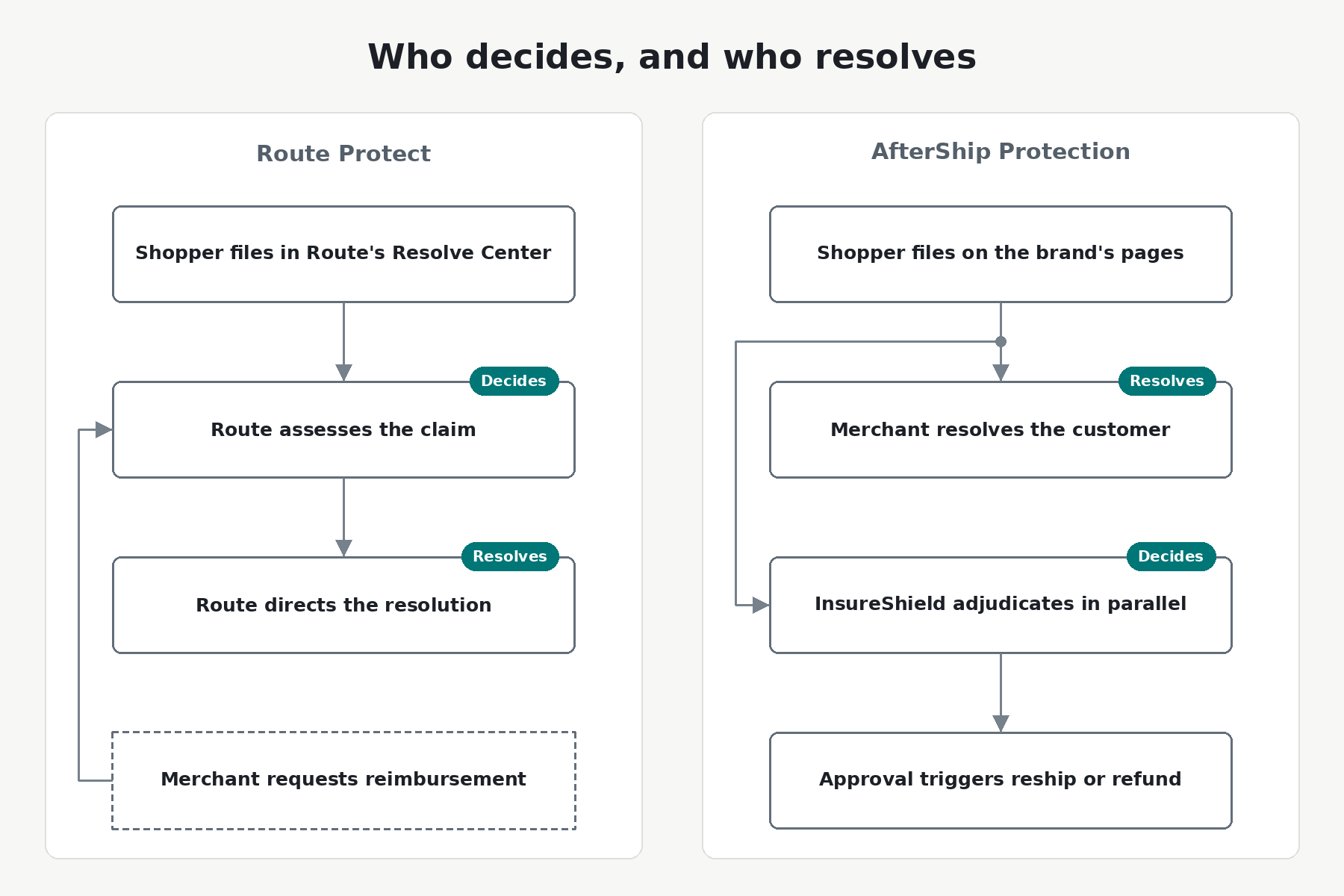
Head-to-Head: How Route and AfterShip Protection Handle a Claim
Six questions settle this for most operations teams, and every one is mechanical: who controls the process and who sees it, where the shopper goes and whose branding is on the page, whether you can step in and when, how long the window stays open, where the data and the resolution land, and what each product connects to in its own vendor's stack.
Two companion pages go wider than this one: a feature-level head-to-head comparison with Route, and a look at how the major providers compare on claims-process transparency.
AfterShip Protection runs on InsureShield, and a merchant in InsureShield's published customer story describes what that changed:
the claim approval time is the shortest of any solution I've used in the past
AfterShip publishes the rate behind that: 95% of valid claims approved, based on aggregate UPS Capital claim-payment data for four consecutive fiscal quarters ended 31 March 2021.
| Criteria | AfterShip Protection | Route Protect |
|---|---|---|
| Claims process: who controls, who sees | Merchant reviews the claim before it reaches InsureShield, or sends it through. InsureShield decides, in about 4 days on average. | Route completes a fraud screening, then assesses the claim itself, through AIR or its team of specialists. Route decides. |
| Customer experience: where the shopper goes | Three entry points on the brand's own pages: an email link, a branded claim page, the branded tracking page. | Shopper files in the Resolve Center or the Route mobile app, on Route's pages and branding. |
| Merchant control: can you intervene, when | Before the decision. Resolve the customer at any point, before or after the insurer decides, and automate the payout. | Merchant can file for a shopper and request reimbursement, which Route reviews. Route directs the resolution. |
| Data ownership: where the record lands | Claim status and the merchant's own resolution status sit on the post-purchase surface the customer already uses. | Claims tab and an Insights report carrying approval rate and top denial reason, both inside Route's own portal. |
| Integration: what it connects to | The claim record sits in the post-purchase stack with shipping, tracking, returns, and warranty, reachable through the Protection API. | Route Protect sits alongside Route Track and Route Returns inside Route's own platform and its merchant portal. |
| Filing window and deadlines | 90 days from the date of delivery for a lost or damaged order. | 30 days for lost, stolen or damaged. An unanswered claim auto-closes after 10 days, and reopens on a reply. |
Read the AfterShip column top to bottom and one pattern repeats: the brand keeps the customer while the insurer works the file.
What Your Shopper Actually Does to File
Your shopper's first move is the part of this you can design, and the two products ask different things of them.
With AfterShip Protection, a claim can start from any of three published entry points:
- An email link. Every order placed with Protection gets an email carrying a "File a claim" entrance.
- A branded claim page. You pull its URL from the Protection settings page.
- The branded tracking page. A shopper tracking a protected order sees its protection status there and opens the claim from the detail page.
Integrate shipping claims directly into your branded tracking page.
From whichever door they came through, the shopper picks the issue type, uploads supporting documents, and chooses a preferred resolution method.
With Route, the shopper files in the Resolve Center or through the Route mobile app. Route also runs an identity check through a third-party vendor, Persona. All customers verify identity the first time they file a claim; on every claim after that, for any brand or retailer, they verify only a phone number. The first-time check asks the customer to upload a photo of a government-issued ID and then to photograph their face so the two can be matched. Route puts the process at approximately one to two minutes inside its claims filing flow.
After the first claim, both flows ask about the same effort of the shopper. They differ in whose pages the shopper is standing on, and with AfterShip Protection they are yours.
Deadlines, Denials, and What Happens When a Claim Stalls
The filing window is the number that changes what your team can promise a customer. AfterShip Protection's is 90 days: "you must file a claim in writing and within 90 days from the date of delivery if your order is lost or damaged." Route Protect's is 30: "All claims must be filed within a 30-day lost, stolen, or damaged protection time frame."
Route also sets floors inside that window for Route Protect claims: a lost domestic order waits 7 days since the last tracking update, 20 days international, and a stolen claim no sooner than 5 days after delivery.
Two Route deadlines to build into your process. The 30-day filing window above, and this: "If you do not respond to a claim correspondence from Route within 10 days, Route will automatically close the claim." Route notes that a closed claim is not denied and reopens on a reply to the original thread.
Route publishes its denial reasons by name, among them "Incorrect delivery address", "Order held in customs", "Claim filed too soon" and "Claim filed too late". It publishes two paths after a denial: a support chat for a merchant who believes a claim was denied in error, and a reopening feature for claims that were previously soft denied.
AfterShip's merchant-side control sits earlier. Review is on by default: "we let the merchants review the claim info before submitting it to the insurance company." Switch it off in Protection settings and claims go straight through. Ninety days of runway and a look at the file before it is submitted widen the same thing: the space in which you decide when your customer gets an answer.
Where the Claims Data Lands
Every claim produces two records: what the insurer decided, and what you did for the customer. Where those two records live decides who can answer a question while the claim is still open.
With AfterShip Protection, both sit on the post-purchase surface your customer is already using. Claim status tracks the insurer's file. Resolution status tracks your side, moving through To be resolved, Resolved and Denied, and the Protection API exposes claims to query and retrieve alongside the coverages themselves.
Route keeps its equivalents in its own portal. The Claims tab is the hub for claims reported to Route. An Insights report publishes Claims Approval Rate, Claims Filed by Value, Claims Filed by Type, Top Denial Reason, Average First Response Time and Customer Feedback, and webhooks push real-time status updates when a claim is created, updated or resolved.
Reporting exists on each side. What changes the work is adjacency: on the AfterShip side the claim record sits beside the order, the tracking page and the return, so a product that keeps arriving damaged becomes something you can act on when you streamline your returns process.
The Verdict
The choice comes down to what you want your team doing while a claim is open.
Route Protect is a workable choice if:
- Running a claims operation is not work you want your team doing, and you are content for Route to resolve the shopper.
- Your shoppers file Route claims across several brands, so their identity check is behind them after the first one.
- You would rather your recourse arrive after a decision, as an escalation path and a reopening option.
Route is a name shoppers recognise at checkout, and it installs with very little work. Recognition at checkout is not the same as control at resolution, and the install is the cheapest part of this decision.
AfterShip Protection is the stronger choice if:
- You qualify. Enrollment runs to US-based Shopify and Shopify Plus merchants with a USD store, more than 5,000 orders a year, and a claim ratio at or under 3%.
- You want to refund or reship a waiting customer today and let the insurance file catch up.
- You want the claim to open and close on pages carrying your own name.
- The filing window covered above gives your team room a 30-day clock does not.
- You want the claim record sitting beside the order, the tracking page and the return, where it can change what you ship and how.
If you are still shortlisting, see AfterShip Protection alongside related shipping protection providers, and pick the one that keeps the resolution on your side.
Frequently Asked Questions
Does AfterShip Protection work for international shipments?
AfterShip Protection covers shipments to destinations worldwide. Merchant enrollment, however, is currently limited to US-based businesses on Shopify or Shopify Plus with a USD store. So the coverage is global; the eligibility to enroll is US-only. One carve-out applies: coverage is void where a shipment would breach US economic or trade sanctions.
How long do I have to file a claim?
90 days from the date of delivery for a lost or damaged order with AfterShip Protection. Route's window is 30 days for lost, stolen and damaged. Route also closes a claim automatically after 10 days without a customer response, though replying to the original thread reopens it.
Who decides whether a claim is approved?
InsureShield, the underwriter. AfterShip Protection is the software the claim runs through, and the merchant controls the resolution rather than the coverage decision. By default the merchant reviews the claim before it reaches the insurer, and Protection settings can be switched to submit claims automatically instead.
What is the pricing model for AfterShip Protection?
The premium is around 1.5% of the protected value, as published on AfterShip's Protection product page. The fee covers the product itself, not the shipping amount or the tax. Both platforms allow the merchant or the shopper to fund the premium, and AfterShip Protection is free to implement.