You've been handed the ticket: "Integrate shipment tracking." You know what that means: a dozen spaghetti-code integrations with carrier APIs whose docs were last updated in 2018, inconsistent data schemas, and webhooks that fail silently in the night. There's a better way. This is a developer's, no-BS guide to choosing a tracking API that won't make you regret your career choices.
What follows is a technical audit. Most parcel tracking API comparison content ranks vendors on capability checklists every platform passes. This one tests four platforms on what decides whether your integration survives production: contractual uptime, data standardization, documentation you can run code against, webhook retry behaviour, and the unit each vendor bills you on.
One ground rule. Every number below names the page it came from, and every page was read on 28 or 29 August 2026, because vendor marketing pages and vendor documentation frequently disagree, including ours. Where two surfaces of the same vendor conflict, both get named.
The Core Problem: Why Your Team Is Drowning in "Where Is My Order?" (WISMO) Tickets
Nobody assigns this ticket because tracking is interesting. They assign it because support is drowning in WISMO, the where-is-my-order queue that grows with every carrier delay.
Look at where the engineering hours go. Every carrier returns a different payload shape, so you write a parser per carrier and a normalization layer on top. Then a carrier quietly changes a status string, your normalization mislabels a delivery exception as in transit, and the first person to notice is a customer.
Webhooks make this worse before they make it better. Your receiver returns a 500 during a deploy, the sender gives up after a couple of attempts, and the event is gone. Some teams want the tracking outcome without owning any of this, which is the real question behind deciding between the API and a pre-built app.
That is the cost of getting it wrong: senior engineers writing carrier glue and chasing silent data loss instead of shipping product.
The 5 Pillars of a Production-Ready Tracking API
No published industry standard exists for evaluating parcel tracking specifically. The five pillars below are this article's own synthesis, drawn from failure modes that keep recurring in production integrations, and each of the five showdowns that follow tests exactly one of them. If you want the concept itself defined first, start with a unified shipment tracking API.
- Reliability and uptime. Does the vendor contractually commit to availability, or only publish a status page after the fact? A status page tells you what already happened. An SLA tells you what the vendor owes you when it happens again.
- Data accuracy and standardization. Raw carrier messages are inconsistent prose written for humans. What matters is whether the platform maps them to a stable enum your code can branch on without string matching.
- Developer experience. Can you run a real call straight from the documentation, or do you export the spec into Postman first, is there an SDK in your language, and do you know when you will be throttled and by how much?
- Webhook performance. Every push integration eventually fails to receive. The question is how long the sender keeps trying, and what happens to the event when it stops.
- Scalable pricing and TCO. The billing unit, the plan gate on API access, and what it costs when you exceed the quota. The headline rate tells you the least.
The API Contenders: AfterShip vs. EasyPost, Shippo, and CWILL
Four platforms, four different bets on what a tracking API should be.
AfterShip approaches tracking as post-purchase infrastructure built for enterprise-grade reliability at every scale, with standardized carrier data underneath it and the API and webhooks available from the Premium plan. EasyPost and Shippo are dev-first, multi-logistics APIs, where tracking sits alongside label purchase, rating and address validation. CWILL, formerly ParcelPanel and briefly ParcelWILL, is built around the Shopify and WooCommerce merchant, with an order-centric data model and headless React components. If the tier decision comes before the API decision, start with the shortlist a growing retailer should start from.
These are the platforms a Shopify-ecosystem developer actually shortlists. They earn a place here because their integration and pricing models contrast sharply with one another.
Deliberately out of scope: the ShipStation API, formerly ShipEngine, and the tracking-first pure-plays TrackingMore, 17TRACK and Ship24. Treat this as a chosen roster, not a ranking, and if you want the wider field, you can compare different tracking platforms separately.
Now the audit. This parcel tracking API comparison runs five criteria one at a time, every claim traced to a vendor page with the date it was read. First up is the one you can check in a browser in under a minute: which of these four commits to staying up, and what AfterShip puts in writing.
Showdown 1: Reliability & Uptime (Who Answers the Phone?)
Start with the question a status page cannot answer: what does the vendor owe you when the API is down?
Of these four, only AfterShip makes a contractual availability commitment at all. The AfterShip Tracking pricing page states it plainly: "AfterShip guarantees 99.9% monthly uptime guarantee. If it is not met, we'll refund 10% of whatever you pay for the downtime period." The separate AfterShip service-level document, last updated 11 April 2025, carries the same commitment in contract language. AfterShip publishes a 99.9% monthly uptime guarantee backed by service credits, available on its paid plans rather than only at the enterprise level.
EasyPost's Master Customer Agreement publishes no uptime percentage and disclaims that the service will be "uninterrupted, secure, or error free". Shippo publishes no platform SLA. CWILL runs a public status page and commits to no figure on it.
Every row below comes from those two AfterShip pages and from each vendor's status page.
| Criterion | AfterShip | EasyPost | Shippo | CWILL |
|---|---|---|---|---|
| Contractual uptime commitment | Yes | None published | None published | None published |
| Committed percentage and window | 99.9%, monthly | None published | None published | None published |
| Remedy if missed | Service credit, 10% of downtime spend | None published | None published | None published |
| Public status page | Month, week and day windows, per API | 90-day measured, per component | Component status, no percentages | 90-day measured, two components |
| Where it is published | Pricing page FAQ, SLA document, status page | Status page only | Status page only | Status page only |
Read the EasyPost, Shippo and CWILL status pages as history rather than as promises. EasyPost and CWILL both publish rolling 90-day component uptime, which measures what already happened; that commitment is forward-looking and measured monthly. Those are different instruments, and a strong number on the first does not substitute for the second.
A commitment with a stated remedy is not proof that AfterShip's measured availability beats anyone else's. AfterShip's own status page publishes per-API uptime on month, week and day windows, a different window from the 90 days EasyPost and CWILL report, so none of the measured figures line up side by side. What AfterShip publishes that no other vendor here does is an availability number with an obligation attached to it.
Showdown 2: Data Accuracy (Garbage In, Garbage Out)
Carrier count is the number every vendor markets and the one that tells you least about your integration.
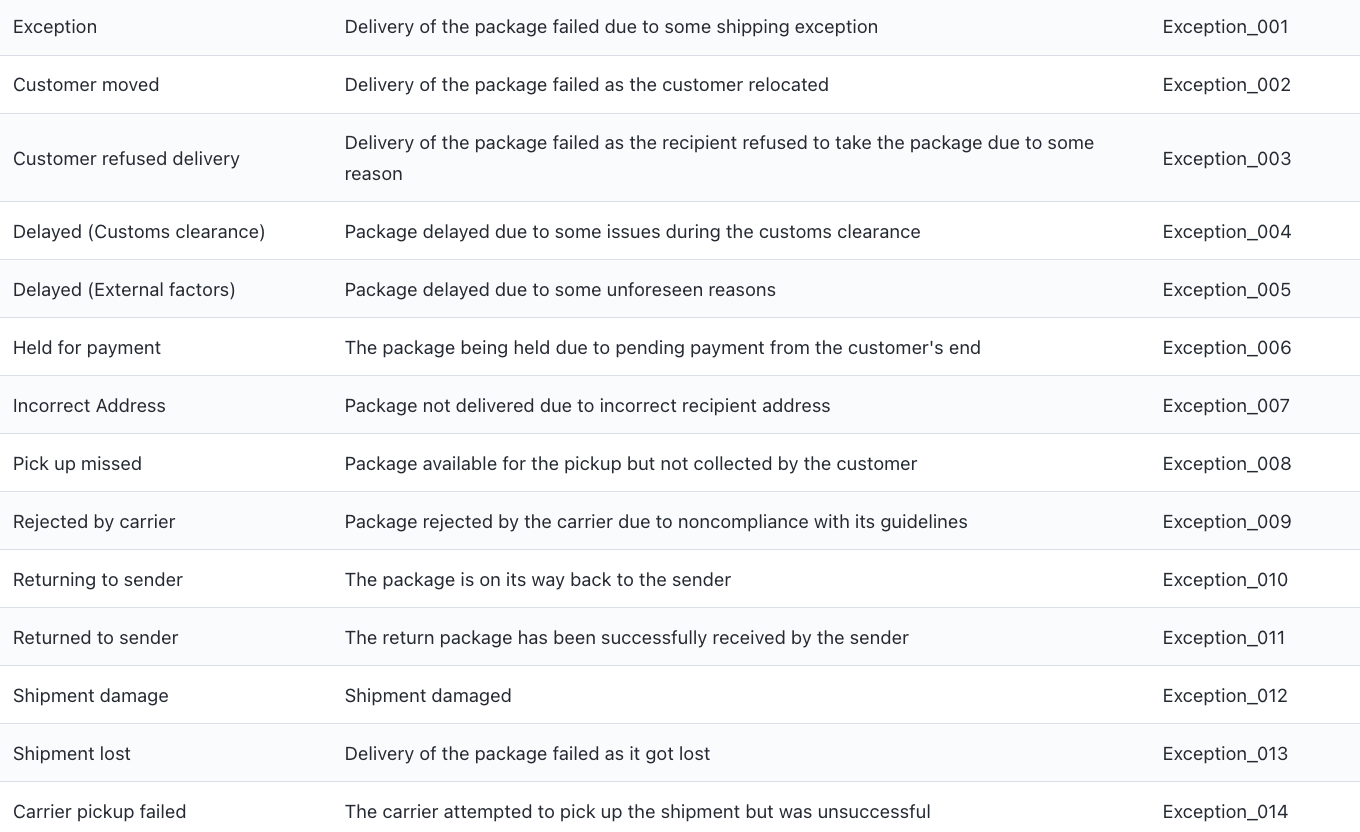
What decides your parsing code is the shape of the data underneath. AfterShip standardizes tracking data from over 2,000 carriers into nine delivery statuses: Pending, InfoReceived, InTransit, OutForDelivery, AttemptFail, Delivered, AvailableForPickup, Exception and Expired. Beneath those sit 52 sub-statuses mapping specific carrier checkpoint messages to codes, Exception_004 for a customs-clearance delay, Pending_003 for a label created with no scan yet. Both counts come from the API's own enum pages.
That is the difference between branching on an enum and string-matching carrier prose. A parser keyed to Exception_007 for an incorrect address keeps working when the carrier rewords its message. A regex looking for "address" does not.
Shippo and CWILL both expose a two-level model. Shippo returns a status alongside a substatus object carrying a code, text and an action_required flag. CWILL pairs statuses like DELIVERED with sub-status codes like Delivered_001. The structures are comparable; the depth of the mapping is where they separate.
AfterShip's carrier count is checkable rather than asserted: the carrier directory is public and searchable, so you can confirm a specific carrier, and the count itself, before you commit to the integration.
On freshness, Shippo states its own figure openly in its documentation: updates arrive within two hours of an event on average. No vendor in this category, AfterShip included, publishes a carrier-scan-to-visible figure, so every freshness claim here is unbenchmarked. Standardization depth is the part you can check for yourself rather than take on trust: open AfterShip's sub-status enum page and count the rows.
Showdown 3: Developer Experience (Will You Love or Hate the Docs?)
Documentation quality comes down to one test: can you run a call without leaving the page?
AfterShip's clear and comprehensive API documentation answers yes. Each endpoint renders in a three-column layout with a runnable console, an editable JSON body and a Send API Request button that fires the real call, alongside request samples in 18 languages. On SDKs, AfterShip publishes seven official libraries: Java, Node.js, .NET, Python, Ruby, PHP and Go. EasyPost publishes seven. Shippo currently lists six, having dropped Ruby from its official set, and notes that its libraries are mid-refresh. CWILL ships a REST API with headless React components.
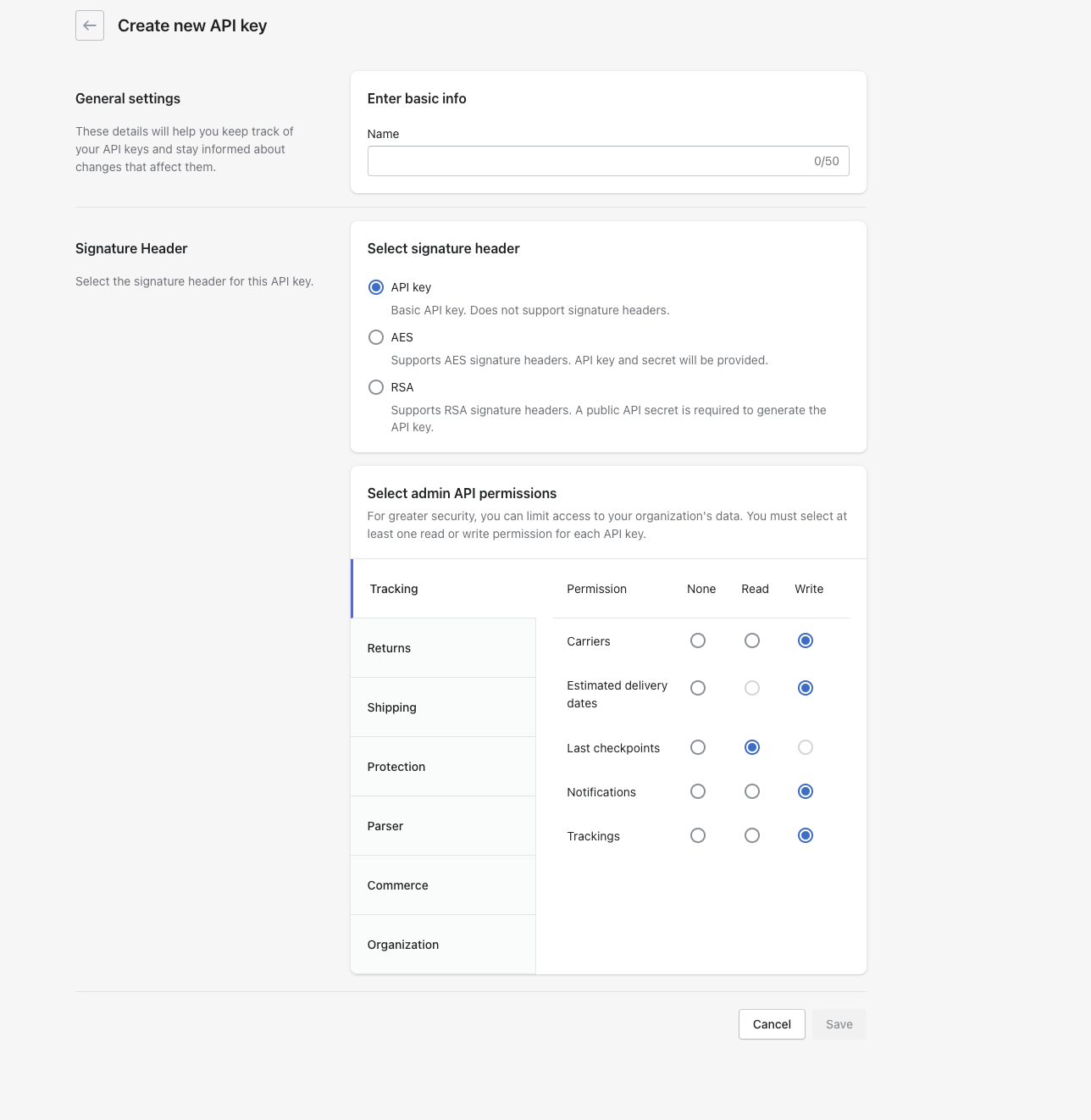
Creating a tracking is one call: Creating a tracking is one call, and the tracking API quick start walks through it from API key to first response:
import requests
r = requests.post(
"https://api.aftership.com/tracking/2026-07/trackings",
headers={"as-api-key": "YOUR_API_KEY",
"content-type": "application/json"},
json={"tracking_number": "1234567890", "slug": "ups"},
)
if r.status_code == 429:
retry_after = r.headers["X-RateLimit-Reset"]
Rate limits are where two AfterShip surfaces disagree, and both belong on the page. The API documentation, version 2026-07, publishes per-endpoint ceilings, each named by HTTP method and path: POST /trackings at 20 requests per second, GET /trackings at 6, GET /trackings/:id at 5, POST /couriers/detect at 3, with HTTP 429 on breach and X-RateLimit-Limit, X-RateLimit-Remaining and X-RateLimit-Reset returned on every response. The same page notes that these replaced a flat 10 requests per second per organization in the 2024-07 version. The pricing page still advertises a 10 requests per second ceiling on Premium with custom limits on Enterprise.
Scope matters more than the ceiling. AfterShip enforces limits at organization or account level, so issuing a second API key does not multiply your throughput. CWILL enforces 120 requests per minute per API key. EasyPost publishes five requests per second across its index endpoints. Shippo publishes per-minute limits, 750 on tracking POST and 500 on single GET in live mode.
Design for the steady-state ceiling; none of the four documents a burst allowance. Organization-level enforcement makes that planning tractable: one number to model, one to alarm on, no drift as services multiply keys.
Showdown 4: Webhook Performance (The Silent Killer)
Push integrations fail. What separates one package tracking webhook API from another is what the sender does next.
AfterShip retries a failed webhook up to 14 times on a published formula, 2^(number of retry) x 30s. The second attempt lands 30 seconds after the first failure, and the accumulated delay across all 14 attempts reaches 245,730 seconds, roughly 68 hours. Every delivery carries a base64 HMAC-SHA256 signature in the aftership-hmac-sha256 header.
The rest of the field is tighter. EasyPost requires a 2XX response within seven seconds and retries up to six times with an increasing delay it does not publish. Shippo requires acknowledgement in three seconds or less and retries twice, and only on 408, 429 and 5XX; other 4XX responses get no retry at all. CWILL retries five times at 10, 30, 60, 120 and 300 seconds, an envelope of 520 seconds, after which, in its own documentation's words, the webhook "will be dropped and will not be sent again".
The four policies below come from each vendor's own webhook documentation: AfterShip's webhook overview and webhook signature pages, EasyPost's webhooks guide, Shippo's tracking webhooks and webhook security pages, and CWILL's Webhooks v2.
| Vendor | Ack timeout | Retry attempts | Backoff | Total envelope | Signature | After final failure |
|---|---|---|---|---|---|---|
| Shippo | 3 seconds or less | 2, only on 408/429/5XX | Not published | Not published | Shippo-Auth-Signature, HMAC setup on request | Not published |
| CWILL | Not published | 5 | 10/30/60/120/300 seconds | 520 seconds | X-ParcelPanel-HMAC-SHA256 | Dropped, not sent again |
| EasyPost | 7 seconds | Up to 6 | Increasing, formula not published | Not published | X-Hmac-Signature, secret on webhook | Not published |
| AfterShip | Not published | Up to 14 | 2^(retry) x 30s | 245,730 seconds, about 68 hours | aftership-hmac-sha256 | Stops, no further delivery |
Run a one-hour receiver outage against those policies. An AfterShip integrator loses nothing, because attempt 14 is still days out. A Shippo or CWILL integrator can lose the event outright.
After attempt 14, AfterShip stops too. The documentation describes no post-failure alert, no replay queue and no delivery-time target, so final reconciliation is your responsibility, exactly as it is with every competitor here.
Which is why you reconcile by pull as well as push. Schedule a sweep against GET /trackings filtered by updated_at_min, size it to the retention window, and treat webhooks as the fast path rather than the only path. AfterShip, EasyPost and CWILL document a signature header as a standard part of every delivery. Shippo offers HMAC on request through its account team and states the setup can take up to 10 business days. The 68-hour envelope is the part that buys your on-call engineer a full night's sleep.
Showdown 5: Pricing Models (The Per-Call Price Is a Lie)
The per-call price is the wrong number to compare, because these four vendors are not selling the same unit.
AfterShip bills per shipment against a quota, and the quota period follows the billing toggle on the pricing page: annual billing quotes a yearly shipment allowance at a lower monthly rate, monthly billing quotes a monthly allowance at a higher one. Repeated API calls against the same shipment do not bill again. AfterShip's API pricing is based on predictable tiers, avoiding per-call overages. Past quota, a per-shipment overage applies on both plans. API and webhooks are gated to Premium, so the API is not available on the entry plan.
The AfterShip vs EasyPost API comparison turns on exactly this. EasyPost's pricing page prices tracking per shipment, while its documentation describes the billed object as a Tracker: free when bundled with an EasyPost label, metered when standalone, with same-carrier duplicates deduplicated for three months in production but not in test mode, and a different carrier on the same tracking code billing separately. Shippo bills per unique tracking number created outside Shippo. CWILL bills per order, where one order is one credit regardless of how many shipments it contains, lookups are free, and access is gated to its Professional tier.
The rates below come from four pricing surfaces: the AfterShip Tracking pricing page, EasyPost's pricing page, Shippo's API pricing page, and CWILL's pricing page.
| Vendor | Billing unit | Published rate | API plan gate | Overage |
|---|---|---|---|---|
| Shippo | Per unique tracking number, created externally | 2¢/track, API Starter | API Starter | Not applicable, pay per use |
| CWILL | Per order; one order, one credit | $59/mo, 2,000 credits, avg $0.0295 | Professional | $0.05 per additional credit |
| EasyPost | Per shipment on pricing page; per Tracker in docs | $0.01-$0.03 per shipment | Not published | Not applicable, pay per use |
| AfterShip | Per shipment; 6,000/yr or 500/mo quota | Essentials $29 annual/$35 monthly; Premium $59/$70 | Premium | $0.08 Essentials, $0.12 Premium |
A like-for-like total is not computable from public data without an explicit assumption about your shipment mix, which is why the table gives per-unit rates instead of an invented monthly bill.
At very low volume an API-first competitor can land at a lower per-shipment cost, and the Premium gate means AfterShip is not the cheapest entry point on this list. That comparison stops holding as you scale. Predictable per-shipment billing with no per-call metering, against the reliability and data quality measured above, removes the engineering hours and support tickets that never appear on a pricing page.
The Developer's Verdict: When to Choose AfterShip's API
Most shortlists of the best logistics and fulfillment APIs stop at the feature grid, where all four of these platforms look interchangeable. Five criteria in, they no longer do.
AfterShip is the definitive choice for any business where the post-purchase experience is a priority, and for developers who value reliability, data quality and long-term scalability over the lowest entry-level cost.
The pattern across the five criteria is consistency rather than any single knockout. AfterShip publishes more of its own behaviour, in more checkable form, than the rest of the field.
That verdict has edges. If you are a bootstrapped startup shipping under a hundred packages a month and the cheapest entry point decides it, Shippo might work, provided you go in expecting the technical debt. If tracking is one call inside a label-buying workflow you already run on EasyPost, consolidating on a single vendor is defensible. And if you are a Shopify or WooCommerce merchant who thinks in orders rather than shipments, CWILL is a capable order-centric option, though a poor fit as a platform-agnostic carrier API. Teams weighing EasyPost head-to-head can read the API comparison for shipping teams before committing to one vendor.
Past the entry-cost gap covered in Showdown 5, the case for AfterShip strengthens with every order of magnitude. On third-party signal, G2 puts AfterShip at 4.7 out of 5 across 311 reviews, EasyPost at 4.2 from 122, Shippo at 4.2 from 77, and CWILL carries no G2 profile at all. Read those as user-satisfaction scores, which is what G2 measures. They are not evidence of uptime, data accuracy or latency, and treating one as a reliability benchmark would repeat the error this article argues against.
One boundary on all of this. A shipping label generation API comparison is a different article and a different AfterShip product; everything above tests the tracking surface only.
Whichever way you go, run the same due diligence yourself. Open the enum pages, the retry table, the pricing toggle, and check that what each vendor markets matches what it documents.
Call this the developer review AfterShip API shortlists rarely get, and it ends on an admission this reader has earned. No independent third-party benchmark of tracking-API accuracy, latency or uptime is published by anyone, so every performance claim in this category, AfterShip's included, is vendor-reported. That is why every claim above carries the surface it came from and the date it was read, and why the only contractual commitment among the four, covered in Showdown 1, is AfterShip's.
Proactive shipment tracking that delights your customers, reduces WISMO tickets, and improves your delivery performance.
Book a demoFAQ: Your Technical Questions, Answered
How does AfterShip's API handle rate limiting?
Ceilings are set per endpoint and enforced per organization: POST /trackings at 20 requests per second, GET /trackings at 6, GET /trackings/:id at 5, and POST /couriers/detect at 3. Breaching one returns HTTP 429. Every response carries X-RateLimit-Limit, X-RateLimit-Remaining and X-RateLimit-Reset, so throttle adaptively against those headers rather than hard-coding a sleep. Issuing a second API key does not multiply throughput. No burst allowance is documented, so design for the steady-state ceiling.
Can I backfill historical tracking data via the API?
There is no fixed backfill guarantee. When you create a tracking, AfterShip returns whatever checkpoint history the carrier still exposes, so depth is carrier-dependent and varies widely across a mixed carrier mix. The 120-day figure you may have seen is a data-retention rule, not a backfill promise. Retracking an expired tracking is capped at three attempts. Before any cutover, create a sample of trackings per carrier and inspect what history actually comes back, rather than assuming parity with your current provider.
What is the typical latency for a new tracking creation call?
AfterShip's product page advertises a response time under 100 milliseconds. Treat that as a vendor-reported product-page figure with no published percentile, endpoint, geography or measurement window, which is how you should treat every latency number in this category, including competitors'. Keep two things separate while you evaluate: API response time is how fast the endpoint answers your request, while data freshness is how quickly a carrier scan becomes visible in the payload. They are different measurements, and no vendor in this comparison publishes a carrier-scan-to-visible figure.
Does the API support multi-carrier label generation?
No, that is our separate AfterShip Shipping API. The Tracking API covers shipment tracking, checkpoints, courier detection and estimated delivery dates. Both are AfterShip products on one platform, so adding label generation later is a scope change inside a suite you already integrate with. That suite covers shipping, tracking, returns, and warranty.