The Real Cost of an "Almost-Right" Delivery Date
Your customer does not care what the carrier estimated on Monday. They care that the box said Thursday and it is now Friday, and that nobody told them. Before you compare two vendors on accuracy, it is worth knowing that the word means four different things here, and that the two companies are quoting you numbers from different ones.
This comparison of AfterShip AI EDD vs 17track starts with the cost of a date that moved, because that is the line item you are trying to shrink.
An almost-right date does more damage to your support queue than a vague one. A window of three to seven days sets a soft expectation, and shoppers hold it loosely. A confident Thursday sets a hard one, and they plan their week around it. Break the hard promise and you are far more likely to generate a contact that the soft promise would not have.
A date that slips by a day is rarely a logistics failure. It is a promise your storefront made and quietly broke, and the customer's first move is to open a ticket. You pay for that ticket twice, once in agent time and once in the trust it spends.
Gartner's 2024 benchmark puts a self-service contact at a median of $1.84, against $13.50 for assisted channels such as phone, chat and email. That is a general customer-service median across all contact types, not a WISMO measurement. Source: Gartner, "Benchmarks to Assess Your Customer Service Costs", 1 February 2024.
The larger cost never reaches your helpdesk. AlixPartners found that delayed orders affect 92% of shoppers' next purchase decision, in a survey of 1,100 US consumers. Descartes sized the exposure at 66% of consumers overall experiencing a delivery problem in the three-month period surveyed, across 8,000 consumers in North America and Europe.
Do not inherit an industry WISMO average for your business case. Pull the last 90 days of tickets, tag the ones that name a date, and divide. That share, priced at your own cost per contact, is the number your leadership will argue with, and it is the number a predictive tool has to move.

How Each One Produces a Delivery Date
The two platforms are doing different work before a date ever reaches your customer.
17track relays the delivery date its carrier reports. Its documentation names three sources for what a shopper sees: the carrier's official EDD, a custom EDD you configure, and an AI EDD of its own, built on the logistics data it has accumulated. By 17track's own account, whether an estimated delivery date can be retrieved depends on the carrier, the route and the shipment information.
AfterShip's AI EDD models the date instead. The predictive delivery date (EDD) model was trained with data from over 4.4 billion shipments, and it weighs your order processing time, historical tracking patterns, holidays, weather and traffic, distribution centre zones and warehouse locations, carrier service types, SKU-specific requirements, and destination down to the street or zip code.
That last input carries more weight than it sounds like it should. A model that knows which warehouse ships to which zip code, on which service level, is answering a narrower question than how long this carrier usually takes. Narrower questions produce firmer dates.
Predictive EDD runs across the major carriers you work with, so the question to put to either vendor in a demo is whether your own lanes are covered.
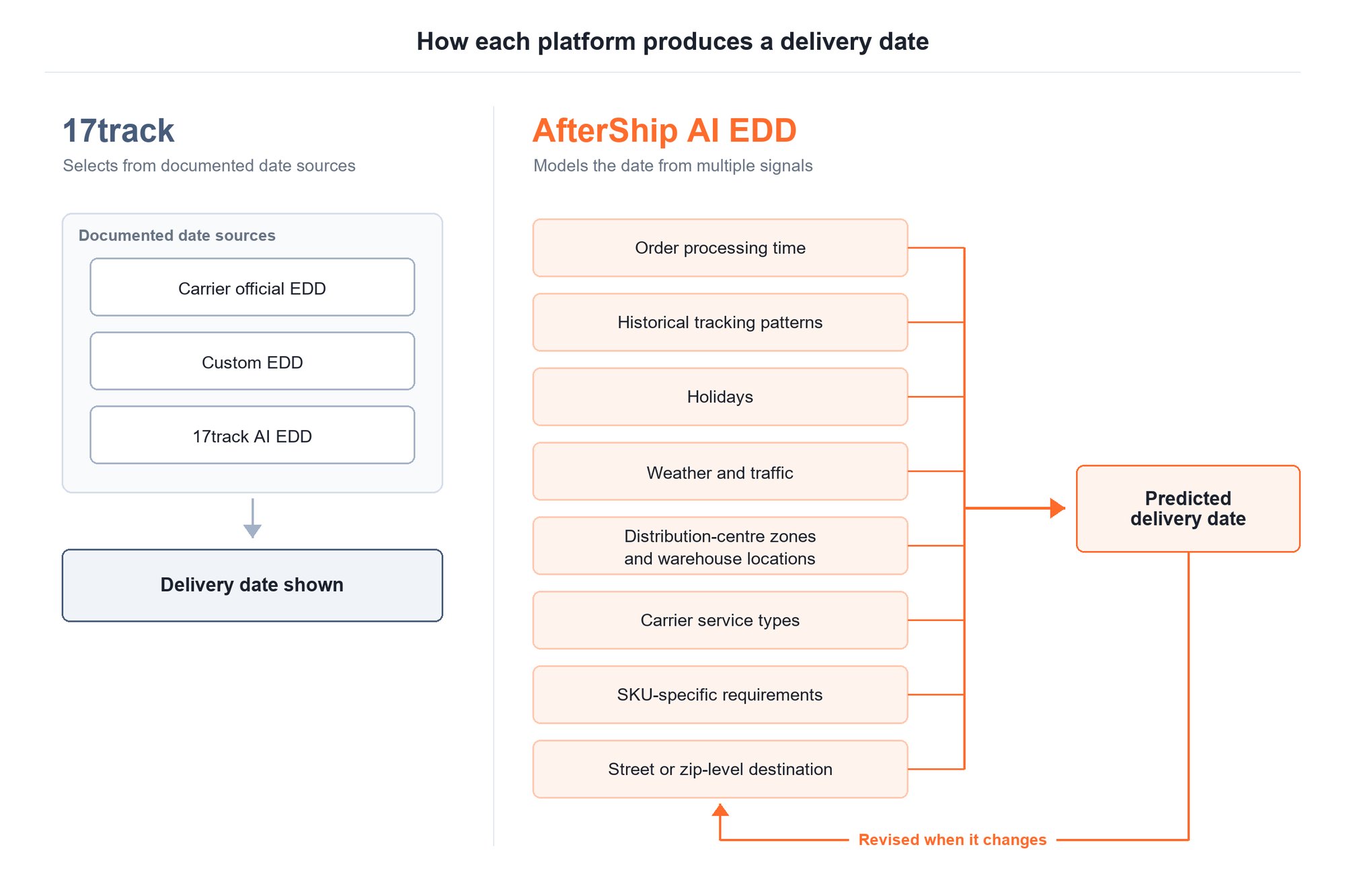
Relaying a date and predicting one are two different products, and they fail in different ways. AfterShip's is built to be checked: a modelled date can be scored against the day the parcel actually arrived, and that score is what the next section puts on the table.
The Honest Accuracy Test: What the Word Actually Measures
Ask two tracking vendors how accurate they are and you will get two numbers that cannot be compared. Accuracy in package tracking is at least four separate measurements:
- Carrier identification. Given a tracking number, does the platform work out which carrier it belongs to?
- Checkpoint relay. Does it receive that carrier's scans and surface them without loss or lag?
- Delivery-date prediction. Does it produce a date, and does the parcel arrive on it?
- Revision and notification. When the date changes, does the platform notice, and does your customer hear about it?
The first pair is a data-plumbing problem. The second pair is a modelling and messaging problem. A platform can be strong at the first pair, publish nothing about the second, and still put a large percentage on its homepage.
17track's homepage carries 99.9% tracking accuracy and automatic identification of 80%+ carriers. Both sit in the first pair: they describe how reliably a tracking number is matched to a carrier and its scans surfaced. Neither one is a statement about the delivery date.
Hold that carrier-identification figure in mind when you reach the next section, because the AfterShip coverage figure you will find there carries the same headline percentage and measures something unrelated: the share of deliveries that get a predicted date at all. Same digits, different question.
Lined up side by side, the figures read as rival scores in a single contest. They are answers to four different questions, and the percentage on its own does not tell you which.
There is also no referee. No independent third-party benchmark comparing delivery-date prediction accuracy across vendors exists, from any analyst, academic or trade body. Every accuracy figure in this category, AfterShip's included, is reported by the vendor that benefits from it.
That is worth stating plainly rather than working around, because it changes the useful question. Not whose number is bigger, but which vendor publishes a figure at all, names what it measures, and leaves you able to check it against your own orders once you are live.
What Each Vendor Actually Publishes
Score both platforms against those four questions and the answers come back in different shapes.
17track's merchant product is substantial. It is a Built for Shopify app with four merchant tiers, a delivery date shown on the product page before purchase, an AI EDD of its own, and an EDD Analysis report that measures the share of parcels delivered within the estimate, gated to a paid tier. They built the tooling to measure a prediction.
What that tooling measures is never published. Across its public surfaces, 17track states no delivery-date accuracy figure, no coverage figure and no methodology for its AI EDD. On availability, its help centre says that whether an estimated delivery date can be retrieved depends on the carrier, the route and the shipment information. That is a fair answer to a hard question. It is not one you can put in a business case.
AfterShip publishes both of the numbers the third question asks for. Coverage first, and it is the one inherently comparative figure either vendor puts on the record:
AfterShip AI EDD generates a predicted delivery date for 80%+ of deliveries. Most carriers offer predictions on fewer than 40%. Source: aftership.com/edd.
That gap is the practical argument for a predictive model. A shipment with no estimate is a shipment your customer has to ask about.
On the prediction itself, AfterShip publishes up to 95% of EDD prediction accuracy. The qualifier travels with the figure every time, here and everywhere else, because it is a ceiling the model is built to reach rather than a promise about your account.
Format changes the meaning again. AfterShip can display a specific date or a date range, and a support-centre article dated 1 July 2026 puts accuracy at around 91% when the prediction is a single named day rather than a range. A narrower promise is a harder one to hit, which is the trade-off you are making when you choose the display format.
Neither AfterShip figure is independently audited, and after the previous section you would be right to hold that against every vendor here equally. What those two AfterShip figures do is put a claim on the record with its metric attached, dated and traceable to a page you can open. That gives you something to hold AfterShip to at renewal, and something to test against your own delivery data in the first quarter after you switch.
Beyond Accuracy: What Changes in the Business
A predicted date earns its place in three ledgers: conversion, support, and staffing.
Dr. Squatch is the clearest published case. After moving to AfterShip, the brand reported 87.76% on-time EDD accuracy across 99.98% of orders, alongside a 31.89% click-through rate on its branded tracking page, 4.5x the AfterShip platform benchmark.
AfterShip's AI EDD is built to reach up to 95% of EDD prediction accuracy. In production, results vary by a brand's carrier mix and shipping lanes. Dr. Squatch's figure is what one merchant's real lanes returned, and the coverage alongside it matters as much as the accuracy: across effectively the whole order book rather than a favourable cohort. A measured number across every lane you actually ship is a better thing to plan against than a ceiling.
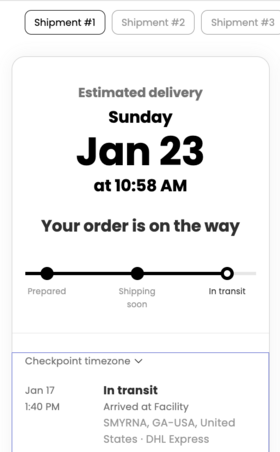
The conversion ledger closes before the parcel ships. A shopper choosing between two storefronts is comparing arrival dates, and a specific date on the product page answers a question that a shipping-policy page leaves open.
The support ledger opens when the date moves. AfterShip treats a revised date as an event in its own right, with triggers named EDD revised, EDD missed and Delivery arriving soon. 17track's emails are triggered when the main logistics status of a package changes, so a date that shifts without a status change does not fire one. For how the two platforms compare across the rest of the post-purchase stack, see the wider platform comparison.
Reducing WISMO contacts is not a differentiator. AfterShip markets it, 17track markets it in its own app subtitle, and both platforms are sold on it. The question is which mechanism gets you there, and a message that goes out the moment a promise changes is a different mechanism from a message that waits for a scan.
The staffing ledger is where your COO feels it. Support volume driven by moved dates is unforecastable, so you staff for the worst week and carry the cost in the quiet ones. A predicted date that holds, plus a message when it does not, turns that spike into something you can roster against. Pair the branded tracking experience with delivery performance analytics and you can see which lanes and carriers are generating the contacts, rather than inferring it from ticket volume.
Feature Breakdown: How the Two Compare
Six criteria, scored on what each vendor publishes about itself.
| Criteria | 17track | AfterShip AI EDD |
|---|---|---|
| How the delivery date is produced | Selects from three documented date sources, including its own AI EDD | Predicts the date with a model trained on data from over 4.4 billion shipments |
| What each publishes about delivery-date accuracy | Publishes no accuracy figure, no coverage figure and no methodology for it | Publishes a prediction-accuracy ceiling and a coverage figure, both on its product page |
| Delivery-date coverage | Depends on carrier, route and shipment information, per its own help centre | At least 80% of deliveries; predictive EDD across the major carriers you work with |
| What happens when the date moves | Emails trigger on main logistics status change | A revised date is its own event, with named triggers |
| Where the date appears | Product page and post-purchase | Product page, checkout and tracking page, from one model |
| Best fit | Broad carrier lookup and a low-cost tracking page | A brand whose support volume is driven by dates that moved |
Read down the middle column and the pattern is consistent: capable delivery of what the carrier supplies. Read down the right and most claims arrive with a published figure or a named mechanism behind them. Two rows deserve more of your attention than the rest: what each vendor publishes about delivery-date accuracy, and what happens when the date moves. Those are the two where a claim is either checkable or absent.
The Verdict: Which Tool Is Right for Your Stage of Growth
Pick by the problem you actually have, not by the size of your business.
If what you need is broad carrier lookup and a branded tracking page at the lowest cost, 17track does that job and merchants rate it well for it. Nothing in this comparison argues otherwise.
If your support volume is driven by delivery dates that moved without a message going out, the requirement is different. You need a date on the product page and at checkout before the customer commits, the same date on the tracking page afterwards, and a notification the moment the prediction changes. That is the job AfterShip AI EDD is built for, and it is the one side of this comparison that publishes what its prediction covers.
Dr. Squatch
“We love having AfterShip's AI EDD on our product pages. It has been beneficial for conversions.”
Read their storyNeither vendor can hand you an independent audit, because none exists for this category. Build your own instead. Ask any shortlisted vendor for the predicted date and the actual delivery date in one export, run it across a full month, and compare the two by carrier and by lane. Before you sign, what you can compare is what each vendor puts in writing about its own predictions, and what happens on the day a date slips. AfterShip has put its answer to both on the record.
AI-powered shipping time estimates that drive conversion, set customers' expectations, and offer peace of mind.
Book a demoStart with your own numbers rather than ours: See what your delivery dates are actually doing.
Frequently Asked Questions
How is AfterShip AI EDD different from 17track's delivery date?
17track relays the delivery date its carrier reports, and its documentation names three sources for what a shopper sees, including an AI EDD of its own. AfterShip AI EDD predicts the date with a machine-learning model that weighs order processing time, historical tracking patterns, holidays, weather and traffic, distribution-centre zones, carrier service types and the destination zip code, then revises that prediction and notifies the customer when it changes.
Is 17track accurate?
17track publishes a tracking-accuracy figure and a carrier-identification figure on its homepage. Both measure carrier recognition and checkpoint relay: how reliably a tracking number is matched to a carrier and its scans surfaced. Neither is a measure of delivery-date prediction. On its public surfaces, 17track publishes no accuracy figure, no coverage figure and no methodology for its delivery-date estimate.
What does AfterShip's 'up to 95%' EDD accuracy figure actually measure?
AfterShip's published EDD prediction accuracy figure measures delivery-date prediction: how often the predicted delivery date matches the day the parcel actually arrives. The 'up to' qualifier makes it a ceiling the model is built to reach rather than an average across every account, and results vary by a brand's carrier mix and shipping lanes. It is a separate measurement from carrier identification and checkpoint relay, which is why accuracy figures from different vendors are rarely comparable.
Is 17track good enough for a business?
17track is a Built for Shopify app with four merchant tiers, a delivery date shown on the product page before purchase, an AI EDD of its own, and an EDD Analysis report that measures the share of parcels delivered within the estimate. For many merchants that is enough. The gap for a business case is what it publishes about that estimate: no accuracy figure, no coverage figure and no methodology on any public surface.
What is a predictive estimated delivery date?
A predictive estimated delivery date is calculated by a model rather than passed through from the carrier. The model weighs order processing time, historical tracking patterns, holidays, weather and traffic, warehouse locations, carrier service types and the destination, and it can produce a date before the carrier issues one. AfterShip AI EDD generates that date for the product page, checkout and the tracking page from one model, and revises it when conditions change.