Your annual parcel spend is one of your largest P&L line items, yet for most enterprises, it's a black box of rising surcharges and opaque carrier contracts. Most of the tools sold to fix it will tell you where the money went. Far fewer will change what happens the next time a label prints. This guide compares both kinds, and shows you which problem each one actually solves.
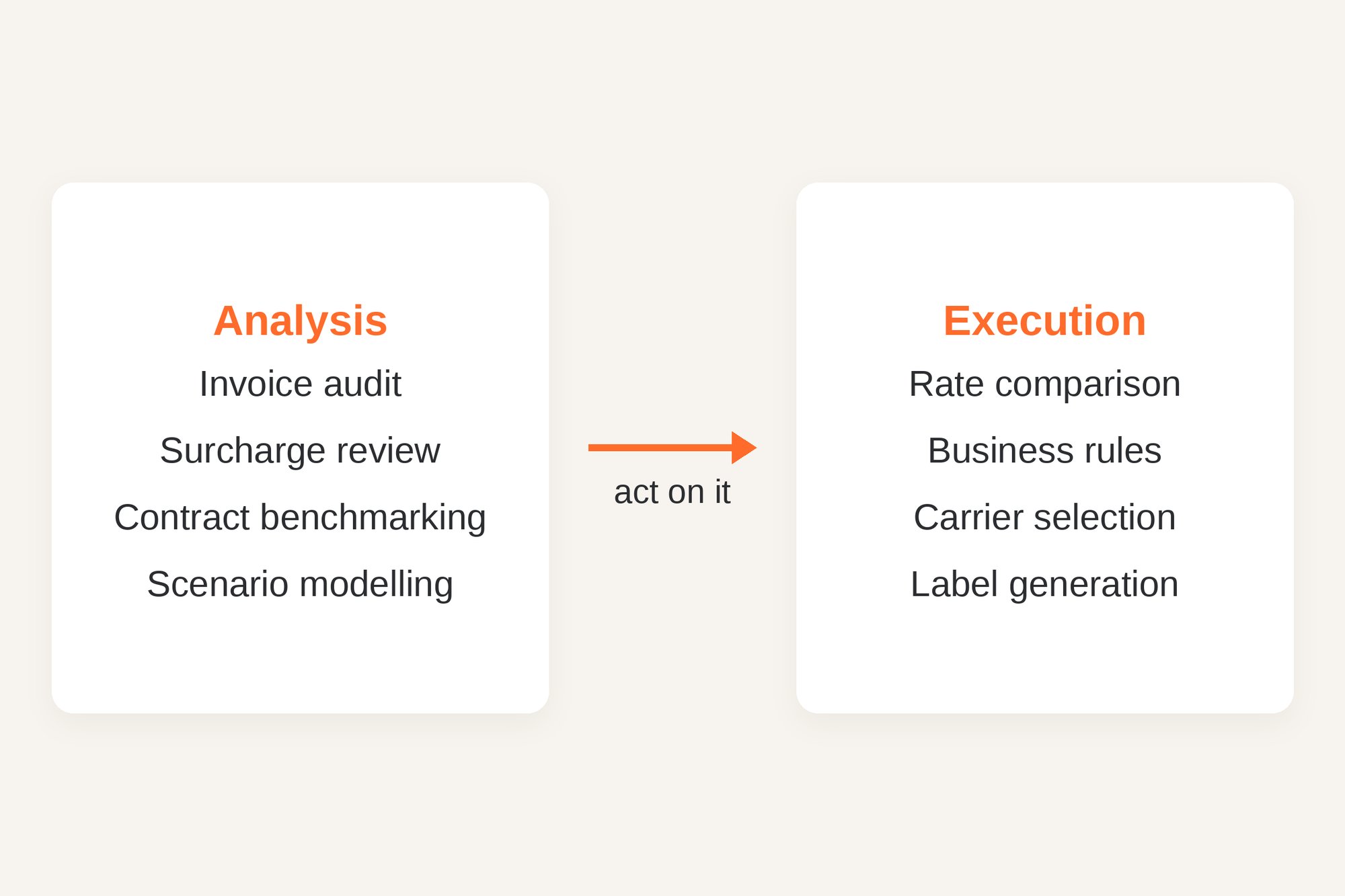
Parcel spend management splits into invoice analysis and shipment execution. The analysis layer works on invoice and contract data to explain what you were charged and to model what you would be charged under a different network, service mix or agreement. The execution layer sits at the moment of shipment and decides which carrier and service each parcel goes out on.
Parcel spend management tools help enterprises optimize shipping costs and performance. The five parcel spend management tools below include both kinds. At 50,000 packages a month you probably need one of each, and knowing which you are shopping for is what separates a business case that clears from one that stalls. Brands well below that volume, where USPS is effectively the whole network, should start with a budget-tier read on delivery platform pricing.
What Is Parcel Spend Management (And Why Legacy Approaches Are Failing You)
The category sells itself as one product. Buy a platform, the pitch goes, and your shipping costs come down. Key features include multi-carrier rate shopping, rule automation, and invoice auditing. The work splits into two jobs at opposite ends of the same shipment, and most vendors do only one.
The analysis layer works on data you already hold. It audits carrier invoices against contracted rates, reviews surcharges and accessorials for charges that should never have applied, benchmarks your agreement against what your shipping profile could command, and models scenarios: a distribution centre relocation, volume moved to a second carrier, a package redesign and what it returns in dimensional weight. Its output is a recommendation, plus a refund claim wherever a carrier billed you wrong.
The execution layer works in the seconds before a label is bought. It compares live rates and committed transit times across your carrier accounts, applies your business rules to the parcel in front of it, selects a service, and generates the label. Its output is a cheaper shipment.
Gartner defines multicarrier parcel management solutions as tools that help companies select the most appropriate parcel carrier from among all contracted carriers, based on order characteristics, delivery rules and carrier performance, while considering the cost differentials of carrier offerings, and that also manage the creation of labels. That is the execution layer, defined by a third party, and the definition leaves the pure audit platforms outside it by its own terms.
Parcel audit platforms recover overspend; execution platforms prevent it. Both are real money, and neither substitutes for the other. Recovered spend is money you already lost and clawed back.
Prevented spend never leaves the building.
The failure mode to watch: a modelled saving that no system enforces at label time is a recommendation, not a saving. Enterprises buy an analysis platform, accept its finding that a slower service holds the same delivery promise across a meaningful share of their volume, and then keep buying the faster service anyway, because the rule lives in a slide deck instead of in the label API. Twelve months later the invoice looks the same.
Core Capabilities of an Enterprise Parcel Spend Management Platform
Eight capabilities decide an enterprise shortlist. Tag each one by layer before you score a single vendor against it. A blank cell then tells you the vendor works in the other layer.
- Surcharge/Invoice Auditing (Analysis). At that volume, wrong service codes, disputed dimensional weights and unclaimed service-failure credits are findable only by machine.
- Contract benchmarking and scenario modelling (Analysis). Pricing a proposed rate card against your real zone and weight profile turns the next carrier negotiation into an evidence conversation.
- Analytics & Business Intelligence (Analysis). Landed cost analysis per order by carrier, service, zone and lane is what your CFO asks for first, and building it takes a quarter.
- Real-Time Rate Shopping (Execution). Pricing the parcel and promise date in front of you across every carrier account is surcharge mitigation at source, before a charge applies.
- Business Rules Engine (Execution). Rules encode the decision your team would make if it had time to make it on every single parcel.
- Support for the shipper's own negotiated carrier accounts (Execution). At seven figures of annual spend your rates beat a reseller's, so carrier diversification pays only when the platform ships on your contracts.
- Integrated Post-Purchase CX (Execution). Branded tracking and delivery notifications sit on the shipment after the label, where a missed promise turns into a support contact.
- API Reliability & Docs (Both). At this volume the platform runs inside your order system, so public documentation and a published uptime commitment decide how long the build takes and how often it breaks.
Carrier performance analytics sit underneath several of these, and SLA adherence by lane is a cost input: a missed date forces reships and refunds you already paid for.
The 5 Best Parcel Spend Management Tools for Enterprise Shippers in 2026
Five tools, chosen to represent the distinct architectural approaches in this market. This is not a ranking of every vendor in it. Two sit entirely in the analysis layer, one primarily in execution, and two span both. TransImpact, Shipware and others occupy similar ground and belong on a longer shortlist. Enterprise shipping software, shipping cost optimization software and parcel audit software are sold under one label and sit at opposite ends of the same shipment, and the parcel spend management tools below are grouped by the job each does. If TransImpact is already on your longer list, we compare AfterShip vs TransImpact on everyday usability separately.
1. AfterShip: The Integrated Execution & Intelligence Platform
AfterShip Shipping generates labels on a shipper's own negotiated carrier rates. It does not resell you rates or re-rate someone else's, and it covers 130+ carriers.
At order time it queries live rates and committed transit times through carrier APIs, so the comparison reflects what a carrier will actually charge and actually promise for that parcel, that destination and that date. Business rules then apply to the shipment in front of the system. For Enterprise customers, a rule-based label API in beta can select the cheapest or the fastest qualifying service automatically before the label is generated, moving the routing decision out of a quarterly review and into the request that buys the label.
The loop closes on the analytics side. AfterShip integrates shipping execution with analytics and the post-purchase customer experience. Carrier performance and delivery analytics and business intelligence score how each carrier performed by lane, which is the evidence your next contract negotiation runs on.
Juniper Creates, a Canadian custom merchandise business shipping 500,000+ parcels a year, used the AfterShip Tracking shipment dashboard to compare carrier performance and cost efficiency, restructured its carrier partnerships on what it found, and reported a 20% reduction in shipping costs. Whether the premium tier is worth its line item is unpacked in how mid-market teams size the spend.
AfterShip does not audit carrier invoices, dispute surcharges or file refund claims, so a shipper whose primary leak is billing accuracy should pair it with a platform that does. Its job is to stop the overspend being booked at all.
Shipping is one product inside AfterShip's AI post-purchase platform. Tracking, Returns, Shipping and the predictive delivery date estimates of AI EDD are billed separately, and Enterprise terms are custom. You can explore AfterShip Shipping for the execution side.
Best for: Enterprise shippers whose spend leaks at the label, running several carrier contracts they negotiated themselves.
Layer: Execution, primarily. Carrier performance and delivery analytics feed the analysis side.
Key capabilities: Live multi-carrier rate and transit comparison; business rules applied at label generation; rule-based cheapest or fastest service selection, available to Enterprise customers in beta; carrier performance and delivery analytics; execution on your own negotiated carrier accounts.
Limitations: No carrier invoice audit, surcharge dispute or refund recovery. Automated service selection is an Enterprise beta capability and is not yet generally available.
2. Sifted: The Pure-Play Analytics & Auditing Specialist
Sifted is the strongest pure analysis platform on this list. It audits every invoice, files claims automatically, and validates every charge against your contracted rates. That is the recovery half.
The modelling is where an enterprise shortlist should actually look. Scenario Modeling answers four separate questions: where to locate warehouses and distribution centres for the cheapest and fastest delivery, what a ground versus two-day versus overnight swap does to cost and transit, what a new box size returns once dimensional weight is priced in, and how a carrier's proposal performs when evaluated against your actual shipping profile. Sifted's own framing is modelling changes before you commit a dollar.
Around that sit continuous monitoring across cost-sensitive KPIs, carrier management, accounting automation and reporting and analytics.
The product set contains no rate comparison at order time, no business rule that selects a carrier, and no label. Sifted works on the invoice and the contract. Nothing in it touches the shipment itself.
Best for: Enterprises whose largest leak is billing accuracy, surcharge exposure and contract terms.
Layer: Analysis.
Key capabilities: Continuous parcel audit with automatic claims filing and charge validation against contracted rates; network, service-type, package and contract modelling; carrier management; accounting automation; reporting and analytics.
Limitations: No rate comparison at order time, no automated carrier selection, no label generation.
3. ShipHawk: The TMS for Complex & Oversize Freight
ShipHawk carries the widest scope here. Warehouse management, transportation management and execution across parcel, LTL and FTL sit on the same platform as a freight and parcel audit.
That audit imports and analyses freight spend from all parcel, LTL and FTL carriers in one place, normalises shipment details, services and charges across carriers, reconciles each invoice charge back to the rate quote, then identifies discrepancies and automatically submits recovery requests to the carrier. ShipHawk frames the outcome as analysing carrier performance to enable contract negotiations.
The enterprise signal is the ERP orientation. ShipHawk publishes direct integrations for NetSuite, Acumatica, Infor, Microsoft Dynamics, Sage and SAP, and its rating runs on your own negotiated rates.
If your freight and warehouse problems are the same size as your parcel problem, this is the one entry that addresses all three on a single contract. If parcel is the whole problem, you are buying scope you will not use.
Best for: Operations where freight and warehouse complexity rivals parcel volume, especially on NetSuite.
Layer: Both.
Key capabilities: WMS and TMS on one platform; parcel, LTL and FTL execution; multi-carrier rating on your own negotiated rates; multi-carrier invoice import, normalisation and reconciliation against rate quotes; automated recovery submission; shipping data and analytics.
Limitations: Parcel depth is one part of a much wider footprint. Its carrier-performance analysis is derived from invoice data inside the audit product, where AfterShip's comes from delivery performance by lane: different dataset, different question. Scenario modelling is not publicly documented.
4. EasyPost: The API-First Developer Toolkit
EasyPost reaches further into execution than an API company is usually given credit for. Luma AI Select automatically chooses the best shipping option for every shipment based on cost, speed and real carrier performance, adapting those decisions continuously as conditions shift across regions and services.
On the analysis side, Luma AI Insights simulates carrier strategy changes before they go live and benchmarks your performance against similar shippers, and Luma AI Advisor answers questions and recommends what to do next, grounded in your own operational data. EasyPost Guard identifies and files carrier claims automatically for USPS, with FedEx claims automation on its Enterprise plan.
What separates it at enterprise scale is the operating model. EasyPost is API-first: your engineering team builds and owns the shipping workflow on top of it, and EasyPost's adaptive model owns the routing decision.
That is a good trade when you have engineering capacity to spend and a workflow no packaged product fits.
Best for: Engineering teams building and owning a bespoke shipping workflow on an API-first platform.
Layer: Both.
Key capabilities: Luma AI Select automated carrier selection; Luma AI Insights carrier strategy simulation and peer benchmarking; Luma AI Advisor guidance grounded in your shipping data; Guard automated USPS carrier claims.
Limitations: The workflow is yours to build and maintain. Claims automation is not a full carrier invoice audit.
5. Reveel: The Contract Negotiation Intelligence Platform
Reveel organises itself around what it calls Parcel Spend Management 2.0, and its centre of gravity is the carrier agreement.
Modelling and simulation begin with the contract itself. Drop a PDF agreement in and Reveel builds a digital model of it, then compares normalised agreements side by side, runs what-if simulations across scenarios you select, and prices the precise impact of a rate change. General rate increase impact analysis runs on the same digital contract model, which is how a shipper forecasts next year's spend before signing anything.
Around that sit parcel audit and recovery, where Reveel files and appeals credit claims and the shipper keeps 100% of what comes back, plus finance automation covering GL coding, accrual management, order matching and SKU-level profitability.
The overlap with Sifted is real. Both audit invoices, both model scenarios, both report on spend. Reveel's edge is the contract cycle: comparing agreements and forecasting spend before a signature. Neither one buys a label.
Best for: Enterprises whose next material saving is locked inside a carrier agreement due for renegotiation.
Layer: Analysis.
Key capabilities: Contract ingestion into a digital model; normalised side-by-side agreement comparison; what-if simulation; rate-change and general rate increase impact analysis; parcel audit with claims filing and appeals; finance automation including GL coding, accruals, order matching and SKU-level profitability.
Limitations: No rate comparison at order time, no automated carrier selection, no label generation.
Comparison Matrix: Enterprise Parcel Spend Management Software
Eight criteria, five tools, every row tagged by layer. Two rows repay a close read: the auditing row, where AfterShip concedes cleanly, and the bottom row, where the platforms that never buy a label drop out of the question entirely.
| Criteria | Layer | AfterShip | Sifted | ShipHawk | EasyPost | Reveel |
|---|---|---|---|---|---|---|
| Surcharge/Invoice Auditing | Analysis | Not a native audit tool. Prevents overspend pre-shipment through rate comparison and rules. | Yes. Continuous audit, automatic claims filing | Yes. Parcel, LTL and FTL | Claims filing only, via Guard | Yes. Files and appeals credits |
| Contract benchmarking and scenario modelling | Analysis | Not offered | Yes. Network, service, package, contract | Negotiation support. Modelling not documented | Yes, via Luma AI Insights | Yes. Contract modelling and simulation |
| Analytics & Business Intelligence | Analysis | Yes. Carrier and delivery performance | Yes. Reporting, analytics and monitoring | Yes. WMS and TMS analytics | Yes. Peer benchmarking and guidance | Yes. Finance automation, SKU profitability |
| Real-Time Rate Shopping | Execution | Yes. Live rates and transit | Not offered | Yes. Multi-carrier smart rating | Yes. Continuous rate shopping | Not offered |
| Business Rules Engine | Execution | Yes. Cheapest or fastest, Enterprise beta | Not offered | Yes. Configurable dynamic rules engine | Yes, via Luma AI Select. | Not offered |
| Integrated Post-Purchase CX | Execution | Yes. Tracking, branded pages, notifications | Not offered | Yes. Branded tracking pages | Yes, via EasyPost Track | Not offered |
| API Reliability & Docs | Both | Yes. Public docs, 99.9% uptime SLA | No public developer docs found | Yes. Public developer docs | Yes. Public developer docs | No public developer docs found |
| Support for the shipper's own negotiated carrier accounts | Execution | Yes, plus performance data feeding renegotiation | Not applicable. No label bought | Yes. Rating uses your rates | Yes. Carrier Account Management API | Not applicable. No label bought |
Three of the five reach the label. One of those three pairs the execution with delivery performance data that feeds your next negotiation, and that pairing is the part which compounds.
How to Build the Business Case for a New Spend Management Platform
Your CFO does not fund a platform. They fund a number, and the number has three terms.
Recovered spend comes from the analysis layer: billing errors, invalid surcharges, dimensional weight discrepancies and service-failure credits your carriers owe you. It is measurable within a quarter of switching on, and it works on invoices you have already received.
Prevented spend comes from the execution layer: the gap between the service your rules select and the service that would have shipped by default, multiplied across every parcel. It is harder to instrument and it is larger, because it applies to every shipment for the life of the contract.
Platform cost is the third term. At enterprise volume both layers are custom-priced, and AfterShip's modules are billed individually.
The rate environment is why the timing matters. FedEx announced that effective 5 January 2026, FedEx parcel and FedEx Freight LTL shipping rates rise by an average of 5.9%. Every zone, weight break and accessorial you have not modelled reprices underneath you on that date. Shipware's analysis of the 2026 increases found delivery area and residential surcharges again rising faster than the headline rate, and fractional inches now round up, which raises dimensional weight.
Do not build the case on a published savings percentage. No defensible industry figure exists for this, and the first thing a CFO asks is where the number came from. Build it on your own data: pull one quarter of invoices, contracts, zones and service selections, price that quarter against a rules-based carrier selection, and set the difference next to the platform cost. That arithmetic survives scrutiny because it is yours.
The Verdict: Choosing the Right Platform for Your Shipping Complexity
Route by where the money actually leaks.
If the leak is billing accuracy and contract terms, buy analysis. Sifted and Reveel are the specialists here, Sifted leaning toward your shipping profile and Reveel toward the agreement itself.
If your freight and warehouse operations are as complex as your parcel volume, ShipHawk puts all three on one contract.
If you have an engineering team that wants to build and own the shipping workflow, EasyPost gives them a platform to build it on.
And if the leak is the daily decision about which service each parcel goes out on, which at this volume it usually is, AfterShip is the strongest choice on this list for intelligent, multi-carrier shipping execution, and the multi-carrier shipping software enterprise operations teams should shortlist first. It is the one tool here that pairs the label decision with the delivery performance data that feeds your next negotiation, so the execution and the evidence that sharpens it live in one system, integrated with the post-purchase experience your customers see.
Most enterprises at this scale will run one tool from each layer. That is the honest recommendation, and it is exactly why AfterShip sits comfortably alongside an audit platform you already own. Teams sizing up the execution layer can start with the 2026 shipping software comparison before shortlisting vendors.
Ready to act on your parcel costs before the label prints? Get a demo tailored to your carrier mix and volume.
See AfterShip in ActionFrequently Asked Questions
What is parcel spend management?
Parcel spend management is the practice of controlling what a business pays to ship parcels, and it divides into two layers. The analysis layer works on invoice and contract data: auditing carrier invoices, reviewing surcharges, benchmarking agreements and modelling scenarios. The execution layer works at the moment of shipment: comparing live rates, applying business rules, selecting a carrier and generating the label. Most vendors sell one layer. Enterprises shipping at volume usually need both.
What is the difference between parcel audit and parcel spend management?
Parcel audit checks carrier invoices for billing errors and service failures, then files for refunds. Parcel spend management contains that recovery work and adds the disciplines around it: contract benchmarking, scenario modelling, spend reporting, and in some platforms the execution that chooses a carrier before the label prints. Audit works on money you have already spent. Spend management extends to the decisions that create the spend in the first place.
Does AfterShip audit carrier invoices?
No, and that is a deliberate scope choice. AfterShip does not audit carrier invoices, dispute surcharges or file refund claims; that work belongs to a dedicated audit platform running alongside it, while AfterShip operates one step earlier, at the moment the label is bought, where rate comparison and business rules keep the overspend from being booked at all.
Can I use my own negotiated carrier rates?
Yes. AfterShip Shipping generates labels on your own negotiated carrier rates, so the discounts your team fought for are the discounts that apply at the label. For Enterprise customers, a rule-based label API in beta can select the cheapest or fastest qualifying service automatically against those same contracts. The delivery performance AfterShip records on those shipments then becomes the evidence base for your next round of carrier negotiations.