You've narrowed your post-purchase platform choice to Wismolabs and ParcelLab. Both handle tracking and both handle returns. Neither compares carrier rates or generates shipping labels, so whichever you choose, you will be adding a third vendor to do it. That third contract is what this comparison is actually about.
Most Wismolabs vs ParcelLab write-ups stop at notification triggers and tracking page templates. Those details matter, and you will have them settled within a quarter. The shape of the stack you commit to is what you live with for years.
What follows is a guide to choosing between post-purchase experience platforms as a brand that is still growing. For the head-to-head you may have started with, we also publish a direct AfterShip vs ParcelLab comparison.
The Quick Verdict: Wismolabs vs ParcelLab
The two vendors sell to different buyers and price in different ways. That shapes a shortlist faster than any single feature does.
| Dimension | Wismolabs | ParcelLab |
|---|---|---|
| Best for | Tracking and returns as a self-contained post-purchase scope | Tracking and returns inside an enterprise programme, including stacks routing through FedEx Tracking+ or Returns+ |
| Ideal Customer Profile | Mid-market brands shipping roughly 1,500 to 20,000 shipments a month | Enterprise retailers with order volume concentrated in Europe |
| Pricing Model | Published tiers from $250/mo | Not published, contact vendor |
| Key Strength | Vendor-configured setup, typically live in about two weeks | Enterprise implementation with a dedicated team |
Read those as two different buying motions rather than two rankings. Neither of them changes what happens the moment you need a label bought at the best rate available to you. If Narvar is also on your shortlist, we compare AfterShip vs Narvar vs parcelLab separately.
What Wismolabs and ParcelLab Cover, and What They Don't
Buy either vendor and you are buying the same three capabilities. This is the part of the evaluation that both of them answer.
- Branded tracking pages that keep order-status checks on your domain instead of the carrier's.
- Proactive delivery notifications that reach the customer before the WISMO ticket does. WISMO is the "where is my order" question, and it is the single most common reason customers contact support.
- A returns product, with a customer-facing portal and the workflow behind it. Both vendors ship one. Any comparison that tells you otherwise is wrong, and you can disprove it in one click on either vendor's site.
Wismolabs and ParcelLab both offer tracking and returns, but neither offers shipping.
What neither vendor does is the outbound side of the journey. Comparing carrier rates across services before a label is bought, and generating the carrier-certified label itself, sit outside both products. So does the work that hangs off those two things: batch fulfillment, rate rules by weight and destination, and the carrier accounts the labels draw against.
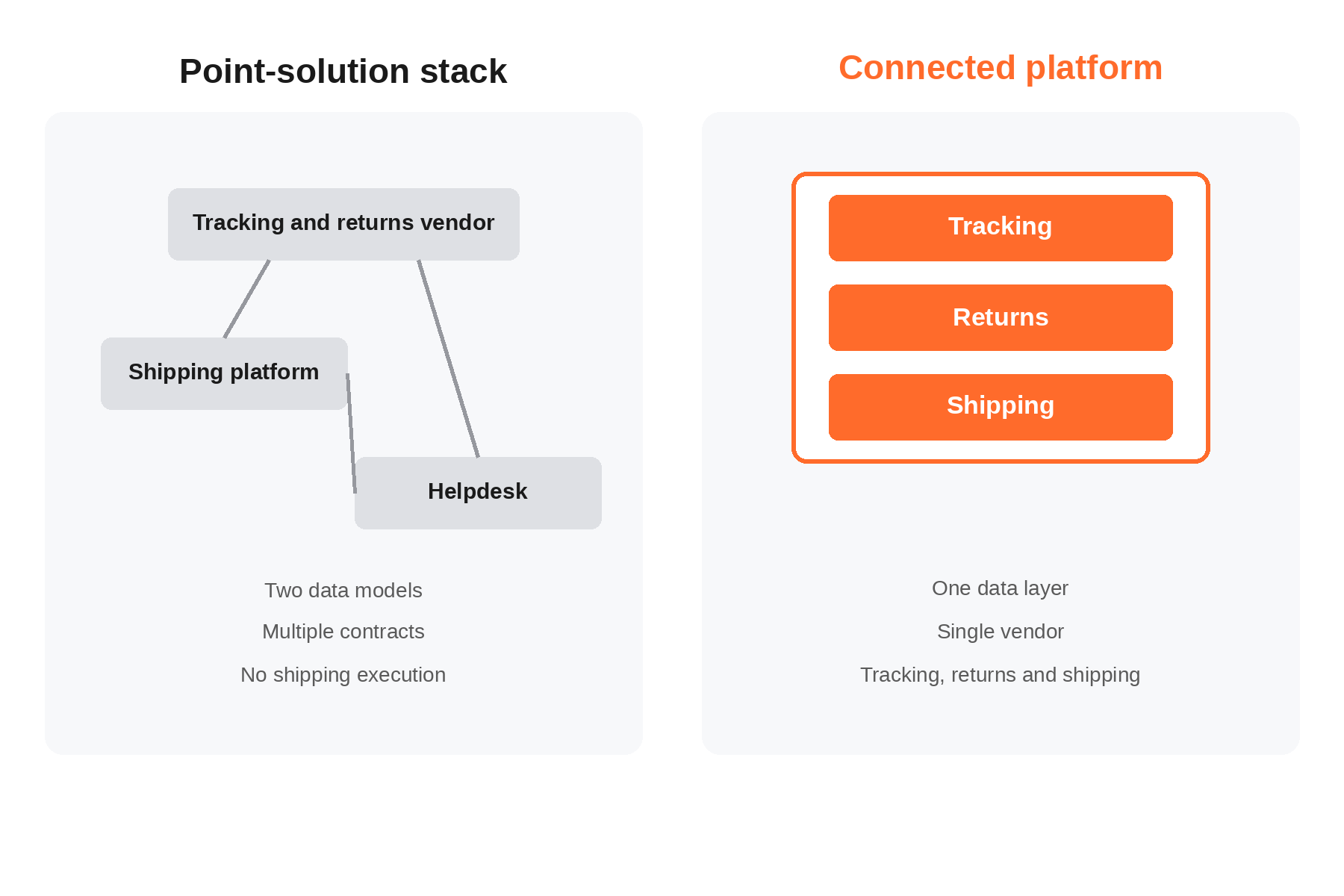
A brand that ships its own orders still needs a separate shipping platform to do that work. That platform arrives with its own contract, its own integration, and its own data model, which means the shipment your customer is asking about is described one way by the vendor that created the label and another way by the vendor that tracks it.
At 1,000 orders a month you can absorb that. At 30,000, the stitching becomes somebody's job.
Before you sign: count the integrations, not the vendors. A tracking and returns vendor plus a shipping platform plus your helpdesk is three contracts, three renewal dates, three support queues, and at least two places where order data has to be reconciled by hand. None of that work appears on any of the three quotes.
The Real Cost of a Disjointed Post-Purchase Experience
Total cost of ownership has three lines on it, and only one of them shows up on a quote.
Software fees are the quotable line. Integration cost is the engineering time to connect each vendor to your store, your helpdesk, and each other, plus the re-work every time one of them changes an API. Management overhead is the recurring human cost: reconciling order data across dashboards, training new hires on three tools instead of one, and chasing an exception across two vendors when a customer is waiting.
Only the first line is quotable from public pricing. The other two are structural, and any number we attached to them would be invented, so treat them as scope questions you ask each vendor rather than figures you put in a spreadsheet.
A unified platform reduces the total cost of ownership (TCO). The fourth cost, though, does not sit on your P&L at all. It leaks through the customer experience, and it is the one your VP will actually feel.
Delivery problems are not edge cases. 66% of consumers experienced a delivery problem in the past three months, according to the Descartes 4th Annual Ecommerce and Home Delivery Consumer Sentiment Study, which surveyed 8,000 consumers across North America and Europe with Sapio Research.
At that frequency, the exception is the ordinary case. Whichever tools handle it are the ones deciding what your customer remembers about buying from you, and every handoff between those tools is a place the answer gets slower.
The Wismolabs vs ParcelLab decision is a real one. It is just smaller than the decision sitting underneath it, which is how many vendors you want standing between a customer's question and its answer. Our full verdict on WISMOlabs vs parcelLab weighs the two vendors side by side on that smaller call.
The Unified Platform Advantage: Why AfterShip is a Smarter Investment
AfterShip comes at this from the other end of the problem. AfterShip integrates tracking, returns, shipping, and delivery estimates. They are separate products on one platform, reading from the same order record.
That sounds architectural until you watch it decide an outcome. When the label was bought in the same system that receives the carrier scan, a stuck shipment has one owner, one timeline, and one place to act on it. When it was not, somebody has to establish that two records are the same parcel before anyone can answer the customer.
The shopper sees that as one page: your branding, the delivery estimate, and product recommendations drawn from the same order record.
Be clear about how this is bought. Each product is billed separately, there is no hard spend cap, and overage alerts are the control, so set them during onboarding rather than after your first peak.
For the wider field, see our view of post-purchase platforms for mid-market brands.
Head-to-Head: AfterShip vs a Point-Solution Stack
Read as Wismolabs vs AfterShip, the honest comparison is AfterShip against the stack you will actually run: Wismolabs or ParcelLab for tracking and returns, plus a separate shipping platform for rates and labels.
| Criteria | AfterShip (connected platform) | Point-solution stack |
|---|---|---|
| Branded tracking and proactive comms | Native | Native. A genuine strength of either vendor |
| Returns management | Native, sharing the tracking data layer | Native, but a separate vendor and a separate contract |
| Multi-carrier rate shopping | Yes | Not offered by either vendor. Requires a third tool |
| Carrier-certified label generation | Yes | Not offered by either vendor. Requires a third tool |
| Carrier tracking breadth | 2,000+ carriers through one integration | Wismolabs 750+. ParcelLab states 550+ on its carriers page |
| Single data layer | One platform, shared data | Multiple dashboards, multiple contracts, manual stitching |
Two of those rows are the ones that decide the shortlist, and they sit next to each other for a reason. Rate shopping and label generation are not adjacent nice-to-haves. They are the two operations that turn a post-purchase tool into a shipping operation, and they are the reason the third contract exists. The same test run across three platforms is in a like-for-like test of ticket outcomes.
Now the money. AfterShip publishes its Tracking ladder, which is the part most buyers cannot get from this category. At the top of that published range, 60,000 shipments a year, buying direct on aftership.com, Essentials is $199 a month and Premium is $479 a month on annual billing at 18% off, with the overage priced on the tier: $0.08 per extra shipment on Essentials, $0.12 on Premium. The same plans are also sold through the Shopify App Store, so confirm which channel a quote refers to. Above 60,000 shipments a year, all three plans move to Custom and Contact sales, Essentials and Premium included, not only Enterprise.
Wismolabs publishes $730 a month including 10,000 shipments. That is 120,000 shipments a year, a volume at which AfterShip quotes rather than lists. ParcelLab publishes nothing, at any volume.
Read the Custom cell as scope rather than evasion. Past that ceiling the variable that moves your bill is which products you run and how they are configured, and that is a conversation, not a slider. The comparison you are actually making is one vendor's published number against the total of a multi-vendor stack, and only one of those totals can be assembled from public pricing today.
Aetrex runs Tracking and Returns together on AfterShip. Since consolidating, it has recorded a 141-point NPS gain, a 50% reduction in operation costs, and an 86% cut in return processing times.
If you want the detail underneath the tracking column, you can compare the top tracking platforms in more depth.
How AfterShip Drives ROI for Mid-Market Brands
Four outcomes matter to an operations lead building this case at 1K to 50K orders a month.
- Cut WISMO tickets with proactive delivery notifications that reach the customer on the sub-status change, before they open a ticket to ask about it.
- Lower returns handling cost with Routing rules, which send each return to the right destination and resolution automatically instead of by hand. Routing rules are available on all plans.
- Compare carrier rates and generate labels in the platform that already holds the order, which removes the third vendor from the diagram rather than integrating it more neatly.
- Increase repeat purchases with a branded tracking page carrying product recommendations, on the one page customers open repeatedly while they wait.
Internet Up runs that model and reports a 4.8 out of 5 shopper review score alongside a 10% increase in net revenue.
For tactical examples of what the last one looks like in practice, see how other brands create a fully branded tracking experience.
The Final Verdict: When to Choose Wismolabs, ParcelLab, or AfterShip
Three different buyers are reading this, and they should not leave with the same answer. Whether you came looking for the best alternative to Wismolabs or a ParcelLab alternative, that depends on which buyer you are.
Choose Wismolabs if...
- you need to be live in about two weeks and the vendor is doing the configuration
- you need a published price on screen before you can build a business case
- your volume sits inside its published bands, roughly 1,500 to 20,000 shipments a month
- tracking and returns are the whole of your post-purchase scope today
Choose ParcelLab if...
- your implementation budget and timeline can absorb a multi-week enterprise rollout, and nobody is expecting a result inside the current quarter
- your order volume is concentrated in Europe, and the separate shipping platform you will still need is one you have already solved for that market
- you would rather brief a named vendor team than have your own people operate the tool day to day
- your stack already routes through FedEx Tracking+ or Returns+, which FedEx delivers in collaboration with ParcelLab and scopes to enterprises, so that integration work is already spent
Choose AfterShip if...
- you need shipping execution, carrier rate comparison and carrier-certified label generation, in the platform that already holds the order
- you want tracking, returns and shipping reading from one data layer, so an exception has one owner instead of two records to reconcile
- you expect to remove vendors from your stack as you scale rather than add them
- you want one contract, one renewal cycle and one support queue instead of three
If your post-purchase scope is limited to tracking and returns today, and you do not expect to bring shipping into it inside 24 months, either competitor covers that scope honestly. The question is whether a scope that stops at two thirds of the journey is what you want to build the next three years on.
See the Unified Post-Purchase Platform in Action
Every vendor on your shortlist can tell a customer where a parcel is. The question worth taking into a demo is what happens next: who buys the label, who owns the exception, who reconciles the two records, and how many renewal dates that answer costs you a year from now.
Bring your own volume and your own carrier mix to that conversation. The numbers only mean something against your lanes.
Proactive shipment tracking that delights your customers, reduces WISMO tickets, and improves your delivery performance.
Book a demoFrequently Asked Questions
Is Wismolabs or ParcelLab better for a mid-market DTC brand?
Neither is better in general; they sell to different buyers. Wismolabs publishes its pricing and configures the tool for you, which suits a team that needs a business case approved quickly. ParcelLab runs an enterprise implementation and fits where order volume is concentrated in Europe. For a North America DTC brand shipping 1K to 50K orders a month, the more useful question is what your post-purchase scope will be in two years, because both vendors stop at tracking and returns.
Do Wismolabs and ParcelLab handle returns?
Yes. Both ship a real returns product, with a customer-facing portal and the workflow behind it. Any comparison telling you otherwise is wrong and you can disprove it in one click on either vendor's site. What neither one does is the outbound side: comparing carrier rates before a label is bought, and generating the carrier-certified label itself. That work needs a separate shipping platform, which is the third contract this comparison is really about.
How much do Wismolabs and ParcelLab cost?
Wismolabs publishes its tiers, starting at $250 a month, with higher bands listed on the same page against a shipment allowance. ParcelLab publishes nothing at any volume, so any figure requires a sales conversation. AfterShip publishes a Tracking ladder to 60,000 shipments a year with the per-shipment overage stated on every tier, and quotes above that volume. Compare the stack totals rather than the sticker prices.
Can AfterShip replace both?
Yes, and it replaces the shipping vendor you would otherwise buy alongside them. Tracking, Returns and Shipping run as three products on one platform, reading from the same order record, so the label, the carrier scan and the return all sit against the original order. Aetrex consolidated Tracking and Returns onto AfterShip and recorded measurable gains in NPS, operating cost and return processing time. That is one contract, one data layer, and one place to answer the customer.