
Your returns spreadsheet is costing you more than you think - not just the hours your team spends processing RMAs, but the customers you lose to a clunky, slow refund process. If you're starting to feel that pain, you're ready for a dedicated returns platform. The right one depends on your growth stage - and for brands planning to scale, AfterShip Returns is the strongest all-around choice.
When Manual Returns Fail: The 3 Tipping Points for Growing Brands
Nobody goes shopping for returns software on a good week. The search starts after something specific breaks, and for brands running 500 to 5,000 orders a month it is usually one of three things.
- Your support queue turns into a refund status desk. Once returns pass a few dozen a week, "where is my refund?" stops being an occasional ticket and becomes a standing category. Every one of those messages comes from a customer who has already sent the product back and is now waiting on you with no way to see where their money is. Your CX team spends its morning digging through an inbox for RMA numbers instead of handling the questions that actually need a person.
- The spreadsheet stops telling the truth. A returns tracker holds up until two people edit it in the same hour. After that you get duplicate RMAs, refunds issued twice, items marked received that never arrived, and a queue of exceptions nobody owns. The spreadsheet only ever recorded a system that really lives in your team's heads, and it fails quietly, weeks before anyone notices.
- You cannot answer why. You can see that a SKU keeps coming back. You cannot see whether that is sizing, product photography, a bad production run, or a delivery experience that made someone give up before the order arrived. Without reason and sub-reason data at the item level every fix is a guess, and merchandising, product and CX each end up solving a different imagined problem.
The cost of all three lands outside operations. 71% of consumers say they are less likely to shop with a retailer again after a poor experience, per 2025 research by NRF and Happy Returns, a UPS company. A slow, opaque refund shows up later as churn.
How to Judge a Returns Platform: 5 Criteria That Actually Matter
Vendor feature lists converge fast, and after three demos they start to sound identical. Five things actually separate these platforms for a brand at your stage. Every tool in this ranking is scored against them, and you can apply the same five to any vendor we do not cover here. If you want the longer version of this evaluation, we have a full guide on how to choose eCommerce returns software.
- Automation and rules engine. How much admin disappears? The real test is conditional logic: can the platform read the return reason, the product tag and the order value, then auto approve, auto refund or offer an exchange without anyone touching it? A tool that only records returns faster moves the work rather than removing it.
- Customer experience. How easy and on brand is the portal for the shopper? This is the moment a refund request either becomes an exchange or becomes a lost customer, so the branding, the clarity of each step and the range of resolutions you can offer all matter more than they look on a feature grid. Baymard Institute's 2026 study of 1,083 US shoppers puts the same point earlier in the journey, calling it critical that return policies are highly visible and easy to understand before a shopper reaches checkout.
- Carrier network and cost control. Can you bring your own negotiated carrier accounts, or are you locked into the vendor's rates? Can you add a regional carrier for a market where the default is expensive? Return shipping is usually the largest line in the returns budget, and control over it compounds every month.
- Data and analytics. Does the platform tell you why returns happen, at the SKU and reason level, in a form you can export and act on? Counting returns is table stakes. Data that changes what you stock and how you describe it is the reason to buy.
- Scalability and true cost. Does the platform grow with you, or price you out of it? Look at what sits behind the entry tier, what the contract does at renewal, and whether the tool still fits when you add a second store, a second market or a second brand.
The Top 5 Returns Platforms for DTC Brands in 2026: Ranked
The five ecommerce returns solutions below are ranked by fit, not by feature count. Each is scored against the five criteria above and placed against the brand stage and business model it actually serves. Reverse logistics gets treated as one category, but the best reverse logistics platforms for a 500-order month and a 50,000-order month are rarely the same product. A tool that is wrong for a 300-order month can be the right answer at 3,000. Between 500 and 5,000 orders a month the constraint usually shifts from processing returns at all to controlling what they cost and what they tell you. If you run a larger retail operation, see our top return management tools for retailers.
1. AfterShip Returns: Best for Scalable, Multi-Carrier Control
Return volume has outgrown manual handling, and the operation will keep getting more complicated. This is where brands graduating from the startup phase need a tool with room in it.
On exchanges it covers the same ground as the exchange-led tools: exchanges for other items, with extra store credit as an incentive, and instant exchanges. What differs is the room behind that. You build the flow instead of adopting someone else's, across multiple stores and multiple commerce platforms, on carrier relationships you own.
Carrier control is the clearest example. You get auto-generated return labels across ~70 carriers worldwide, plus your own negotiated carrier accounts on every paid tier (3 on Essentials, 5 on Premium, unlimited on Enterprise) and pre-negotiated USPS & 40+ others. For a brand whose return shipping bill grows every quarter, keeping your own negotiated rates while a default pool backs them up is the difference between a cost you manage and one you inherit. Adding a regional carrier for one market does not require a platform change.
The automation is equally configurable, with powerful automation rules that read the return reason, the product tag and the order value, then auto approve, auto refund or push an exchange without anyone opening the request.
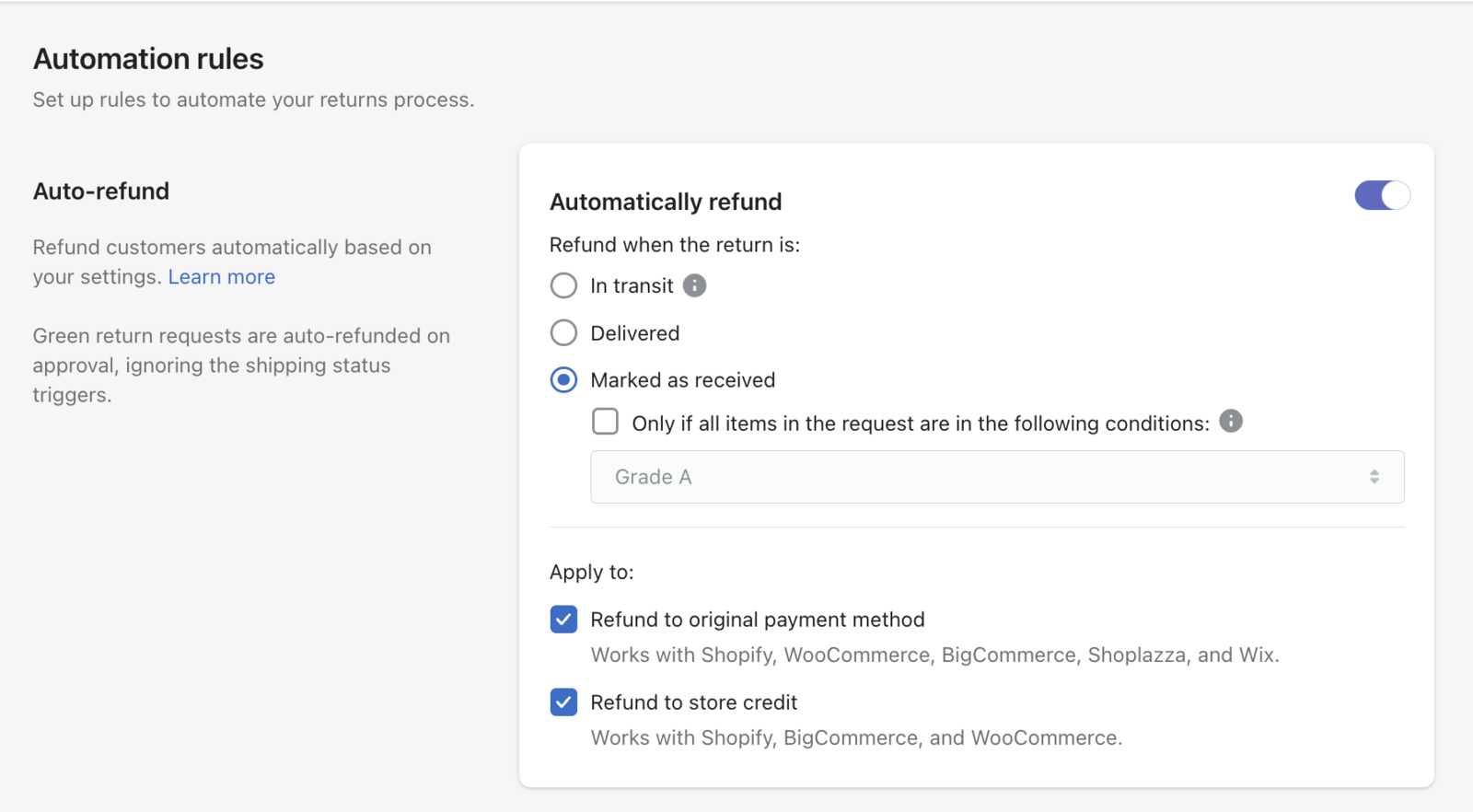
AfterShip Returns is a scalable platform for growing DTC brands. Returns sit inside AfterShip's shipping, tracking, returns, and warranty suite, and capabilities such as predicted delivery dates come with that stack rather than as separate purchases. That matters for the reason most platform decisions go wrong at this stage: returns data, tracking data and shipping data land on one data layer, so the system can tell you which delivery experiences are producing returns and what to change, instead of handing you four dashboards from four stitched-together point tools and leaving the join to you. AfterShip Returns publishes as 4.7/5 on the Shopify App Store. Coffee equipment brand Fellow cut its returns resolution time by 52% after moving to AfterShip Returns.

“The automation rules on AfterShip Returns are amazing.”
Stephen Davis Hernandez, Digital Product Manager
Read their story →2. Loop Returns: Best for Shopify-Native, Exchange-First Experiences
Swapping a size should not cost you the sale. For smaller fashion and apparel brands on Shopify, that is the whole returns problem.
Loop Returns is best for Shopify stores focused on product exchanges. Loop is a returns-first solution built for Shopify, and documents its integrations around that, including headless Shopify and TikTok Shop. Other commerce platforms are not documented publicly, which is the constraint to check first if you sell anywhere else. The same exchange resolutions are available on AfterShip, so the decision is about scope rather than capability.
Pricing is where the shapes diverge, and both vendors publish enough to compare honestly. Loop offers a shopper-funded route and a SaaS ladder; so does AfterShip. Checkout+ carries no software fee, and Loop's own help centre describes a rev share on the fees collected. It is also gated to merchants above 10,000 annual orders, which sits above the lower half of this article's persona, so a brand at 500 to 2,000 orders a month is choosing between paid tiers.
Those paid tiers are annual contracts. Loop's terms carry a 6% annual increase at the completion of each term and require 60 days written notice not to renew. Shop Now, Instant Exchange and Bonus Credit sit on Advanced, from $340 per month. Loop currently publishes as 4.6/5 from 442 reviews on the Shopify App Store.
For a single-channel Shopify brand whose priority is exchange velocity, Loop does the job it is built for. The commitment and the ceiling are worth pricing before you sign, particularly if a second store or platform is on your roadmap.
3. Happy Returns: Best for Brands Prioritizing Box-Free Drop-Offs
Some shoppers will never print a label at home. In categories where that friction decides whether they buy again, handing the item back in person is the whole proposition.
Happy Returns, a UPS company since late 2023 (PayPal sold the business to UPS), runs a Return Bar network its network page puts at nearly 10,000 locations nationwide, including 5,000+ The UPS Store locations. That physical footprint is the product.
Happy Returns offers a network of box-free, in-person drop-off locations. The scope conditions follow from that. The drop-off moment is Happy Returns and UPS branded at the Return Bar rather than yours. The network is US focused, and shoppers outside it fall back to ordinary mail returns, which are supported. Happy Returns states its focus is the largest enterprise merchants, and its Shopify listing publishes as 3.1/5 from 23 reviews.
For a DTC brand at this stage, the practical question is whether box-free drop-off is a reason your customers buy again, or a nice-to-have you would like to offer some of them. If it drives repeat purchase in your category, this belongs in your stack, and it can sit alongside a returns platform rather than replacing one. If it is one convenience among several, you will get more out of the platform that runs the whole returns operation. Our AfterShip vs. Happy Returns comparison breaks that down further.
4. Narvar: Best for Enterprise-Level Budgets and Complexity
At the top of the market, returns become a systems-integration problem. Narvar targets that tier, serving enterprise retailers with custom returns logic, multiple regions and an internal team to run the deployment. Its returns product is Narvar Shield, with its products named and sold separately.
Narvar publishes no pricing; buying means a sales process and guided implementation, and its own materials address large multinational retailers. That weight is the point for enterprises and overkill for a brand at this stage. Its Shopify listing publishes as 4.6/5 from 18 reviews.
The test is whether your returns problem is genuinely an enterprise one. If you are running returns across dozens of markets with bespoke rules per region, a team to own the deployment and a procurement process that expects a quote, Narvar is built for that. If your problem is that three people handle RMAs by hand and nobody can say why the returns come back, you would be buying an implementation ahead of the need, and starting a sales cycle to learn the price. Come back to Narvar when the complexity is real.
5. ReturnGO: Best for Configurable, Multi-Platform Returns
Selling on two platforms turns a Shopify-only returns tool into a dead end. ReturnGO is aimed at brands that want detailed return policies across more than one platform, without an enterprise sales cycle.
ReturnGO publishes its pricing with the volume attached, which makes it easy to model. Premium is $147 per month and includes 110 returns per month, at $1.25 per extra return; Pro is $297 per month and includes 300 returns per month, at $0.90 per extra return, per its Shopify listing. It covers variant and product-for-product exchanges plus Shop Now, supports multiple stores, and publishes as 4.8/5 from 364 reviews.
The trade-off is the flip side of the configurability. Policy depth means more decisions at setup and more to maintain once live, real work for a team without an operations hire. It also runs returns on its own, without the shipping, tracking, returns, and warranty suite that traces return reasons back to a delivery problem.
ReturnGO sits outside the head-to-head table below, which compares the four platforms competing on the full returns operation. If configurability across platforms is your binding constraint, shortlist it. If you expect returns, tracking and shipping to answer to one another later, weigh that before you commit.
Head-to-Head: AfterShip vs. Loop vs. Happy Returns vs. Narvar
Four platforms compete on the full returns operation, and the table below scores them against the five criteria set out earlier. A returns management software comparison is only useful when the criteria come from your operation, which is why Loop Returns vs Happy Returns is the wrong framing for most brands at this stage: the two solve different problems. At 500 to 5,000 orders a month, carrier cost and scalability are usually the two rows that decide a shortlist, because those are the ones that keep charging you after the implementation is finished. If email is still where your returns live, see what to move to when returns outgrow the inbox.
| Criteria | AfterShip Returns | Loop Returns | Happy Returns | Narvar |
|---|---|---|---|---|
| Automation & Rules Engine | Rules read return reason, product tag and order value, then auto approve, auto refund or exchange. | Workflows automate return policies from the Essential tier; reason-driven rules and keep-item flows supported. | Handles in-store, Return Bar and mail returns: exchanges, refunds, store credit with optional incentive bonus. | Custom returns logic configured during a guided implementation rather than self-serve setup. |
| Customer Experience | You build the flow: exchanges for other items, extra store credit as an incentive, instant exchanges. | Exchange-led portal. Shop Now, Instant Exchange and Bonus Credit sit on Advanced. | Box-free in-person drop-off. The Return Bar moment is Happy Returns and UPS branded. | Shield is the returns product, named and sold separately from Track, Notify, Promise and Assist. |
| Carrier Network & Costs | ~70-carrier auto-label pool; bring your own carrier accounts + pre-negotiated USPS & 40+ others. Own accounts on every paid tier: 3 on Essentials, 5 on Premium, unlimited on Enterprise. Keep negotiating your own rates as volume climbs while the default pool covers everything else, so a regional carrier can be added for one market without changing platform. | Loop-negotiated rates, or bring your own account via EasyPost. Its shipping page publishes 100+ worldwide carriers and negotiated rates across 33+ carriers. Loop's May 21 2026 article says the two cannot be used in tandem; its June 18 2026 article says each negotiated-rate carrier also supports BYOA. | Return Bar drop-off network. US focused, with ordinary mail returns supported outside it. | Advertises 1,000+ carrier integrations at network level; publishes no return-label carrier count and no pricing. |
| Data & Analytics | Return reason and sub-reason at item level, exportable, sitting on the same data layer as tracking. | Return reasons by product and SKU, with Return Insights outlier detection. | Dashboard tiles give aggregate returns analytics including reasons, return methods, refund types and exchanges. | Shield claims analytics on return reasons, product performance and customer behavior. |
| Scalability & True Cost | Grows from SMB to Enterprise: multi-store, multi-platform, your own carrier accounts, published pricing, one suite. | Shopify-centric. Paid tiers are annual, carrying a 6% annual increase and 60-day non-renewal notice. | Focused on the largest enterprise merchants. | Enterprise scale by design. No published pricing, so evaluation starts with a sales process. |
The Verdict: Which Returns Platform is Right for Your Brand?
AfterShip covers the same exchange ground: exchanges for other items, extra store credit as an incentive, instant exchanges. While Loop Returns may offer a slightly more opinionated, out-of-the-box flow for driving exchanges on Shopify, this comes at the cost of flexibility. AfterShip gives you the power to build your ideal returns flow - whether that's exchange-first, refund-focused, or a complex mix - while also giving you full control over carrier relationships and costs, which becomes critical as you scale.
AfterShip is not the cheapest option for a store doing 50 orders a month; at that volume a free tier serves you better. At 500 to 5,000 orders a month the economics invert.
Choose AfterShip Returns if...
- Return shipping is growing and you want to keep negotiating your own rates.
- You sell on more than one platform, or run more than one store, under one returns operation.
- You need to know why returns happen at item level, in data you can export.
- You expect returns, tracking and shipping to answer to one another rather than sit apart.
Choose an alternative if...
- Loop, if you are Shopify-only, exchange velocity is your single metric, and an annual commitment suits you.
- Happy Returns, if box-free in-person drop-off is what makes your customers buy again.
- Narvar, if you run enterprise returns across many markets with a team to own the deployment.
The mistake to avoid is the hardest to reverse. Don't choose a platform that solves today's problem but creates a new one in 18 months. Prioritize flexibility and a platform that can grow with you. For a wider field of vendors, see our ranking of ecommerce returns platforms before you commit.
Frequently Asked Questions
What is the difference between a returns platform and a 3PL?
A returns platform owns the workflow: the customer-facing portal, the policy rules, approvals, refunds, exchanges, labels and the reporting behind them. A 3PL owns physical custody: receiving the parcel, inspecting it, restocking or disposing of the item. The two are complementary rather than competing. Most brands at 500 to 5,000 orders a month already have somewhere for returned stock to land; what they lack is the software layer deciding what happens to each request.
How much do returns platforms typically cost?
Published pricing varies by model and volume, so compare the quota alongside the price. On annual billing, AfterShip Returns lists Essentials at $16 per month with 240 returns included per year and $0.50 per extra return, and Premium at $99 per month with 1,200 returns included per year and $1.00 per extra return. Loop lists Advanced from $340 per month. ReturnGO lists Premium at $147 per month and Pro at $297 per month. Narvar publishes no pricing.
What happened to Returnly?
Returnly built its reputation on an instant-credit model that fronted shoppers store credit toward their next purchase before the returned item arrived back. The business was acquired by Affirm in 2021 and the technology was folded into Affirm's wider product. Returnly shut down on October 1, 2023, and Loop was named as the migration partner for merchants who needed somewhere to go. It is no longer available to buy or evaluate.
Can I use AfterShip Returns if I am not on Shopify?
Yes. AfterShip Returns names Shopify, BigCommerce, Magento and WooCommerce on its pricing page, so a brand running a second storefront on a different platform can keep one returns operation across both rather than running two. That matters more than it looks at this stage, because the platform decision you make now is the one you carry into a replatform, a second brand or a new market.
Returns automation that enhances the returns and exchanges experience, reduces costs, and retains more revenue.
Book a demo