You are here because you are comparing Returnly and ShipTheory. That is a reasonable place to land, and it says something good about how you are thinking: you have found real breakage in two separate workflows, returns and shipping, and you want both of them fixed.
A Returnly vs ShipTheory shortlist usually lands on your desk under pressure. Your CFO wants the shipping line item down this quarter, your CX lead wants the returns experience fixed before peak, and both of them expect one answer from you. For the multi-channel view of the same choice, see where multi-channel brands go after Returnly.
There is a problem with the comparison itself. Returnly was a returns management point solution that shut down in October 2023. One of the two tools on your shortlist cannot be bought, integrated or evaluated today, and the merchants who had standardized on it did not get to choose when they moved off it.
Solving returns with one vendor and shipping with another buys you two contracts, two data models, two roadmaps you do not control, and two opportunities for a vendor to set your priorities for you. A ShipTheory vs Returnly comparison sizes up those two vendors against each other, and leaves the shape of the stack exactly as it was.
The question is not which point solution to buy. It is whether a stack assembled from point solutions holds up while you scale, and what it costs you on the day one of them goes away.
A unified platform fixes both problems in one system. That is the case this article makes.
Understanding Your Choices: The Specialist Approach
Your two problems are real and they are genuinely different. Returns are eating manual hours and margin. Outbound label generation is slow and expensive. Each has an established specialist, which is why your shortlist looks the way it does.
Returnly was a returns management specialist built around converting refunds into exchanges. Affirm acquired Returnly in 2021, in a deal announced on April 21 and worth about $300 million. On July 6, 2023, Affirm announced it would divest the business and said the platform would be sunset by early October. At that point roughly 1,500 merchants were running returns on it, and they migrated on Affirm's timetable rather than their own. Affirm's fourth-quarter fiscal 2025 shareholder letter still reports separately on the discontinued Returnly business.
ShipTheory is a shipping automation point solution. The UK-headquartered platform connects stores to carriers and prints labels automatically, and its published scope covers more than outbound:
- Rules-based label automation, available on all its accounts
- A returns portal on its Saturn, Jupiter and Cosmos tiers, switched on by request
- Incoming return labels supported by a subset of its carrier list
The Returnly and ShipTheory differences a shortlist would capture are differences of scope. One worked the reverse leg. The other works the outbound one.
The category definition makes the point. G2's returns management software category requires a qualifying product to track returned items from pickup to delivery and to integrate with ecommerce or related platforms. The standard already assumes the two halves talk to each other, so a returns tool blind to your outbound shipping data is working below the bar its own category sets.
Neither specialism is a hole in AfterShip's coverage. The outbound side is covered in how AfterShip stacks up against shipping automation platforms, and the reverse side in the best returns platforms for eCommerce in 2026. AfterShip runs outbound shipping and returns on the same platform and goes further on each: automatic return label generation across a wider carrier set, and a returns workflow engine that does more than route requests.
The Hidden Costs of a Disconnected Post-Purchase Stack
Two vendors cost you more than the two invoices show. The overrun sits in the gaps between them.
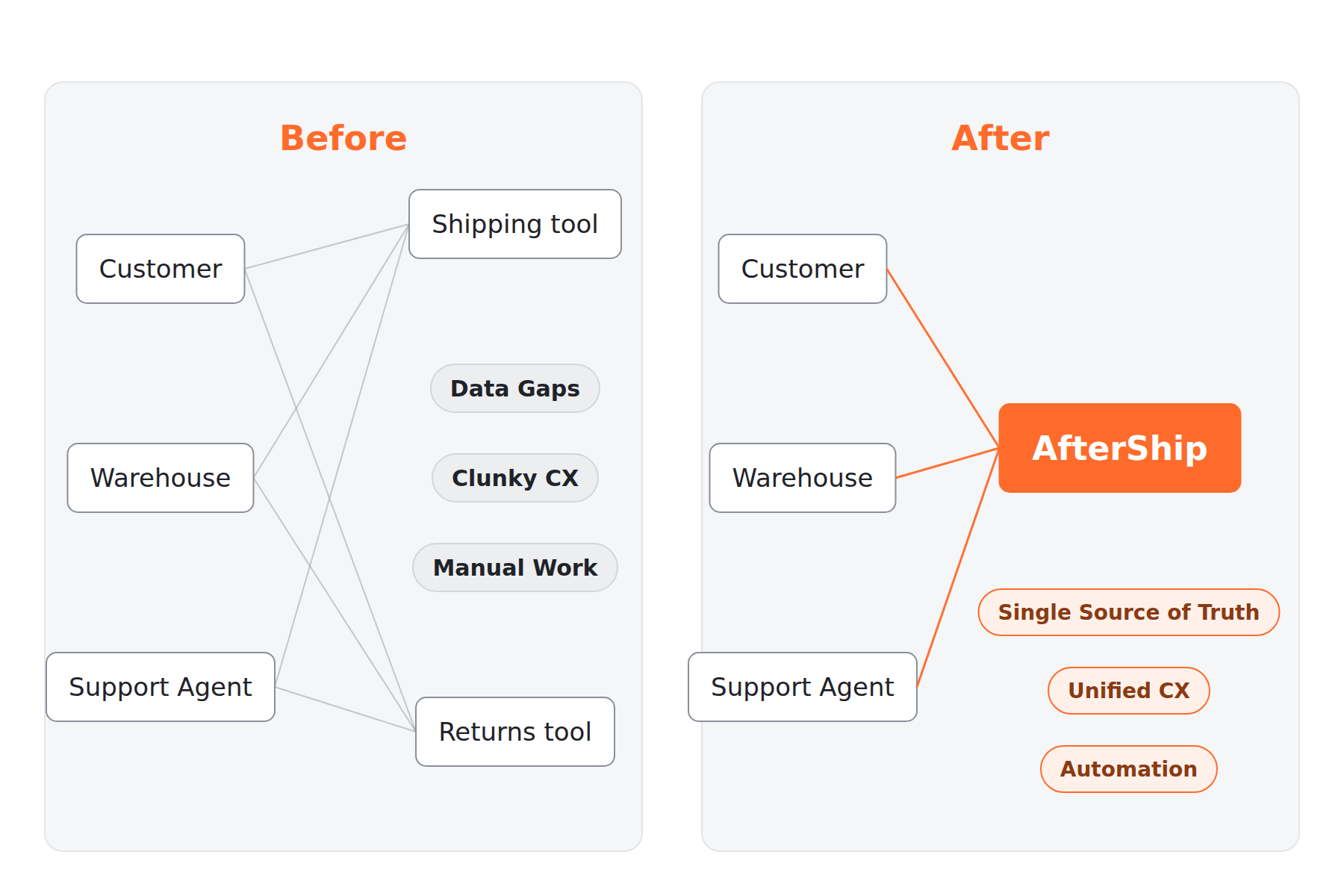
Data silos. Your shipping system knows the carrier, the service level, the transit history and the exception codes for every outbound parcel. Your returns system knows none of that. The return gets created as though the order had no delivery history, so the decision to approve it, route it or flag it is taken with half the record missing.
A broken customer experience. The shopper follows the outbound parcel on one branded page, then starts the return and receives an email pointing somewhere else that looks like a different company. The Baymard Institute's 2024 Order Tracking and Returns UX Benchmark assesses order tracking and returns together, as one continuous experience, and a two-vendor stack fails that standard by construction.
Operational drag. One customer question, two or three logins. Your agent opens the shipping tool for the outbound leg, the returns tool for the reverse leg, and reconciles the two by hand. The carrier rules your ops team spent a quarter tuning for outbound cannot be reused on the return, because the system that would apply them cannot see them.
Vendor exit risk, already realized. The Returnly half of your shortlist proved this one. When the platform was sunset, open returns could not be moved out of it into another returns system. Merchants absorbed a migration they had not planned, on a deadline they had not set, with customer returns still in flight.
Every one of those failures lives in the space between two vendors, which is the one place neither vendor is responsible for.
The Strategic Shift: Why Mid-Market Leaders Prioritize Unified Platforms
Consolidation is what scaling brands do once the workarounds stop scaling with them. At a thousand orders a month you can absorb the reconciliation by hand. At thirty thousand it becomes a headcount line. Put the outbound and reverse halves of the journey on one platform, let them share a record, and most of the overrun disappears along with the gap that produced it.
Goodr consolidated returns and warranty onto AfterShip, cutting support tickets by 60% and warranty claims by 75%.

“For us, AfterShip is a one-stop shop for delivery options and post-purchase support. We mainly use it for warranties and returns, where it helps with claims, processing, and customer service.”
Read their story →Each of those four failures has an inverse. A shared record gives the returns decision the delivery history it was missing. One branded journey means the shopper who followed the parcel out follows the return back in the same place. One workflow surface means your agent answers the question without reconciling two systems, and the carrier logic your team tuned for outbound is available on the return. One vendor means one contract, one renewal, and one roadmap you can plan around.
IMRG's study of 1,000 UK consumers puts returns at the center of satisfaction, conversion and loyalty, which moves the returns experience onto the revenue side of the ledger. It also makes the benefits of a unified commerce platform legible to a CFO, who reads retained revenue faster than saved clicks. For the wider category view, choosing the right post-purchase software for your growing brand walks through the mid-market field. AfterShip was built for exactly this shape, carrying the outbound and reverse halves of the journey on one stack.
AfterShip: Your Unified Command Center for Shipping, Tracking, Returns, and Warranty
AfterShip offers a unified platform for shipping, tracking, returns, and warranty. The products are separate subscriptions composed on the same platform, sharing one login and one shared data model, and that shared record is what turns four products into one workflow.
Follow a single order through it. AfterShip Shipping creates the outbound label, and on September 5, 2026 aftership.com/shipping listed 130+ carrier integrations for rates and transit times, with over 87 carriers supported for label generation. AfterShip Tracking then owns the journey your shopper sees, reading delivery status from 2,000+ carriers and driving the branded tracking page along with email and SMS updates. When the order comes back, AfterShip Returns takes the reverse leg, and aftership.com/returns showed automatic return shipping-label generation across 71 carriers when it was read on September 5, 2026. AfterShip Warranty handles the claims that arrive later, on the same platform and the same login, which keeps the fourth leg of the suite out of a separate inbox.
Teams shopping this category usually frame it as how to integrate returns management with shipping automation. On one platform that integration work is already done, because the same record carries both legs.
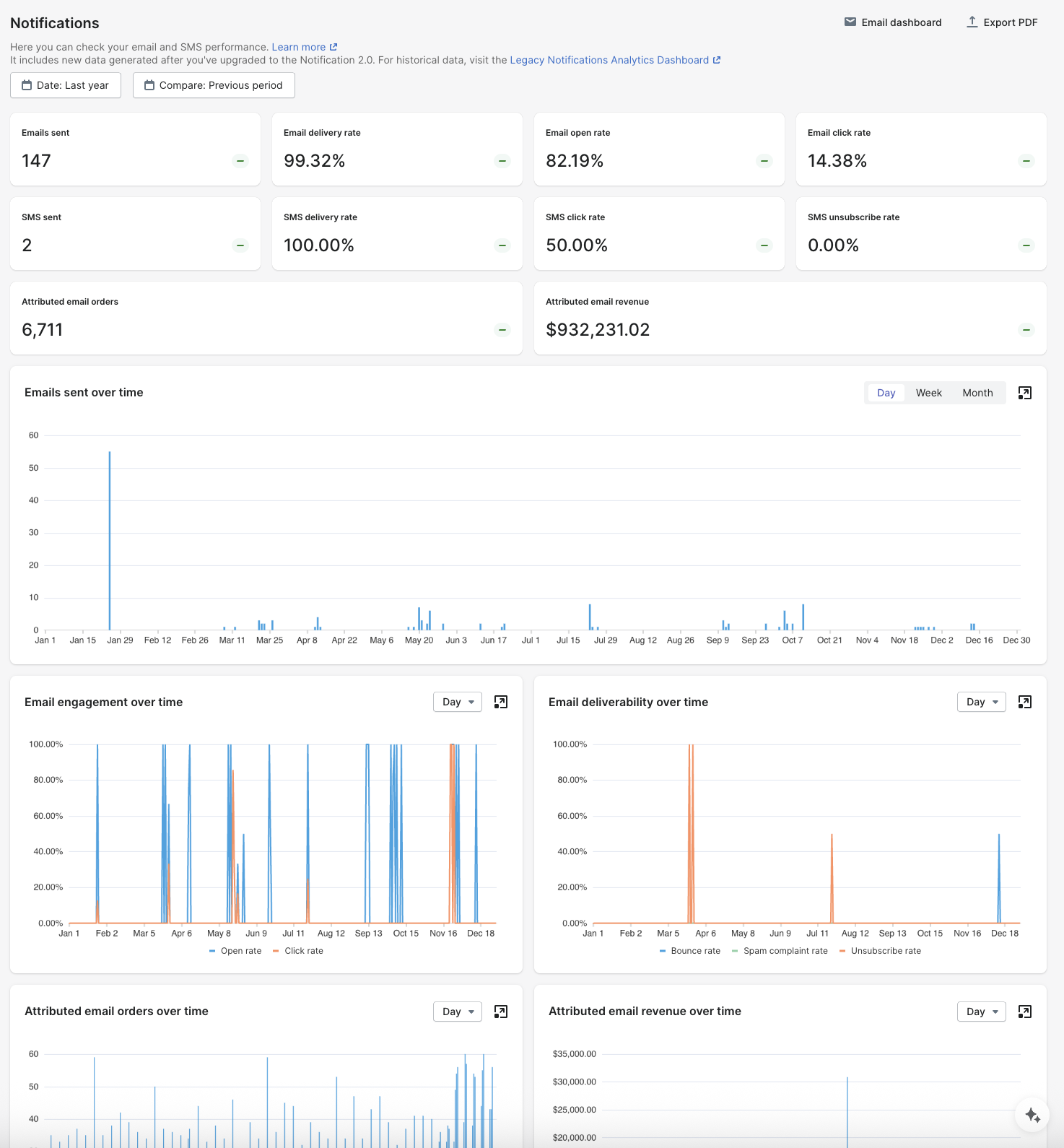
Behind that one login, each product reports on its own work, so the notification analytics view in AfterShip Tracking puts delivery-comms performance on a single screen.
Pricing is published on both routes. Return Care lets shoppers fund free returns by paying a small fee at checkout while AfterShip buys the label, and it is open to Shopify stores in the US, Canada, Australia and the UK, with a CSM arranging it in other markets. The direct route is listed on the same site: AfterShip Returns starts at $16 a month on Essentials and $99 a month on Premium at annual billing, with Enterprise quoted.
AfterShip carries all four, and the record follows the order across every one of them, from the outbound label to the warranty claim.
Simplify shipping and order fulfillment across Shopify, TikTok Shop, and your carrier network.
Book a demoHead-to-Head: AfterShip vs. Point Solutions Feature Breakdown
Six criteria decide this one, chosen because each changes when the outbound and reverse halves share a platform. For feature-level depth on the returns side, a direct comparison of AfterShip and Returnly goes further than one table row can.
| Criteria | AfterShip | Returnly (historical, shut down October 2023) | ShipTheory |
|---|---|---|---|
| End-to-End Customer Journey (Outbound + Return) | Outbound and return on one branded journey | Covered returns only; outbound sat elsewhere | Outbound plus branded tracking on 11 carriers |
| Operational Consolidation (Single Vendor, Shared Data Layer) | One vendor, one login, one shared data model | Was a returns vendor; shipping contracted separately | Shipping vendor; returns portal on higher tiers |
| Returns Automation & Label Generation | Auto return labels, 71 carriers; workflow engine, instant exchanges | Returns specialist; used 9 carriers via EasyPost | Portal on Saturn, Jupiter, Cosmos; 8 return-label carriers |
| Outbound Shipping Automation & Label Generation | 87+ label-generation carriers, plus rate and transit-time comparison | Outbound shipping sat outside its scope | Rules engine on all accounts; automated label printing |
| Carrier Network & Rate Optimization | 130+ shipping integrations; 2,000+ carriers for read-only tracking coverage | Offered return labels only, via EasyPost | Advertises over 70 carriers; rate rules cover UPS, FedEx |
| Analytics & Data Unification | Delivery, returns and warranty analytics on one data model | Reported on returns only | Shipment volumes, top services, destinations, daily email reports |
A dedicated point solution can go deeper in one narrow area; AfterShip covers the core workflows plus the strategic value of a unified data model and customer experience.
The Verdict for Unified Ops in 2026
The choice turns on how many of these problems you are solving at once, and how much you want them solving each other.
Choose AfterShip if you are fixing returns and shipping together.
- Both workflows run under one vendor, one login and one shared data model, so a return opens with the order's delivery history already attached
- Returns automation goes deep where the manual hours actually are: a custom workflow engine, instant exchanges, and bonus store credit
- You own the branded tracking journey your shopper sees, along with the email and SMS updates that carry it
Choose ShipTheory if shipping automation is your only open problem.
- Its rules engine is available on all its accounts
- Its carrier coverage is strongest in the UK
- Its pricing is published in full, tier by tier
Returnly is no longer an option. It was discontinued in October 2023, and the roughly 1,500 merchants who had standardized on it were forced to migrate, proving how costly a returns-only point solution becomes when the vendor's strategy changes.
You arrived comparing two point solutions. The stronger answer is one platform carrying both halves of the journey, and that is what AfterShip was built to do.
Frequently Asked Questions
Can I integrate Returnly with ShipTheory?
No. Returnly shut down in October 2023, so there is no product left to connect to. That is precisely the risk of stitching point solutions together: when one vendor exits, the merchants who built around it absorb a migration they never planned. A single platform removes the seam, because there is no integration left to lose.
Is AfterShip more expensive than Returnly or ShipTheory?
AfterShip is priced as a platform, and total cost of ownership is the comparison that matters. On one side sits one vendor, one contract and one data layer. On the other sit separate subscriptions, separate integrations to build and maintain, and no data hand-off between them. AfterShip publishes both of its commercial routes, so you can price the platform before you speak to anyone: consumer-funded Return Care, and standard SaaS pricing from Essentials through Enterprise.
Does AfterShip work with my carrier and ecommerce platform?
The answer splits by product. AfterShip Tracking supports 2,000+ carriers for read-only tracking. AfterShip Shipping offers 130+ carrier integrations for rates and transit times, 87+ of them for label generation. All major ecommerce platforms are supported, so the same record follows an order from checkout through delivery and back again.