Why Returns Software Pricing is Designed to Confuse You
You're trying to compare returns software, but the pricing is a maze. One buries an annual contract in a FAQ accordion, another publishes only a 'starting at' floor, and a third has a 'free' plan that feels too good to be true. How do you calculate what you'll actually pay at the end of the month? The answer is total cost of ownership, and the 'cheapest' option is usually the most expensive one.

Total cost of ownership includes software fees and operational costs. In returns that means the subscription line your finance team approves, plus everything it does not cover: the fee for paying by card, the escalator at renewal, the hours spent approving requests by hand, and the revenue that walks when a shopper gives up on your portal. A price you can read is not the same as a price you can predict. If you are earlier in the process and still building a shortlist, start with our ranking of ecommerce returns platforms.
Most of it comes down to how the information is arranged. Loop publishes its plans openly, and its pricing FAQ states, "Other Loop plans require an annual contract." That sentence sits inside a collapsed accordion, so you can read the page and still miss the commitment. Happy Returns goes further: its own pricing URL returns a not-found page, and the only surface publishing a price is its Shopify App Store listing. And our own ladder stops. AfterShip publishes every step up to 300 returns a month and names 400 as the point where Contact sales begins, so the boundary is on the page before you talk to anyone.
The 3 Common Pricing Models (and Their Traps)
Once you know what to add up, the next question is which shape of bill you are being offered. Three exist, and each hides its cost somewhere different.
The first is shopper-funded, free to the merchant. Both AfterShip and Loop offer an option like this: the shopper pays a checkout fee and the platform covers the label with no SaaS fee. Loop calls its version Checkout+. AfterShip Return Care runs on Returns Premium or higher alongside an AfterShip Protection subscription on the same store, is Shopify-only, and has US-only Protection onboarding today. Which post-purchase options genuinely carry no merchant fee, and where the cost simply moves instead, is unpacked in which returns and protection options cost the merchant nothing.
The second is a published subscription with quotas and overage. You buy a tier, it includes a return quota, and returns beyond it bill at a stated rate. The quota boundary is where this model bites. A season that runs hot pushes every additional return onto the overage rate, and some platforms move you up a tier automatically once you sit above the line. Misjudging your volume therefore costs more than the difference between two tiers, because you pay the overage first and the higher tier afterwards.
The third is quote-gated. Nothing useful is published and the number arrives from a salesperson. Happy Returns sits here. Until that call happens you cannot shortlist on cost, model the bill at your own volume, or put a figure in front of finance. That pushes the comparison to the end of your evaluation, and the time spent getting there is yours.
These are not opposing camps. AfterShip and Loop each appear in the first two. A fourth model, revenue share, does exist in this market. None of the three platforms compared here uses it. For platforms beyond these three, see our list of the top return management tools for retailers.
| Model | Who publishes it | Primary risk |
|---|---|---|
| Shopper-funded, free to the merchant | Loop Checkout+ and AfterShip Return Care. No software fee; the shopper's checkout fee funds the label. | You depend on shopper opt-in, and you give up some control of the fee your customer sees. |
| Published subscription with quotas and overage | AfterShip Returns: Essentials $16/month billed annually or $19 month-to-month, 240 returns a year, then $0.50 per extra return; Premium $99/month billed annually or $119 month-to-month, 1,200 returns a year, then $1.00 per extra return. Loop: Essential from $155/month, Advanced from $340/month, annual contract. | Misjudge your volume and you pay overage, or jump a tier. |
| Quote-gated or custom | Happy Returns: $500/month Plus on its Shopify App Store listing, shipping additional. AfterShip above its published ladder: Contact sales from 400 returns a month. | You cannot model the bill before a sales call. |
The three separate on how much of their model they publish. A floor with no ladder above it is a number you will meet later. AfterShip publishes the full ladder, the quota on every tier, and the rate charged on every return above it, which is the part you can put in a forecast.
5 Hidden Costs That Inflate Your Returns Bill
The subscription line is the smallest part of what returns cost you. Hidden returns costs include per-label fees and manual labor. That is the pattern across the returns market, and the five below are the hidden costs returns software buyers meet in practice, each one documented by AfterShip, Loop or Happy Returns.
- Card convenience fees. Loop charges 2.9% on paying subscription fees by card, and 3.75% on funding the Ship by Loop wallet by card. Both are documented in Loop's terms, updated 3 March 2026.
- Automatic escalators and exit windows. Loop's terms carry a 6% annual increase at each renewal and require 60 days of written notice not to renew. A three-year stay costs meaningfully more than the floor you were quoted.
- Manual labor. Every return a human touches is a cost your software was supposed to remove. Approvals, routing decisions and refund methods handled by hand scale linearly with order volume, which is why automation depth belongs in a pricing decision.
- Churn from a poor returns experience. NRF's 2025 returns research, conducted with Happy Returns, a UPS company, found 82% of shoppers weigh free returns when they choose where to buy. A clunky, unbranded portal from a free tool costs you those shoppers twice.
- Overage, tier moves and quote-gated ceilings. Loop's overage rates live in the Order Form. AfterShip has an Auto-Upgrade toggle that moves you up a tier, and its overage rates are published, so the move arrives with a number attached. Happy Returns quotes anything beyond its one listed plan.
In a five-star Shopify App Store review from February 2026, Akin Moto compared it with what they had run before: "Only at the early stages of using this app, but it seem very powerful and versatile, but with a very friendly user experience. Other apps I had tried were very difficult to manage in comparison."
2026 TCO Showdown: AfterShip vs. Loop vs. Happy Returns
Run the returns platform pricing comparison at your own volume. A store shipping 1,000 orders a month, at the 19.3% online return rate in the same NRF and Happy Returns research, is handling about 193 returns a month, about 2,316 a year.
| Criteria | AfterShip Returns | Loop Returns | Happy Returns |
|---|---|---|---|
| Pricing Model | Tiered subscription with published quotas and overage rates ($0.50/$1.00 per extra return); shopper-funded option (Return Care) also available | Subscription from $155/month on an annual contract, plus a free shopper-funded tier | Quote-based; the only published price is a $500/month 'Plus' plan on its Shopify App Store listing, with shipping charges additional |
| Cost Predictability | High below the published ceiling. The full ladder and the overage rates are public, with the last published slider step at 300 returns per month and Contact sales from 400 returns per month | Floors published, volume ladder quote-gated; 6% automatic annual increase; 60-day non-renewal notice | Low. Cannot be modeled from public surfaces without a sales call |
| Hidden Fee Risk | Published in advance: overage above quota is charged at the disclosed $0.50 or $1.00 per extra return, and optional team seats are listed at $10 or $12 per member per month. Nothing is quoted privately | Documented: 3.75% wallet card-funding fee, 2.9% subscription card fee, 6% annual escalator | Unquantifiable from public surfaces; per-item and shipping charges are quoted in the sales process |
| Reduces Labor Costs? | Yes (eligibility rules, routing, auto-approval from Essentials; advanced conditional workflows on Premium) | Yes (Workflows with customer/order/product/return conditions; exchange focus) | Yes (rule-driven automation and logistics focus) |
| Use Own Carrier Rates? | Yes. Connect your own carrier accounts, 3 on Essentials and 5 on Premium, or fall back to AfterShip's pre-negotiated rates on any plan, with the choice made per carrier rather than per account | Yes (own carrier accounts supported via EasyPost; Loop-negotiated rates optional) | Yes for mail returns (own carrier account rates); Return Bar logistics are part of the contracted service |
At about 2,316 returns a year that store sits above Premium's base quota and still inside the published range, where the slider re-prices the tier for the volume you enter, so the figure for that store is on the page. Loop Returns pricing shows a floor and keeps the volume ladder in a private Order Form. Happy Returns publishes one plan price and quotes the rest. Loop at enterprise scale is covered in a detailed comparison of enterprise returns platforms.
AfterShip is not the cheapest option on day one for a very low-volume store. That changes as volume climbs, and predictability is what does the separating.
AfterShip's automation rules read the order, the return reason, the item and the customer, then automate the decisions that carry the hidden manual labor cost: routing, approvals, and refund methods.
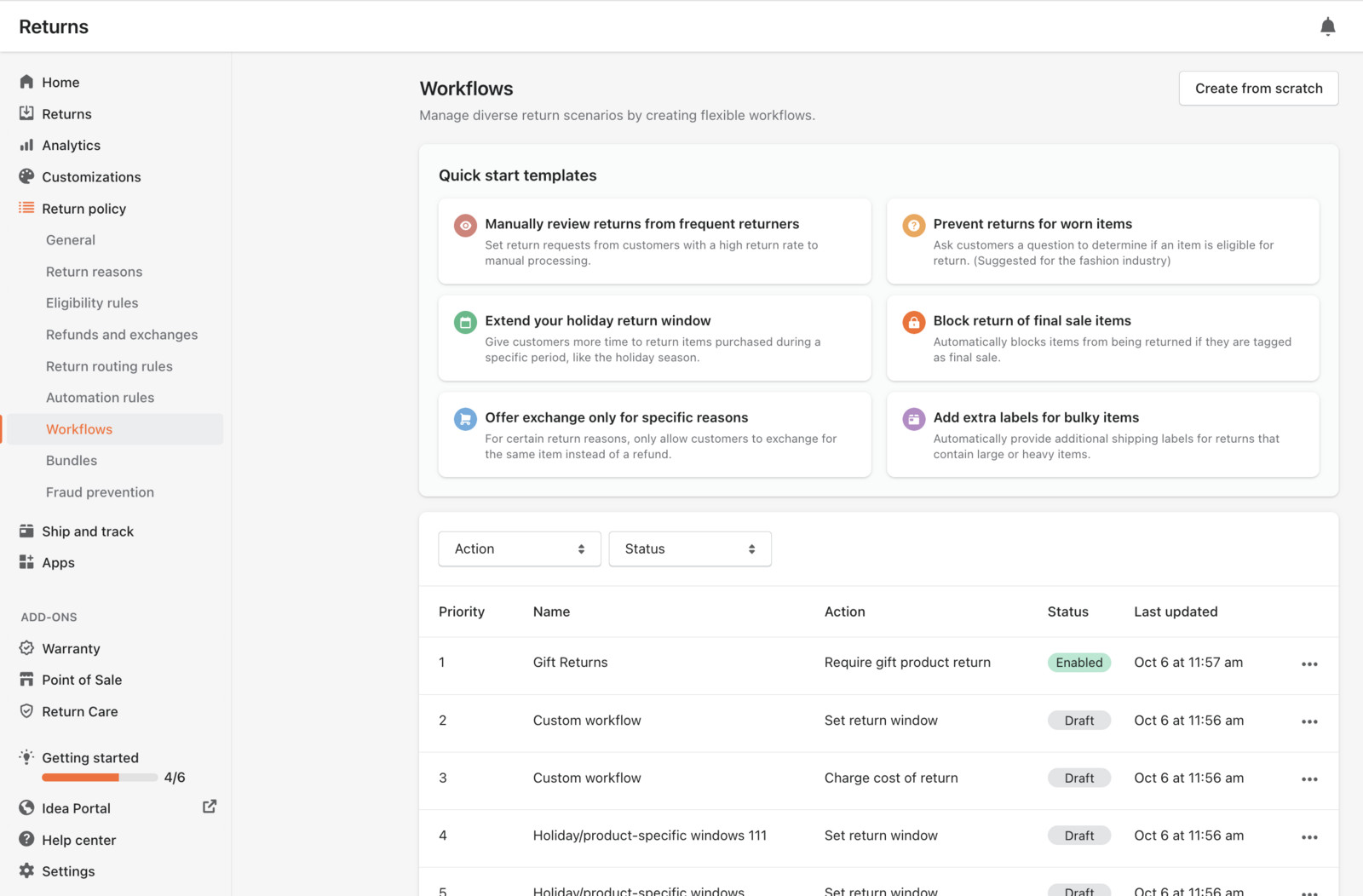
Of the three, only AfterShip publishes the whole slope: the ladder, the quotas and the rate on every return above them.
How to Calculate the ROI of Your Returns Software
You can size this before you sign anything, using your own numbers rather than a vendor's. The structure is simple: ROI equals cost savings plus retained revenue, divided by software cost. Every input on the top line is something you already measure. That calculation is what total cost of ownership returns management looks like in practice. If returns still run through an inbox, see our review of the software that automates it.
Cost savings has three drivers worth tracking separately:
- support tickets your team no longer answers, measured against your current ticket volume
- shipping cost, which moves with rate selection and with your own carrier accounts
- hours recovered from automation, measured as returns resolved without a human touch
Retained revenue has two:
- revenue held in the business when a return becomes an exchange
- lifetime value from shoppers who return once and buy again
Set your baseline against the latest eCommerce returns benchmarks before you run the numbers.
Keep the drivers apart. Adding them into a single savings figure produces a number nobody can defend in a budget meeting, and a driver with no measurement of its own stays qualitative until you have one. Run the arithmetic on your own store, then hold each vendor's pricing against it. AfterShip is the one you can complete that calculation against today.
The AfterShip Returns Promise: Predictable Costs for Scaling Brands
Predictability is what a growing brand is actually buying. AfterShip Returns is priced so a finance lead can model next year from this year's volume, before any conversation with sales.
Return Care sits alongside that for brands who want to offer free returns. Shoppers pay an opt-in fee, that fee funds free returns, the merchant keeps profits and control, and AfterShip takes no revenue share. It is available on Returns Premium or higher, with Protection on the same store.
Subscription models offer more predictable pricing than revenue sharing. That holds as a general point about pricing structures, whichever platform you are looking at.
Loop's onboarding and interface are often praised for being slick and Shopify-native for exchange-first workflows. That polish comes with an annual contract, an automatic annual increase, and a volume ladder you cannot see before you sign, while AfterShip delivers a comparably good branded experience for both returns and exchanges with the full ladder published.
Choose AfterShip Returns if:
- you want predictable, published pricing you can put on a P&L (tiered subscription with disclosed per-extra-return rates)
- you want deep automation that removes manual labor cost
- you want your own carrier accounts plus pre-negotiated rates
- you want a branded returns and exchange experience that scales from 1,000 orders a month to enterprise volume without a revenue-linked bill
Choose an alternative if:
- you are an early-stage Shopify brand hyper-focused on exchange velocity and comfortable accepting a shopper-funded or annual-contract model with card convenience fees and a 6% annual increase (Loop)
- in-person box-free drop-off is your single most important strategic requirement and you can absorb quote-gated pricing, where the only published price is $500/month plus shipping, on its Shopify listing (Happy Returns)
AfterShip Returns pairs that pricing with the automation depth that keeps the labor line flat as volume climbs.
Returns automation that enhances the returns and exchanges experience, reduces costs, and retains more revenue.
Book a demoFrequently Asked Questions
What are the hidden costs of returns software?
The subscription fee is only part of it. Card convenience fees can apply when you pay a vendor by card or fund a shipping wallet by card. Annual contracts can carry an automatic increase at each renewal and a written notice period for leaving. Manual approvals and routing consume staff hours that scale with order volume. A poor returns experience costs repeat revenue. Overage above a plan quota, automatic tier moves and quote-gated enterprise pricing complete the list.
How do returns software pricing models differ?
Three models are common. Shopper-funded plans charge the shopper a fee at checkout and cover the return label, with no software fee for the merchant. Published subscriptions sell a tier with a return quota and charge a stated rate on returns above it. Quote-gated pricing publishes little or nothing and arrives through a sales conversation. These are not exclusive categories, and a single vendor can offer more than one. Revenue share exists as a model in the wider market.
How do you calculate the ROI of returns software?
Divide the sum of cost savings and retained revenue by software cost, using your own figures. Cost savings come from support tickets avoided, shipping cost reduced through rate selection and your own carrier accounts, and hours recovered from automation. Retained revenue comes from returns converted into exchanges and from the lifetime value of shoppers who return once and buy again. Track each driver separately rather than combining them into a single number.
Which returns platform has the most predictable pricing?
Predictability depends on how much of the pricing a vendor publishes. AfterShip Returns publishes its full tier ladder, the return quota on every tier and the rate charged on returns above that quota, so a merchant can model the bill at any volume before speaking to sales.