Returnless refunds, also called keep-the-item refunds, close a return without paying to ship the item back. But a blanket 'keep it' policy is a fast track to margin erosion. The difference between saving money and losing it is the rules engine underneath: which items, which customers, which return reasons, which destinations, and how much of that you can change yourself without opening a support ticket. On that measure the platforms Shopify brands shortlist separate quickly, and AfterShip Returns documents its conditions across order, product, return and customer data.
Why a 'Dumb' Returnless Policy Is a Margin Killer
A flat keep-it threshold is not a policy. It is a published price for gaming your returns.
Set one value ceiling for every shopper and you have taught the entire customer base exactly where the line sits. Once that threshold is learned, working it is rational behaviour rather than fraud, and your highest-volume returners find it first. A flat rule gives you one lever, and that number has to be right for every SKU you sell.
The costs that follow are real but rarely itemised. You write off COGS on items that still had resale or refurbishment value, and a keep-it decision forecloses grading and resale in one step. You treat a first-time buyer and a serial returner identically, because the rule cannot tell them apart. And when you eventually tighten the threshold, the shoppers who learned the old one escalate, which lands as ticket volume rather than as a line in the returns report. The other lever is cutting the return rate itself, which a keep-it policy does nothing to move.
The underlying economics are what make the shortcut so tempting.
The cost to return a purchase averages 27% of the purchase price, which Optoro says erases as much as 50% of the sales margin (Optoro, Returns Unwrapped, November 2024).
Return cost as a share of price moves with category. What is uneconomic to recover in apparel can be worth recovering in electronics, and one ceiling cannot express both.
A key benefit of returnless refunds is reducing reverse logistics costs. That benefit only survives contact with your P&L if the decision is conditional.
The Anatomy of a Smart Returnless Strategy for 2026
Every platform in this comparison can refund without a return. What separates them is how precisely each one decides when to.
Smart returnless policies use rules based on product, customer, and order data. Score any returns platform against these four criteria before shortlisting it.
- Conditional logic: product value, SKU, and product tags, so a low-margin accessory and a 'final_sale' item follow different paths.
- Customer segmentation: order history, prior keep-item count, or customer tags such as VIP. LTV segmentation is the goal, and the documented customer tag is the mechanism that carries it.
- Return reason codes: triggering a keep-the-item outcome on the stated reason, because damage, poor fit, and changed-mind returns carry different resale economics.
- Geographic rules: shipping zones and destination country, where return freight often exceeds what the item is worth on arrival.
A policy earns its margin when the four are evaluated together in one rule, so item value, customer history, stated reason, and destination all have to agree before a refund clears. The same four criteria work as a filter when you review the top return management tools for retailers.
The 4 Best Returnless Alternatives for Shopify, Ranked
Four platforms can run a keep-the-item policy for a Shopify brand at this volume: AfterShip Returns, Loop Returns, Happy Returns and ReturnGO. Those are the returnless refund providers Shopify teams weigh when the policy has to carry conditions. Each one below is scored against the four criteria above, the same criteria that apply to comprehensive returns platforms for Shopify Plus more broadly. For the full platform ranking behind those four, see the best ecommerce returns platforms.
1. AfterShip Returns: Best for Granular Control & Data-Driven Brands
Green Returns is the named keep-the-item resolution in AfterShip's returns management solution, documented as refunding the order amount without collecting the package from the customer. It is available on Essentials, Premium and Enterprise. The custom workflow engine that automates it by condition sits on Premium and Enterprise.
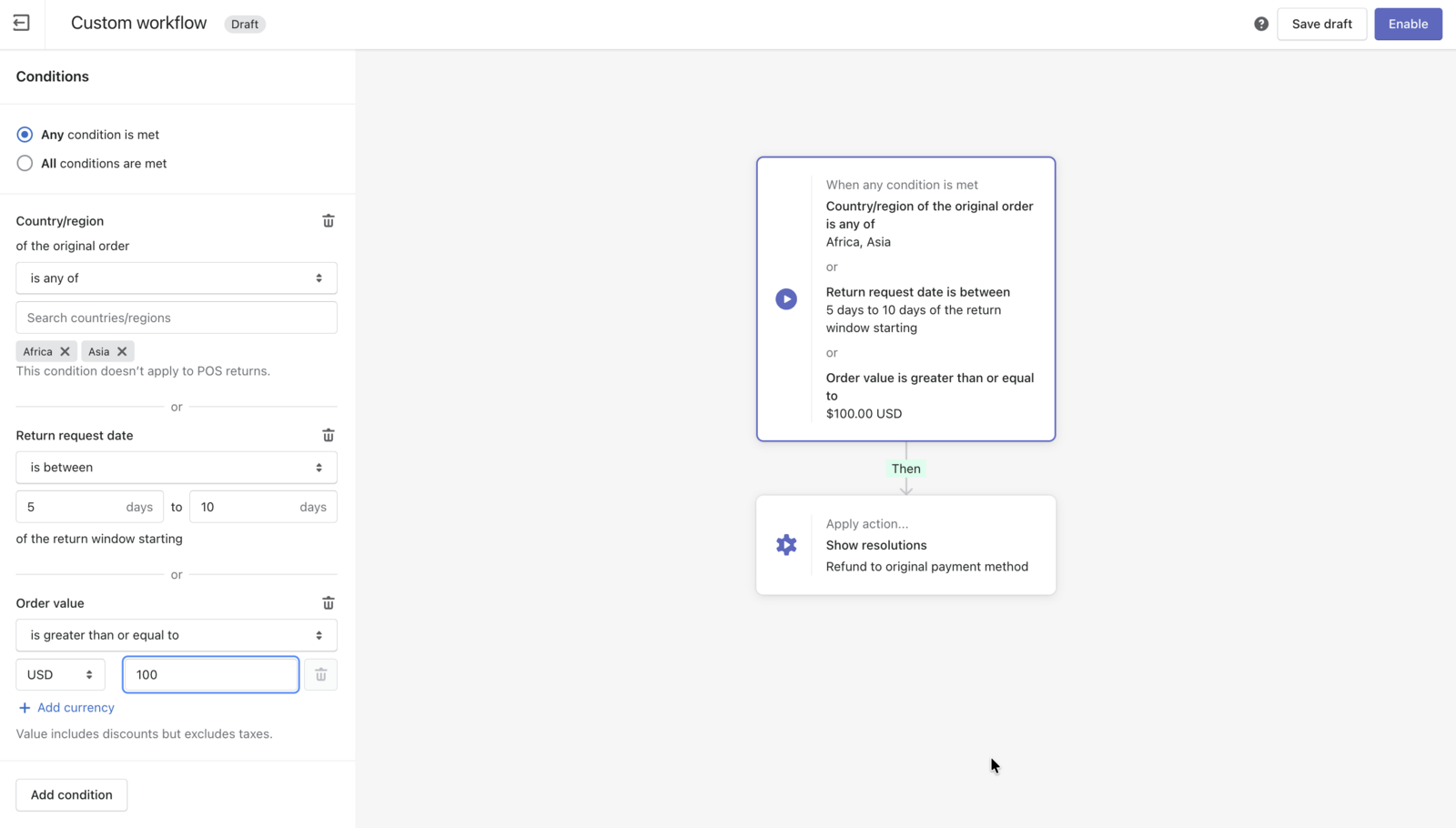
AfterShip Returns offers granular automation rules for returnless refunds. They fall into four families, covering order, product, return and customer data, which is what lets a rule read like an operations policy rather than a single threshold. Those families also drive resolutions that never begin as a return at all, which we cover in the same rule families applied to failed deliveries.
You can create a rule that offers a green return (keep-the-item refund) only for items under $15, for customers tagged 'VIP', who selected 'damaged' as the return reason, shipping from a specific country, and cap how many green returns each customer can use.
One mechanic to set up correctly: each workflow carries a single action, so the per-customer cap on green returns is built as its own rule alongside the one above rather than as a clause inside it. Both use the same green-return action, and both are configured without a support ticket.

“It's just so easy and effortless for me to check in on things and work with the returns portal. I don't have to worry about it anymore. There's so much time that I've saved so that I can direct my focus elsewhere.”
Nikolas Callas, Director of Operations
Read their story →You can also set up granular non-returnable rules, which mark items ineligible for return in the first place. That is a different lever from a keep-the-item refund, and the two belong in separate parts of your policy. Klaviyo and Gorgias both connect to the returns data.
The returns dashboard reports retained revenue and its ratio, return rates, return value, and label costs by carrier. Essentials starts at $16/month and Premium at $99/month billed annually, the same plans read $19 and $119 monthly on the Shopify App Store listing, and Enterprise is custom. Published prices show how a vendor sells. What this brand pays is a separate calculation: the Premium band is scoped to 100 to 400 returns a month, and a brand doing 10,000 to 50,000 orders a month sits above it. At that volume the conversation is an Enterprise quote, running the same documented condition set.
2. Loop Returns: Best for Exchange-First Shopify Native Experience
Two of the four criteria decide this comparison: conditional logic, and who is able to change it. Loop Returns & Exchanges makes its Keep Item action available on every tier including its free Checkout+ tier, configurable through return policy settings and as a workflow action. Its workflow engine documents conditions including prior keep-item outcomes and order country, and its fraud workflows can exclude Keep Item for returns it scores as high risk.
Both platforms run real returnless (keep-the-item) rules engines. AfterShip's advantage is depth and self-serve control: a longer documented condition set (28 documented workflow conditions against Loop's roughly 20), self-serve per-customer green-return caps and SKU-level exclusions where Loop requires contacting its account or onboarding team to configure SKU exclusions and its Limited Keep Item setting, and fraud-prevention controls that arrive at a lower price point.
Loop publishes Essential at $155/month and Advanced from $340/month alongside a free Checkout+ tier, and its pricing FAQ states that plans other than Offset Free and standalone order tracking require an annual contract. With Return Care, eligible US Shopify merchants pay no platform subscription fee - the shopper pays a small fee at checkout and AfterShip covers the return labels.
Seasonal policy changes come round every year, and on AfterShip the SKU exclusions and per-customer caps behind them stay editable by the merchant.
3. Happy Returns: Best for Brands Prioritizing In-Person Drop-Offs
Brands that want rule-based keep-the-item policies have to decide where that logic lives. Happy Returns runs a physical drop-off network of ~10,000 US locations, with fraud prevention built on in-person item verification; it does not publicly document returnless / keep-the-item automation. Brands typically pair that drop-off layer with a rules-engine returns platform, or choose one outright.
Its Shopify listing publishes one plan at $500/month, with shipping charges excluded and further charges billed outside the Shopify invoice. One structural consequence follows from the verification model: the item is checked when a shopper hands it over, and a returnless decision means it never arrives, so there is nothing to inspect. AfterShip Returns carries Happy Returns drop-off as one of its return methods on every plan, so the network stays available to a brand running its keep-item rules elsewhere.
4. ReturnGO: Best Self-Serve Alternative for Brands Replacing Returnly
If the platform you standardised on no longer exists, or your stack is not all-in on Shopify, a self-serve configurable portal is the practical starting point. ReturnGO documents a Keep the Item resolution, with auto-approval available on all subscription plans. Its eligibility engine spans order, customer, item and RMA-level conditions, including item cost.
Published plans start at $147 and $297 a month with per-plan return allowances, and the Shopify App Store listing showed 4.8 from 401 reviews when read on 4 September 2026.
A replacement platform has to carry the policy you already run. Map your existing conditions against its eligibility levels before you migrate, and against AfterShip's four condition families while you are there.
Comparison Table: Returnless Capabilities at a Glance
| Criteria | AfterShip Returns | Loop Returns | Happy Returns | ReturnGO |
|---|---|---|---|---|
| Rule Granularity | 28 documented conditions across order, product, return, customer data; green return is an action | roughly 20 documented conditions; keep-item action on every tier | No publicly documented keep-item rule engine | Eligibility engine spanning order, customer, item and RMA-level conditions |
| Analytics & ROI Tracking | Reports retained revenue and its ratio, return rates, value, label costs by carrier | Keep-item usage tracked via ASN report label-status filter | Analytics and reporting in the merchant dashboard | Dashboard covering resolutions, return reasons, return rates, processed value |
| Platform Integration | Klaviyo and Gorgias connect; Signifyd documented as an external fraud-scoring path | Shared helpdesk and marketing connectors | UPS-owned; integrates with returns platforms including AfterShip Returns | Integrations with shipping carriers, 3PLs, ERPs, helpdesks and APIs |
| Customer Experience | Green return offered in the branded portal, with auto-approval and per-customer caps | Keep Item message shown after request submission | Advertises box-free, label-free drop-off with refunds on in-person verification | Keep the Item or Donate shown in the portal |
No vendor here publishes a returnless-specific profit metric, so the analytics row records what each dashboard reports. On rule granularity, Loop Returns vs AfterShip is the closest comparison of the four: two platforms publish condition sets, ReturnGO publishes eligibility levels, and Happy Returns runs its logic at the drop-off point. Control is where the four separate. AfterShip's per-customer caps and SKU-level exclusions are merchant-editable, so a policy that changes twice a year does not queue behind an account manager. That editability is what to test in a demo when choosing the right eCommerce returns software.
The Verdict: Which Returnless Platform is Right for You in 2026?
The four platforms answer different questions, and only one of those questions is about rule depth.
Choose AfterShip Returns if:
- you need keep-item decisions conditioned on product, order, return and customer data together
- per-customer caps and SKU-level exclusions have to be editable by your own team
- fraud controls must be able to suspend the automation before a refund leaves
- shipping, tracking, returns, and warranty belong on one data layer rather than stitched-together point tools
Consider an alternative if:
- Loop: you are Shopify-only, exchange-led, and content to involve an account team to configure SKU-level keep-item exclusions
- Happy Returns: the physical drop-off network is the primary business driver and the keep-item logic will live in another platform
- ReturnGO: you are replacing Returnly or running a stack that is not all-in on Shopify and want a self-serve configurable portal
While Loop offers an excellent UI, AfterShip provides the industrial-grade power and flexibility that scaling brands require to manage complex rules across thousands of SKUs and customer segments.
A keep-item policy that has to satisfy all four criteria at once is the smart returns management Shopify brands need at scale, and it is the case AfterShip Returns is built for.
Returns automation that enhances the returns and exchanges experience, reduces costs, and retains more revenue.
Book a demoFrequently Asked Questions
How do you implement returnless refunds on Shopify?
Shopify natively supports refunding an order without creating a return, and its return rules cover return windows, who pays return shipping, restocking fees and final-sale items. Conditional keep-the-item automation is not part of that documented scope, so deciding which items and which customers qualify falls to an app. That is the layer a returns platform adds: a condition set, an action, and a record behind every refund.
How do you prevent fraud with a 'keep the item' policy?
Cap it and condition it. A Shopify keep the item policy is only as safe as the conditions wrapped around it. Frequency caps limit how many keep-item refunds one customer can take, customer tags and prior keep-item counts separate a first-time buyer from a repeat returner, and asking for a photo against a stated reason gates the rest. The control that matters most is a review step that can suspend the automation before money leaves. Appriss Retail's 2026 benchmark separates the two problems worth measuring: returns abuse runs at roughly 12% of returns, and fraud at roughly 2%.
Do returnless refunds increase customer loyalty?
No rigorous public study from 2024 or later isolates returnless refunds and measures incremental repeat purchase, so loyalty is not the case to build a policy on. The defensible case is unit economics: you avoid a return label, a receiving step and a restocking decision on items that would not have recovered their handling cost. Narvar reports that 90% of keep-item offers went to existing customers, though the page carries no methodology behind the figure.
What happened to Returnly?
Returnly, formerly owned by Affirm, shut down on October 1, 2023. Brands that used it have since migrated to platforms such as AfterShip Returns, Loop, or ReturnGO. If you are rebuilding that policy now, specify the condition set behind your keep-item rules first, and AfterShip Returns documents that set across order, product, return and customer data.