Your business is scaling, and now you are shipping freight. Your parcel stack is solid, but your tracking and customer experience are fragmenting: parcels get a branded tracking page, freight gets a raw carrier link. Do you bolt on more tools and fragment further, or consolidate the parts that actually create hidden costs? This is not just a technical choice. Let us calculate it. Banyan's claims are quoted from banyantechnology.com on 4 November 2026, AfterShip's from its own product and pricing pages on the same day.
The short answer, in each product's own nouns. Yes — Banyan's LIVE Connect rate-shops and quotes LTL in real time, and it connects to shipper ERP and TMS systems. AfterShip tracks freight and parcel shipments and runs the customer-facing experience on top of them. Brands hitting that inflection point often start with how mid-market DTC brands pick a multi-carrier platform before adding one more tool.
The Core Dilemma: Specialist Freight API vs. Unified Post-Purchase Platform
Banyan and AfterShip are not fighting over the same lane, so the real question is whether you need to book freight or only see it. Get that straight and the comparison stops being a feature bake-off and becomes a total-cost-of-ownership decision. Italian merchants comparing multi-carrier tools closer to home can start with the ShippyPro alternatives for growing stores (in Italian).
Banyan Technology is a specialist freight execution API. Its patented LIVE Connect platform offers, in Banyan's own words, "multi-mode rating and booking for Truckload (TL), Less-Than-Truckload (LTL), Final Mile and Parcel from a single interface", generates the BOL and POD paperwork, and audits freight bills on the back end. If your team needs to programmatically rate-shop an LTL lane and tender a load, that is the job Banyan is built for, and it is a genuinely deep one. Shippers with a heavier LTL mix usually compare alternatives for teams shipping both LTL and parcel before committing to one execution vendor.
AfterShip plays a different role. It executes parcel shipping across 130+ parcel carriers (this is its multi-carrier shipping software), and it provides one unified tracking and post-purchase experience across both parcel and freight. The distinction that matters for a freight-literate buyer: AfterShip tracks freight, but its published shipping product covers parcel label generation and rate calculation — freight rating, booking and BOLs are not in scope. There is no single API doing parcel and freight execution together here, and AfterShip does not replace Banyan. For a mixed-mode shipper, AfterShip runs alongside a freight tool, owning the parcel-execution layer plus the visibility layer that sits on top of every shipment, no matter the mode. On BigCommerce the same multi-carrier question narrows to a handful of apps, which we rank in the BigCommerce shipping apps built for multi-carrier volume.
That is why the decision reduces to one test. If you only need to see freight move and keep the customer informed, AfterShip consolidates the parts of the stack that quietly run up cost. If you need to book and audit freight in-house, you keep a freight execution tool and let AfterShip own parcel and visibility around it. At retail scale that same test narrows fast once you see which platforms enterprise retailers actually shortlist for cross-mode coverage. If you are still choosing the parcel layer itself, see how AfterShip Shipping compares with other shipping platforms.
Banyan vs. AfterShip: What Each Platform Actually Does
A flat feature checklist will mislead you here, because these two products own different layers of the stack rather than competing across the same one. Banyan owns freight execution across all four over-the-road modes it publishes, parcel included; AfterShip owns parcel execution plus unified visibility and post-purchase experience across every mode, including the freight a tool like Banyan books. Developers sizing the integration effort will recognise the same trade-off in what US developers use instead of Shippn for parcel APIs.
| Layer | AfterShip | Banyan (or similar freight API) |
|---|---|---|
| Parcel rate shop + label + manifest | Yes (130+ parcel carriers) | Yes — Parcel is one of four OTR modes on LIVE Connect |
| Freight rate / book / BOL / freight-bill audit | No | Yes (TL, LTL, Final Mile, Parcel) |
| Tracking visibility, parcel | Yes | Yes — real-time tracking for small-package shipping |
| Tracking visibility, freight (LTL/FTL) | Yes (2,000+ tracking network incl. LTL carriers and freight forwarders) | Yes — real-time across TL, LTL, Final Mile and Parcel |
| Branded end-shopper tracking page + WISMO notifications across all modes | Yes | Branded customer portals, aimed at shipper and 3PL clients |
| Post-purchase CX (returns, EDD, warranty) | Yes (separate AfterShip products) | Not part of the published LIVE Connect scope |
| Published carrier coverage | 130+ (labels) · 2,000+ (tracking) | No count published; "3x more carrier connections than any other provider" |
| ERP / TMS integration | Commerce and ops platforms listed on /integrations — Shopify, Salesforce Commerce Cloud, Magento 2, BigCommerce, Amazon, eBay, NetSuite (ERP), ShipStation; no TMS connector published | Yes (ERP and TMS) — published partners include NetSuite, Oracle, SAP, Infor, Microsoft Dynamics 365 Business Central, McLeod, MercuryGate (now part of Infios), Revenova, Turvo |
| Published cost | Essentials from $9/month (1,200 labels/year) · Pro from $69/month (24,000 labels/year, Shipping API included) · Enterprise custom — see AfterShip Shipping pricing | Not published; quote-based |
Sources: banyantechnology.com (About, API & Carrier Connectivity, Supply Chain Integrations) and aftership.com (/shipping, /pricing/shipping, /tracking, /integrations), all checked 4 November 2026. Banyan publishes no price list; AfterShip Shipping prices are the published plan rates on the edit day.
Read the division of labour above with one thing in mind: the two AfterShip carrier numbers describe two different jobs. 130+ parcel carriers is what AfterShip Shipping can print a label with; the separate 2,000+ carrier network is what AfterShip Tracking can follow, 2,000+ tracking carriers, up from the 1,000+ and 1,200+ still quoted in older comparisons, and AfterShip publishes that it adds up to 50 new carriers a month.
Calculating the True Cost of Ownership: Beyond the API Price Tag
The sticker price on an API is the smallest number in this decision, so judging the two tools on per-call cost will steer you wrong. Total cost of ownership is where a fragmented stack actually bills you, and it does so in three places: what your engineers spend keeping integrations alive, what your operations team loses jumping between systems, and what your customers cost you when their post-purchase experience falls apart. Each one is a cost center a fragmented stack creates and a consolidated platform is built to remove. Price the decision on those three, not on the cost of an individual API call, and the cheaper-looking option often turns out to be the more expensive stack. The same arithmetic decides renewals elsewhere, which is why buyers model what a Scurri replacement actually costs before the contract lands. Security reviews add their own cost to every vendor you onboard, and AfterShip documents its security and compliance practices in the AfterShip Trust Centre.
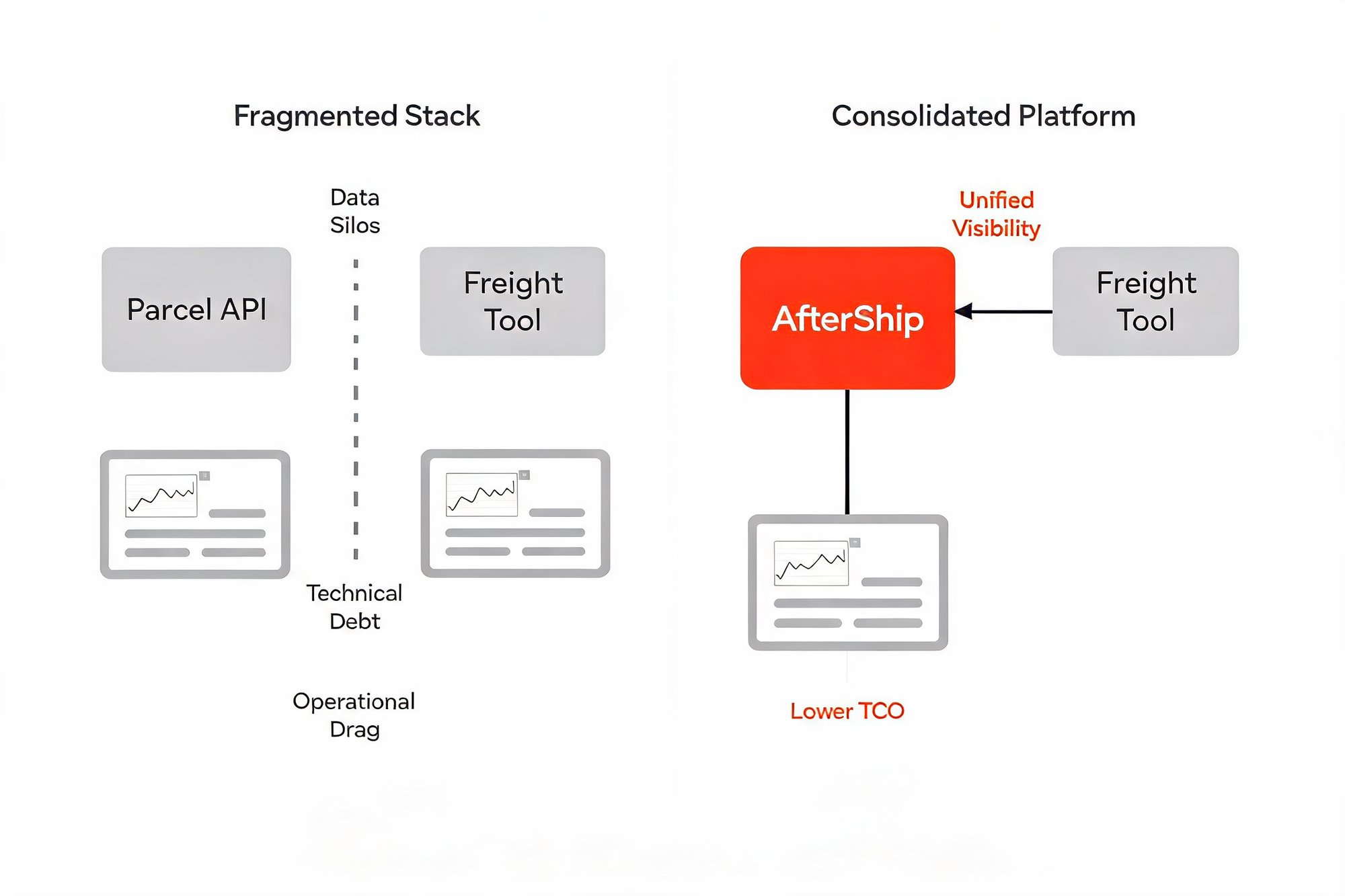
1. Developer & Maintenance Costs: The Price of Extra Integrations
Every integration you run is a standing liability, not a one-time build. On a fragmented stack the hidden bill looks like this:
- Separate API keys and credentials to provision, rotate, and secure for every parcel carrier and every freight tool.
- More documentation to read and keep current as each provider versions its endpoints on its own schedule.
- More points of failure: each connection is one more thing that can break, rate-limit, or silently change behavior in production.
- Double maintenance: when a carrier changes a field or a tool ships a breaking update, someone on your team owns the fix, every time, for every connection.
Here is where AfterShip earns a real but bounded win. Its single Shipping API consolidates the parcel layer, so 130+ parcel carriers sit behind one integration, documented in our comprehensive API documentation, that your engineers maintain once rather than carrier by carrier. Size the plan before you size the saving: the Shipping API (labels, rates, webhooks) is a Pro and Enterprise capability, with Pro starting at $69 a month, while the Essentials plan connects a single carrier account and does not include API access. On Pro or above, that is a genuine reduction in technical debt on the side of the stack where most of your shipment volume lives. Be precise about the limit, though: the freight integration covered above stays in place, so the "one API" consolidation is real for parcel and only partial overall, and an honest TCO model should book it exactly that way. What you should expect is one fewer integration to staff and patch, not zero, and that single subtraction compounds every time a parcel carrier ships a change you would otherwise have chased down by hand. The same build-or-buy arithmetic decides whether you maintain carrier connections yourself at all, which is the question behind tracking API vs building carrier integrations. Reliability belongs in the model too: on Enterprise, uptime and support response commitments are set out in AfterShip's Enterprise SLA.
2. Operational Drag: The Cost of Swivel-Chair Management
The expensive inefficiency is not booking freight in a freight tool; it is everything your team does after the shipment already exists. Picture a single order with a parcel item and an LTL item. The parcel side is rated and labeled in AfterShip. The freight side is booked in your freight tool, exactly where it should be. The drag begins the moment someone has to answer a simple question: where is this whole order right now? Retailers that merge parcels before the linehaul hit the same question earlier, which is why we rank parcel consolidation software for 3PLs and retailers.
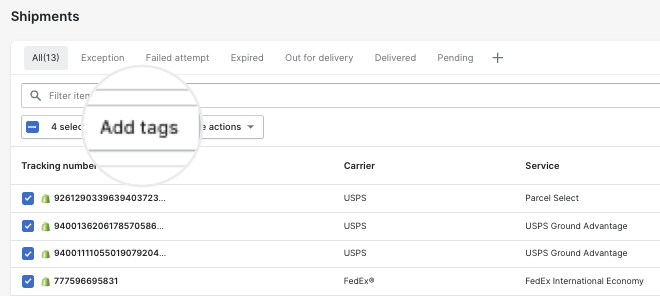
On a fragmented stack, answering that means one browser tab for the parcel carrier, another for the freight carrier portal, and a third for the helpdesk, with an agent stitching the story together by hand. That swivel-chair tax is what consolidation takes out. Because AfterShip tracks both the parcel leg and the freight leg, both shipments surface in one AfterShip view, against the same order and the same customer record. The freight is still booked elsewhere; what changes is that nobody has to leave one system, log into another, and reconcile two versions of the truth to see status. On a mixed-mode order that is the cost that repeats hundreds of times a week. When the LTL leg throws a delivery exception, the same unified view flags it next to the parcel status, so your team catches it before the customer does instead of after the angry email lands. European teams hitting the same reconciliation drag often review the carrier management tools Scurri users switch to before rebuilding the workflow.
3. Customer Experience Blindspots: The Cost of a Disjointed Journey
Your customer does not know or care whether their order moves by parcel or by pallet; they only want to know where it is. A fragmented stack answers that question two different ways, and one of them is bad: parcels get a clean branded tracking page, while freight gets forwarded to a raw carrier link that looks nothing like your brand and tells the shopper almost nothing. That gap is where confidence leaks out and "where is my order" tickets come in. Enterprise retailers facing that gap across regions tend to weigh enterprise delivery management options beyond Metapack when the tracking layer fragments.
AfterShip closes it by giving both modes the same treatment. Because it can natively track LTL carriers like TForce Freight, the freight leg gets the same branded tracking experience and proactive notifications as a parcel order, so the customer gets a consistent, on-brand status update whether the box arrives by van or the pallet arrives by LTL. Deflecting those status questions across modes is not a soft benefit; it shows up directly in support volume. After unifying its post-purchase experience on AfterShip, Mous cut WISMO inquiries by 54%, the kind of reduction that pays for the platform out of saved support hours alone.
The Unfair Advantage: How Unified Visibility Data Creates Better Decisions
The real payoff of one dataset is not a tidier dashboard; it is better carrier decisions you simply could not make while parcel and freight lived in separate tools. Because AfterShip tracks both modes in one system, our delivery and carrier performance analytics report on-time rate, exception rate, and transit time from a single dataset, broken out by carrier and by lane, and exportable to your warehouse. That surface is AfterShip Tracking analytics, and the point is performance, not spend. It tells you which carriers and lanes are letting you down across parcel and freight, so the decisions you make are about service quality rather than guesswork. Buyers who want that analysis pushed into carrier selection itself should read what Shipium's optimization layer actually delivers on the same data.
That is not a theoretical benefit. Mous used exactly this kind of cross-mode performance data to identify an underperforming carrier and switch it, cutting its lead times within Canada from two weeks to 2.5 days, an 82% reduction driven by the analytics rather than by the shipping itself. The data found the problem; the switch fixed it. This is also where the broader market is heading: top performing supply chain organizations are investing in artificial intelligence and machine learning (AI/ML) to optimize their processes at more than twice the rate of low performing peers (Gartner, February 2024). A single source of cross-mode truth is what makes that kind of optimization possible in the first place, and it is precisely the layer a fragmented stack can never assemble on its own.
Other Freight Execution Tools Buyers Compare with Banyan
Banyan is rarely the only name on the shortlist. Four others come up repeatedly, and each solves a narrower problem than "freight execution" implies. All four were checked on 4 November 2026.
- MercuryGate (now part of Infios). A full multi-modal TMS rather than a connectivity layer. Körber Supply Chain Software acquired MercuryGate and rebranded as Infios on 4 March 2025, and the product is now also marketed as Infios Transportation Management. Verdict: pick it when you are buying a transportation management system outright, not when you only need rating and booking connectivity bolted onto systems you already run — and note that MercuryGate is itself one of Banyan's published integration partners, so the two are often bought together rather than against each other.
- FreightPOP. Describes itself as "an AI supply chain software platform built for mid-market and enterprise shippers", covering parcel, LTL, FTL, ocean, rail and international air from one login across "1,500+ supported connections". Verdict: the closest like-for-like alternative when you want modes beyond over-the-road, including ocean and air, in the same rate-shopping screen; Banyan stays narrower and deeper on North American OTR.
- Go.MyCarrier. Built for one job: "an award-winning transportation management system (TMS) built specifically for LTL shippers", connecting shippers directly to their contracted carriers with no broker markup, free to start, and reporting 16.5k+ shipments booked daily. Verdict: the cheapest honest answer if your freight is LTL only and you already hold carrier contracts — but it does not cover parcel, so a mixed-mode shipper still needs a parcel layer beside it. If you want both in one place, start with parcel and LTL rate shopping in one place.
- ProShip. An enterprise parcel engine, not a freight API: it "supports over 250 domestic and international parcel and LTL freight services" and is SOC 2 Type II certified. It is also a published Banyan integration partner, which is the clearest signal of how the market divides the work — ProShip executes parcel, Banyan executes freight. Verdict: evaluate it when parcel volume and carrier compliance are the hard problem, and see the enterprise case for ProShip at scale for how it compares with AfterShip on the parcel side.
The Verdict: Who Should Choose Banyan vs. AfterShip in 2026?
The decision comes down to one honest question: do you need to book freight, or only to see it? If you only need to see it, consolidate on AfterShip for parcel execution plus unified visibility and customer experience, and let the fragmentation costs fall away. If you must rate, book, generate BOLs for, or audit freight in-house, run AfterShip for parcel and visibility alongside a freight tool like Banyan; the two are complementary, not interchangeable.
Where you land next depends on which buyer you are. An API-first developer sizing integration effort should start with what US developers use instead of Shippn. A mid-market DTC brand choosing its first multi-carrier layer should read how mid-market DTC brands pick a multi-carrier platform. An enterprise retailer weighing cross-mode coverage should see which platforms enterprise retailers actually shortlist. A shipper that wants parcel and LTL rate shopping in one tool should compare the alternatives for teams shipping both LTL and parcel. And a team buying an enterprise shipping engine for parcel volume should weigh the enterprise case for ProShip at scale. If the underlying need is a fulfilment partner rather than a carrier API, we rank those in the fulfilment options for growing dropshippers. If the gap is parcel optimization rather than freight booking, start from the competitors a 3PL weighs against Shipium.
Give Banyan its due, because the honest case is the convincing one. Banyan wins decisively on freight execution: multi-mode rating and booking across truckload, LTL, and final mile, dispatch, BOL and POD, freight-bill auditing, and deep TMS and ERP integrations. What AfterShip owns is the parcel-execution layer and the unified visibility and post-purchase experience across every mode, which is where mixed-mode shippers actually lose time and rack up WISMO. Banyan alone fits a pure, 100% freight operation with no parcel and no direct-to-consumer post-purchase needs; for everyone shipping a mix, the alongside model is the lower-TCO answer. If parcel and visibility are your bottleneck, AfterShip, one of the top multi-carrier parcel management solutions, is the layer worth consolidating first. If LTL is the larger share of your freight, the software field for it is surveyed in a 2026 guide to LTL shipping software. eBay is the proof at marketplace scale: on AfterShip Tracking, auto-correction makes 200,000+ additional packages trackable every month, has lifted the valid tracking rate by more than 20% since 2017, and has saved millions of dollars in reduced delivery disputes — a multi-carrier tracking and visibility result.

“With our other aggregators, we must identify issues with carriers and report them ourselves, which leads to a high operational load for our team. AfterShip has a superior monitoring system.”
Skyler Loth, Product Manager - Shipping Tracking
Read their story →Proactive shipment tracking that delights your customers, reduces WISMO tickets, and optimizes your delivery performance.
Get started freeFrequently Asked Questions
Does AfterShip Shipping have a freight API?
AfterShip Shipping gives you one parcel API across 130+ parcel carriers on the Pro and Enterprise plans, and AfterShip Tracking adds freight visibility on the same platform. It is not a freight execution API: rating, booking, labels and BOLs for freight stay in your freight tool. UK and EU brands comparing parcel platforms closer to home can start with our guide to the Shiptheory alternatives for UK and EU brands.
Does Banyan Technology offer real-time LTL rate shopping integrated with ERP and TMS systems?
Yes. Banyan's LIVE Connect platform publishes multi-mode rating and booking for Truckload, LTL, Final Mile and Parcel from a single interface, and its published integration partners include ERP systems (NetSuite, Oracle, SAP, Infor, Microsoft Dynamics 365 Business Central) and TMS platforms (McLeod, MercuryGate, Revenova, Turvo). Checked on banyantechnology.com, 4 November 2026.
Can I compare carrier rates, transit times and service levels across LTL carriers in one query with Banyan?
Yes — that is the core job LIVE Connect is built for. Banyan publishes real-time rating and booking across its carrier network and markets it as giving shippers more carrier connections than any other provider, though it publishes no carrier count to verify that claim against. Rate, transit-time and service-level comparison happens inside Banyan; what it does not do is give the end shopper a branded status page afterwards.
Banyan vs MercuryGate: which fits a shipper that needs ERP-integrated LTL rating?
If you want a connectivity layer that plugs LTL rating into the ERP or TMS you already run, Banyan is the narrower, faster answer. If you are replacing the transportation management system itself, MercuryGate (now part of Infios after the 4 March 2025 rebrand) is the full multi-modal TMS. They are not mutually exclusive: MercuryGate is one of Banyan's published integration partners. See the comparison of other freight execution tools above for how the four shortlist names divide the work.
What tool rate-shops parcel and LTL in one place?
Very few do both well. Go.MyCarrier covers LTL only; ProShip covers parcel plus a set of LTL freight services; FreightPOP covers parcel, LTL, FTL, ocean, rail and air. AfterShip Shipping rate-shops and labels parcel across 130+ carriers and does not rate freight. If one screen for both is the requirement, start with our guide to parcel and LTL rate shopping in one place.
How is Banyan priced?
Banyan does not publish a price list. Pricing is quote-based and arranged through its sales team — checked on banyantechnology.com, 4 November 2026. For comparison, AfterShip Shipping publishes its plans: Essentials from $9 a month (1,200 labels a year), Pro from $69 a month (24,000 labels a year, Shipping API included) and Enterprise custom, on the AfterShip Shipping pricing page.
How many carriers does AfterShip support for shipping, and how many for tracking?
They are two different numbers for two different jobs. AfterShip Shipping generates labels and rates across 130+ parcel carriers. AfterShip Tracking follows 2,000+ carriers worldwide — postal services, last-mile couriers, 3PLs, freight forwarders and LTL carriers — and publishes that it adds up to 50 new carriers a month. Older comparisons still quoting 1,000+ or 1,200+ tracking carriers are out of date.
Can AfterShip track freight booked in Banyan?
AfterShip tracks freight shipments from the LTL and FTL carriers in its 2,000+ carrier network, whoever booked them, so a pallet tendered through a freight tool still lands on the same branded tracking page and in the same notifications as a parcel order. There is no published Banyan-specific connector between the two products, so the join happens at the carrier and tracking-number level rather than through a direct integration.
Can I use AfterShip just for freight?
Yes, for the visibility and post-purchase half of it: branded tracking, proactive notifications and delivery analytics on your LTL and FTL shipments, in the same view as parcel. Freight rate-shopping, booking and label generation stay with a freight execution tool, as covered above.
What LTL carriers does AfterShip support?
AfterShip Tracking follows major LTL carriers, including TForce Freight (the former UPS Freight, sold to TFI International in 2021) and Estes, as part of its 2,000+ carrier tracking network, and is always adding more. The full list is published in AfterShip's supported couriers directory. That coverage is what lets a mixed-mode shipper give every shipment, parcel or pallet, the same branded tracking page and the same proactive notifications.