Why Your EDD Tool Is Failing Your Support Team
You invested in Fenix Commerce, but your support team is still drowning in WISMO. Those where-is-my-order tickets keep arriving even though the estimated delivery date on your product page looks sharp and the checkout promise lands clean.
Here is the uncomfortable part: an accurate date at purchase is only half the job. The moment a package ships, that promise lives or dies on the tracking page and the notifications that follow it. When those go quiet, the customer does the predictable thing. They open a ticket. For the returns side of the same shortlist, see the returns platforms we rank for 2026.
This is not a knock on Fenix. It is a capable tool for what it was built to do. The problem is structural: a delivery date is a system output, not a single feature. When the estimate, the tracking page, and the proactive updates do not move as one, a routine carrier delay turns into a support spike.
The stakes are concrete. WISMO already accounts for 10 to 25% of all support contacts at most brands, and the cost compounds when an estimate slips and no follow-up goes out.
So the real question for anyone weighing Fenix Commerce alternatives is not "whose date is more accurate." It is "which system keeps the promise after checkout." That reframing is what separates a point solution from a platform.
The 4 Pillars of an EDD Solution That Actually Reduces Costs in 2026
If accuracy is an outcome of the system, then evaluate the system, not the headline percentage. Four pillars decide whether an EDD tool actually lowers your support load.
- ML accuracy from global carrier data. A prediction is only as good as the shipment history behind it. Look for a model trained on real carrier performance across routes, not a static rules table. AfterShip's AI EDD draws on 101 major carriers for its delivery predictions, on a platform that tracks 1,700+ carriers overall.
- Carrier and fulfillment coverage. Your estimate has to reflect reality across every lane: multiple carriers, multiple warehouses, and the specific origin a SKU actually ships from. A store-wide default date is a guess. A lane-specific date is an estimate.
- Integrated CX. The EDD, the branded tracking page, and the email and SMS notifications should run off one model. When the date shifts in transit, the tracking page and the next notification update on their own, before the customer thinks to ask.
- API-first and extensible. A date is only useful where your customers and agents already are. Look for native hooks into tools like Klaviyo for marketing flows and Gorgias for support, so the EDD travels into the rest of your stack.
Notice what these pillars share. Not one of them is "a bigger accuracy number." Each is about whether the date stays trustworthy through the entire post-purchase journey.
Score any Fenix Commerce alternative against these four, and the decision stops being a feature debate. It becomes a question of how much of the journey a single platform can actually hold together.
3 Fenix Commerce Alternatives for True Delivery Accuracy
If accuracy is a property of the whole system, the shortlist of Fenix Commerce alternatives comes down to three honest paths. You can adopt an integrated post-purchase platform (AfterShip), step up to an enterprise suite (Narvar), or build it yourself on shipping APIs. Each solves the problem from a different angle, and each fits a different kind of team.
1. AfterShip: The Integrated Post-Purchase Platform
Start with why the date is accurate, because the method is the product. AfterShip's AI EDD is trained on more than 4.4 billion shipments across 101 major carriers, so it predicts from how lanes actually perform, not from a flat handling-time rule.
The model reads a rich set of signals for each order: carrier service level, origin warehouse and destination down to the zip, historical transit patterns, weather and traffic, and the processing time your own operation adds before a label is even scanned. That signal richness is what lets it commit to a specific date instead of a vague window.
It also keeps working after checkout. This is a post-purchase model, so it re-predicts while the package is moving and revises the estimate the moment a lane slows down. Depending on confidence, it can show a single firm date or a date range, configurable in the AI EDD settings.
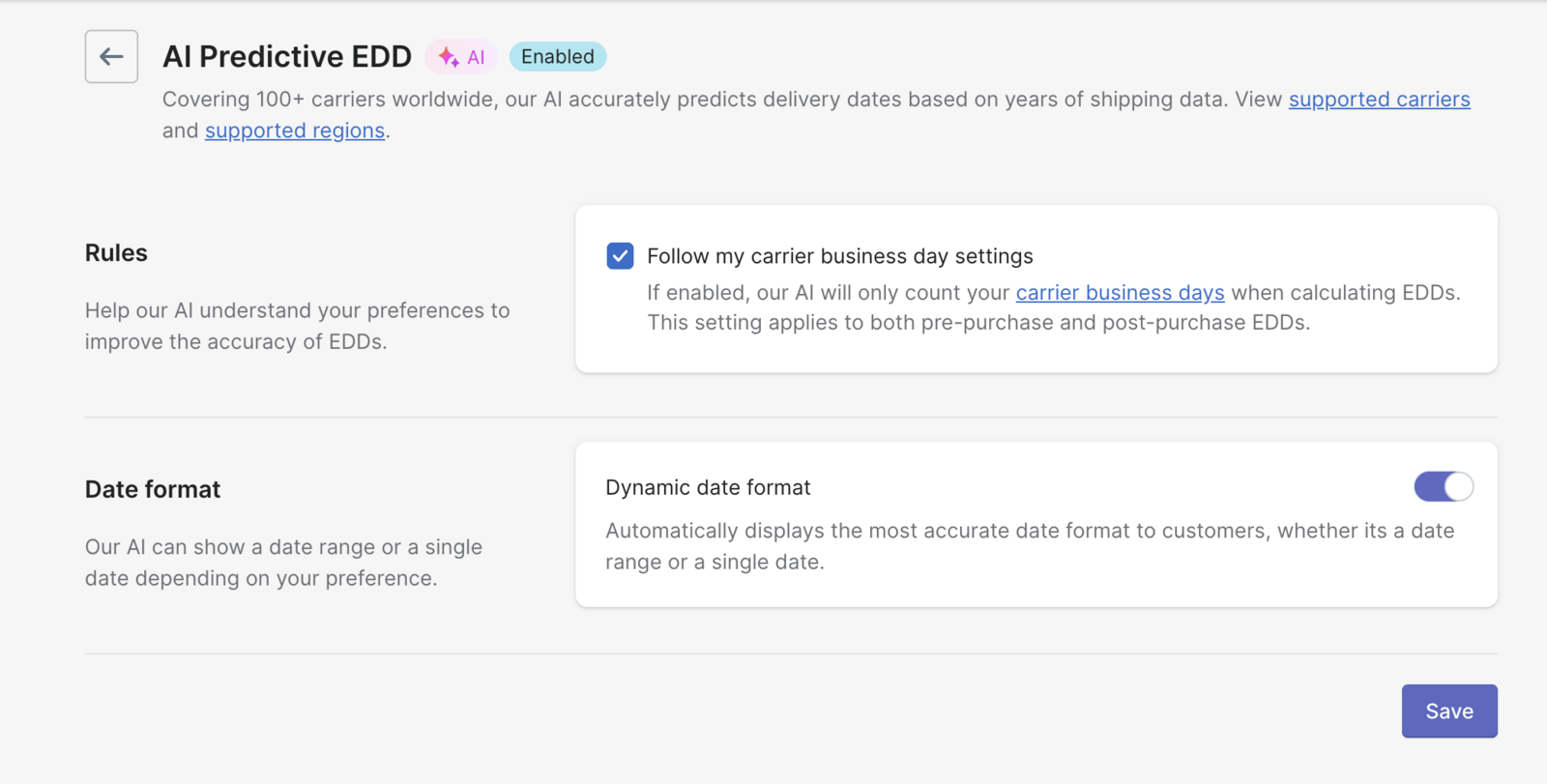
The figures carry real meaning once you know the method behind them. AfterShip publishes up to 95% EDD prediction accuracy, and coverage matters as much as the headline number: an AfterShip estimate reaches 80%+ of deliveries, against the sub-40% typical of carriers' own dates. That is more than double the coverage, and what the date is wired into is what decides whether it holds.
That wiring is the next advantage. One model renders the same estimate on the product page, at checkout, on the branded tracking page, and inside every email and SMS notification. That pre-purchase clarity matters: Baymard finds 21% of shoppers abandon checkout when delivery is too slow, and 39% over unexpected costs. When the date shifts in transit, the tracking page and the next message update on their own, so the customer sees the change before they think to ask.
Here is the real differentiator, and it is not an EDD feature at all. AfterShip runs the delivery estimate on the same data spine as Returns, Warranty, Shipping, and Protection. Fenix concentrates on the pre-purchase estimate and delivery tracking layer, while AfterShip lets one post-purchase record follow the customer from the delivery promise through a return, an exchange, or a warranty claim. That is carrier coverage plus a full suite running off shared data, which is exactly what a brand scaling past a point tool grows into.
The payoff shows up in support and in revenue. Mous cut its WISMO contact rate by 54%, from 12.9% to 5.9% across more than a million monthly shipments, after consolidating its post-purchase stack. On the revenue side, SpeedyTire saw 24% more repeat sales, a 21.2% drop in returns and refunds, and a 65.2% SMS opt-in rate once delivery expectations were set and then kept.
For a switching decision, independent proof carries more weight than anything we say about ourselves.
2. Narvar: The Enterprise-Focused Suite
Narvar is the credible enterprise peer on this list. By its own marketing, Narvar reports 95%+ EDD accuracy, 1,000+ carriers, and 1,500+ brands, many of them large retailers with complex logistics, and it cites conversion gains of up to 5% on its Promise product and a 50% higher conversion rate in its Sonos case study. Those are vendor-reported figures, not independently audited.
For a mid-market DTC brand, the question is fit, not capability. Narvar's strength is depth for enterprise programs, and its rollouts tend to be API-heavy projects scoped for that environment. AfterShip aims at faster time-to-value for the 1K to 50K orders-a-month brand: a pre-trained model and a Shopify App Store install get you to an accurate date sooner, without a long integration runway. If you run an enterprise program with a dedicated logistics team, Narvar is a serious option. If you are scaling and want speed, the agility tilts toward AfterShip.
3. In-House Solution (via EasyPost / ShipStation API)
Building it yourself is tempting because the raw ingredients exist. EasyPost markets its Luma AI as delivering a “23% increase in delivery accuracy” while auto-selecting the best-value label across 100+ carriers, so this is not a question of whether you can get an ML-based date. The question is everything you would have to build around it.
The catch is everything around the model.
Warning: A DIY EDD only looks cheap until you price the whole system. You own perpetual model retraining and exception handling, you have to map the estimate to every lane and shipping origin you run, and you still have to build the display layer on the product page plus the entire notification pipeline yourself, the parts customers actually see.
Framed as total cost of ownership, the build rarely wins. The engineering you would spend rebuilding global coverage, ongoing maintenance, and the customer-facing layer is the same work an integrated platform has already done. That opportunity cost, not a missing algorithm, is what sends most teams back to a packaged solution.
Head-to-Head Comparison: AfterShip vs Narvar vs Fenix
Put the three side by side on the four pillars and the picture gets clear fast. Fenix earns full marks where it competes: it offers an AI-based EDD, a branded tracking page, and proactive email and SMS notifications. The separation shows up in how much of the post-purchase journey each platform actually covers.
| Pillar | AfterShip | Narvar | Fenix |
|---|---|---|---|
| ML accuracy (global carrier data) | ML EDD trained on 4.4B+ shipments across 101 major carriers; up to 95% EDD prediction accuracy, with an estimate on 80%+ of deliveries versus the sub-40% typical of carriers | ML-based EDD; accuracy figures are self-reported | ML-based EDD for pre-purchase delivery estimates |
| Carrier and fulfillment coverage | 1,700+ carriers tracked (101 major carriers in the AI EDD model), plus multi-warehouse and multi-origin, lane-specific estimates | 1,000+ carriers | Covers the delivery and tracking layer |
| Integrated CX (EDD + tracking page + notifications) | One model drives the EDD, branded tracking page, and email/SMS notifications, self-updating in transit, on a shared post-purchase data spine that also powers Returns, Warranty, Shipping, and Protection | Enterprise post-purchase suite (tracking and returns) | AI EDD, branded tracking page, and proactive email/SMS notifications, focused on the pre-purchase EDD and delivery tracking layer |
| API-first / extensible (Klaviyo, Gorgias) | API-first, with native Klaviyo and Gorgias so EDD and tracking data flow into marketing and support tools | API-driven enterprise integrations (heavier implementation) | Integrates at the delivery and EDD layer |
Read down the columns and the gap is scope, not capability: Fenix is strong at the delivery layer, while AfterShip extends the same EDD across a full post-purchase suite and a wider carrier set.
The Verdict: When to Choose AfterShip
The "best" tool depends on how much of the journey you need to own. So here is the verdict by brand profile, without the hedging.
Choose AfterShip when your plans run past the delivery date itself:
- You want to unify the whole post-purchase journey, with Returns, Warranty, Shipping, and Protection on one data spine.
- You ship globally across many carriers, or run multiple warehouses and shipping origins.
- You want the EDD flowing into the tools you already run, like Klaviyo and Gorgias.
- You are scaling past a point tool, somewhere in the 1K to 50K orders-a-month range and climbing.
Now the honest part. If all you want today is a pre-purchase EDD and delivery tracking, a single focused provider like Fenix is genuinely simpler, and there is nothing wrong with starting there. The catch is that the simplicity becomes a ceiling the moment you need returns, warranty, or global multi-carrier running off the same customer record. Narvar is a fit question rather than a default at the enterprise end: it suits programs that already have a dedicated logistics team and the appetite for a heavier, API-led rollout, and AfterShip serves enterprise brands too, on a shorter runway. For most mid-market brands outgrowing a point tool, AfterShip is the lowest-risk way to get accurate dates and the rest of the journey onto one platform.
AI-powered shipping time estimates that drive conversion, set customers' expectations, and offer peace of mind.
Book a demoFrequently Asked Questions
Is AfterShip's EDD more accurate than Fenix Commerce's?
Both platforms run machine-learning models, so this is not a simple yes. AfterShip's edge is method and consistency: its AI EDD trains on more than 4.4 billion shipments across 101 major carriers and re-predicts in transit, and AfterShip publishes up to 95% EDD prediction accuracy with an estimate on 80%+ of deliveries, against the sub-40% typical of carriers' own dates. The larger difference is that the same date stays consistent across the product page, checkout, tracking page, and notifications.
Does AfterShip's EDD work for multi-warehouse and multi-carrier operations?
Yes. The model factors in warehouse locations and DC zones, carrier service types, per-route carrier mapping, and the destination down to the street and zip. The same SKU shipping from a different origin or carrier gets a lane-specific estimate rather than one store-wide default, which is what keeps the date honest as you add fulfillment nodes.
What is the ROI of switching, and how soon do we see it?
The return shows up as fewer tickets and stronger repeat revenue. Mous cut its WISMO contact rate by 54%, and SpeedyTire saw 24% more repeat sales alongside a 21.2% drop in returns and refunds after delivery expectations were set and then kept. Because an accurate date reaches the shopper on the product page, and AfterShip covers 80%+ of deliveries with an estimate versus the sub-40% typical of carriers, the impact starts before purchase and continues through delivery.
How hard is it to migrate from Fenix to AfterShip?
It is a configuration project, not a re-platform. You install through the Shopify App Store or API, which auto-detects your carriers, then enable the AI EDD and choose where it displays, brand the tracking page and notification flows, and connect your helpdesk. Realistically that is days to a couple of weeks; Rakuten France, a complex enterprise rollout, went live in one to two weeks. The model is pre-trained, so you get accurate dates from day one without re-platforming, and they sharpen as your store data accrues.