Your brand is growing, and that's great. The problem? Your customer support tickets are growing faster. If every "Where Is My Order?" (WISMO) inquiry feels like a paper cut, this guide is your solution. You've graduated from basic tracking; now it's time to choose a platform that scales with you.
That graduation usually arrives between 1,000 and 10,000 orders a month. A campaign lands, volume spikes, and a two-person CX team spends the week answering the same question in a hundred different tones of voice. Then your VP asks for a shortlist and the reasoning behind it.
Here is the promise this comparison makes. Every figure below comes from a page you can open in a second tab, and it is attributed to that page. No blended averages, no numbers that evaporate when you click through.
You're Not Just Choosing Tracking Software, You're Choosing Your Growth Partner
Between checkout and delivery, the tracking page is where your customer goes to answer their own question. Whatever sits on that page is what your brand looks like during the wait.
That makes post-purchase a revenue surface as well as a support queue. A cost-centre tool gets measured on ticket deflection alone. A growth-lever platform also reports click-throughs, attributed orders and repeat-purchase behaviour from that same page, which is the language a business case is written in.
The alternative is handing that moment to someone else. Baymard has observed that shoppers who follow a tracking link to a third-party courier page often see a message like "Status not available" for several hours, until the tracking information becomes available on the courier's own page.
So bring a harder question to the demo. Which of these still fits the quarter after you open a new market, add a channel or launch returns? Those are the moves where the bills and the ticket queue both change shape.
AfterShip is built for that second question. The tracking a brand buys now runs on the same platform as the returns, shipping and warranty it adds later.
The 5 Core Pillars of a Scalable Tracking Platform
Five things decide whether the platform you sign this quarter is still the right one in eighteen months. Rank them against your own roadmap before you rank any vendor.
- Carrier coverage that is actually included. Every vendor advertises a carrier network. The question is which parts your subscription covers and which arrive as a per-shipment line on the invoice. Regional and international carriers are where the two answers diverge, and they are exactly the carriers a growing brand adds next. Ask for the split in writing, because it rarely appears on a pricing page.
- Delivery-date coverage. An estimated delivery date stops a WISMO inquiry before it is typed. Accuracy matters, but coverage matters more: a highly accurate estimate that only appears on a fraction of your shipments leaves the rest of your customers with nothing to look at.
- Branded experience and who owns the traffic. Two vendors can both offer a customisable tracking page and still differ completely on where that page lives. One is your property and the other is rented. Check the address bar on a live order before you believe a demo.
- Proactive CX and automation. Judge this on the situations a platform can detect and act on. Customs delay, attempted delivery, a shipment that has stopped moving, a parcel heading back to sender: these are the events that generate your hardest tickets, and each one is a message you would rather send than receive.
- Platform extensibility. Tracking is the first post-purchase problem a scaling brand solves, and rarely the last. Returns, shipping and warranty tend to follow within a year. Whether those run on the same contract, the same data and the same support relationship decides how much of next year you spend integrating rather than selling. It also decides whether a delivery exception, a return reason and a warranty claim on the same order can ever be read together.
The Contenders: A Quick Look at the Landscape
Four vendors come up repeatedly on this shortlist. All four sell platforms now, which makes company size a weak way to sort them. Sort them by how they charge and the shortlist resolves quickly. Readers who want the wider vendor map before narrowing to four will find it in the category guide to tracking service providers.
- AfterShip. A connected post-purchase platform covering tracking, returns, shipping, warranty and AI-powered delivery estimates. Commercial model: a published self-serve subscription ladder, with a stated volume above which pricing moves to a sales conversation, plus published per-shipment rates once a plan's allowance is used.
- Narvar. An enterprise post-purchase platform with eight published products. Commercial model: no price published on any surface, at any volume, which makes it a different kind of evaluation from the start. Readers weighing enterprise-focused solutions like Narvar against a mid-market stack will want that difference on the table early.
- Malomo (owned by Redo). Acquired by Redo, announced on Redo's site on 11 February 2026, and not renamed. Redo's announcement states it will continue investing in Malomo's core product and team. Note that Redo also sells its own tracking product at a different rate, so a brand evaluating "Malomo" in 2026 should confirm which of the two is in the quote. We cover this matchup in a dedicated AfterShip vs. Malomo comparison. Commercial model: a published subscription ladder with a per-shipment add-on for part of the carrier network.
- Route. Shopper-funded package protection alongside a named tracking product, Route Track, and a returns capability acquired with Frate Returns in January 2026. Commercial model: the shopper funds protection at checkout, so the merchant pays nothing for it, which changes who the product is designed to please.
Those four descriptions reduce to three questions. What does the subscription include, what gets billed per use, and whose property does your customer land on when they click "track my order"? On all three, AfterShip is the column to measure the others against.
Package Tracking Software: The 2026 Feature-by-Feature Comparison
Six criteria separate these four platforms for a brand at this volume. Every cell comes from a live vendor page checked on 21 August 2026.
| Criteria | AfterShip | Narvar | Malomo (owned by Redo) | Route |
|---|---|---|---|---|
| Carrier coverage: included vs metered | 1,700+ carriers, one integration, included | No included-versus-metered split published on any surface | Advertises 2,000; own help centre splits into an included Standard network and an Extended network billed per shipment on Growth | Carrier network published; no included-versus-metered split disclosed |
| Delivery-date coverage | AI EDD, at least 80% of deliveries | Publishes a delivery-date product, Promise | Estimates unavailable for many Extended Network carriers, per its own help centre | No delivery-date claim on its tracking page |
| Branded experience and traffic ownership | Custom domain, brand-owned traffic (Premium) | Brand pages on {brand}.narvar.com, "Powered by Narvar" in footer | Branded, marketing-led tracking pages | Route-hosted page, logo and colour customisation, shopper routed into the Route app |
| Proactive CX and automation | Customs delay, attempted delivery, stalled shipment, return to sender | Publishes a notification product (Notify) | Publishes notifications on tracking events | Publishes real-time tracking updates; no event list published |
| Platform extensibility | Tracking, Returns, Shipping, Warranty, AI EDD | Eight published products | Tracking, with returns and shipping via parent Redo | Package protection, Route Track, returns via Frate Returns (Jan 2026) |
| Primary business model | SaaS subscription, published ladder, metered lines above it | Quote-only, no published price | SaaS subscription with a per-shipment carrier add-on | Shopper-funded protection at checkout |
Three findings in that table matter to the person who signs the invoice.
The carrier row splits on a word that rarely survives a demo: included. AfterShip's figure is one network reached through one integration. Malomo's headline number resolves into two networks on different terms, a split its own help centre sets out and the section below unpacks.
The delivery-date row is a gap in disclosure as much as in capability. AfterShip publishes a coverage figure for its estimates. Malomo documents the carriers where its estimates stop. Narvar publishes a delivery-date product, Promise. Route's tracking page carries no delivery-date claim at all.
The traffic row is structural, fixed by architecture rather than configuration, and the section below unpacks it. For the wider category view, we maintain a comprehensive comparison of platforms across the post-purchase stack.
What You Can Actually Find Out Before You Talk to Sales
Here is the question your VP will actually ask. How much of this can you establish before anyone gets on a call?
| Vendor | Published self-serve price? | Metered on top | What a buyer can establish before a sales call |
|---|---|---|---|
| AfterShip | Yes. Public tiers with a volume slider, a monthly/annual toggle, and published overage rates | API and webhooks, AI-powered EDD, the full analytics suite and Order Edits begin at Premium. Overage: $0.08 per extra shipment on Essentials, $0.12 on Premium. Support: Standard free with all plans; Silver 20% of the product subscription ($200/month minimum per product); Gold 30% ($400/month minimum per product). Bespoke carrier integrations $8,000 per carrier for Tracking, printed on the Silver tier | $29/month Essentials and $59/month Premium at 6,000 shipments per year, annual billing. A brand at 1,000 to 10,000 orders a month ships above that stop. Both overage rates. Above 5,000 shipments per month, pricing moves to a sales conversation |
| Malomo (owned by Redo) | Yes. Published ladder | Extended Carrier Network billed per shipment, rate not published, chargeable on Growth | Plan prices, but not the Extended Carrier Network rate |
| Redo Order Tracking | Yes. Published per-use menu | Email, SMS, support, AI agents and upsell each priced per use | The per-order rate |
| Narvar | No published price on any surface | Not disclosable | Nothing. Every input needs a sales conversation |
| Route | $0 to the merchant. The shopper funds protection at checkout | Tracking-only is not documented publicly and lands in the quote-only Custom package | That the model is shopper-funded, and little else |
Start with AfterShip's own metered lines, because a comparison that only counts the other side of the table is worth very little. The table above sets them out, and the 99.9% uptime SLA is an entitlement of the first paid support tier. Those are upgrades a brand chooses, and the choosing is the point. The lines that compound are the ones that trigger without a decision.
Malomo's Extended Carrier Network is the clearest example. On Growth plans, the plan a scaling brand moves to, that part of the network requires opt-in with additional charges per shipment (Malomo help centre, checked 21 August 2026). Redo prices email, SMS, support, AI agents and upsell per use, and its tracking product is billed per tracked order, so the invoice moves with activity in several directions at once.
Route sits outside this frame. The shopper funds protection at checkout, so tracking-only pricing is not documented publicly and lands in a quote-only package.
Which leaves Narvar. It publishes no price on any surface, at any volume.
AfterShip publishes self-serve Tracking pricing and routes brands above 5,000 shipments a month to a sales conversation. That boundary is itself a finding: you know where the self-serve ladder ends before you pick up the phone.
One practical note for the model you hand your VP. Build it on the tier your current volume sits in plus the overage rate above it, because those are the two figures that move as you grow.
Carrier Coverage That's Actually Included, and Data You Can Trust
Advertised carrier networks and included carrier networks are two different numbers, and the vendor usually publishes both. The gap between them is where a scaling brand's shipments quietly land, because the carriers you add on the way up are regional and cross-border ones.
Malomo advertises 2,000 carriers. Its own help centre splits that into a Standard Carrier Network available on all plans and an Extended Carrier Network of "1000+ new carriers, such as small regional and international carriers". Two things follow. Shipments through the extended network do not count toward a plan's allotted shipment capacity, on any plan. And the same help centre states that estimated delivery dates "will not be available for many of the carriers in our Extended Carrier Network" (checked 21 August 2026), a limit that holds on every plan, including the ones where the extended network costs nothing extra.
Which brings the argument back to coverage, and to the figure AfterShip publishes for its AI delivery estimates, because an estimate you cannot show does the same work for your customer as no estimate at all.
AfterShip AI EDD covers at least 80% of deliveries. Most carriers offer predictions on less than 40%.
For a brand opening a second region next quarter, the practical test is whether the carrier your 3PL just added is already connected on the day you need it. Coverage of that kind depends on direct connections to carriers and on the standing to build them.
AfterShip connects directly to 1,700+ carriers and belongs to the Universal Postal Union Consultative Committee. No other platform in this comparison is on the roster.
Beyond Tracking: Turning Your Tracking Page into a Profit Center
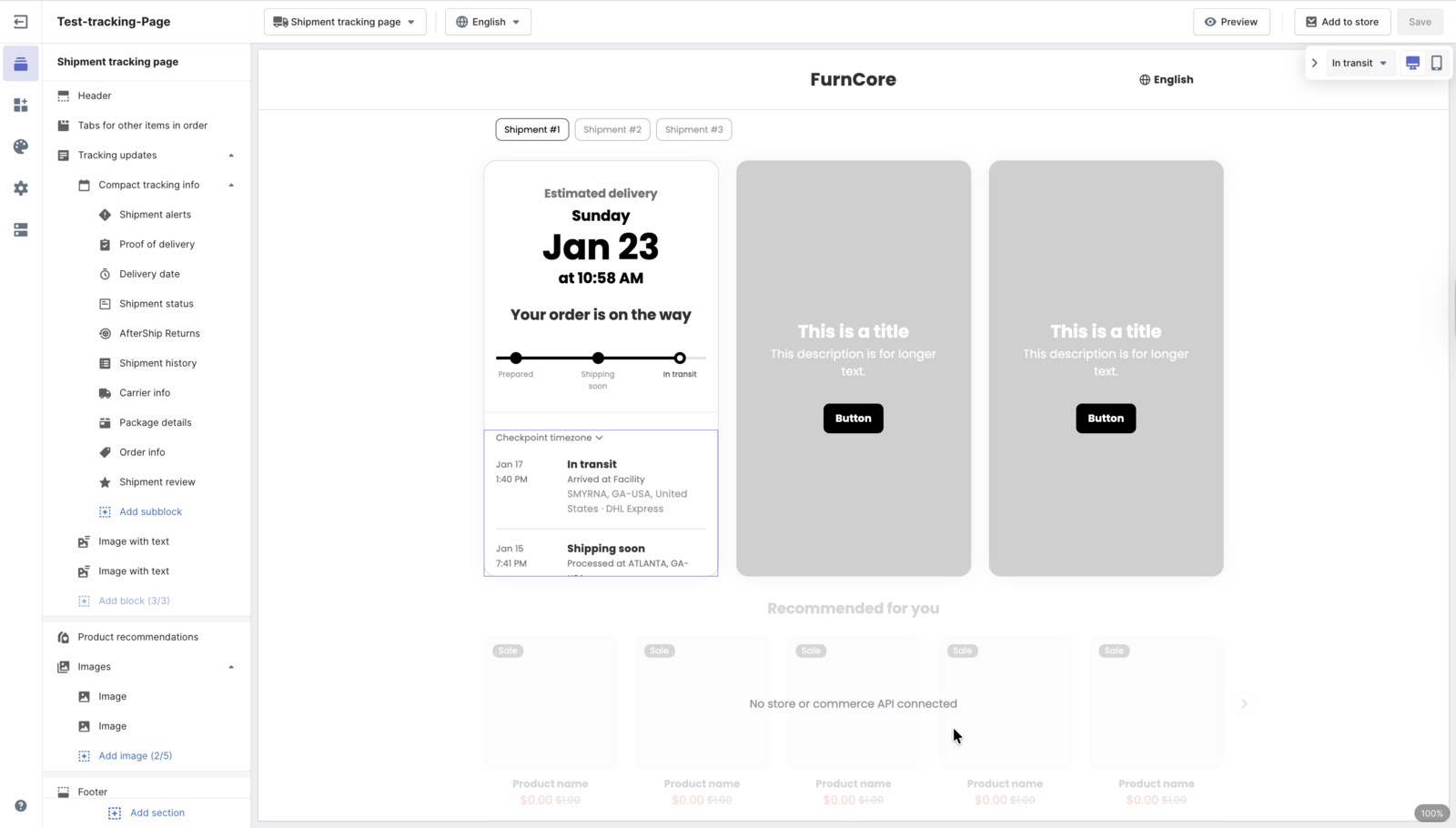
Every platform in this comparison can put product recommendations and promotional banners on a tracking page. Treat that as table stakes and go to the question underneath it. Whose property is the page on?
Narvar-hosted brand pages sit on a Narvar subdomain. The pattern is {brand}.narvar.com/{brand}/tracking, and it held on Sephora, Gap and lululemon when we checked all three on 21 August 2026: none redirects to a merchant-owned domain, the browser tab shows the bare hostname, and a "Powered by Narvar" wordmark renders in the footer of each. Route's tracking experience carries the shopper into Route's own app.
That decides more than aesthetics. Traffic on your domain feeds your analytics, your remarketing audiences and your first-party data. Traffic on a vendor's subdomain feeds theirs, and no amount of logo customisation changes the address bar.
AfterShip supports a custom domain on the branded tracking page. Be straight with your finance team about where it sits: custom domain is a Premium capability, so budget the tier, not just the tool.
What the page returns once you own it is measurable. Dr. Squatch's branded tracking page produced a 31.89% click-through rate and 766 attributed orders in Q1 2026, in a customer story published in July 2026. Those are marketing numbers from a page that is usually treated as a status screen and staffed like a cost centre.
What About the Top-Rated Shopify Tracking Apps?
Search the Shopify App Store for tracking and you will meet a different tier of product with very strong ratings. On 21 August 2026, 17TRACK showed 4.9 stars across 3,912 reviews, Track123 showed 4.9 stars across 1,590 reviews, and CWILL, formerly ParcelPanel, showed 5.0 stars across 2,896 reviews.
Those scores are real, and they measure something specific: a lightweight tracking widget doing its job reliably. Capability depth is a different measurement, and no star rating captures it. What it takes to run returns, shipping, warranty and delivery estimates for the same order, on one contract and one data set, does not show up in a review count.
So here is the honest read. At the bottom of the range, a Shopify-only brand with one region, one or two carriers and no returns programme yet, the free and near-free tiers in this market are genuinely enough, and AfterShip's own free plan is one of them. The evaluation only starts to matter when a second region, a second channel or a returns programme enters the plan, because that is the point at which the metered lines start compounding. For the direct comparison at that tier, see how AfterShip and Parcel differ for Shopify stores.
If you are that smaller brand, take the app store recommendation and spend the saved hours somewhere else. If you are the brand this article was written for, the platform question is the one on your desk.
The Verdict: Which Tracking Software is Right for Your DTC Brand in 2026?
The question is not which platform fits this quarter. It is which one you will not have to replace when the plan changes.
Narvar is a capable enterprise post-purchase platform, and its self-serve track-page editor is a genuinely good piece of software to work in. The friction is commercial: with no published price at any volume, a brand that has to build a business case before it can buy starts that case with an empty cell. AfterShip's Enterprise tier publishes dedicated CSM and onboarding, Enterprise SLAs and SSO, so segment is not the deciding factor.
Malomo (owned by Redo) delivers a clean, marketing-led tracking experience, and brands that want the page to look like a campaign will like working in it. The limit is what happens to the long tail as you grow, which the extended-network terms covered above set out plainly.
Route works when shopper-funded protection is the point of the purchase, and the economics of that model are genuinely different from a subscription. Tracking comes with it, on Route's property and inside Route's app, which is a trade a brand should make deliberately. For a broader view of the category, we also maintain a guide to other AfterShip alternatives.
AfterShip is the choice for a brand that plans to be bigger next year. Included carrier coverage rather than a network that splits as you scale. A published delivery-date coverage figure, which no other platform in this set publishes at all. A self-serve ladder a buyer can model from published figures, with a documented boundary above it. AfterShip unifies tracking, returns, shipping, and warranty in one platform. That is what stops the next post-purchase problem from becoming the next vendor evaluation.
Proactive shipment tracking that delights your customers, reduces WISMO tickets, and optimizes your delivery performance.
Book a demoFrequently Asked Questions (FAQ)
What is the real cost of package tracking software?
Sticker price is the smallest part of it. The real cost is the subscription plus everything metered on top: carriers outside the included network, channels, API access, the support tier. The second table in this article sets out what each vendor publishes and what each bills per use. Narvar publishes no price at any volume, so its total cost cannot be estimated without a sales call. AfterShip publishes self-serve Tracking pricing and routes brands above 5,000 shipments a month to a sales conversation, so every figure below that line is yours to check and model.
How long does it take to implement AfterShip Tracking?
Installing on Shopify takes minutes, and a branded tracking page with proactive notifications can be live the same day. A custom build takes longer and starts higher: API access and webhooks require Premium or above, so factor that tier into any plan that involves your own front end or a data pipeline into your warehouse.
Can AfterShip really reduce WISMO tickets?
Named brands publish their results. Moda Operandi reports a 65% reduction in WISMO inquiries and a 25% reduction in shipment exceptions. Vivino reports a 50% reduction. Those are two brands' outcomes rather than a platform average, and the mechanism behind them is the same in both: a delivery date the customer can see, and a notification that reaches them before they think to ask.
Can I work out what AfterShip will cost before I talk to sales?
Yes, up to a point, and further than you can with the alternatives. Narvar publishes nothing at any volume, so that exercise cannot begin until after the first meeting. AfterShip publishes what each tier contains, what each extra shipment costs, and the volume at which pricing becomes a conversation, which is enough to build a model your VP can question before anyone picks up the phone.