If you are re-pricing your tracking app, here is the whole field on one screen, with real dollars instead of dollar signs.
| Tool | Starting price (USD) | Carriers | Best for | Free plan |
|---|---|---|---|---|
| AfterShip Tracking | $9/mo (annual billing, 1,200 shipments/yr) or $11/mo (monthly, 100 shipments/mo) | 2,000+ direct integrations | Scaling DTC brands that will add returns, EDD and warranty to the same stack | Yes |
| Narvar | Quote only | Not published | Enterprise retailers buying a services-led implementation | No |
| Track by Loop (formerly Wonderment) | $99/mo (up to 2,500 shipments/mo) | ~180 | Klaviyo-first Shopify brands already running Loop Returns | Limited free plan |
| Redo Order Tracking (formerly Malomo) | $0.08 per tracked order | Not published | Shopify brands that want metered, month-to-month billing | No subscription; metered from the first order |
| CWILL Order Tracking (formerly ParcelPanel) | $11/mo (200 orders/mo) | Advertises 1,600+ | Early-stage Shopify stores that need a tracking page live this week | Yes — 20 orders/mo |
| 17TRACK Order Tracking | $9/mo (200 shipments/mo) | Advertises 3,300+ | Cross-border and dropshipping stores tracking long international lanes | Yes — 50 shipments/mo |
| TrackingMore | $9/mo (200 orders/mo) | Advertises 1,707 | Teams that want a tracking API and a Shopify app from one low-cost vendor | Yes — free to install |
| LateShipment.com | Usage-based, billed monthly (no flat entry price published) | Not published | Brands whose main pain is carrier refunds and delivery-failure recovery | 30-day free trial |
| Shopify's own notifications + Shop app | $0 | Carrier data passed through from your fulfilment | Stores under ~200 orders a month with no budget | Included with Shopify |
Prices checked on November 3, 2026 from each vendor's own pricing page or Shopify App Store listing. Carrier figures marked "advertises" are the vendor's own published claim and are not independently verified; AfterShip's 2,000+ are direct carrier integrations that need no merchant credentials, published on the AfterShip Tracking page. We ran no side-by-side technical benchmarks, and a feature a vendor does not document publicly is marked "not published" rather than "no". AfterShip publishes this page, so the AfterShip rows are its own claims, each linked to its source — the G2 reviews are the other side of it.
Why "Cheaper" Is the Most Expensive Word in Post-Purchase
Your monthly bill for your tracking app seems reasonable, but your Gorgias queue is still overflowing with "Where is my order?" tickets. You're paying for a tool, but you're still paying to solve the problem.
The sticker price on a tracking app is the one number that tells you the least. The cost that actually hits your P&L is what we call the Total Cost of Post-Purchase, or TCOP: the subscription fee plus everything a less expensive but less effective tool quietly pushes back onto your team.
That hidden cost shows up in three places. WISMO tickets (short for "where is my order") that your support team answers by hand, one copy-pasted carrier link at a time. Customers who churn after a confusing delivery and never come back, taking their lifetime value with them. And developer hours burned patching brittle carrier integrations that break the week before Black Friday, when you can least afford it.
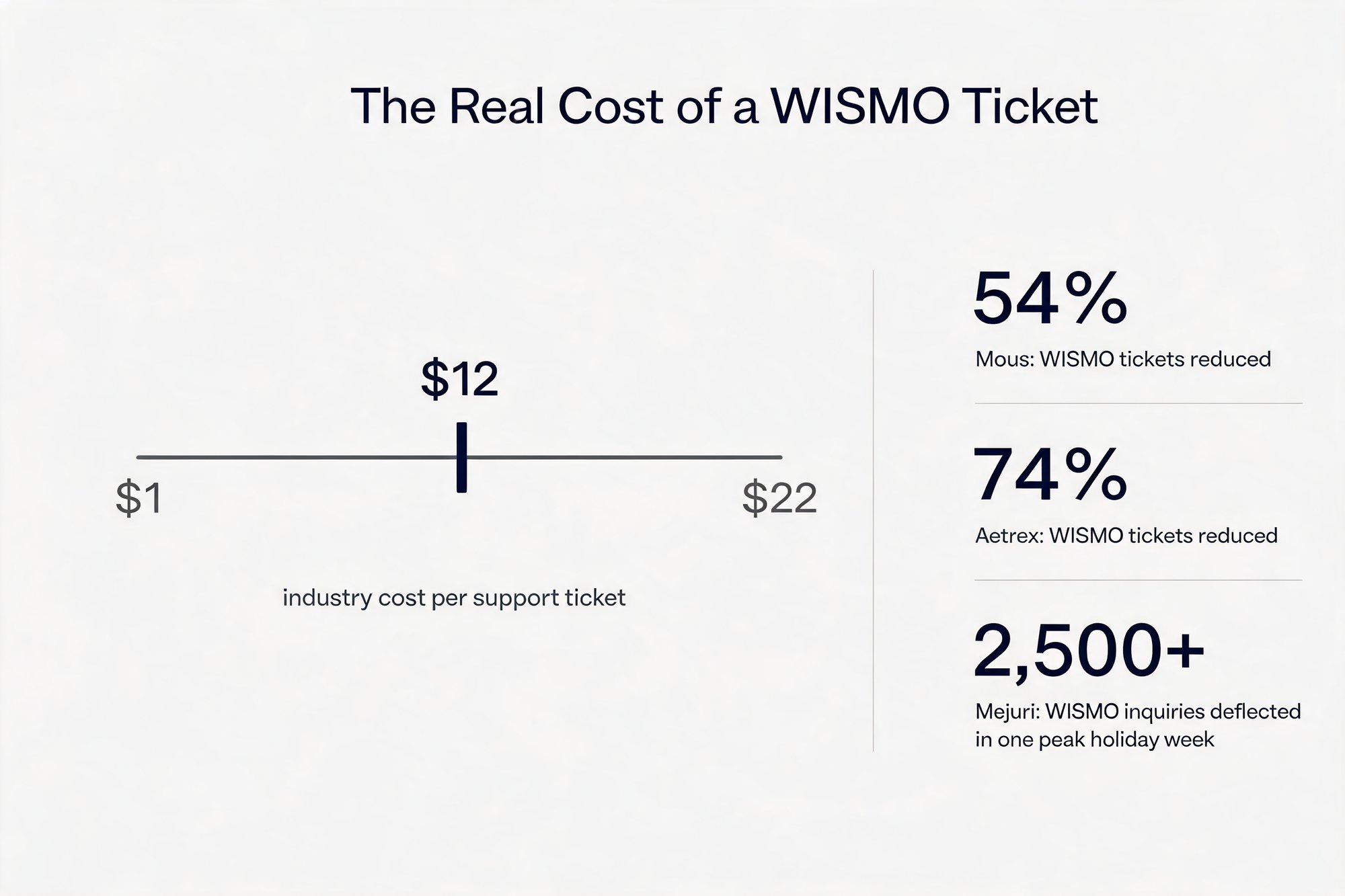
Put a number on the first one. Industry estimates for the fully loaded cost of a single WISMO ticket range from roughly $1 on the low end to $22 on the high end, with a defensible midpoint around $12 once you count agent time and tooling. At a few thousand tickets a month, that line item dwarfs any difference in subscription price, and it scales with your order volume rather than shrinking as you grow.
Now look at what happens when the tool actually does its job. AfterShip merchants have cut that ticket volume hard: Mous reduced WISMO tickets by 54%, Aetrex cut them by 74%, and during one peak holiday week Mejuri deflected more than 2,500 WISMO inquiries before they ever reached an agent. We put those deflection numbers side by side in the ticket-volume scorecard across three platforms.
So the real question is not "which tool is cheapest this month." It is "which tool gives me the lowest total cost over the next two years." The number in the table above is the starting point, not the answer — and the crossover table further down shows where the two diverge.
The 2026 Shortlist: AfterShip Alternatives DTC Brands Actually Consider
Eight names cover almost every shortlist in 2026, and each wins attention for a different reason. Buying for a 3PL or an enterprise logistics team changes the shortlist entirely, and we rebuild it in the shortlist for 3PL and enterprise logistics buyers.
Here is the field, framed by the job each tool is hired to do, with a verdict that stands on its own.
- Narvar: best for enterprise retailers buying a services-led implementation; pricing is quote-only. It is built around professional services and large, sales-led deployments, and fits retailers with the budget for a heavy rollout, alongside enterprise-level alternatives like parcelLab.
- Track by Loop: best for Shopify brands already paying for Loop Returns who want tracking from the same vendor. It came out of Loop's 2024 acquisition of Wonderment, was built for Shopify and Klaviyo-first brands, and sits around 180 carriers, mostly North American. Tracking and Returns remain two separate subscriptions with two quotas and two renewals.
- Redo Order Tracking: best for brands that want metered, month-to-month billing with no subscription floor. It came out of Redo's 2026 acquisition of Malomo and is sold as its own module at $0.08 per tracked order.
- CWILL Order Tracking (formerly ParcelPanel): best for early-stage Shopify stores that need a branded tracking page live this week. A free tier covers 20 orders a month, and the Shopify listing holds a 5.0 rating across 3,210 reviews. We compare it directly in AfterShip vs ParcelPanel.
- 17TRACK Order Tracking: best for cross-border and dropshipping stores tracking long international lanes. Its Shopify listing advertises access to 3,300+ carriers, starts free at 50 shipments a month, and holds a 4.9 rating across 4,563 reviews.
- TrackingMore: best for small teams that want a tracking API and a Shopify app from one low-cost vendor. It advertises 1,707 carrier integrations, bills from $9 a month on its Shopify listing, and charges separately for SMS.
- LateShipment.com: best for brands whose main pain is carrier refunds rather than tracking pages. Its pricing is usage-based and billed monthly with no contract, and its refunds product is the reason most buyers arrive.
- For zero budget: Shopify's own notifications and the Shop app. They cost nothing and need no install. The trade-offs are real: Shopify branding rather than yours, no returns or warranty workflow, no AI delivery estimate, and no owned post-purchase page to put product recommendations on. It holds until WISMO volume starts costing you agent hours.
One name you may be expecting is deliberately missing: ShipStation. ShipStation handles label printing and fulfilment workflows, the steps that happen before a package leaves your warehouse. This comparison covers the customer-facing layer that takes over once the label is printed.
Head-to-Head: AfterShip vs. The Competition on What Matters
The scorecard below uses one value per cell, so you can scan it rather than read it.
| Criteria | AfterShip | Narvar | Track by Loop | Redo Order Tracking | CWILL Order Tracking |
|---|---|---|---|---|---|
| Entry price | $9/mo (annual, 1,200 shipments/yr) | Quote only | $99/mo | $0.08/order | $11/mo |
| Carriers | 2,000+ direct | Not published | ~180 | Not published | Advertises 1,600+ |
| Status granularity | 7 main / 33 sub-statuses | Not published | Custom statuses not supported | Not published | Not published |
| Channels | Email · SMS · Facebook · Apple Wallet | Not published | Email · SMS | Email · SMS (metered separately) | Email · SMS |
| Free plan | Yes | No | Limited | No | Yes — 20 orders/mo |
| AI EDD | Included from Premium | Paid Promise add-on | Plus tier only | Checkout-only EDD | Not published |
| Branded experience | Full white-label + custom domain on Premium | Edits routed through an account manager | Polished page, fixed statuses | Branded portal | Basic branded page |
| Platform scope | Tracking + Returns + Shipping + EDD + Warranty + Protection | Discrete products, separate add-on lines | Returns + Tracking, separate subscriptions | À-la-carte modules | Order Tracking only |
| Shopify setup | One-click, Built for Shopify certified | Sales-led implementation | Shopify-native | Shopify-native | Shopify-native |
Channels are as listed on each vendor's own site or Shopify App Store listing. "Not published" means the vendor does not document the figure publicly, not that the capability is absent.
Two rows decide most evaluations. Carrier coverage sets the ceiling on how many of your shipments the tool can track accurately at all, which is why the gap between AfterShip's 2,000+ direct integrations and the roughly 180 Track by Loop covers matters the moment you ship outside one domestic lane. AfterShip connects to those carriers without merchant credentials, adds up to 50 a month, and is the only tracking provider that sits on the UPU Consultative Committee. Status granularity decides how much of your messaging you can automate: AfterShip normalizes carrier data into 7 main and 33 sub-statuses and fires notifications on sub-status changes and revised delivery dates from the Essentials tier up, with native Klaviyo, Attentive, Gorgias, Zendesk and Kustomer integrations from Premium. For brands building the whole flow in Klaviyo, we price out what a Klaviyo-first tracking setup actually costs. For Narvar specifically, we break down how Narvar's tracking stacks up against AfterShip's in its own comparison.
What each tool costs at 500, 2,000 and 10,000 orders a month
Entry prices are set at tiny volumes, so they tell you almost nothing about your bill. This table shows the cheapest published plan that covers each volume, using monthly billing.
| Tool | 500 orders/mo | 2,000 orders/mo | 10,000 orders/mo |
|---|---|---|---|
| AfterShip Tracking — Essentials | $35 | $109 | $478 |
| AfterShip Tracking — Premium (adds AI EDD, custom domain, API) | $70 | $239 | $1,039 |
| Narvar | Quote only | Quote only | Quote only |
| Track by Loop | $99 (Starter) | $99 (Starter, up to 2,500) | $449 (Plus; quota not published) |
| Redo Order Tracking | $40 | $160 | $800 |
| CWILL Order Tracking | $59 (2,000-order plan) | $59 | $479 (25,000-order plan) |
| 17TRACK Order Tracking | $49 (1,000 shipments) | $159 (2,000 shipments) | Not published on the listing |
| TrackingMore | $55 (2,000-order plan) | $55 | $1,189 (70,000-order plan) |
| LateShipment.com | Usage-based | Usage-based | Usage-based |
Prices checked on November 3, 2026 from each vendor's pricing page or Shopify App Store listing, at the cheapest plan whose published quota covers the volume. Overage rates where published: AfterShip $0.08 per extra shipment on Essentials and $0.12 on Premium (AfterShip Tracking pricing page), Track by Loop $0.04 per shipment above 2,000, CWILL and TrackingMore $0.05 per extra order. AfterShip's annual-billing plans are cheaper again — Essentials is $29/mo at 6,000 shipments a year and $89/mo at 24,000. AfterShip list prices change on November 17, 2026; this table will be re-checked after that date.
Read it and the pattern is consistent: the cheapest sticker price and the lowest cost at your actual volume are rarely the same column. At 2,000 orders a month, the entry-level apps and AfterShip Essentials land within about $50 of each other — at which point the question stops being price and starts being how many of your delivery questions each one actually prevents. And the lowest line in the 10,000-order column is still an AfterShip plan.
Support, across every plan. Support works the same way across AfterShip Tracking, Returns and Shipping: live chat on every paid plan (not the Free plan), with a 10-minute live-chat target and a one-business-day email target, as published on the Returns and Shipping pricing pages. Issues escalate from chat to a support engineer, and enterprise customers can put contractual uptime and response commitments in writing with an Enterprise SLA rather than relying on an account manager's goodwill. That matters in a cost comparison because support you cannot reach is support you end up replacing with your own team's hours.
The same pattern shows up in independent reviews, not just AfterShip's own case studies.
Which alternative fits your role?
The right pick depends less on your order volume than on whose problem you are solving.
| Your role | What you are optimizing for | Where to start |
|---|---|---|
| Ops / logistics lead | Carrier coverage and exception handling across lanes and 3PLs | AfterShip, for direct coverage across 2,000+ carriers — see the shortlist for 3PL and enterprise logistics buyers |
| Developer | One normalized API instead of per-carrier integrations | The AfterShip Tracking API, and which courier tracking APIs developers rate highest for the neutral comparison |
| CX / support lead | Fewer WISMO tickets reaching the queue, and tracking data inside the helpdesk | AfterShip's native Gorgias and Kustomer integrations, so agents see shipment status without a tab switch |
| Founder | Lowest cost now, without a rebuild in twelve months | A free tier — Shopify's own notifications, CWILL, or 17TRACK — then re-price once WISMO tickets start costing agent hours |
Switching from or to AfterShip: what moves and what doesn't
Migration scope depends on two things: how many separate tools AfterShip is replacing, and what your current platform can export. A brand moving one tracking app across is a different project from a brand consolidating tracking, returns and notifications in the same quarter, so there is no single switching timeline worth quoting.
What is consistent: active and recent shipments can be moved into AfterShip, so in-flight orders keep updating through the cutover. Returns already started in your old system are generally finished there rather than migrated mid-flight. Most teams run both systems in parallel for about 30 days before cutting over, which means your current tool keeps working until the new one is proven, and you can time the switch to your renewal date instead of the other way round.
If you are coming from Narvar and run your flows in Klaviyo, AfterShip publishes a transition guide for that exact path. For procurement, the Trust Centre holds the security documentation most reviews ask for.
Deep Dive: When an AfterShip Alternative Is the Right Choice
There are a couple of scenarios where AfterShip may not be the ideal post-purchase solution for your brand yet.
The first is the pre-launch or very early brand. If you are shipping under 200 orders a month, a lighter, marketing-led tool like Track by Loop or Redo Order Tracking can be a cleaner starting point for brands that prioritize a Klaviyo-native experience (see how Wonderment compares with AfterShip). At that volume, the math behind a dedicated post-purchase platform simply has not kicked in yet.
The second is the large enterprise with a services-heavy mandate. If your post-purchase rollout needs a dedicated implementation team and a vendor that staffs the project end to end, Narvar's professional-services model is built for that. It is a sales-led, quote-based engagement rather than a self-serve setup, which is the right shape for some enterprise buying processes and the wrong shape for most scaling DTC brands. Teams running that kind of procurement should start with which tracking platforms clear an enterprise procurement bar, and enterprise teams putting Narvar next to parcelLab can see all three vendors scored in AfterShip vs Narvar vs parcelLab.
The Platform Advantage: Why a Tracking Point Solution Hits a Wall
A standalone tracking app solves one problem well and then stops, while a connected platform compounds value across every post-purchase touchpoint, and the brands running the full stack have the numbers to prove it.
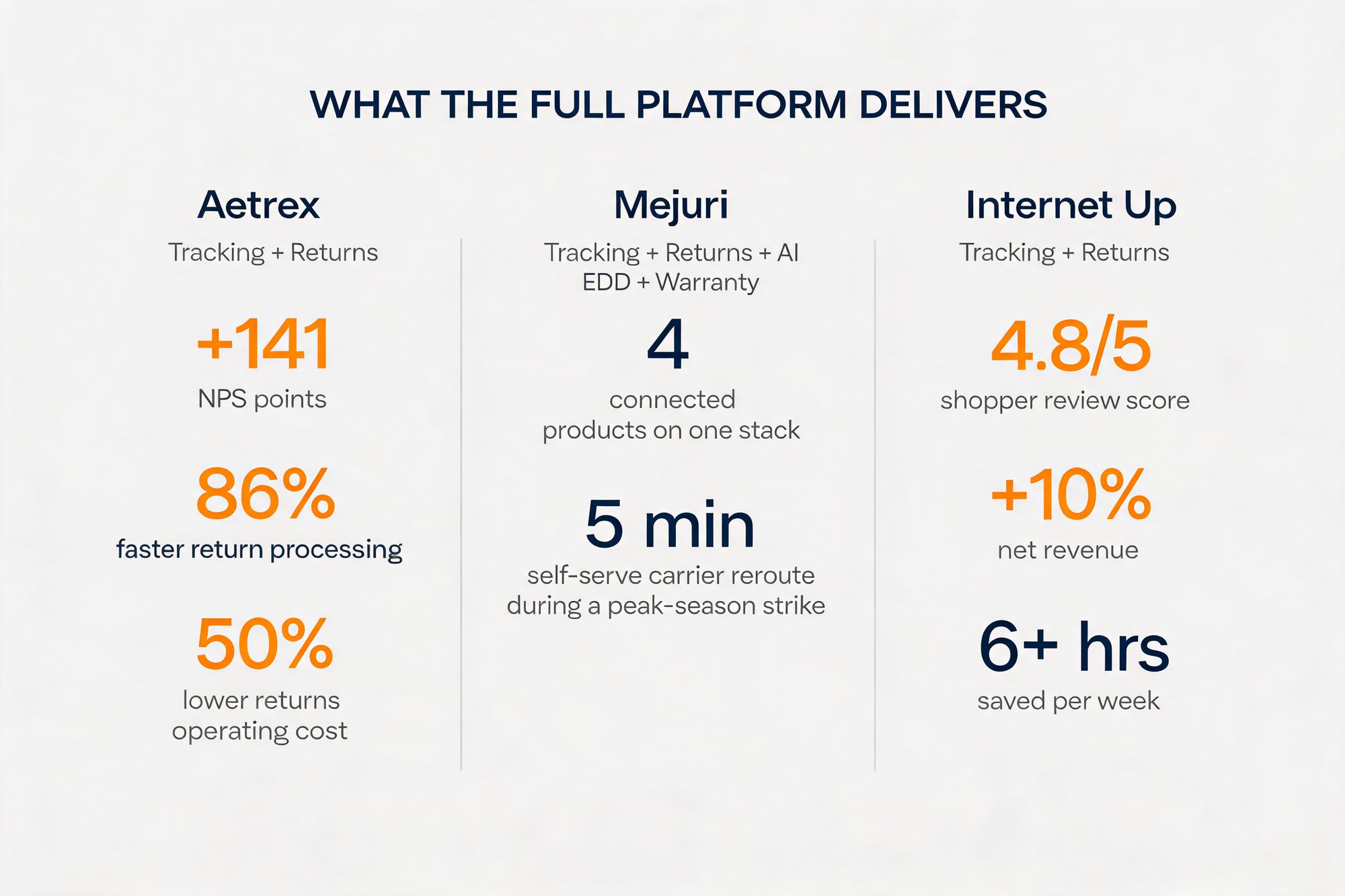
Start with Aetrex. Running AfterShip Tracking and Returns together, the footwear brand lifted its NPS by 141 points, cut return processing time by 86%, and reduced its returns operating cost by 50% across more than 120,000 annual packages. Those are not three separate wins from three separate tools. They come from tracking and returns sharing one data layer, one customer profile, and one set of automations.
Mejuri shows what that looks like under pressure. The jewelry brand runs Tracking, Returns, AI EDD, and Warranty as a single connected stack, and when a carrier strike hit during peak season, its team rerouted shipments through a self-serve flow in about five minutes rather than waiting on a carrier ticket. A point solution cannot do that, because it does not own enough of the journey to act on it.
Internet Up rounds out the pattern at scale. With Tracking and Returns connected, the brand earned a 4.8 out of 5 shopper review score, grew net revenue by 10%, and saved its team more than 6 hours a week while handling 170,000+ packages and 10,000+ returns a year.
The reason this works is structural. On a unified platform for tracking, returns, and even shipping, those functions share data instead of fighting over it. A delivery exception can trigger a proactive message, a return can be pre-approved off a tracking scan, and a warranty claim can pull the original order without a CSV export. Point solutions force you to stitch those handoffs together yourself, usually with developer time and a brittle integration that needs re-testing every time a carrier changes its data format. That maintenance tax never shows up on the invoice, but your engineering team pays it every quarter.
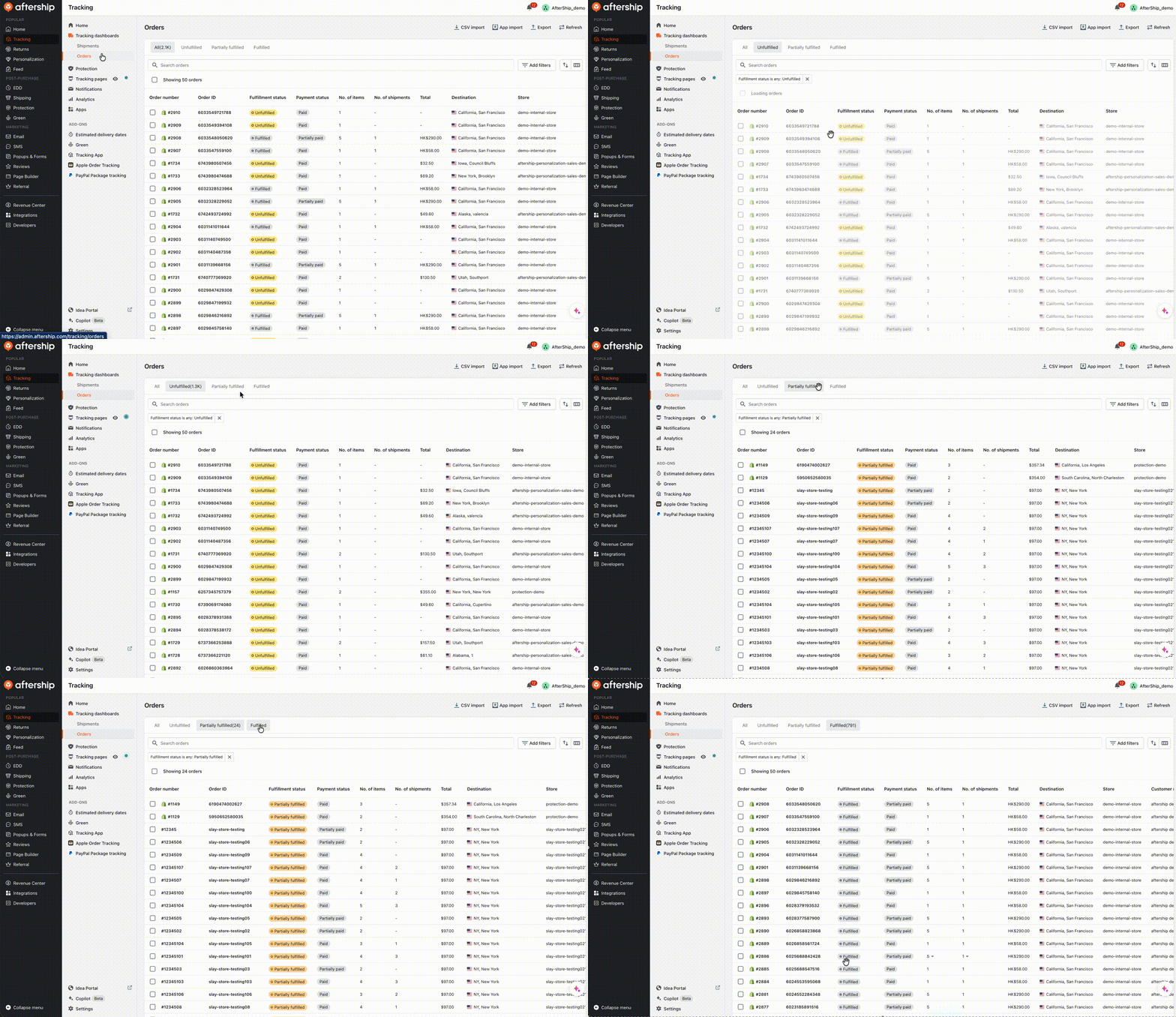
A tracking-only tool can match AfterShip on the narrow job of showing a package's location, but it hits a wall the moment your operation needs returns, exchanges, warranty, or delivery estimates to work together.
The 2026 Verdict for Scaling DTC Brands
The verdict splits cleanly by stage. Below roughly 200 orders a month, a free plan or Shopify's native notifications will hold you over, and the money saved is real. In the 1,000 to 50,000 orders-per-month range, where WISMO volume, returns and carrier complexity compound at once, AfterShip's connected platform is both the lowest line in the cost table and the one that absorbs the next three things you buy. The alternatives stay viable at the edges: CWILL, 17TRACK and TrackingMore for stores still finding their feet, Track by Loop for brands already on Loop Returns, and Narvar for enterprise buyers who want a heavy professional-services engagement.
If your brand is in that scaling window and serious about post-purchase as a retention lever, AfterShip Tracking is the place to start the evaluation; procurement can review the security and compliance posture and security documentation first, and About AfterShip covers the company behind the platform. Shopify brands weighing two returns-only apps against each other should read how the two stack up on Shopify returns workflows, and if your store runs on Shopify, we narrow the same field in our ranked list of tracking page tools.
Proactive shipment tracking that delights your customers, reduces WISMO tickets, and optimizes your delivery performance.
Explore AfterShip TrackingAfterShip Alternatives FAQ
Is there a free AfterShip alternative?
Yes, several. AfterShip itself has a free plan. Among the alternatives, CWILL Order Tracking is free up to 20 orders a month, 17TRACK is free up to 50 shipments a month, and TrackingMore is free to install. Shopify's own order notifications and the Shop app cost nothing at all, with the trade-off that the experience carries Shopify's branding rather than yours and there is no returns, warranty or AI delivery-estimate workflow attached. Free tiers work until WISMO tickets start costing agent hours; at that point the cheaper tool is usually the more expensive one.
How much does AfterShip cost and what does the entry plan include?
AfterShip Tracking Essentials starts at $9 a month billed annually for 1,200 shipments a year, or $11 a month billed monthly for 100 shipments a month, with $0.08 per extra shipment. Essentials includes a branded tracking page with your logo and colors, carrier-based delivery estimates, carrier auto-detection and auto-correction, delivery sub-status reporting, triggered notifications on sub-status and revised delivery dates, multi-language support, and the tracking dashboard. Premium adds AI-powered delivery estimates, a custom domain, full white-labelling, the API and webhooks, and the full analytics suite. Current list prices are on the AfterShip Tracking pricing page; prices change on November 17, 2026.
How many carriers does AfterShip support?
2,000+ carriers through a single integration, with up to 50 new carriers added each month. The connections are direct and do not require you to supply your own carrier credentials, and AfterShip is the only tracking provider that is an official member of the UPU Consultative Committee. Coverage spans postal services, last-mile couriers, 3PLs, freight forwarders and LTL carriers. Several lower-cost apps advertise larger carrier totals; those are the vendors' own published claims and are worth testing against your actual lanes before you decide.
Should I use a tracking API or a Shopify app?
Use the app if your orders live in Shopify and you want a branded tracking page and notifications live in a day without engineering time. Use the API if you need tracking events inside your own systems — a custom storefront, a warehouse system, a data warehouse, or a helpdesk workflow you built yourself. The AfterShip Tracking API returns normalized events from 2,000+ carriers through one integration, so your team maintains one connection instead of one per carrier. Plenty of brands run both: the app for the customer-facing page, the API for internal systems.
What happens to my tracking history if I switch?
It depends on how much your current platform lets you export, which varies by vendor. In general, active and recent shipments can be moved into AfterShip so in-flight orders keep updating through the cutover, while returns already started in your old system are usually completed there rather than migrated mid-flight. Most teams run both systems in parallel for about 30 days before cutting over, which lets you verify the new setup against the old one before you cancel anything. Scope the export with your current vendor before you set a cutover date.
Which helpdesks does AfterShip integrate with?
AfterShip has native integrations with Gorgias, Kustomer, Zendesk and Salesforce, alongside marketing platforms including Klaviyo and Attentive, as part of 70 platform integrations. These connect from the Premium tier up. The practical benefit is that your agents see shipment status inside the ticket rather than switching to a carrier site, which is where a large share of WISMO handling time actually goes.
Is AfterShip SOC 2 compliant?
Yes. AfterShip's security certifications, including SOC 2, along with its GDPR posture, sub-processor list and uptime commitments, are published in the AfterShip Trust Centre, which is the document set most procurement reviews ask for. Enterprise customers can also add contractual uptime and response-time commitments through an Enterprise SLA.
Do any AfterShip alternatives include package protection?
Some do, with different commercial models. Redo funds its returns coverage with a fee the shopper pays at checkout, and Loop offers Package Protection as an optional add-on to its free Checkout+ plan. AfterShip Protection is included on all plans and products as an additional widget that shoppers opt into at checkout. The question to ask of any of them is who pays — the shopper, the merchant, or the vendor out of the premium pool — and what share of the premium comes back to you.
What is the best cheap AfterShip alternative?
If budget is the only constraint and you are under 200 orders a month, 17TRACK at $9 a month, TrackingMore at $9 a month, or CWILL Order Tracking at $11 a month all get a branded tracking page live quickly, and each has a free tier to test with. They are genuinely good at that job. What they do not do is absorb returns, exchanges, warranty or AI delivery estimates later, so the switching cost arrives at roughly the same time your WISMO volume does. At 2,000 orders a month, AfterShip Essentials at $109 is within about $50 of the cheapest alternative plan that covers the same volume, and it is the only one on that list you will not outgrow.