You're down to the final two: ParcelLab and WeSupply Labs. You have the proposals, you've seen the demos, and now you're looking for the definitive tie-breaker before making a five-figure decision. But what if that's the wrong final two?
Most comparisons of post-purchase software for mid-market brands stop at a feature grid. A grid tells you which tool wins today. It does not tell you what your CFO will ask in eighteen months: how many post-purchase vendors are we paying, and why do none of them share data? The comparison that goes past the feature grid is Malomo versus parcelLab on what actually differs.
At 5,000 to 50,000 orders a month, that second question sets the budget. Framing the decision as ParcelLab vs Wesupplylabs assumes the shortlist is already complete. Both vendors are good at what they sell. Neither publishes a buyable outbound shipping product, so the stack you approve this quarter is a stack you will have to extend.
This article gives you the honest read on both, then the third name that belongs next to them.
Quick Verdict: Who Wins for Scaling Brands?
If you are skimming, start here. Three platforms, three different bets on what post-purchase actually is.
| Criteria | AfterShip | ParcelLab | WeSupply Labs |
|---|---|---|---|
| Best For... | Brands building a unified post-purchase stack | Enterprises needing a bespoke communications layer | Brands led by returns and store operations |
| Platform Strategy | Tracking, Returns and Shipping on one platform, one login | Communications and experience layer, plus Retain returns | Returns, BOPIS and store locator; an EasyPost company since 2025 |
| Core Strength | The only one publishing buyable outbound shipping | Enterprise operational messaging depth | Returns depth, in-store returns and curbside pickup |
ParcelLab and WeSupply each win a lane. AfterShip is the only one of the three that takes the next purchasing decision off your roadmap.
Understanding the Choice: Two Sides of the Post-Purchase Coin
ParcelLab and WeSupply Labs solve different halves of the post-purchase problem.
ParcelLab is a communications and experience layer over your existing logistics systems, controlling what the customer sees between checkout and delivery. It also sells returns through Retain.
WeSupply Labs works from the logistics side: tracking, notifications, returns, in-store returns, curbside pickup and a store locator.
Where ParcelLab Excels (and Falls Short)
ParcelLab earns its place on an enterprise shortlist through messaging depth.
Strengths
- Enterprise-grade communication workflows for complex operational messaging
- Retain, its own returns product
- Multiple shops or brands under a single account
- Klaviyo and Gorgias integrations
- "92% accurate promise dates", its own figure, no coverage figure published
Where it falls short
- An experience layer, not a logistics platform: no outbound shipping or carrier rate comparison on any page, so you still run a separate shipping platform
- Its own comparison page states a "Standard 4-8 week implementation"
If ParcelLab is your front-runner, we published an honest breakdown of its features that goes deeper than any proposal will.
Where WeSupply Labs Excels (and Falls Short)
WeSupply Labs is the stronger of the two if returns and store operations are the problem you are actually solving. It has been an EasyPost company since 2025.
Strengths
- Solid returns management features with real depth: conditional auto-approval, restocking fees, multi-destination returns and instant store credit
- In-store returns/pickup capabilities: curbside pickup and a store locator, which most post-purchase tools leave to your commerce platform
- "200,000+" printerless drop-off locations, its own figure
Where it falls short
- Per its own pricing page, AI predictive delivery dates, BOPIS, store locator and auto-refund are gated to Advanced and above, full API to Enterprise; no EDD accuracy or coverage figure published
- Outbound label generation announced in its 8 May 2025 release notes, with nothing buyable documented for it yet
- Its own documentation requires one WeSupply account per brand for a multi-brand Magento setup
Both vendors are credible on their own terms. The problem is what neither proposal puts in front of you.
The Hidden Risk of Point Solutions: Why Your Comparison is Incomplete
Every vendor you add to the post-purchase stack is a decision you make once and pay for repeatedly.
Choose either finalist and the immediate problem gets solved. Tracking improves, notifications go out, returns get a portal. What also happens is quieter: your shipment data sits in one system, your returns data in a second, and the label that created the shipment in a third. It cannot be queried as a whole.
That matters more than a feature grid suggests, because post-purchase is where customer attention concentrates. Baymard Institute reports that 50% of respondents in its quantitative study said order tracking is the most important account feature. The moment your customer cares most about is the moment your data is split across vendors.
Your engineering team already has a name for this. It is technical debt, and you are not buying a tool so much as an integration surface. Each additional vendor adds a contract to manage, a data model to reconcile, a login to provision and a support path to escalate through. When one of them stops fitting, the cost is not the subscription. The cost is a replatforming project, plus the reporting continuity you lose in the middle of it.
That is the part of a wesupplylabs vs parcellab decision neither proposal has any reason to raise. If a third name is still on your list, we cover how WISMOlabs and parcelLab score against each other.
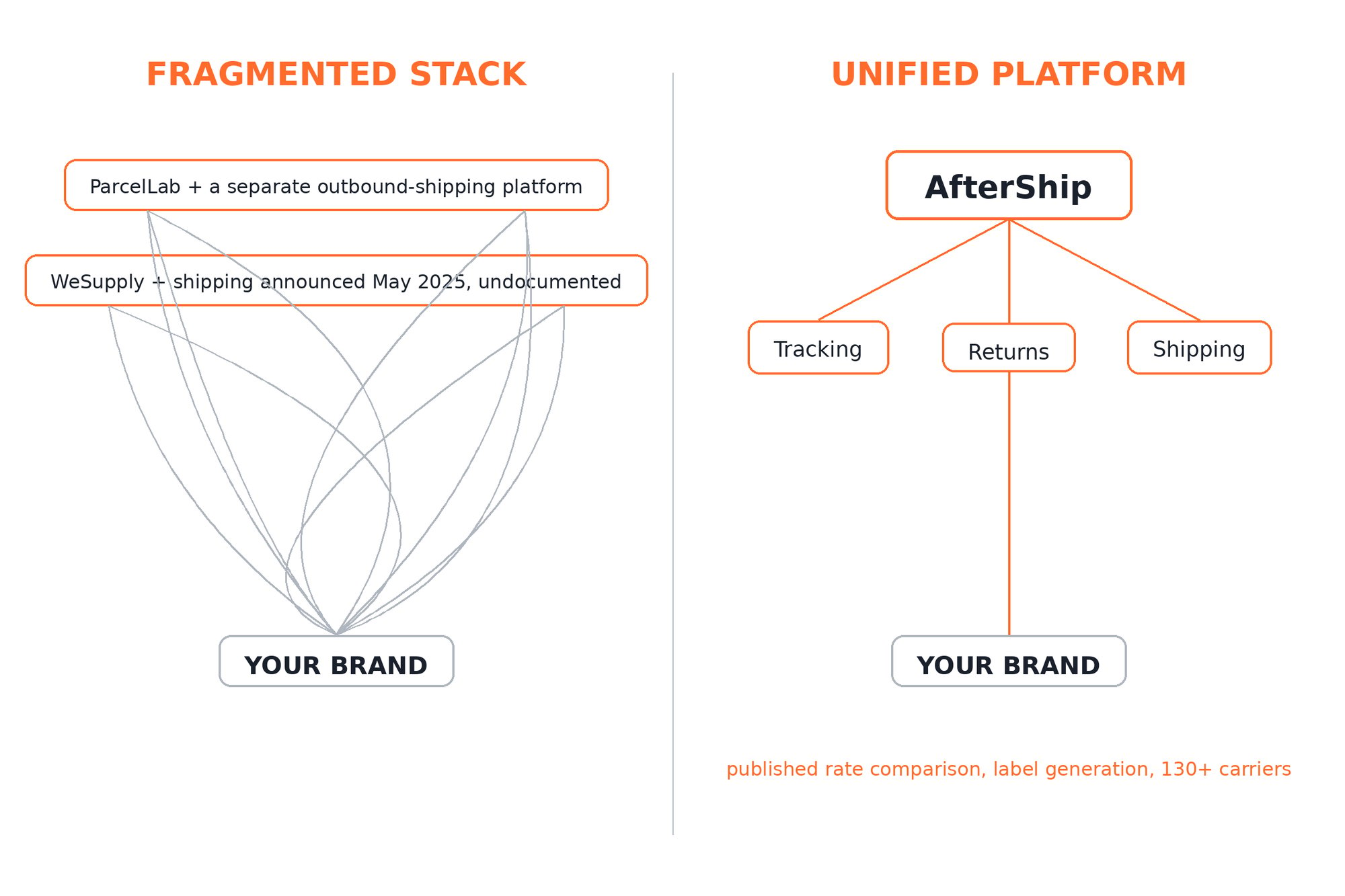
Two vendors plus a separate shipping platform, or one platform that already publishes outbound shipping.
The Strategic Alternative: AfterShip's Integrated Post-Purchase Platform
AfterShip comes at the same problem from the other end: one platform, one vendor, one data model, one login.
Tracking, Returns and Shipping run as distinct products on shared infrastructure, so your return policy can read a delivery event without a webhook between two vendors.
At this volume you are an Enterprise conversation. That covers a named onboarding lead and ongoing Customer Success Manager who own your launch, QBRs, and roadmap influence, AI-powered EDD on Premium and Enterprise, APIs and webhooks on Tracking and Returns, and multiple organizations and members managed from one unified control center on the Enterprise Company console.
Shipping is a distinct product line that rounds out the stack. For the wider field of post-purchase experience platforms, here is AfterShip vs parcelLab vs Narvar, compared.
Unify Your Experience with Superior Tracking
Start with coverage. AfterShip's carrier directory lists 2,000+ carriers for tracking, which decides whether your long-tail regional shipments produce checkpoints or silence. The same tracking API carries a 99.9% uptime SLA with service credits.
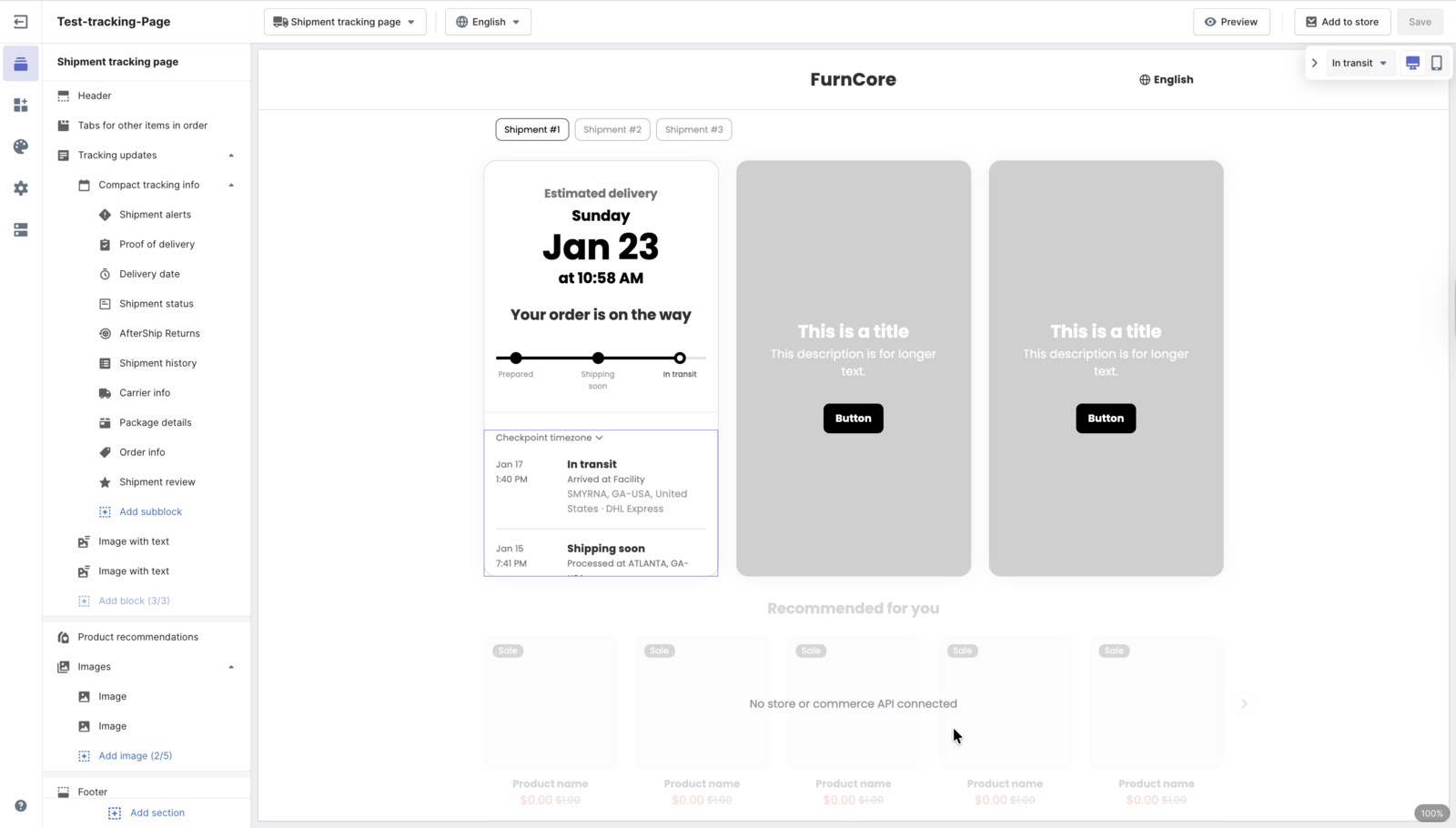
The delivery estimate is where the gap widens. AfterShip's AI-powered EDD returns a prediction on 80% of deliveries, against typical carrier estimates covering under 40%, with accuracy up to 95%. Coverage is the figure to read first. An estimate you cannot show on most orders is not one your CX team can plan around. EDD runs on Premium and Enterprise.
For multi-brand operators the difference is structural. AfterShip lets you manage multiple organizations and members from one unified control center at the Enterprise level, through the Company console, set up on request. WeSupply's own documentation says a multi-brand Magento setup needs "two (or more) WeSupply Accounts".
The rest of our complete order tracking platform sits behind that same login.
Automate and Optimize Your Entire Returns Process
Returns is the category where WeSupply is strongest, so the comparison has to get specific.
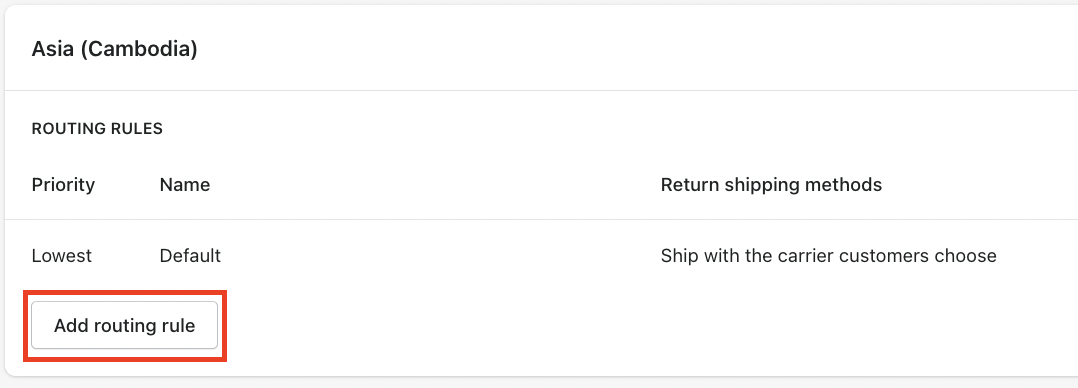
AfterShip Returns runs on automation rules: rules approve eligible returns instantly and route the rest. It auto-selects the cheapest connected carrier, applies zone-based routing so each parcel reaches the right warehouse, and handles exchanges, store credit with incentive, and in-store returns.
Drop-off reach matters at this volume. AfterShip publishes 300,000+ drop-off locations. Separately, the same page states more than 9,000 Return Bars from Happy Returns supported in the U.S., the label-free option. WeSupply publishes 200,000+.
Then there is the capability that exists only because these products share a data model. Delivery-date-based return windows anchor to verified carrier delivery events from Tracking, so the return clock starts when the parcel actually arrived rather than when it shipped. That runs on Premium and Enterprise and requires a Tracking plan.
Go Beyond Post-Purchase with Native Multi-Carrier Shipping
Here is the contrast that appears in neither proposal, and the one you cannot resolve later without signing another vendor.
ParcelLab sells no outbound shipping. WeSupply announced outbound label generation in May 2025 and has published no product page, carrier list, rate comparison or tier for it. AfterShip Shipping publishes all four: real-time rate comparison, carrier-certified label generation, 130+ carriers, and a pricing page you can read before you speak to anyone.
Operationally that buys you one workflow instead of three. The delivery event that closes the tracking record is the same event your return window reads.

“We've been happy with AfterShip Tracking, there's no downtime or issues. Going with AfterShip Returns made sense. We can simplify our tech stack and leverage the data together.”
Rui Kojima, Senior Director of eCommerce
Read their story →Aetrex reports an 86% reduction in return processing time and a 74% decrease in WISMO tickets with AfterShip Returns. Those are Returns outcomes. The consolidation case is in Kojima's own words: one tech stack, data used together. That is the one thing a shortlist of ParcelLab competitors cannot offer you until it includes a platform that publishes tracking, returns and shipping.
Feature Breakdown: AfterShip vs. ParcelLab vs. WeSupply Labs
Here is the evidence behind everything above, criterion by criterion, with every figure attributed to whoever published it.
| Criteria | AfterShip | ParcelLab | WeSupply Labs |
|---|---|---|---|
| Platform Strategy | Tracking, Returns and Shipping on one platform, one vendor, one data model, one login | Engage, Convert and Retain. No outbound shipping | Tracking, notifications, returns and BOPIS. Outbound labels announced May 2025, undocumented |
| Core Tracking & Comms | 2,000+ carriers (AfterShip carrier directory, read 2026-10-14). AI-powered EDD on 80% of deliveries vs typical carrier estimates under 40%, accuracy up to 95% (Premium and Enterprise). 99.9% uptime SLA with service credits. Email, SMS and Facebook Messenger channels with flow control | Advertises 550+ carrier integrations and "92% accurate promise dates" on its own pages; no coverage figure published | Advertises 1,400+ (integrations page) and 1,000+ (pricing page). AI predictive EDD from Advanced; no published accuracy or coverage figure |
| Returns Management Scope | 300,000+ drop-off locations. Separately, 9,000+ Happy Returns Return Bars in the U.S., label-free. Auto-approve rules, cheapest-carrier selection, zone-based routing, exchanges, store credit, in-store returns | Retain: print-at-home labels, QR codes, in-store drop-offs, exchanges, store credit, AI-driven approvals | 200,000+ drop-off locations, its own figure. Conditional auto-approval, restocking fees, multi-destination returns, instant store credit. Auto-refund and auto-restock from Advanced |
| Native Shipping Solution | Published and buyable: real-time rate comparison, carrier-certified label generation, 130+ carriers, published pricing page | None | Outbound labels announced 8 May 2025. No product page, carrier list, rate comparison or tier |
| Scalability & Integrations | APIs and webhooks on Tracking and Returns. Native Klaviyo, Attentive, Omnisend, Gorgias, Zendesk, NetSuite. Multiple organizations and members from one control center at Enterprise (Company console, set up on request). Rakuten France enterprise API integration: "It only took 1-2 weeks for our engineers to implement" | Klaviyo and Gorgias. Multiple shops under one account. "Standard 4-8 week implementation", its own comparison page (modified 2026-04-02) | Klaviyo, Gorgias, Attentive, Omnisend. Full API on Enterprise only. Per its own docs: "two (or more) WeSupply Accounts" for multi-brand Magento; "same day" (Shopify), "up to a week" (complex), "around four weeks" (custom ERP) |
Read the Native Shipping Solution row twice. ParcelLab sells post-purchase communication and returns, but no outbound shipping.
The Final Verdict: The Smartest Choice for Growth in 2026
Three recommendations, no hedging.
Choose ParcelLab if you are an enterprise that needs a bespoke communications layer over logistics systems you have already committed to.
Choose WeSupply Labs if returns and store operations are your primary pain, and you are content to run tracking and shipping as separate concerns.
Choose AfterShip if you are scaling and want the whole journey after checkout on one platform. AfterShip provides an integrated platform for tracking, returns, and shipping.
One honest caveat before you decide. ParcelLab may offer deeper white-glove implementation for complex legacy enterprise systems. AfterShip's pre-built integrations and self-serve configuration mean most scaling brands get more out-of-the-box functionality across the whole post-purchase journey without a month-plus bespoke project. For one published AfterShip enterprise API integration, Rakuten France, "It only took 1-2 weeks for our engineers to implement." Your own timeline will depend on carrier count, ERP or WMS integration, and custom-domain setup.
AfterShip's unified platform helps scaling brands avoid vendor fragmentation. That is the decision you are really making.
Proactive shipment tracking that delights your customers, reduces WISMO tickets, and improves your delivery performance.
Book a demoFrequently Asked Questions
How does ParcelLab vs WeSupply Labs pricing compare?
Neither vendor makes a like-for-like comparison easy. ParcelLab publishes no price. WeSupply's Enterprise tier starts at 15,000+ shipments a month. AfterShip is quote-based at this volume. Compare what the engagement includes rather than chasing a number. AfterShip Enterprise covers a named onboarding lead and an ongoing Customer Success Manager who own your launch, QBRs, and roadmap influence, AI-powered EDD on Premium and Enterprise, APIs and webhooks on Tracking and Returns, and multiple organizations and members managed from one unified control center on the Company console. Each AfterShip product is licensed and billed separately, so scope the products you actually need and price the outcome rather than the line item.
Which integrates better with Klaviyo and Gorgias?
All three integrate both, so the integration checkbox will not separate them. What differs is the data flowing through it. AfterShip's native Klaviyo, Attentive and Omnisend integrations run on unified tracking and returns data, so a flow can branch on a verified delivery event and a return status held in the same platform instead of reconciling two vendors' payloads. Judge these integrations on event depth and template control rather than on which partner logos appear on the page.
Can AfterShip replace ParcelLab and a returns tool?
ParcelLab already sells returns through Retain, so this is not a straight swap of a tracking tool for a returns tool. AfterShip replaces a tracking vendor, a returns vendor and a shipping vendor with one platform, billed per product. For Shopify Plus teams weighing parcellab vs wesupplylabs for shopify plus, the public app record is worth reading: AfterShip Order Tracking holds 4.7/5 from 1,304 reviews and AfterShip Returns and Exchanges holds 4.7/5 from 1,393 reviews. ParcelLab's Shopify app has had 0 reviews since April 2024, and WeSupply has no Shopify App Store listing. Both AfterShip listings are Built for Shopify certified.