What Is Redo's "Free Returns" Model, Really?
The promise of "free returns" is the holy grail for DTC brands. Redo offers a tempting path: let customers pay for package protection, and use that money to fund returns. It sounds like a perfect solution. But have you run the numbers on what it really costs your brand?
Before you can run those numbers, you need a distinction almost no comparison article makes. Redo sells two separately priced products, and merchants routinely bundle them into one checkout checkbox.
Redo Coverage is return-label coverage. Redo Package Protection is the one a shopper sees at checkout, and it covers lost, stolen and damaged parcels. Redo Coverage and Package Protection are separately priced products with different pricing models.
Redo's returns software is genuinely free to merchants, and Redo covers return label costs. Redo also moved first on the managed, shopper-funded model that several vendors now offer.
What you cannot do is quote a price. Redo publishes no shopper-facing Package Protection price on any surface it owns. The merchant sets it and can edit it, which is why observed live storefronts run anywhere from $0.10 to $3.99, with order-value ladders reaching $49.98. Those are observed merchant-set prices across a very wide range, not a rate card.
Coverage prices differently again. Redo's own return policy template hands merchants an example line to publish: "If you purchase Redo for $1.98 with your order, your return shipping label will be covered." That is a return label price, so it belongs to Coverage, and it tells you nothing about what protection costs.
Two questions decide whether this model works for your brand. What is the experience for the shoppers who do not opt in? And what happens when your returns cost more than the pool generates?
How a Protection-Funded Model Is Actually Priced
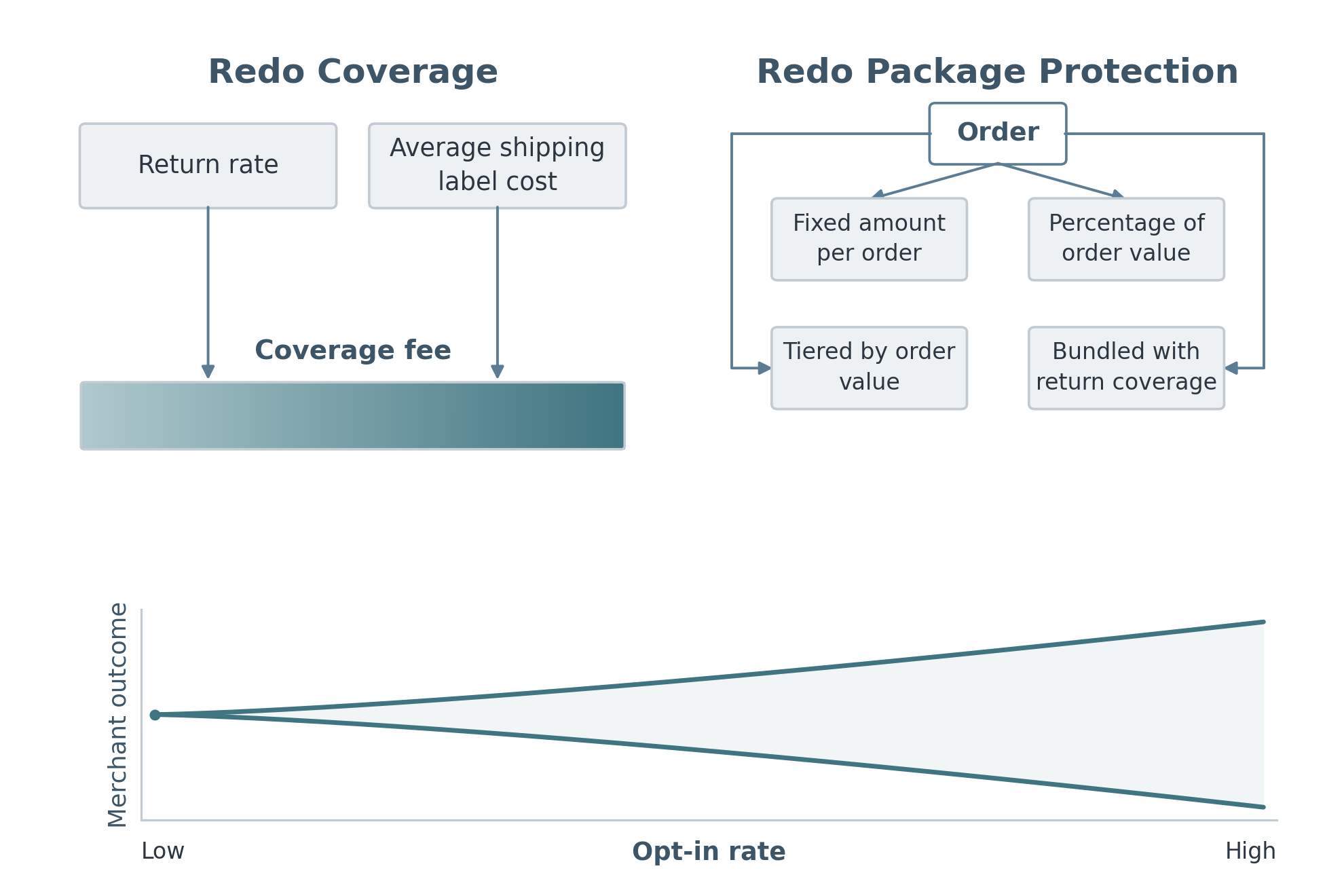
Redo's help centre names two inputs behind the Coverage price: your return rate, and your average shipping label cost. Return rate is returns divided by orders. Average label cost moves with your product weights and shipping distances, including how much you ship internationally.
So the Coverage fee is not a number Redo picks off a shelf. It is a number your own operation generates, and it moves when your operation does.
Redo Package Protection does not work that way at all. You choose the pricing mode from four options: a fixed amount per order, a percentage of the order value, tiered pricing based on order values, or bundled with your existing return coverage.
Two Redo storefronts selling the same catalogue can price protection completely differently, because the price is a merchant setting rather than a product specification.
Which raises the question the whole model rests on: what does a return actually cost you? The most defensible method is labour-based. Multiply the time your team spends on a return ticket by your CS hourly wage, then set that against recaptured and incremental revenue. AfterShip's Returns ROI calculator runs this calculation, and it scales with inputs you set rather than an industry average. If you are still forming a view of the app itself, we walk through what Redo actually is for a Shopify merchant.
As a sanity check only, a 2022 Pitney Bowes survey found returns cost US online retailers roughly 21% of order value on average.
Opt-in rate is the last variable, and no vendor's figure should stand in for yours. Model it across a range and watch how far the outcome swings. Every input that decides whether protection-funded returns pay sits on your side of the ledger, and Redo gives you exactly one funding model to run them through.
What the Shopper Actually Gets for the Fee
Pricing is one question. What the shopper receives in exchange is a different one, and it has a documented answer.
Redo Coverage is configurable by resolution type, and the configuration decides who buys the return label. Redo's own policy template gives merchants this line to publish: "If you choose not to buy Redo, or would like a full refund, you can still return items, but you will have to cover the cost of the return shipping label."
Read that carefully. A shopper who paid at checkout, then decides they want their money back rather than a swap, buys the label anyway. Redo's help centre describes how common that setup is.
"In an effort to de-incentivize refunds, most merchants select Redo coverage to only be active for Exchanges and/or Store Credit."
Redo Help Center
That is a merchant configuration rather than a restriction Redo imposes, which is why the shopper experience varies from one Redo storefront to the next.
AfterShip Return Care runs one setting across every outcome. All five documented resolution methods stay open to a shopper who paid the fee: refund to the original payment method, refund to store credit, variant exchange, shop with the refund value, and condition-based resolution. None of them is carved out, and excluding coverage by resolution type or product tag is documented as a future capability rather than a current one.
AfterShip's shopper-funded returns cover every resolution, including a cash refund, where Redo merchants typically limit free coverage to exchanges or store credit.
The AfterShip Alternative: Own Your Policy, Control Your Costs
The stronger position starts earlier in the journey than the checkout box.
Prevent the claim. Proactive delivery notifications reduce WISMO tickets, the "where is my order" contacts that arrive when a shopper cannot see their parcel. They also reduce the delivery anxiety that sits behind them. A shopper watching a tracking page with an accurate delivery estimate has less reason to file a claim, and less reason to open a ticket asking about one.
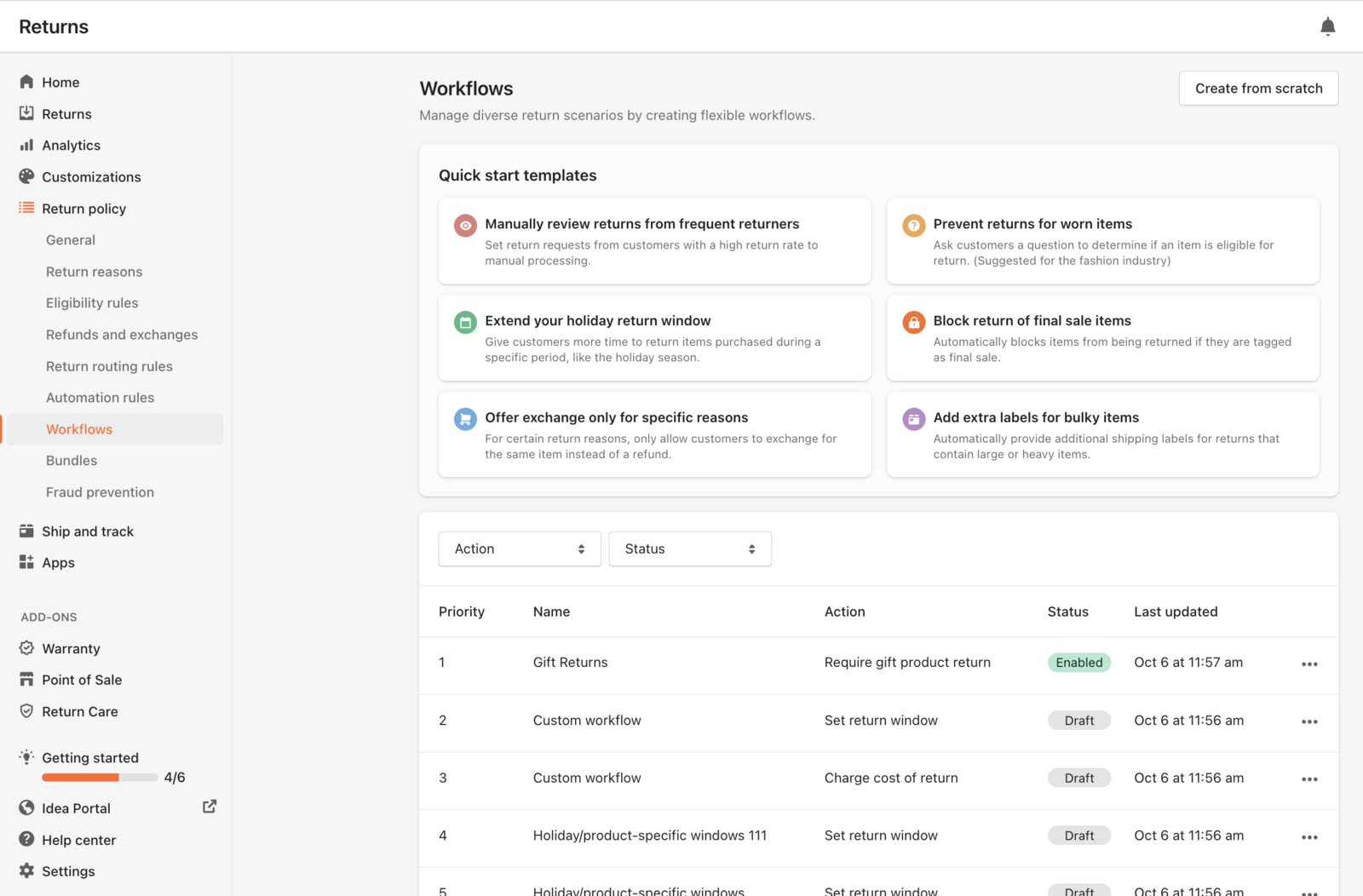
Control what the return costs. AfterShip Returns runs on automation rules. Conditional logic decides which resolutions a shopper is offered, whether a given return is paid or free, and which carrier the parcel travels back on. You set the policy once and the rules apply it on every return, which is what keeps cost per return flat as volume climbs.
Then choose how to fund it. AfterShip lets brands choose shopper-funded returns (Return Care) or absorb costs, with full policy control. Pass the cost of returns to shoppers who opt in, or carry it yourself and treat free returns as an acquisition expense. Both are supported configurations, and the choice is reversible as your margins and your return rate move.
Which Return Care model you run matters, because fee ownership changes between them. This article describes the fully managed model. Under it, AfterShip collects the shopper fee, holds it as the coverage pool, and buys the return labels on its own carrier account. The merchant never pays out of pocket and carries none of the risk. The managed program described here is US-only today.
Fellow, running AfterShip Returns on Shopify, recaptured over 20% of revenue through exchanges and store credit, and brought average resolution time down from 14.46 days to 7.52 days inside six months.
AfterShip Protection is the separate product covering the parcel itself. Merchants control how Protection is presented and how approved claims are resolved. The premium is AfterShip-set, starting at $1.50 for every $100 of order value and adjusting with your claim ratio, and the covered band runs from $10 to $10,000 of order value. Claims are underwritten through InsureShield, and InsureShield takes the final call, not AfterShip.
Two things to plan around. Protection is not a switch you flip yourself, which the next section covers in full. And the two products travel together at checkout: with both services enabled, customers will not be able to purchase only one of the services.
The Gates: Who Can Actually Use This
AfterShip Protection is not a Shopify-only product. It supports Shopify and Shopify Plus, WooCommerce, BigCommerce, Salesforce Commerce Cloud, and custom integration through the Protection API, with install guides published for BigCommerce, Magento 2, WooCommerce and Salesforce. The "Shopify or Shopify Plus" line in the eligibility list is the condition for the Shopify onboarding path.
Return Care is narrower. It is Shopify-only.
The remaining gates are firm. Step one is not an install but an application for access: a form, followed by a qualification decision you do not control the timing of. Your business entity must be based in the US, because InsureShield adjudication is a US program. Your store currency should be USD. You need more than 5,000 orders annually, and a claim ratio at or below 3%. The US requirement applies to your business entity and not to your shipping lanes, and AfterShip supports shipments from global to global.
Redo asks for none of that. Its returns software installs with nothing to buy and nothing to apply for, and it runs on Shopify, BigCommerce, WooCommerce, Salesforce Commerce Cloud and custom sites. If your constraint is getting something live this quarter, that gap is real and it favours Redo.
That friction is the price of the underwriting. An approved claim is adjudicated and paid by the insurer rather than administered by AfterShip.
Comparison: Redo vs AfterShip for Mid-Market DTC
The criteria that decide this are strategic rather than a feature count, starting with how each model is funded and who carries the risk when a parcel goes missing.
| Criteria | AfterShip | Redo |
|---|---|---|
| Business model | Choose how returns are funded: shopper-funded through Return Care, or absorbed onto your own P&L. | One funding model. Redo Coverage is sold to shoppers at checkout and funds return labels. |
| Who carries the risk | AfterShip Protection is underwritten through InsureShield. The insurer adjudicates, and approved claims are paid to you to pass on. | You set the price, and fees pool as a reserve in your own Shopify account. A separate Shipsurance opt-in is available through the Redo Insurance Program. Redo's terms state that Redo provides no actual package-protection coverage and place responsibility for self-insuring on you. |
| Impact on checkout CVR | The shopper fee is optional. Run it, or absorb the cost and leave checkout untouched. | The core model requires a fee at checkout. |
| Control over returns policy | Resolution logic, eligibility and paid-versus-free treatment are yours to configure. | Configurable, with free coverage scoped by resolution type. |
| Cost control levers | Automation rules apply your policy to every return, including carrier routing. | Coverage price is derived from your return rate and average shipping label cost. |
| Customer-experience control | Return Care applies to all five resolution methods, a cash refund included. | Coverage is commonly configured to exchanges and store credit only. |
| Scalability | Tracking, Returns, Protection and warranty run as one post-purchase suite. | Returns portal, with further modules enabled separately. |
| Built for Shopify | AfterShip Returns holds the Built for Shopify certification. | No Built for Shopify badge on its Shopify App Store listing, checked August 2026. |
The funding question and the risk question have different answers, and the risk row is where a protection decision is actually made.
Feature-level detail sits in a head-to-head comparison.
The Verdict: Who Should Choose Redo vs AfterShip in 2026?
Redo is the right call for a smaller or newer brand with tight cash flow that needs a returns portal running this week. The free portal covered earlier installs across Shopify, BigCommerce, WooCommerce, Salesforce Commerce Cloud and custom sites, with no application, no minimum order volume and no qualification decision to wait on. If your binding constraint is time and cash rather than control, that combination is hard to argue with.
The checkout question deserves a straight answer rather than a statistic. An opt-in fee is one more decision placed in front of a shopper who has already decided to buy. Whether it costs you conversion depends on your AOV band, your category and how the option is presented, and no vendor on either side of this comparison can hand you a number for your storefront. What you can decide is whether you are obliged to run the fee at all.
AfterShip is the right call once returns are something you manage rather than something you install. The wedge is the choice of funding model: shopper-funded through Return Care, or absorbed onto your own P&L, with the policy, the resolution logic and the carrier routing under your control on either setting. A single locked model gives you one answer to a question whose right answer moves with your margin, your return rate and your category mix.
The eligibility gates covered above are real, and they are a reason to start qualifying early rather than late.
Marc Nolan, running AfterShip Returns on Shopify, cut returns-handling time by 97%, from roughly 35 hours a week to one, according to Nikolas Callas, its Director of Operations. That is CX capacity returned to the business rather than a cost moved between columns.
For a brand that expects to still be scaling in 2027, how you fund returns is a decision you want to be able to revisit. Only one of these two leaves that decision open.
Returns automation that enhances the returns and exchanges experience, reduces costs, and retains more revenue.
Book a demoFrequently Asked Questions
What's the difference between Redo Coverage and Redo Package Protection?
Redo Coverage pays for return shipping labels, and its price is derived from two inputs Redo publishes: your return rate and your average shipping label cost. Redo Package Protection covers lost, stolen and damaged parcels, and the merchant sets its price using one of four modes: a fixed amount per order, a percentage of order value, tiered pricing by order value, or bundled with your existing return coverage. Merchants frequently present both as a single checkout checkbox, which is why a storefront price rarely matches either product on its own.
Is package protection legally required?
No. Package protection is optional on both sides of the transaction: the merchant chooses whether to offer it at checkout, and the shopper chooses whether to buy it on any given order. The two decisions are separate. For the merchant it is a commercial question about who absorbs parcel risk and how that risk is funded, and the answer to it holds regardless of how many shoppers opt in.
What are the best alternatives to Redo for shipping protection?
The established options include Route, Navidium, Corso, Seel, ShipAid and AfterShip Protection. They differ on who underwrites the coverage, who adjudicates a claim, how the fee is priced, and whether the merchant or a third party holds the risk. Compare on those four dimensions rather than on the checkout fee alone, because the fee is the most visible difference and rarely the one that decides the outcome.
How do you offer free returns without a tool like Redo?
AfterShip Return Care funds free returns from an opt-in fee shoppers pay at checkout. Under the fully managed model AfterShip collects that fee, holds it as the coverage pool and buys the return labels on its own carrier account, so the label cost stays off your P&L. It runs on Shopify, requires an AfterShip Protection subscription on the same store, and the managed program described here is US-only today. Within those bounds it covers every resolution a shopper can choose, including a cash refund, and leaves the policy and the resolution logic under your control.