Your returns operation gets judged on four numbers: cost per return, exchange rate, the hours your team spends touching each request, and whatever finance will sign off on next quarter. When those numbers stall, the cause is rarely that your platform cannot process an exchange.
Most teams searching for a Return Rabbit alternative, or for the best Shopify returns app, are not hunting for a missing feature. Return Rabbit handles exchanges, refunds and store credit, and its own documentation says so. So does AfterShip Returns, through a deep Shopify integration on the store you already run. For the platforms that field is drawn from, see the returns platforms worth shortlisting.
The difference is decision depth: what each platform is allowed to weigh before it settles a return, and which published ceilings start to bite as your volume climbs. Both are checkable on the vendors' own pages.
AfterShip and Return Rabbit compared
Five criteria decide most Return Rabbit vs AfterShip shortlists: best fit, core design, carrier and label flexibility, automation depth, and platform scope. AfterShip Returns leads on the last three.
| Criteria | AfterShip Returns | Return Rabbit |
|---|---|---|
| Best For | Brands judging returns on every outcome | Brands focused on exchange conversion |
| Core Design | Any outcome, chosen by rules you configure | Built around exchanges, in its own words |
| Carrier and Label Flexibility | Global carrier network; cheapest-carrier selection on Premium and above | Six carriers direct, others via your aggregator account |
| Automation Depth | Rules weigh five signals at once | One published rule condition, item value |
| Platform Scope | Shipping, tracking, returns and warranty, one account | Returns and exchanges |

“Thanks to AfterShip's customizable return windows and non-refundable tagging, we can now effectively deter fraud, preventing customers from creating requests and generating shipping labels.”
Rui Kojima, Senior Director of eCommerce
Read their story →Aetrex cut return processing time by 86%, operational costs by 50%, and lifted returns NPS by 141 points.
What an exchange-centred design leaves on the table
Pull your last quarter of returns and sort them by what the customer actually wanted. Some wanted a different size. Some wanted their money back. Some wanted store credit, because they like the brand and not the item. And some were not really returns at all: the product failed, and what the customer wanted was a warranty claim.
The National Retail Federation, in its 2025 Retail Returns Landscape published with Happy Returns, projected that 19.3% of online sales would be returned in 2025. That figure is a share of sales, not of returns. At mid-market volume it is already a line item your finance team can name.
Return Rabbit's product page states that "Exchanges are the foundation of Return Rabbit". Refunds, store credit and returnless refunds are documented there too.
Warranty is where the two diverge. Warranty claims are handled in the same place as returns: AfterShip Warranty is available on AfterShip Returns Premium and above (it is not on Essentials). Across returnrabbit.com, its help centre, its Shopify App Store listing and its terms, warranty is not published as a supported resolution on any surface. If defective product is a real share of your volume, that work already lives somewhere else: a separate tool, a shared inbox, or an afternoon of your CX team's week.
AfterShip Returns settles each request on rules you set, so the resolution follows the customer's reason rather than the shape the tool was built around.
Reason 1: Control your reverse logistics costs
Every return you accept buys a label. The price of that label is set by which carriers you can reach, and by whether the platform compares them before it commits.
AfterShip Returns supports multi-carrier return label generation and carrier rate selection. It generates prepaid return labels across a global carrier network and more than 300,000 drop-off locations, and on Returns Premium and above it selects the cheapest connected carrier on every request, so no single carrier is the default. Printless QR drop-off runs across major carriers including FedEx, USPS, Royal Mail and Canada Post, so a customer without a printer is still served.
Rate selection earns its keep on the returns you did not plan for. Shoppers notice too: McKinsey's 2025 Consumer Returns Preferences Survey of 850 US consumers ranks the cost of the return among their top concerns.
Return Rabbit documents six carriers you can add directly: Pitney Bowes, FedEx, UPS, Newgistics, DHL e-commerce and USPS. Past those six, carriers arrive through your own ShipStation or ShipEngine account. Those are two different scopes: inheriting a network through an aggregator account means the returns platform is working with rates you already arranged, and the ceiling on your options is the one your own contract sets.
Two further conditions shape the price. Return Rabbit's QR returns run through USPS only, and its cheapest-label selection applies only when dynamic shipping rates are switched off.
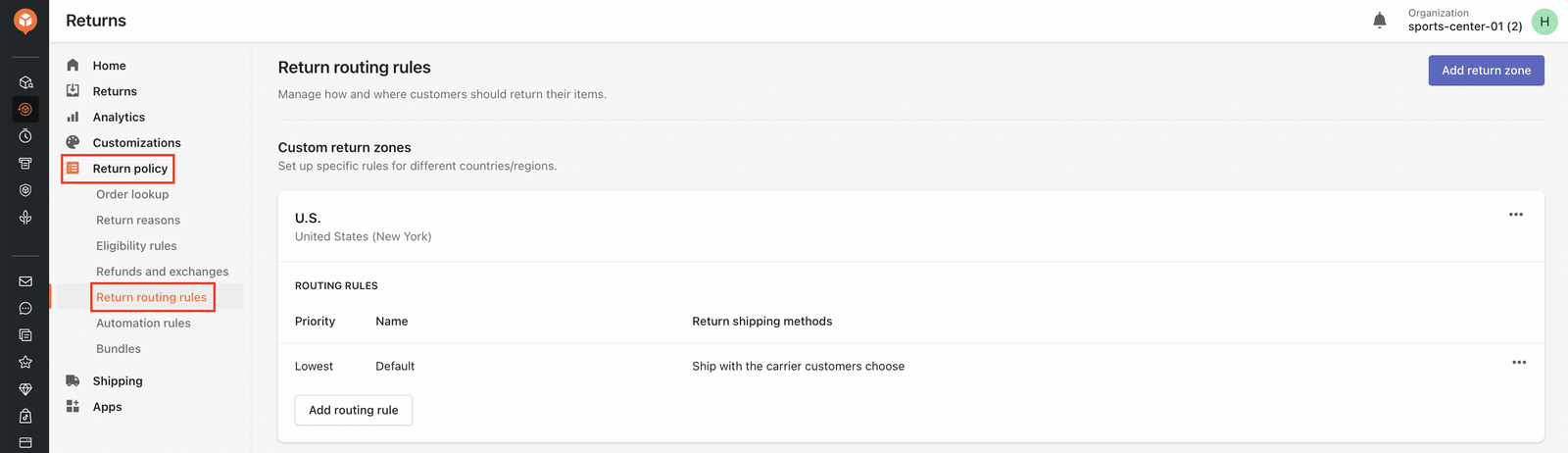
A few cents a label is a rounding error on one return and a budget line across a year of them. The routing rules you configure decide which carrier and destination each return takes.
Reason 2: Automate on more than one condition
A returns rule is only as useful as the things it is allowed to look at. The rule most operations teams actually want reads something like this: a customer on her fourth order this year sends back a dress because it ran small, so offer the next size before offering a refund, and route it to the warehouse holding one.
That single rule needs four signals at once. Who the customer is, what the item is, why it came back, and where it should go.
AfterShip Returns automates on return reason, item, customer history, destination and carrier cost. Those five signals sit on one data layer, so a single rule can weigh why an item came back against who is sending it back and what the return will cost to move. The result is granular automation rules that make your best CX agent's judgement the default.
Return Rabbit's Rules and Exceptions documentation, in an article dated October 2023, states that "At this moment, we only provide for 'Item value lies between'". The remainder of its automation keys off carrier scan events. A carrier scan reports where a parcel is; customer history and SKU-level return reasons live in your store rather than on the carrier's network, so a rule keyed to scans is reading a different class of signal. Its current pricing page advertises a rules tier without publishing what those rules can test.
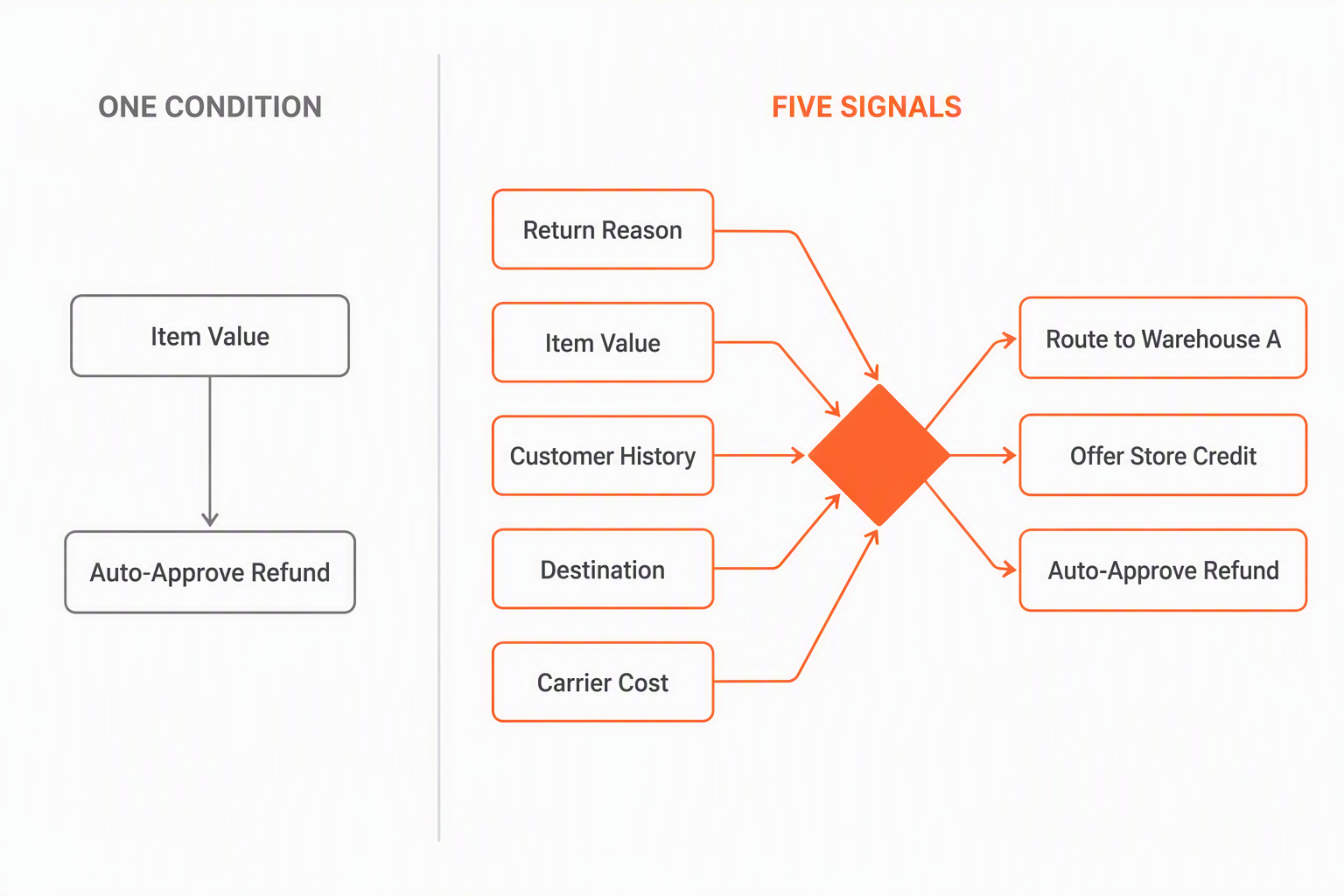
Item value is a real condition and it settles some returns on its own. For a growing operation the question is what share of returns a single condition can settle, and AfterShip Returns answers it with five.
Reason 3: One account, one portal, one backend
Running tracking in one system and returns in another means two records of the same customer, and two places your team has to look when a shopper asks where their refund is.
AfterShip Returns shares one account, one branded customer-facing portal and one admin with AfterShip Tracking and AfterShip Shipping. AfterShip unifies shipping, tracking, returns, and warranty in one platform. Your shopper gets one branded surface for where is my order and where is my refund, and your team runs both from a single backend.
For the shopper, the return request starts on the same branded surface where they tracked the parcel. For your team, a policy change lives in one admin and applies wherever it should, with no second entry to keep in sync. Return Rabbit brands its returns portal too. A shopper who has to hunt for a second site to start a return is a shopper who opens a ticket first.
The operational effect is in the small things: one set of permissions, one vendor relationship when something breaks, one place where post-purchase data accumulates.
That last point is what makes multi-signal automation possible at all. A rule can only weigh signals the platform already holds, and AfterShip Returns holds the tracking and returns signals together because they run on the same stack.
Reason 4: Published limits that appear at scale
The ceiling that matters is the one you reach in year two, and it is usually written on the pricing page you skimmed in week one.
Return Rabbit's pricing page stops its bring-your-own-carrier plans at 12,000 returns a year. That is a thousand a month, which a brand shipping fifty thousand orders a month at a mid-teens return rate passes inside its first quarter.
Unlimited volume appears only on its Free Plan, and that plan is conditional on using Return Rabbit's own discounted shipping rates rather than the carrier contracts you negotiated. If your carrier rates are a competitive advantage, the unlimited tier asks you to set them aside.
Return Rabbit documents service facilities, service zones and lanes, a warehouse flow, and dashboard analytics with scheduled reports. Integration and localization carry their own conditions. The Return Rabbit integration requires a ShipStation account based in the US or Canada, with account setup routed through email to support, per ShipStation's own help centre. Return Rabbit's own help centre states the product is "not multi-lingual or enabled for translation yet".
Then the section your security reviewer opens first. Across returnrabbit.com, help.returnrabbit.com and its Shopify App Store listing, Return Rabbit publishes no SLA, no SOC 2 and no ISO 27001, and GDPR is asserted without a named auditor or certificate.
None of this matters at a thousand returns a year. At ninety thousand, volume bands and compliance posture decide the shortlist, and AfterShip Returns answers both in writing, with published returns pricing tiers and rule conditions you set yourself.
AfterShip vs. Return Rabbit: Detailed Feature Breakdown
The detail that settles a shortlist sits in seven rows.
| Criteria | AfterShip Returns | Return Rabbit |
|---|---|---|
| Returns Automation Rules | Rules weigh return reason, item, customer history, destination and carrier cost. | One published rule condition, item value, plus carrier-scan triggers. |
| Carrier Flexibility & Cost Control | Global network, printless QR across major carriers; cheapest-carrier selection on Premium and above. | Six carriers direct, others via aggregator; QR is USPS-only. |
| Exchange & Refund Options | Exchanges, refunds, store credit, keep-the-item, plus warranty on Premium and above. | Exchanges, refunds, store credit and returnless refunds; warranty not published. |
| Branded Portal Experience | One branded self-service portal for tracking, returns and warranty. | Personalized return portal, branded to your store. |
| Unified Platform (vs. Point Solution) | Shipping, tracking, returns and warranty on one account. | Returns and exchanges. |
| Scalability | Routing by destination and carrier cost; published tiers through Enterprise, then a quote. | Service zones, lanes and warehouse flow documented; bring-your-own-carrier plans stop at 12,000 returns. |
| Reporting & Analytics | Returns and tracking on one record, not two your team reconciles. | Publishes a dashboard and scheduled reports on shopper behaviour. |
The Verdict: When to Choose AfterShip Over Return Rabbit
Return Rabbit is built around exchanges and says so on its own product page, and for a team whose whole returns strategy is exchange conversion, that focus is a genuine strength rather than a gap. The AfterShip Returns platform configures any outcome on your own rules: exchange, store credit, refund, keep the item, and warranty on Returns Premium and above. No one path is the default the others work around. Return Rabbit competitors are separated by how many outcomes one rule can reach.
Choose AfterShip Returns if:
- Your annual return volume is climbing past the bands published for bring-your-own-carrier plans.
- Your negotiated carrier rates are an advantage you intend to keep, and the platform should shop across them on every shipment.
- One rule has to weigh more than a single condition before it settles a request.
- Your shoppers should find tracking and returns on one branded surface, administered by your team from one backend.
- Your security review needs SLA and certification answers published somewhere a reviewer can find them.
Choose Return Rabbit if:
- Exchange conversion is the single outcome you are working on, and item value is a sufficient rule condition.
- Your annual return volume sits comfortably inside its published bands.
- You will use its discounted shipping rates as the price of unlimited volume on its free plan.
A returns platform whose published limits and documentation have not moved with your business is a cost you pay in workarounds, and the bill arrives as an unscheduled migration.
Returns automation that decides on your own rules, across exchanges, refunds and store credit
See AfterShip's Strategic AdvantageFrequently Asked Questions
How does AfterShip handle exchanges?
Both platforms handle exchanges, refunds and store credit. On AfterShip Returns you decide which resolution a request receives and on what basis, so an exchange is offered where it suits the reason and the item, and a different resolution where it does not. Exchange incentives such as store credit run on the same rules.
How do I migrate from Return Rabbit to AfterShip?
Plan the move around three things: your return policy rules, your carrier and label setup, and your branded portal. Policy rules are written once in the AfterShip Returns admin, and because a single rule can weigh several conditions, work you currently handle by hand can move into the rule. The portal is branded to match the tracking experience your shoppers already know, so the change is largely invisible to them.
How does pricing compare?
On its pricing page, Return Rabbit publishes a Free Plan at $0 per month with unlimited returns, conditional on using its own discounted shipping rates, plus three bring-your-own-carrier tiers: Startup at $250 per month for 1,200 annual returns, Growth at $450 for 6,000, and Market Leader at $650 for 12,000, billed through Shopify's Billing API (read 3 September 2026). AfterShip offers both a shopper-funded option through Return Care (Premium and above; $0 platform fee, funded by an optional shopper-paid Return Care fee, for eligible Shopify merchants) and standard SaaS pricing for flexibility. Return Care is a Shopify offering, live in the US and Australia with the UK in validation. Above the published bands on either side pricing becomes a quote, so weigh AfterShip's flexible pricing on total cost of ownership.
Does AfterShip cover warranty claims?
Yes. AfterShip Warranty is available on AfterShip Returns Premium and above (it is not on Essentials). Registration, repair and replacement run in the same operation as returns, so the customer with a faulty product and the customer sending back the wrong size are handled by one team, in one admin, on one set of rules you control.
Replacing a different returns app?
- Coming from ReBound? See AfterShip vs ReBound Returns.
- Coming from Return Prime? See Return Prime alternatives.
- Coming from Return Magic? See Return Magic alternatives.
- Coming from Rich Returns? See our Rich Returns alternative guide.