Your returns volume is finally high enough to be a problem, and now you are staring down quotes from returns platforms where the pricing makes no sense: one publishes a ladder, one publishes a starting price with no limits attached, and one publishes a single plan. Each of them is marketed as one of the best returns platforms for eCommerce, which tells you nothing about what it costs. The pricing model matters more than the price, because it decides who absorbs the variance when your return volume moves. And at the volume most growing brands are heading toward, two of the three largest platforms stop publishing prices at all.
Why Your 'Free' Returns Process Actually Costs You Thousands
Nothing about a manual returns process is free. It is billed to you in staff hours instead of on an invoice.
Three costs do most of the damage. Your CX team works returns as email threads, one at a time, and every thread is a decision somebody makes twice. Your warehouse takes in parcels it cannot match to an order, so restocking waits on an inbox. Refund disputes then arrive weeks later, when nobody remembers what was agreed.
None of it lands as a line item, which is why it survives every budget review.
Baymard Institute's research on return-policy user experience points the same way from the shopper's side: it calls for cutting unnecessary friction by making return policies highly visible and easy to understand before checkout.
Those three costs build a real argument for buying something. What they cannot build is a number you can defend, because the sum moves with your own volumes, wages and error rates. The cost is real and you cannot quote it.
The 3 Pricing Models You'll Encounter (and Who They're For)
Returns software pricing models come in three shapes, and you will be quoted all three.
Shopper-funded removes the software fee. AfterShip offers this as Return Care: shoppers pay a small optional fee at checkout, AfterShip handles the return labels, and the program offsets the merchant's cost of offering free returns. It runs on Premium and above, for eligible Shopify merchants in the US and Australia with the UK in validation, and it requires the cart widget. Loop offers Checkout+. Happy Returns lets the merchant set a shopper-facing processing fee, but it also charges for the software, so that fee sits on top of a paid plan.
Published subscription is a public monthly ladder, and where the three diverge furthest. Loop Returns pricing shows tier names and "starting at" prices, without allowances or overage rates attached. AfterShip publishes its tiers, the volume allowance inside each tier, and the rate on every return above it; standard subscription pricing sits alongside Return Care rather than replacing it. Tiered subscription pricing offers predictable costs for growing brands.
Quote-only above a threshold is where all three finish, and what differs is how much each tells you first.
| Model | How you pay | Who it suits | Who offers it |
|---|---|---|---|
| Shopper-funded | Shopper pays a small fee at checkout | Brands offering free returns funded at checkout | AfterShip Return Care, Loop Checkout+, Happy Returns' fee |
| Published subscription | Monthly tier priced by return volume | Brands forecasting a growing returns line item | AfterShip with allowances and overage, Loop starting prices |
| Quote-only above a threshold | Custom pricing agreed with a salesperson | Brands past every vendor's published ceiling | All three, at different volumes |
Each model is defensible on its own terms. What separates the three vendors is how much of the model they will show you before a sales call, and AfterShip is the one that puts the arithmetic on the page.
The Scaling Trap: Why Per-Return Pricing Punishes Growth
Every returns platform contract carries a second price, and it is the one you cannot read at signing. Per-return pricing models can become expensive as return volume increases. So do subscriptions, when the allowance inside the tier is unpublished and the contract reprices itself on renewal.
Loop's terms of service set out three of those mechanisms, and two of them are triggered by growth alone. Which one applies when you cross your licensed volume is set by the order form. The pricing page does not say.
The Costs That Are Not On The Pricing Page
Loop's terms of service, last updated 3 March 2026, publish three charges its pricing page does not: an automatic move to a higher tier once licensed volume is exceeded, or overage fees where the order form sets no tiers; a 6% increase upon completion of each term; and a 2.9% card convenience fee.
AfterShip's overage rates sit on the pricing page: $0.50 per extra return on Essentials, $1.00 on Premium. You can price your worst case before you sign for it.
2026 Price Comparison: AfterShip vs. Loop vs. Happy Returns
Your order volume is not your return volume. Pull last quarter's returns, divide by three, and carry that number into every quote. Returns platform pricing only resolves once you have it.

“With AfterShip Returns, the bottleneck of manual returns processing is gone, and exchanges are ready to be shipped as soon as a return has been received.”
Stephen Davis Hernandez, Digital Product Manager
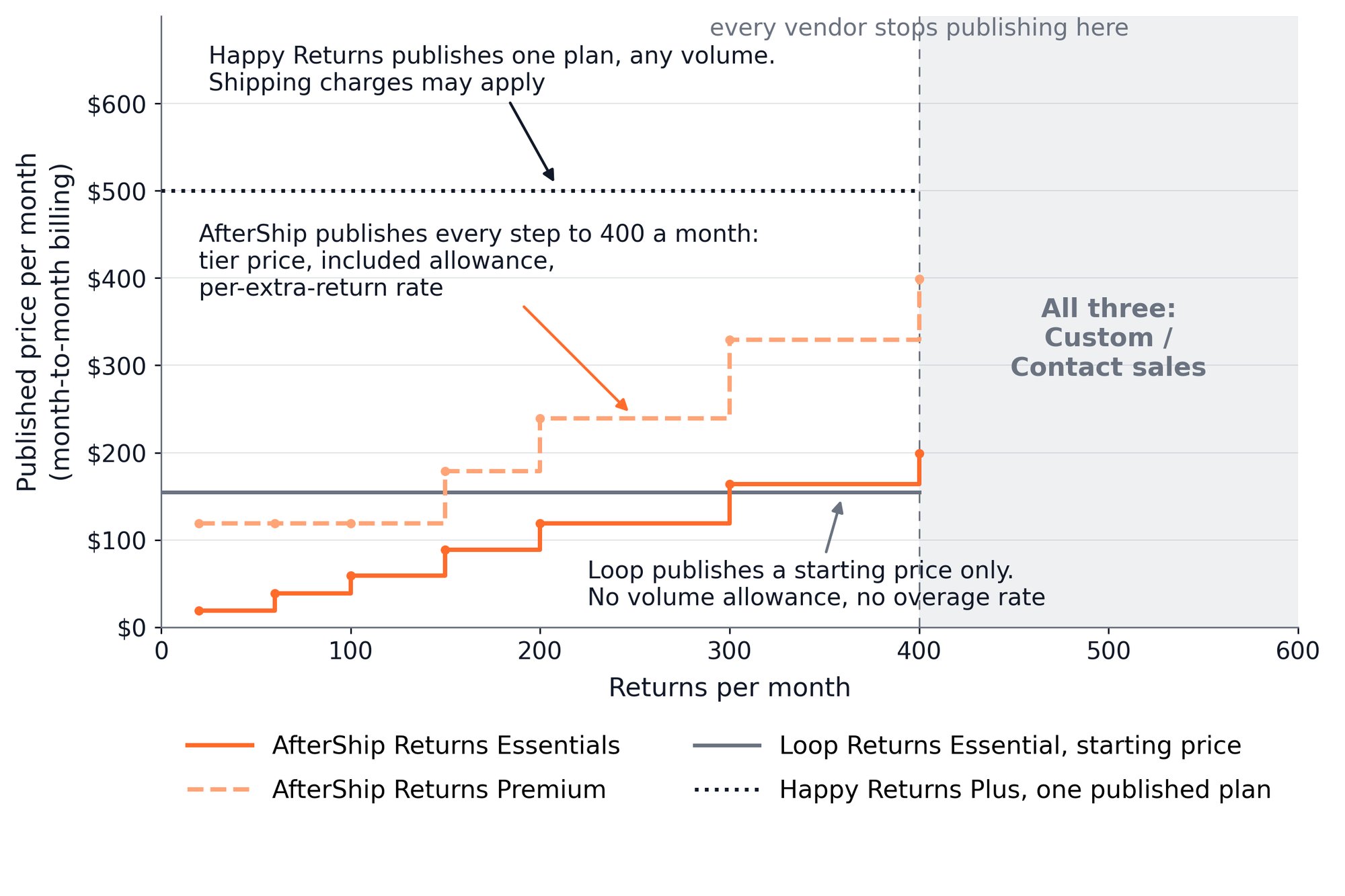
Read their story →At 100 returns a month, all three publish something. AfterShip Premium is $99/month billed annually, $119 month-to-month, and includes 1,200 returns a year, which is 100 a month. Essentials prices to $59 month-to-month at the same volume, and its card reads "Growing stores <100 returns per month". Loop Essential starts at $155 per month, with no volume allowance and no overage rate published anywhere on its pricing page. Happy Returns publishes a single plan, Plus, at $500 per month, noting that shipping charges may apply and further charges are billed separately from your Shopify invoice.
Figures read from each vendor's own pages: aftership.com/pricing/returns on 1 September 2026, and aftership.com/returns, Loop's pricing page and Happy Returns' Shopify App Store listing on 5 September 2026.
AfterShip's pricing page reprices the plan to the volume you select on its slider, so the published number already contains that volume's allowance. Adding overage on top double-counts.
AfterShip's own pricing stops publishing above roughly 400 returns a month and hands you to sales, the same as Loop and Happy Returns. The difference: every step below that line is public, including the per-extra-return rate, so you can see the slope before you're on it.
Brands at that volume are often choosing a returns platform for Shopify Plus, where the volumes are higher and the published steps run out sooner. The same publish-or-quote split shows up a generation earlier, in how Returnly's pricing stacks up.
| Criteria | Loop Returns | Happy Returns | AfterShip Returns |
|---|---|---|---|
| Pricing Model | Free Checkout+, then Essential and Advanced on annual contracts | One plan; the merchant may set a shopper fee | Published subscription ladder, plus Return Care as a shopper-funded route on Premium |
| Predictability at Scale | Tier moves and renewal increases sit in the contract | Flat plan; shipping and further charges are billed separately | Allowance and per-extra-return rate are published at every tier below Enterprise |
| Published Before Sales | Tier names and starting prices; no allowance, no overage | One plan at $500 monthly; shipping charges may apply | Tier price, included allowance and per-extra-return rate, up to 400 returns monthly |
| Included per Tier | Advanced adds Bonus Credit, Shop Now and Loop POS | Return Bar network and returns portal on one plan | Premium adds advanced workflows, fraud prevention and AI-powered exchanges |
| Carrier & Label Flexibility | Carrier rate shopping listed in Essential's included features | Box-free and label-free drop-off across its own Return Bars | ~70 carriers on AfterShip rates; connect your own (18) |
| Integration Ecosystem | Shopify-first, with integrations across its own partner ecosystem | Portal agnostic; connects through your existing returns portal | Runs on Shopify, BigCommerce, Magento and WooCommerce, so returns survive a replatform |
Happy Returns has built its own physical drop-off network. AfterShip prioritises flexibility, integrating across carriers including QR-code returns and supporting more than 9,000 Happy Returns Return Bars in the US, so a brand designs the most cost-effective experience rather than being locked into one network's footprint.
Choose AfterShip Returns if you want:
- predictable published pricing with a visible overage rate
- real automation rules as you scale past a handful of returns a month
- multi-carrier label flexibility, roughly 70 carriers on AfterShip's own negotiated rates plus your own accounts
- returns inside one platform spanning shipping, tracking, returns, and warranty on a single data layer
Consider an alternative if:
- Loop: you are Shopify-only and exchange-led, and can accept that allowances and overage are not published
- Happy Returns: you want drop-off run end to end by the same vendor as your portal, accepting one published plan with further charges billed outside the Shopify invoice
Judge the model and what the vendor publishes about it. On that test the platform that shows its ladder, its allowances and its overage rate is the safest choice for a brand that intends to grow, and that is AfterShip.
Don't Forget "Value": The Features That Justify the Cost
Three Premium capabilities earn their place on the line item, and each one works on data that a single return request does not contain.
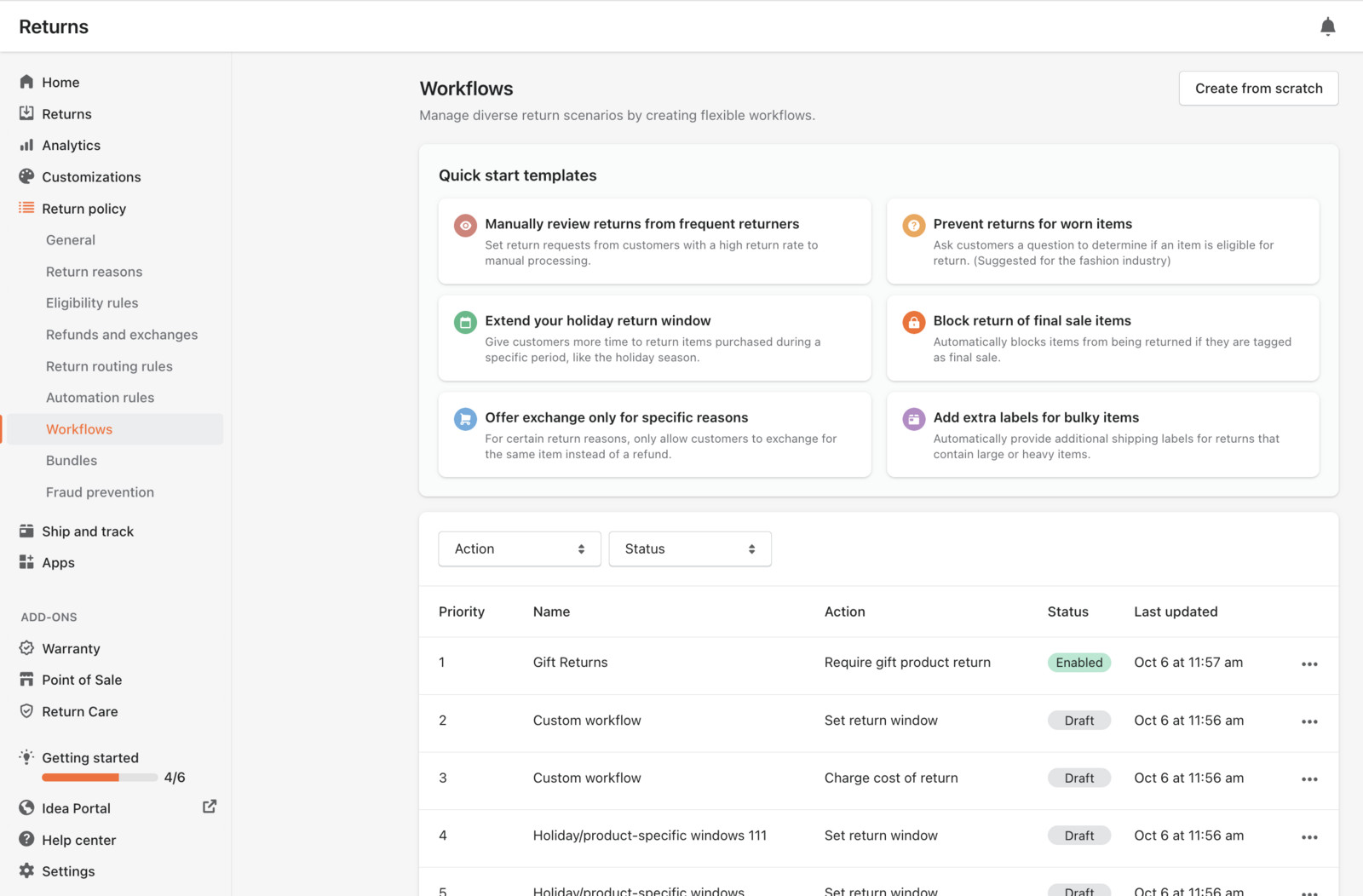
Advanced workflows are multi-step conditional approval flows with exception paths built in. Conditions draw on the order, the product, the return and the customer's history, so the same rule still applies when 100 returns a month becomes 500. The action is an approval decision that reaches the shopper without a person touching it.
Fraud prevention matches patterns across your customer base: serial returners, wardrobing, policy abuse. None of that is legible in the return sitting in front of your CX agent, because it lives in what the same shopper did on earlier orders. The action lands at approval, before a label has been paid for.
AI-powered exchanges read the shopper and your catalogue together, then surface a higher-value or better-fitting option at the moment of return. The action is a refund that leaves as an exchange.
All three sit on AfterShip Returns Premium, and they are the part of the bill you are actually buying.
The Final Calculation: Choosing Your Platform
Evaluating pricing models is crucial for forecasting returns management costs. Five questions do most of that work inside a single demo call.
- What is my included allowance at the volume I just gave you?
- What is the overage rate above that allowance?
- What does this cost at three times this volume?
- Does the price renew flat, and by how much if it does not?
- Is that answer on your pricing page, or only in the order form?
The fifth question decides the other four. A vendor who can point at a public page has already answered, and you can check the answer after the call without asking anyone. A vendor who reaches for an order form is telling you the number is set deal by deal, which is worth knowing before you build a forecast on top of it.
AfterShip answers the first four of them on a public page, so the fifth is the only one you need the call for.
Returns automation that enhances the returns and exchanges experience, reduces costs, and retains more revenue.
Book a demoFrequently Asked Questions
How much should a returns platform cost in 2026?
What ecommerce returns management platforms cost depends on your volume and on what each one publishes. At 100 returns a month, the three platforms compared here publish very different things. AfterShip Returns Premium is $99/month billed annually, $119 month-to-month, and includes 1,200 returns a year, which is 100 a month; Essentials prices to $59 month-to-month at that same volume. Loop Returns Essential starts at $155 a month. Happy Returns publishes a single plan at $500 a month. Above roughly 400 returns a month, all three move you to a custom quote, so the question that matters is how much of the ladder below that line you can see.
Is Loop Returns or Happy Returns cheaper?
All three publish an entry option, so none of them is structurally cheaper at the volume this guide targets. Loop's Checkout+ is free software, and Loop Returns Essential starts at $155 a month. Happy Returns pricing is one published plan at $500 a month, with shipping charges and further billing handled separately from the Shopify invoice. AfterShip Returns Essentials starts at $16/month billed annually, $19 month-to-month, including 240 returns a year. The difference sits in what comes attached to the number: Loop publishes neither a volume allowance nor an overage rate for any tier, so its starting price is a starting point rather than a figure you can plan against, while AfterShip publishes the allowance inside each tier and the rate charged on every return above it. That is what makes a like-for-like comparison possible at all.
What's the ROI on a returns platform?
Work it from your own numbers rather than from any vendor's own ROI model. Take your monthly returns, find that volume on each published ladder, add the cost of anything above the included allowance, then run the same pass again at three times the volume. Where a vendor's page stops publishing, that gap is itself the answer about how predictable the cost will be as you grow. Both passes run cleanly against AfterShip Returns, where the tier price, the included allowance and the per-extra-return rate all sit on the page: $0.50 per extra return on Essentials, $1.00 on Premium. That is the full calculation, published, before anyone books you a call.
Conclusion
Your returns volume will keep moving, and it will not move smoothly. The platform you choose is a bet on how clearly you will see what that movement costs, and the three compared here differ far more on that than on their entry prices.
Read the model first, then the allowance, then the rate charged above it. Where a vendor stops publishing, treat the silence as information, because that is the point where the forecast stops being yours to make.
AfterShip publishes further down that ladder than the alternatives here, and you can check the whole of it yourself in our detailed pricing plans before you talk to anybody.