At 25 orders a day, copying addresses into a label tool stops being a chore and becomes the bottleneck. Stamps.com and Shippo both import Shopify orders and print labels in batches, so the real difference is how each is built and priced for an online store. Past the label, the tracking emails, returns and delivery exceptions decide how many "where is my order?" messages you answer.
This comparison takes those in order: how each tool is built and for whom, what each does at your real plan, and what each costs at 150 to 750 labels a month.
The Real Difference: Printing Postage vs. Managing Ecommerce Shipping
Your shipping tool was chosen for a business that no longer exists. When the office sent a dozen envelopes and the odd parcel, buying postage was the whole job. At 150 to 750 labels a month it is one step inside a workflow that starts when an order lands in Shopify and does not end until the customer stops asking where it is.
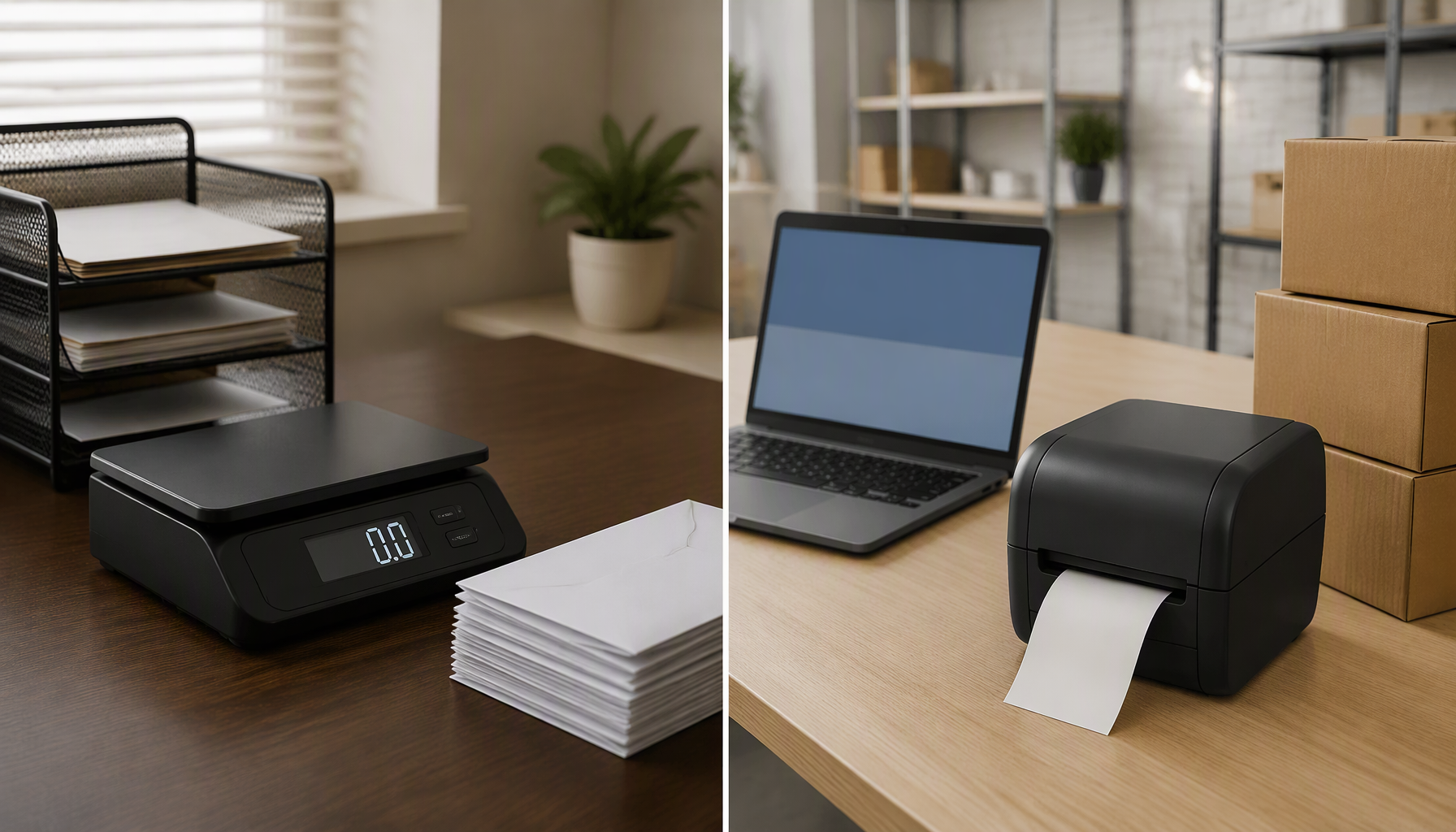
Both tools connect a store, so what separates them is positioning. Stamps.com markets to offices and also imports ecommerce orders for shipping. Its own pricing page describes the Professional plan as built for busy offices that mail and ship every day, and that plan carries the store-side work: multi-address batch printing, tracking and notification emails, unlimited stamps and shipping labels. Shippo is built for ecommerce stores and puts the store connection on its entry plan. That is the difference between Shippo and Stamps.com in one line: each is built around a different job, and the plan ladder follows from it.
So the question is not which tool can do the job. It is which job each product was shaped around, and which plan you land on to get the store workflow. That framing, rather than a feature count, is what choosing the right shipping software comes down to.
| Stamps.com | Shippo | |
|---|---|---|
| The job | Task: buy postage for what the office sends | Workflow: fulfil a store's orders |
| Marketed to | Busy offices that mail and ship every day | Ecommerce stores |
| Where the store workflow sits | A paid upgrade | The entry plan |
Shippo vs. Stamps.com: 2026 Feature Breakdown for Online Sellers
Seven criteria decide this at your volume, and each one maps to a task you already do by hand. Store connection decides whether orders import and tracking posts back, or whether you re-key them. On Stamps.com vs Shippo integrations for Shopify, both connect the store; what differs is the plan each puts it on. Batch printing decides whether a pick list becomes one print run. Rate comparison decides whether you can compare real-time shipping rates, USPS against UPS, on the order in front of you. Modern shipping platforms reduce costs via multi-carrier rate shopping.
Read the plan detail as carefully as the capability. Stamps.com batch printing and buyer notification emails begin on Professional. Shippo includes automation rules, return labels and unbranded tracking emails on its free Starter plan, and gates branded tracking pages and notification emails to Pro. Both tools do this work. They gate it at different plans.
| Criteria | Stamps.com | Shippo | Why It Matters |
|---|---|---|---|
| Ecommerce platform integration | Shopify, Amazon, eBay, Etsy, WooCommerce online, BigCommerce, Squarespace; Shopify imports Paid and Not Fulfilled orders and posts tracking back | Unlimited store integrations on every plan | Orders import and tracking posts back on their own rather than being re-keyed by hand at 25 orders a day |
| Batch label printing | On Professional and above | Up to 100 labels per batch | At 25 orders a day a pick list becomes one print run |
| Multi-carrier rate comparison | Rate Advisor compares rates and delivery times; Best Rate auto-selection is USPS only and runs only in the PC software | Compares rates at label creation | Seeing USPS against UPS on each order is where postage cost actually moves at 150 to 750 labels a month |
| Return label generation | Every plan, QR and pay-on-use, domestic | Pay-on-use, domestic | Returns start arriving once volume does, and both bill only on use |
| Post-purchase customer experience | Buyer notification emails on Professional; branded page and emails in beta, by request | Unbranded tracking emails and pages on Starter, branding from Pro | What the customer sees decides how many where-is-my-order emails you answer each week |
| Automation and rules | Unlimited IF/THEN rules, browser version with a connected store | Automation rules on every plan | Rules are what keep 750 labels a month from becoming manual work |
| Pricing model | Basic $14.99 a month, 10 labels; Professional from $29.99; Multi-Location from $49.99; overage 15% of label cost, $2 to $8 | Starter free to 30 labels a month; Pro $19, $29 and $54 by band, about 10% less annually | Both land you on a paid plan at 150 to 750 labels a month, so the question is what each plan buys you |
At 150 to 750 labels a month, both tools clear the bar on capability. What you land on is a plan, and what your customer sees after the label prints. The best shipping software for ecommerce at this volume is the one whose plan carries the workflow you actually run.
Pricing Explained: What Each Plan Actually Costs at Your Volume
Shippo vs Stamps.com pricing is two different shapes of bill: a subscription ladder on one side, a volume band on the other. At your volume you are paying either way, so the question is what the money buys.
Stamps.com is subscription only, with no free plan and a 30-day trial. Basic runs $14.99 a month and caps you at 10 shipping labels. Professional starts at $29.99 a month and lifts that to unlimited stamps and shipping labels, and Multi-Location starts at $49.99 a month on the same unlimited terms. Go over a plan's label limit and the overage is 15% of the label cost, with a $2 minimum and an $8 maximum. At 150 to 750 labels a month, Basic is not a plan you can stay on.
Shippo prices its entry plan at zero and its paid plan by monthly label volume. Starter is free up to 30 labels a month. Pro is $19 a month up to 200 labels, $29 a month at 201 to 500 labels, and $54 a month at 501 to 1,000 labels, about 10% less billed annually. Your 150 to 750 labels a month land in the first or second Pro band, so budget for a paid plan on either side.
Shippo is not the only one offering a free entry plan. AfterShip Shipping publishes a free plan of 10 labels a month on its Shopify App Store listing. What sits on top of it is what counts: Smart Carrier Recommendation is on every AfterShip Shipping plan, not held behind an upgrade.
One more number matters more than any of these subscriptions at your volume, and it is the postage itself.
USPS Ground Advantage: from $7.90 at the Post Office, from $6.93 with Commercial Pricing, per usps.com.
When Stamps.com Still Fits in 2026
Count the labels you printed last month before you decide anything. If the answer is a few dozen, most of them envelopes, the tool you have is the tool for the job. Stamps.com fits businesses whose shipping is mostly office mail and a few parcels a month.
That fit is real and it holds. It stops holding at 150 to 750 labels a month, where the plan ladder settles the question before any feature comparison does. The Basic cap and the overage charged above it, both priced out in the section above, put you on Professional at your volume regardless of which features you end up using.
Once Professional is the floor, price is settled and the workflow around the label is what is left to compare.
Where Shippo Fits a Growing Online Store
A growing store needs the store connection working on day one. Shippo is eCommerce shipping software with direct store integrations. Its published plan gates read like this:
- Starter is free up to 30 labels a month and already includes automation rules, return labels and unbranded tracking emails.
- Store integrations are unlimited on every plan.
- Batches run up to 100 labels at a time.
- Your own carrier accounts work on every plan, at $0.05 a label on Starter and free on Pro.
- Branded tracking pages and notification emails start on Pro.
Two of those gates land on you at this volume. 30 labels a month is roughly a day and a half of your order flow, so Pro arrives in the first week. Branding, the part your customer sees, starts there too.
You've Outgrown Stamps.com... Will You Outgrow Shippo Too?
Once labels are automated, the load shifts to what happens after them. Where is my order, can I send this back, and why did this parcel sit in a facility for four days. Delivery exceptions are the worst of the three, because nobody sees one until a customer complains.
Baymard Institute puts a number on the first of those. Asked which features matter most in a customer account, 51% of shoppers named checking order status or delivery tracking, ahead of everything else on the list.
That queue is what the post-purchase layer is built for. AfterShip Shipping buys labels in bulk on every plan, and its Smart Carrier Recommendation compares live rates across connected carrier services and screens out services with a high exception rate for a shipment's origin and destination, using AfterShip tracking data. An exception you avoid is a ticket you never answer. Branded tracking belongs to AfterShip Tracking, the product that lets a store deliver a branded tracking experience once that queue starts growing.
AfterShip Shipping's automation rules are a Pro plan feature, where a rule can match on package weight and ship-to postal code and set the carrier account and service for those orders.
Shippo vs. AfterShip: Choosing Your Next Step
Labels are solved either way by this point.
StackCommerce reduced WISMO tickets by 71% using AfterShip Tracking.

“AfterShip's shipment tracking is pretty amazing stuff. And I think the 71% drop in WISMO tickets is due to us providing that tracking visibility to our customers.”
Deryck Lim, Sr. Operations Manager
Read their story →AfterShip runs shipping, tracking, returns, and warranty on one stack: labels and rates in AfterShip Shipping, branded tracking pages and notifications in AfterShip Tracking, return labels and portals in AfterShip Returns.
Stamps.com versus Shippo is a label-workflow decision. If labels are solved and the support load is not, that is where the post-purchase layer earns its place. That is the point at which a more powerful alternative like AfterShip is worth comparing directly.
AfterShip Shipping's automation rules start on the Pro plan ($89 a month billed monthly, or $69 a month billed annually, for up to 2,000 labels a month), while Shippo includes automation rules on its free Starter plan. Smart Carrier Recommendation, which compares live rates across connected carrier services and screens out high-exception services, is on every AfterShip Shipping plan.
Stamps.com still fits if:
- shipping is mostly office mail and a few parcels a month
- the workflow is USPS-first
- Certified Mail and letter postage matter more than store automation
- a 10-label plan limit is not a constraint
Choose AfterShip Shipping if:
- you want automation rules on a plan priced by label volume
- you want live rate comparison across connected carrier services on every plan, with high-exception services screened out
- you want branded tracking pages and notifications through AfterShip Tracking as the support load grows
- you want a path into returns through AfterShip Returns without changing label tools again
- you want one data layer across shipping, tracking, returns, and warranty rather than a separate tool per stage
Simplify shipping and order fulfillment across Shopify, TikTok Shop, and your carrier network.
Book a demoFrequently Asked Questions
Can I use my own UPS account with Shippo?
Yes, on every plan. Shippo lets you connect your own carrier accounts on Starter, Pro and Premier. On Starter there is a $0.05 charge per label for using your own account, and on Pro and Premier that charge is removed. Bringing your own UPS account matters once you have negotiated rates worth keeping, because it lets you print against your contract rather than against a platform's published rates.
What are the limitations of the Shippo free plan?
Starter is capped at 30 labels a month and one user login. It includes automation rules, return labels and unbranded tracking emails, so the capability is there, but the tracking pages and notification emails your customer sees carry no branding until you move to Pro. At 150 to 750 labels a month you will clear the label cap in the first days of the month, which makes Starter a way to test the workflow rather than run it.
Is Shippo better than Pirate Ship?
Pirate Ship is free to use and covers USPS and UPS. Its tracking emails link the customer out to the carrier, its return labels are USPS-only and approved on request, and it stopped taking new Etsy connections in October 2024. Shippo carries more store integrations, its own automation rules and pay-on-use return labels. If your orders arrive from a store and you want automation around them, that is the difference between the two.
How do I migrate from Stamps.com?
Export your print history to CSV first, then close the account online or by phone. Any remaining postage balance is refunded in 4 to 8 weeks, and promotional postage is non-refundable, so spend it before you close. Shippo documents a CSV order upload for bringing orders in. If you are weighing the post-purchase side at the same time, AfterShip Shipping connects to Shopify through its Shopify App Store listing and buys labels in bulk on every plan.