Your order volume just doubled, and printing labels is now your biggest bottleneck. Shippo and Stamps.com both fix the label: both give you USPS Commercial pricing, and both email your customer a tracking link. Neither publishes a self-service returns portal, and neither web app shows your customer a delivery date before they buy. That second half of the job is where a growing brand's next bottleneck sits, and it is what AfterShip's shipping, tracking, returns, and warranty suite is built for.
So the real question in front of you is whether you are buying a label printer or the platform that runs everything after the label. At 50 to 500 orders a month, that distinction decides whether you are still on this tool in 18 months or migrating again.
The Short Answer: Who Wins in 2026?
Each of the three fits a different shape of business, and scope is what separates them.
Where Shippo and Stamps.com fit
- Shippo suits a brand that wants multi-carrier labels priced by label volume, starting on a free plan and stepping up through Pro bands as it grows.
- Stamps.com suits an office that mails as much as it ships and wants USPS-rooted postage software on a flat monthly plan.
Where AfterShip Shipping fits
- You want the label and the work after it held on one data layer instead of stitched across separate vendors.
- Smart Carrier Recommendation is included on every plan, with no tier gate to clear first.
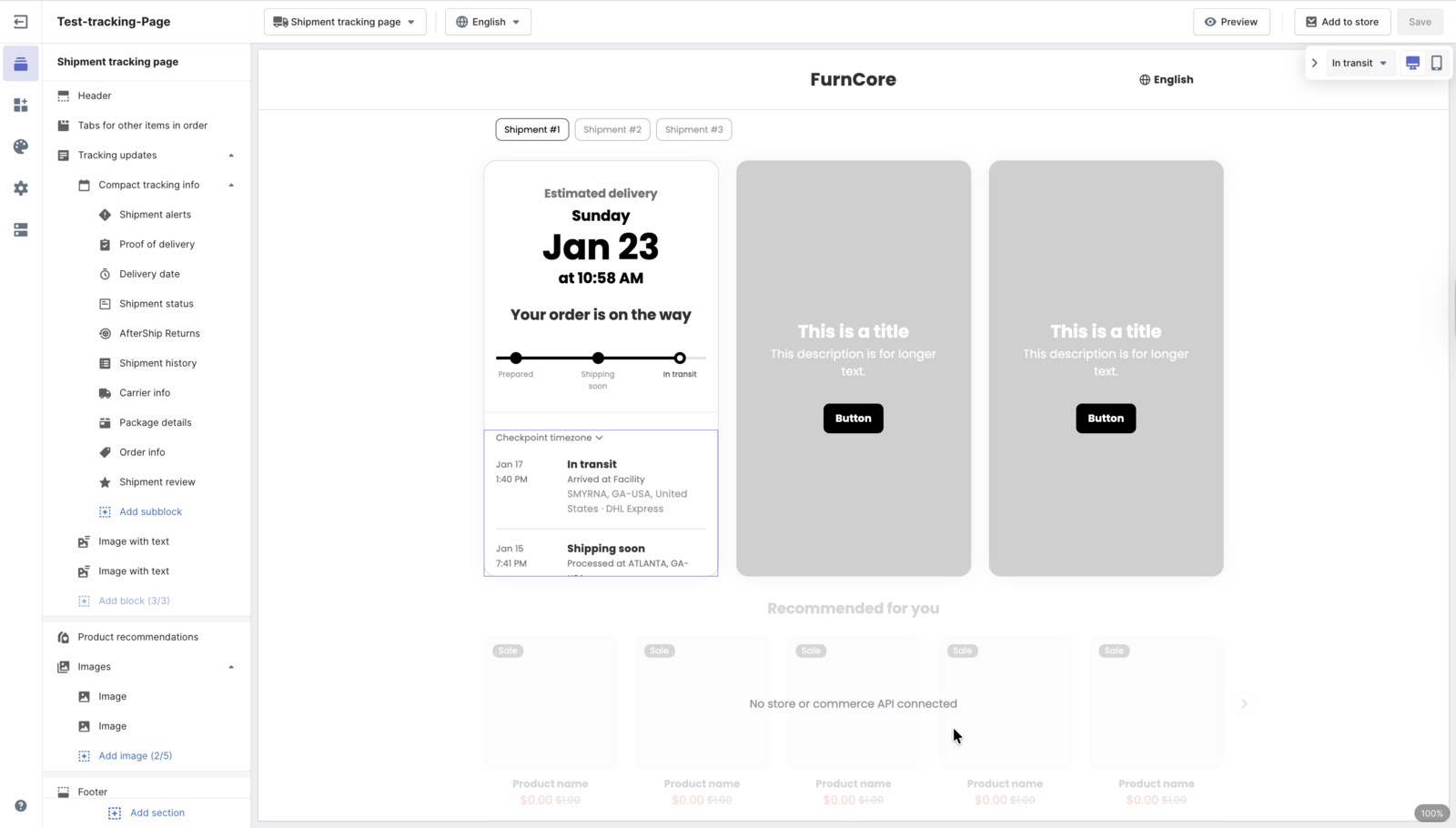
- Add AfterShip Tracking when order-status questions start eating support hours; it carries the branded tracking page and the delivery date a shopper sees before buying.
- Add AfterShip Returns when returns stop being occasional; it gives the shopper a self-service portal to start one.
- Each product is a separate subscription with its own pricing page, so you add the next one at the point the problem shows up.
Shippo Deep Dive: What You Get and Where It Stops
Start with what the money buys at each stage. Shippo pairs a free Starter plan with paid Pro tiers priced by label volume. Starter covers fewer than 30 labels a month and includes tracking pages, order-notification emails, return labels and automation rules. Pro runs across three bands up to 1,000 labels a month, with annual billing lower in each band. Pro and Premier add branded tracking pages, branded emails and AI-powered estimated delivery dates; Premier carries a 99.9% uptime SLA. Those tiers and inclusions are published on Shippo's pricing page.
Where it stops matters more at your volume. Return labels are pay-on-use and domestic only, there is no shopper-facing self-service returns portal, and the web app's delivery estimate is shown to you at label purchase, not to the shopper before they buy. Costs also move with volume: the first label past a plan allowance moves the account up a plan level with no prorated refund, and using your own carrier account on Starter carries a per-label fee. For a closer read, we published an honest verdict on Shippo's capabilities.
Shippo and AfterShip Shipping both let you start on a free plan, and both outgrow it within the first 30 labels a month. AfterShip Shipping's fixed automation rules sit on Pro and above, capped at 10 outside Enterprise, where Shippo includes rules on its free plan. But AfterShip includes Smart Carrier Recommendation on every plan, so it picks the service per shipment on live rates and lane performance without a rule to build.
Stamps.com Deep Dive: USPS-Rooted Postage Software
If most of what leaves your building is mail rather than parcels, the shape of this option changes. Stamps.com is USPS-rooted postage software from ShipStation Global. The web app runs in Chrome, Firefox or Safari on a PC or Mac, a classic Windows PC client is still offered for XML import and export and ODBC, and both a REST API and a SOAP API are published. Stamps.com charges a monthly subscription on every plan, each with USPS Commercial pricing. There is no free tier, and the plans run from Basic through Professional to Multi-Location, as set out on Stamps.com's pricing page.
Plan structure is the part worth reading closely, because stamps.com vs shippo for shopify turns on the tier where store connections appear. Basic is pitched for individuals and small offices and caps at 25 stamps and 10 shipping labels a month, with an overage of 15% of the label cost. Professional lifts both caps and carries the ecommerce workflow: store connections, batch label printing, cross-carrier rate comparison and unlimited automation rules, though those rules run only in the browser app and on certain plans.
The limits show up after the label. Recipient tracking emails start on Professional. The branded tracking page and branded emails are a beta enabled on request. No shopper-facing returns portal appears on its pages, though return labels print on every plan, and no customer-experience integration such as Klaviyo or Gorgias is listed on the surfaces we checked.
Shippo vs. Stamps.com: Head-to-Head Feature Comparison
The honest shippo vs stamps.com pricing answer splits on label volume: one bills by band, the other by a flat monthly fee. What you weigh here is cost against what happens after the label, and no plan wins on price alone. Rate accuracy at checkout depends on your own carrier accounts, which Shopify's documentation on third-party carrier-calculated shipping explains.
| Criteria | Shippo | Stamps.com | AfterShip Shipping |
|---|---|---|---|
| Post-purchase ecosystem | Tracking pages and notification emails, branded on Pro. No shopper returns portal. | Recipient tracking emails on Professional. Branded page in beta on request. | Separate Tracking and Returns subscriptions add branded pages, notifications and a shopper returns portal. |
| Monthly price, billing term and volume band | Starter free under 30 labels/month. Pro by band, monthly: $19 (1-200), $29 (201-500), $54 (501-1,000). Annual lower. | No free plan. Monthly billing: Basic $14.99 (10 labels), Professional from $29.99 (unlimited), Multi-Location from $49.99. | Free plan at 10 labels/month. Annual billing: Essentials $9/month (1,200 labels/year), Pro $69/month (24,000 labels/year), Enterprise custom pricing. Annual label quota rather than monthly bands. |
| Per-label and overage fees | Per-label fee for own carrier account on Starter. Passing an allowance bumps the plan. | Basic caps at 10 labels/month; overage 15% of label cost, min $2, max $8. | Labels billed through Easyship or through your own carrier accounts, which connect on every tier. |
| Carrier discounts (USPS, UPS, DHL) | USPS Commercial pricing and Priority Mail Cubic available to every user. | USPS Commercial pricing on every plan. UPS and DHL Express access included. | USPS discount account on every tier, alongside your own negotiated carrier rates from connected accounts. |
| Ease of use and setup | Browser app with bulk label editing on every plan. | Browser app on PC or Mac, plus a classic Windows client. | Browser app that takes orders from Shopify, BigCommerce, WooCommerce and TikTok Shop. |
| Shopify integration quality | Connects to Shopify; branded tracking pages and emails on Pro. | Store connections on Professional. No Klaviyo or Gorgias integration listed. | Shopify app listing with multi-channel order sync. Auto-sync into AfterShip Tracking is a setting needing an active Tracking subscription. |
StackCommerce cut WISMO tickets by 71% year over year with AfterShip Tracking.
The tracking page and notifications took over the order-status conversation before customers had to ask.
The Blind Spot: Why Label Printing is Only Half the Battle
Once the parcel leaves your warehouse, the work changes shape. What lands on your team is delivery expectations, order-status questions and returns, and none of it is solved by the label that started it. Both tools do part of this. Shippo and Stamps.com each email your customer a tracking link, Shippo adds branded tracking pages and emails on Pro, and Stamps.com offers a branded tracking page and branded emails as a beta enabled on request. Return labels print from both.
The contrast is depth, and it shows in two places. Neither publishes a shopper-facing self-service returns portal, so a return still starts as an email to your team and ends with someone generating a label by hand. And neither web app shows the shopper a delivery date before they buy, which is the moment the expectation is actually set. A status page tells a customer where the parcel is after the fact. A delivery date on the product page shapes what they expected in the first place.
At 50 to 500 orders a month, both gaps are absorbed by a person. That person is usually you.

The Third Option: AfterShip Shipping, The Platform Approach
What do you want to own after the label prints? AfterShip connects shipping, tracking, returns, and warranty on one data layer. AfterShip Shipping is the shipping component of it, and each of those products is a separate subscription with its own pricing page. You buy shipping first and add the others when the work arrives.
At 50 to 500 orders a month, what AfterShip Shipping does is multi-carrier label generation with live rates. When you go to buy a label, the app returns rates and transit times across the services available for that shipment, and you pick from them. Labels are billed either through Easyship, which provides and bills the discounted rates, or through your own carrier accounts, which connect on every tier alongside a USPS discount account.
Smart Carrier Recommendation is included on every plan. It is off by default. Once you turn it on, it selects a carrier service for each shipment from live rates and that lane's past performance and puts it in front of you to review. It never buys the label, so nothing moves until you approve the choice.
Anyone evaluating label generation across vendors can compare multi-carrier shipping software before narrowing the list.
How a Unified Platform Solves Your Next Problem
The order record the label created is the same one the next two products read.
- Turn on auto-sync and every label you print in AfterShip Shipping flows into AfterShip Tracking, where your branded tracking page and notifications take over. Auto-sync is a setting, it needs an active AfterShip Tracking subscription, and the shipments it creates draw on your Tracking quota. Hosting that tracking page on your own domain is a Tracking Premium feature.
- When a customer needs a return, they start it in the AfterShip Returns self-service portal and the portal issues the label. If you connect your AfterShip Shipping account, that label prints through it, which is one option alongside your own carrier account and Easyship.
- AI EDD puts a delivery date on the product page and at checkout, trained on historical tracking data across major carrier services and on your own tracking patterns, with up to 95% prediction accuracy. That date comes with AfterShip Tracking, which lists AI-powered EDD on Premium and above, so a shipping subscription does not carry it alone.
Each of those is a paid product you turn on when the problem is real, and each one reads the same order record the others wrote to. That is the difference an AI-powered tracking page makes when it is fed by the system that printed the label.
The Final Verdict: Which Shipping Software Should You Choose in 2026?
There is no single best shipping software for ecommerce 2026; the band you are in decides more than the feature list does. Between 50 and 500 orders a month, the tool you pick now either carries you to 2,000 or gets replaced at 800. Match the choice to the stage you are in. A complete shipping software comparison covers the wider field for anyone still building a shortlist.
- Choose Stamps.com if your parcel count is small and flat and it is not the number that grows next year. It is sized for an office volume that stays where it is.
- Choose Shippo if you are early in the band, under a few hundred labels a month, and the post-purchase work is still small enough for one person to absorb by hand.
- Choose AfterShip Shipping if you are moving through the band with the intent of leaving it. Somewhere near 500 orders a month the tracking and returns load stops being absorbable, and what you want by then is a shipping product you can extend with AfterShip Tracking and AfterShip Returns without rebuilding the label workflow underneath.
Simplify shipping and order fulfillment across Shopify, TikTok Shop, and your carrier network.
Book a demoFrequently Asked Questions
Which is cheaper for a small business, Shippo or Stamps.com?
People searching shippo vs stamps com want one cheaper option, and there is not one; it turns on label volume. Shippo's Starter is free under 30 labels a month, and Pro is banded on monthly billing: $19 at 1 to 200 labels, $29 at 201 to 500 and $54 at 501 to 1,000, with annual billing lower in each band. Stamps.com charges a monthly fee on every plan with no free tier: Basic at $14.99 capped at 10 labels a month, Professional from $29.99 with unlimited labels, and Multi-Location from $49.99. AfterShip Shipping lists Essentials at $9 a month for 1,200 labels a year and Pro at $69 a month for 24,000 labels a year on annual billing, plus a free 10-label-a-month plan.
Does Shippo or Stamps.com have better carrier discounts?
On USPS, they are at parity. Every Stamps.com plan carries USPS Commercial pricing, and Shippo makes USPS Commercial pricing and Priority Mail Cubic available to every user, including the free Starter plan. That makes USPS access settled between them, so the decision lands on the criteria around it. AfterShip Shipping gives every tier a USPS discount account, with discounted labels provided and billed by Easyship alongside your own negotiated carrier rates.
Is AfterShip a good alternative to Shippo and Stamps.com?
It is the stronger fit when the work after the label is already on your plate. AfterShip Shipping prints multi-carrier labels with live rates and includes Smart Carrier Recommendation on every plan. What sits beside it is the difference: AfterShip is a platform covering shipping, tracking, returns, and warranty, and each of those is a separate subscription with its own pricing page. Add AfterShip Tracking and your branded tracking page, notifications and pre-purchase delivery dates run on the same order record your labels created, with AI-powered EDD on Premium and above. Add AfterShip Returns and your shoppers get a self-service portal. You buy them as the problems arrive, and each one reads the data the last one wrote.