Most 2025 peak post-mortems blamed the carriers. Capacity ran short in week two, surcharges landed harder than the model predicted, and a regional partner missed the commitments it had signed. The review deck more or less wrote itself around those facts.
Go back through the ticket queue, though, and a different pattern usually shows up. The label printed. The parcel moved. What broke was the seam between the system that bought the rate and printed the label, and the system that was supposed to tell the customer where the parcel had got to.
That seam is the reason this list is organised the way it is. It helps to start where most evaluations start and define what multi-carrier shipping entails: connecting several carriers through one system rather than running each carrier's own portal. That definition is accurate, and it hides the thing that decides your shortlist. Multi-carrier platforms for enterprise retailers cover two procurement decisions at once, an execution decision and a visibility decision, and the vendors below sit on one side of that line or the other. Only one of them publishes products on both. On the enterprise 3PL side specifically, see the Metapack alternatives for enterprise 3PL.
Split the category first. Then the ranking makes sense.
What "multi-carrier" actually means in an enterprise stack
The word covers two functions that share a label and almost nothing else.
Execution is everything that happens before the parcel exists. It means holding or connecting carrier accounts, shopping rates across them, generating the label, manifesting, and producing customs documentation for cross-border lanes.
Visibility and experience begins the moment the parcel does exist. It means aggregating tracking data from whichever carriers touched the shipment, turning that into an estimated delivery date, firing notifications when the shipment deviates, and running the branded tracking and returns portals the customer actually sees.
Different buyers, usually. Execution is scored by your transportation and finance teams on landed cost per parcel. Visibility is scored by CX on ticket deflection and by marketing on what the tracking page does for repeat purchase.
The vendors you will meet on the execution side are largely absent from this ranking, and they should be named rather than quietly omitted. EasyPost, Metapack, nShift and the ShipStation API all sell label generation and rate shopping at scale. They are credible at what they do. They are scoped to the execution layer, which is why a list evaluating both layers does not rank them. If your volume sits below the enterprise line, the execution question is close to the whole question, and how the shipping-software field ranks at that scale is a separate piece of work.
Here is the part that trips up most shortlists.
Carrier counts from the two layers are not comparable, and vendors publish them as if they were. A label-generation count and a tracking-integration count measure different work, so putting them in the same column produces a ranking that means nothing. The published figures make the problem obvious:
- EasyPost advertises 100+, and its own materials scope that explicitly to label generation.
- Narvar advertises 1,000+, which describes tracking integration rather than anything you can print a label against.
- project44 publishes 160+ last-mile carrier integrations, alongside a 280,000+ network figure that appears elsewhere on its own site and counts something else entirely.
- nShift's carrier-network page pairs 1,000+ carrier connections with 10,000+ active carrier services, which are two different units and a tenfold gap.
None of those vendors is being dishonest. They are each counting the thing their product does, and the numbers only mislead once a buyer lines them up in a spreadsheet column headed "carriers".
The split is not an argument this article invented to justify its shortlist. Gartner maintains multicarrier parcel management as its own category, separate from transportation management systems, and publishes a Market Guide for Multicarrier Parcel Management Solutions, current edition 15 June 2026. Two analyst categories exist because two buying decisions exist.
Five criteria for an enterprise multi-carrier platform in 2026
These five run in the order a real evaluation runs, which is not the order a vendor demo runs. Each one is scored against every platform later in this piece, so they are worth defining precisely now.
1. Carrier network and contract model. Not carrier count. The question is whether you keep your own negotiated accounts and rates, or whether you are routed through the vendor's contracts and pricing. Most enterprise retailers have spent years earning their FedEx and UPS terms and are not willing to hand that hard-won position to a software vendor. The follow-up question matters just as much: how fast can you add a regional carrier when November goes sideways?
2. Peak-season reliability. Score this on published contractual commitments, not on a status page. A vendor that publishes an uptime figure, a service-credit schedule and named response targets for a severity-one incident is making a commitment you can hold them to at renewal. A vendor that publishes a green dashboard is making no commitment at all. The difference only becomes visible on the worst day of your year.
3. Actionable business intelligence. Volume dashboards are table stakes. What changes decisions is carrier performance broken out by lane and service level, with on-time rates you can put in front of a carrier rep during a rate negotiation. If the reporting cannot tell you which carrier is failing on which route, it cannot influence a single procurement conversation.
4. Unified post-purchase experience. This runs from the delivery estimate a shopper sees at checkout, through the notifications that fire when something slips, to the branded tracking page and the returns portal. Split across two vendors, it becomes a data-join your team builds and then maintains forever.
5. Platform and helpdesk integration depth, including the ERP path. Commerce platform and helpdesk connectors decide how much of this your engineers touch. The ERP question deserves an honest answer per vendor rather than a checkmark, because "integrates with SAP" covers everything from a badged, certified connector to a middleware project your team scopes and staffs.
Your CFO cares about criterion one, your Head of CX cares about criterion four, and the shortlist you defend upward has to survive both. Score the five vendors below against all five, and the field sorts itself faster than any feature matrix will sort it for you.
The top 5 enterprise multi-carrier platforms for 2026
The order below follows coverage across both layers. Each entry says what the platform is, which layer it occupies, where it is genuinely strong, and where its boundary sits. Those boundaries are statements about product scope, not about quality.
1. AfterShip
AfterShip is a complete post-purchase suite that sells into both layers. Shipping handles execution. Tracking, Returns and the analytics layer handle visibility and experience. That combination is the reason it opens this list, and it is a narrow claim rather than a broad one: no other vendor here publishes products on both sides of the line.
On execution, AfterShip Shipping covers 130+ carriers you can generate labels with in one integration, per its product page as of August 2026. The number matters less than the contract model behind it, which is criterion one. The Shipping page describes both paths: ship with AfterShip's connected carriers, or onboard your own carrier accounts and your own negotiated rates. For a retailer that has spent five years earning its FedEx terms, that second path is the one that decides whether a platform is viable at all.
Reliability is where the enterprise case gets unusually concrete. AfterShip publishes a contractual 99.9% Service Uptime commitment, backed by a tiered service-credit schedule and defined incident response and resolution times by severity. Most vendors in this field publish a status page instead. A status page tells you what happened; a commitment with credits attached tells your procurement team what you are owed when it happens on 2 December.
Read the agreement before you cite it internally, because the exact credit tiers and severity targets are the part your legal team will want.
On API capacity, Enterprise accounts receive custom rate limits set at onboarding rather than a published shared ceiling. Paired with the uptime commitment, that is the peak-readiness answer, and it is worth getting in writing during evaluation rather than discovering in November.
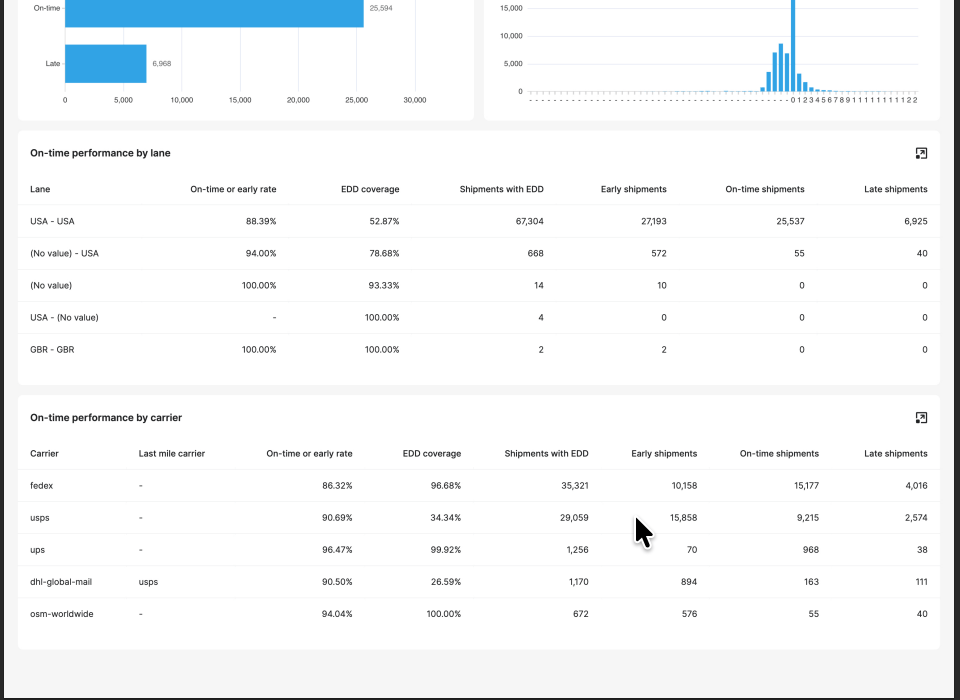
That reporting is also what connects the two layers in practice. Carrier performance by lane sits in the same platform as the notifications that fire when a lane slips and the returns portal the customer lands in afterwards, so the joins between them are not a project your engineering team owns.
The published outcomes from that side of the platform are worth reading for what they are. StackCommerce reports a 71% reduction in WISMO tickets and Vivino 50%. Those are post-purchase tracking results, not shipping-execution results, and no vendor in this field publishes a named customer outcome for label generation. Treat them as evidence for criterion four and nothing else. On independent proof, AfterShip holds a 4.7 out of 5 rating on G2 across 311 reviews.
The honest limitation is ERP, and it belongs here rather than buried in a table. AfterShip publishes no SAP connector, and its NetSuite connector is scoped to Tracking in AfterShip's own documentation. If your integration architecture assumes a badged, vendor-certified ERP connector, AfterShip is not where that requirement gets met, and project44 scores above it on exactly this point.
What AfterShip offers instead is the path most enterprise stacks already run: native commerce-platform connectors, a documented multi-carrier API, and integration either directly or through whatever iPaaS layer your team already maintains. Whether that is the right trade depends on whether your ERP work is already brokered through middleware. For most retailers on this list's volume profile, it is.
2. Narvar
Narvar is an enterprise post-purchase platform with a product line covering Promise, Secure, Track, Shield, Notify and Assist. Its enterprise credentials are real: a long Tier-1 customer base, a documented SAP Hybris integration for retailers running SAP's commerce platform, and a resource library that shows up in most category searches.
Its boundary is a category boundary. Narvar publishes no outbound shipping-execution product, so it does not compete for the label-generation and rate-shopping decision at all. That is a scoping fact rather than a capability gap, and it is worth stating precisely because the opposite gets said carelessly: Narvar does generate return labels, and does so as a documented part of its returns product.
If your execution layer is already solved by a carrier-direct integration or a dedicated shipping platform, Narvar remains a credible answer to the visibility half of the question. If you are trying to consolidate both halves onto one contract, it does not reach that far. If Narvar is on your shortlist, dive deeper into the AfterShip vs Narvar matchup before you book the demo.
3. project44
project44 is a real-time transportation visibility platform covering multimodal freight and last-mile shipments. It is a Leader in the 2025 Gartner Magic Quadrant for Real-Time Transportation Visibility Platforms, its fifth consecutive year in that position. It also holds SAP Endorsed App status on the SAP Store as of June 2026, which is the badged ERP connector the previous section conceded.
Its retail credentials are stronger than the freight framing suggests. Its own ecommerce page displays Sephora, Neiman Marcus, Ralph Lauren and Abercrombie & Fitch among others, so anyone describing project44 as uninterested in B2C retail has not read the page.
The boundary is parcel execution. project44 publishes no parcel-label generation product, so it sits in the visibility layer for your purposes, and its centre of gravity is multimodal freight rather than the parcel flows a DTC and retail operation actually ships. For the enterprise view of that trade, our head-to-head on project44 goes further.
4. ParcelLab
ParcelLab is post-purchase experience software with a genuine specialism in personalised, operationally-triggered customer communication. The company reports tracking coverage across 550+ carriers, 1.6 billion packages tracked, roughly 200 employees, and more than 1,000 brands. Those are the company's own published figures.
It runs a returns product, and that product issues return labels, so the same precision applies here as with Narvar. What ParcelLab does not publish is an outbound shipping-execution product, which puts it firmly on the visibility side of the line.
The second boundary is commercial. ParcelLab publishes no pricing at all, on any surface, which means every evaluation begins with a sales conversation and no ability to model cost before that conversation happens. For a team building a business case upward before it books demos, that ordering is backwards. On the post-purchase feature set, a direct comparison with ParcelLab covers the detail.
5. Pitney Bowes
Pitney Bowes sells ShipAccel, a current multi-carrier execution product with published multi-carrier and multi-piece rate shopping and a NetSuite add-on. It is a real execution-layer platform, not a museum piece, and it should be evaluated as one.
The 2026 fact that changes the evaluation is structural. Pitney Bowes exited its own parcel delivery network: it sold a controlling interest in Global Ecommerce to Hilco on 8 August 2024, the liquidation plan was confirmed on 25 November 2024, and it took effect on 9 December 2024. What remains is shipping software plus carrier partnerships, which is a different proposition from the integrated carrier-and-software vendor the name still suggests to some buyers.
The other thing to check early is cost visibility. Pitney Bowes publishes rates up to 10k parcels a month and quotes above that, so a retailer at this article's volume cannot model cost before a sales call. That is the same constraint ParcelLab imposes, and it puts you back in a procurement runway before you have a number to take to your CFO.
Comparison matrix
Every cell below scores against the five criteria as defined earlier, and every cell traces to a published source. Where a vendor's own marketing is the only source for a figure, the cell says so rather than presenting it as verified.
| Criteria | AfterShip | Narvar | project44 | ParcelLab | Pitney Bowes |
|---|---|---|---|---|---|
| Carrier network and contract model | Your own accounts and rates, or AfterShip's connected carriers | Not applicable, no outbound execution | Not applicable, no outbound execution | Not applicable, no outbound execution | Bring your own carrier accounts, Enterprise tier |
| Peak-season reliability | Contractual 99.9% uptime commitment with service credits | Public status page | Public status page, published API rate limits | Public status page | Public status page, published API rate limits |
| Actionable business intelligence | On-time and transit performance by lane and by carrier | IRIS insights and reports, oriented to personalisation, fraud and decisioning rather than carrier performance | On-time percentage and average transit days across all network carriers | Data-driven insights product | Shipping and order analytics; carrier performance at Enterprise |
| Platform and helpdesk integration depth, including the ERP path | Native commerce-platform connectors and multi-carrier API; no badged SAP connector | SAP Hybris integration documented | SAP Endorsed App, June 2026 | Not publicly documented | NetSuite and MS Dynamics, Enterprise add-ons |
| Unified post-purchase experience | Execution and visibility on one contract: shipping, tracking, returns | Post-purchase suite; no outbound execution | Consumer visibility and predictive delivery dates; no parcel-label execution | Post-purchase suite with returns; no outbound execution | Branded tracking and returns; no visibility-layer suite |
The table is where the ERP trade shows up as a score rather than a paragraph: project44 takes that cell, and AfterShip does not.
Read the rest of it by profile rather than by row count. A multimodal freight-heavy operation that needs real-time transportation visibility is better served by project44. Narvar and ParcelLab are credible where the execution layer is already solved and the open requirement is post-purchase experience. Pitney Bowes suits an operation that wants execution software from a long-established vendor and does not need the visibility layer from the same supplier. A retailer that wants execution and post-purchase under one contract and one data model is looking at AfterShip, on the strength of publishing products in both layers.
Why a unified platform lowers total cost of ownership
The cost of running two vendors is not mainly the second licence fee. It is the integration work that never appears in either contract.
Execution data and visibility data have to be joined for anything useful to happen. Carrier cost per lane means little until it sits beside on-time rate per lane. A delivery estimate at checkout is only as good as the carrier performance history feeding it. When those live in separate platforms, someone on your team builds that join, maintains it through every schema change on either side, and owns it at 2am during peak. That work is real, it is permanent, and it is invisible to the procurement comparison that led to it.
Then there is the part your customer sees. A post-purchase experience split across two contracts tends to look split: the delivery promise, the delay notification and the returns portal drift apart in tone, timing and accuracy, because no single system owns the whole sequence.
There is a quieter cost in the middle of all this: managing the vendors themselves. Two renewal cycles, two security reviews, two support relationships to escalate through when the failure sits at the boundary and each vendor can reasonably say the problem is on the other side. None of it lands in a single line item, and all of it lands on the operations lead supposed to be reducing cost per parcel.
The consequences of getting that sequence wrong are measurable. In research by Descartes and SAPIO Research across 8,000 consumers in Europe and North America, surveyed on their buying behaviour during the first three months of 2024, 67% of those surveyed encountered delivery problems. Of those who experienced one, 63% took action with negative consequences for the retailer or the delivery company. Descartes publishes this research itself, so read it as provider-published rather than independent, but the direction is hard to argue with: delivery failure does not stay in operations.
This is where the two layers pay for themselves together rather than separately. AfterShip's AI EDD predicts delivery dates with up to 95% accuracy and covers at least 80% of deliveries, against the under 40% that carrier-supplied estimates typically reach. That coverage figure depends on the tracking data behind it, which is the visibility layer, applied to the shipment the execution layer created. AfterShip Returns closes the same loop at the other end, so a return arrives back inside the platform that shipped the order rather than in a system that has to be told about it.
One contract, one data model, and a post-purchase sequence that behaves as one thing is not a procurement preference. It is what removes the integration work from your team's roadmap.
Frequently asked questions
Why isn't ShipStation or Shippo on this list?
Both solve the execution layer well, and for a different volume band than this list is scoped to. This ranking covers enterprise multi-carrier management across execution and post-purchase visibility together, which is a different requirement from label generation and rate shopping alone. If your volume sits below the enterprise threshold, the execution-layer question is close to the whole question, and that field is ranked separately.
What is the difference between a TMS and a multi-carrier parcel platform?
A transportation management system plans and manages freight across modes, including truckload, less-than-truckload, ocean and air, and it is built around loads, lanes and tenders. A multi-carrier parcel platform works at the individual parcel level: rate shopping across carrier accounts, generating labels, and tracking each shipment to the doorstep. Gartner maintains them as two separate analyst categories, and most enterprise retailers running both are buying two different things for two different flows.
How do these platforms integrate with NetSuite or SAP?
It varies by vendor, and the honest answers differ more than the marketing does. project44 holds SAP Endorsed App status on the SAP Store. Narvar documents an integration with SAP Hybris, which is SAP's commerce platform rather than the ERP itself, so check which system you actually need connected. Pitney Bowes lists NetSuite as a ShipAccel add-on. AfterShip connects through native commerce-platform connectors and its multi-carrier API, either directly or through whatever iPaaS layer you already run, though it publishes no badged SAP connector, and for most enterprise stacks that already broker ERP work through middleware, that is the path the integration would take anyway.
Can these platforms handle multi-warehouse routing?
Most multi-carrier platforms, AfterShip Shipping included, let you register multiple ship-from locations and apply rule-based logic to carrier and service selection. Automatic origin assignment, meaning picking the warehouse nearest the customer or the one holding stock, is typically driven upstream by the OMS or WMS, which passes the chosen origin to the shipping platform. In AfterShip Shipping today, a default ship-from location is applied to imported orders and can be overridden per order, while rules automate service selection.
Which multi-carrier platform should you shortlist?
Two procurement decisions, not one shortlist. That is why a field that looks incoherent on a feature grid sorts cleanly once you ask which layer each vendor sells into.
Score the five against the criteria defined earlier, in the order your own organisation will ask about them. The verdict above says who each profile should be talking to.
For the wider stack, a dedicated guide for 3PLs and enterprise logistics covers the operating models around it.
For the retailer who wants both layers on one contract and one data model, AfterShip is where that requirement gets met.
Multi-carrier shipping execution across your own carrier accounts and AfterShip's connected network.
Book a demo