Your returns process is probably costing you more than you think. It's not just the shipping labels and refunds; it's the hours your CX team spends on status updates, the warehouse space tied up in unprocessed items, and the customers you lose forever after one bad experience. Choosing the right software isn't about finding a returns portal: it's about choosing a new business strategy.
Those costs sit in three separate budget lines, so nobody manages the total: CX time on status tickets, warehouse space on unprocessed items, margin on return shipping. Teams running returns on email and spreadsheets rarely see the true cost of manual returns until somebody adds them up.
Returns run 19.3% of online sales, and 71% of shoppers say a poor returns experience makes them less likely to buy again. Both are NRF 2025 Retail Returns Landscape figures, co-published with Happy Returns, which appears in this ranking.
First, Choose Your Philosophy: The 3 Types of Returns Strategy
Before you compare a single feature, decide what your returns program is for. Most teams skip that step, then evaluate return management tools against a checklist that quietly encodes somebody else's answer. Three philosophies cover almost every program worth running, and each optimises for something different.
1. Exchange-First. Optimises for revenue retention: every decision pushes a return toward an exchange or store credit instead of a refund. (Think Loop.)
2. Efficiency-First. Optimises for low operational cost and minimal manual effort, so volume scales without adding headcount. (Think AfterShip's core strength.)
3. Experience-First. Optimises for a brand-led journey at enterprise scale, wired into stores and services. (Think Narvar.)
Naming yours changes what a demo is for, and it reframes the rising complexity of returns from a problem to absorb into a program to design.
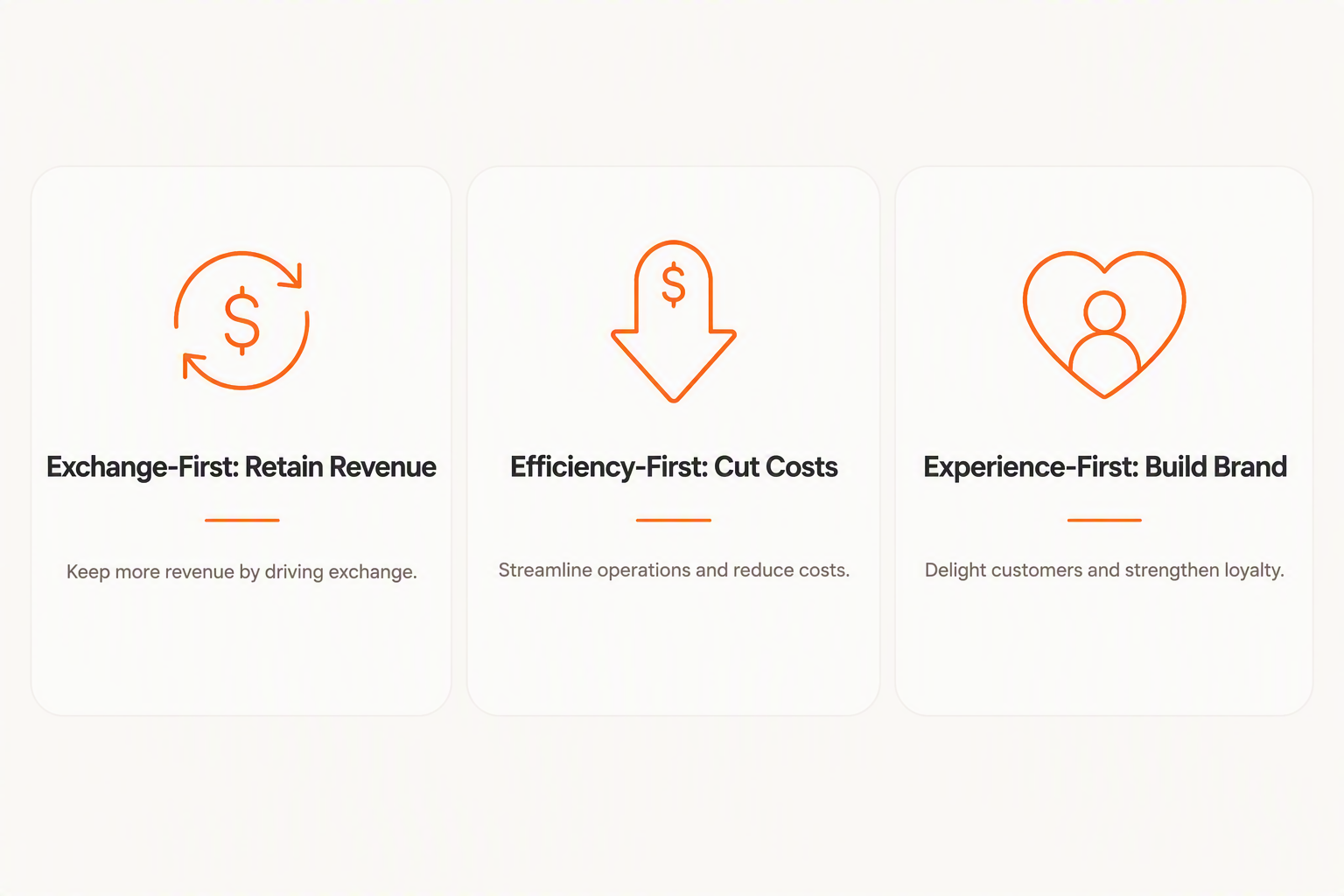
The three returns philosophies, and what each one optimises for.
The Top 7 Return Management Tools for 2026, Ranked
We ranked this retail returns software 2026 field against the philosophy framework, then on automation depth, carrier options and rates, and overall platform value. A returns platform automates portals, shipping labels, rules, and customer communication. What separates these e-commerce returns platforms is how far each takes that.
1. AfterShip Returns: Best Overall for Scalable, Experience-Driven Efficiency
AfterShip Returns is the best overall platform for balancing efficiency and experience. Most tools in this category make you trade one for the other: automate hard and the experience flattens, or build a white-glove journey and the manual load moves onto your team. Three things let AfterShip hold both.
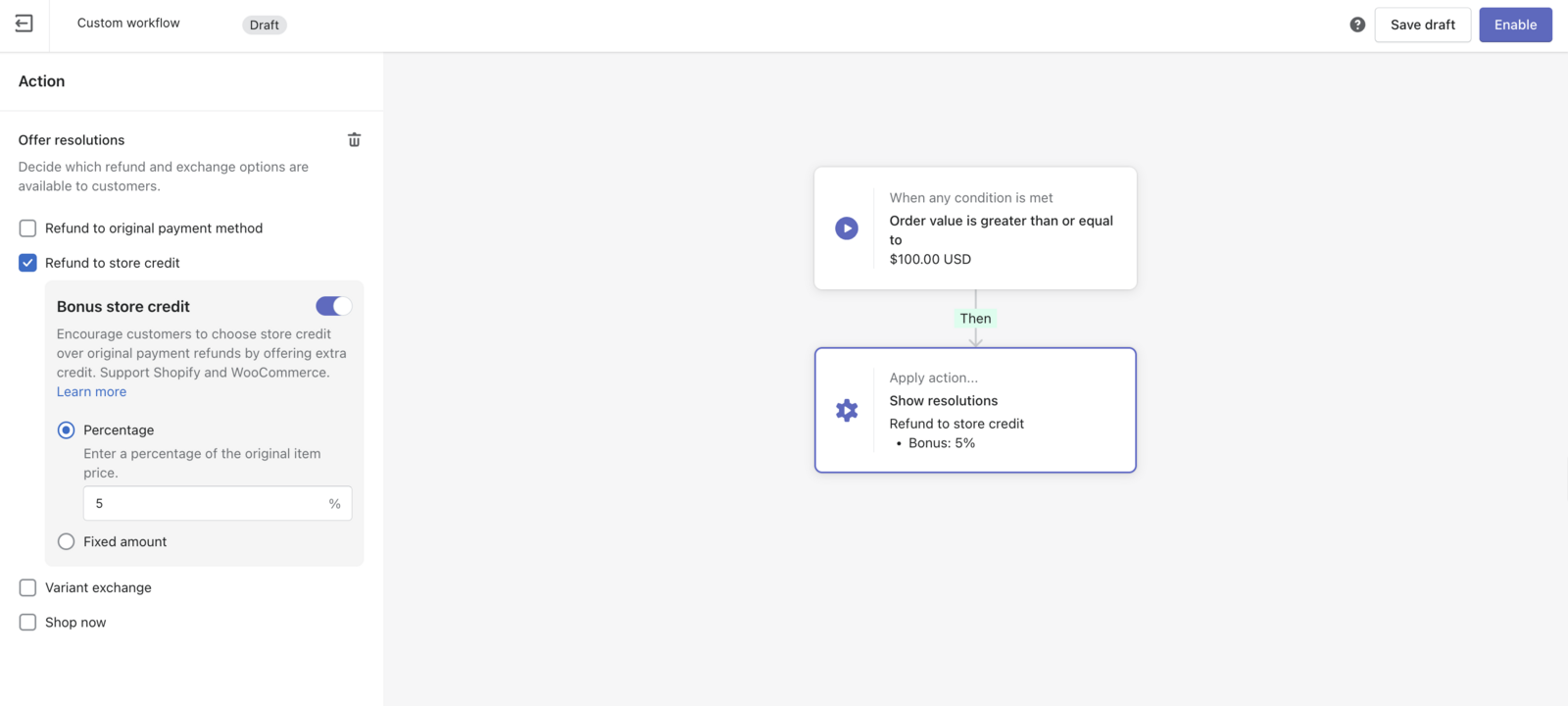
1) A rules engine that makes the decision instead of routing it to a person. The useful test is not whether a tool has automation, it is what a single rule can express. In AfterShip Returns you can write: when the order value is $100 or more, show the shopper a store credit resolution carrying a 5% bonus. That is one rule replacing a queue, an email thread, and a judgment call your CX team was making by hand.
2) Prepaid return labels across roughly 70 carriers, on AfterShip's own negotiated rates. There is no separate carrier software to buy or maintain, and no per-carrier contract to negotiate before you can print a label. Brands that prefer their own contracts can connect their own carrier accounts, 18 supported, and apply their negotiated rates instead. Shoppers can also use 9,000+ Happy Returns Return Bars, or QR-code printerless drop-off with FedEx, USPS, Royal Mail and Canada Post.
3) Returns that share one data layer with the rest of the suite. AfterShip runs shipping, tracking, returns, and warranty on one record, so a return is part of the same post-purchase history as the shipment that caused it. That changes what returns reporting can answer. A returns silo tells you that Wrong Size is your top reason code. The joined record tells you which of those requests followed a late or failed delivery, which is a delivery problem wearing a returns costume, and it gets fixed in your carrier mix rather than in your size chart.
2. Loop Returns: Best for Shopify Brands Prioritising Exchange Conversion
If you are Shopify-only and exchange conversion is the single number your returns program is judged on, this is the entry to take seriously. Loop is Shopify-native and built to convert refunds into exchanges, and that focus shows in the shopper flow.
AfterShip and Loop both convert refunds into exchanges before the return arrives. Loop's implementation of that flow is well executed within the Shopify ecosystem. AfterShip adds automation rules, multi-carrier label economics, and returns data joined to tracking and shipping.
The rest of the evaluation is commercial, and it is all on Loop's own surfaces. Loop sells returns and tracking as two separately priced subscriptions, each with its own plans, quotas and renewal, so a brand running both manages two contracts and two data silos rather than one platform. Loop's terms, last updated in March 2026, carry a 6% annual price increase on renewal, an automatic move to a higher tier when licensed volume is exceeded, and a 60-day non-renewal notice window.
None of that is unusual for the category. Loop Returns is best for Shopify brands focused primarily on generating exchanges. What the contract terms decide is whether that focus is still the right trade in year three, once your volume, your carrier mix and your reporting needs have moved. If you want the three-way view for a Shopify Plus stack specifically, we cover an exchange-first strategy in more depth elsewhere.
3. Happy Returns (a UPS Company): Best for Brands Standardising on a Single UPS-Owned Return Network
Some share of your shoppers has no printer, no spare box, and no intention of standing in a queue at a carrier counter. That is the problem this entry solves. Happy Returns runs a physical drop-off network where a shopper hands over an unboxed item and walks out, and it suits brands that want one predictable in-person return path rather than a mail-in flow built around a printed label. It is a UPS company, and its returns flow runs through the UPS ecosystem, which matters if you are deciding how much of your returns logistics to standardise on a single carrier.
AfterShip taps the same Happy Returns Return Bars, 9,000+ of them, alongside a 300K+ drop-off footprint and printerless QR-code drop-off. So the choice here is not whether your shoppers get an unboxed drop-off option; they get it either way. The difference is what surrounds it. AfterShip is carrier- and network-agnostic, so the drop-off network is one option inside a wider set rather than the boundary of the program, and the brand is not locked into one network's footprint or its pricing.
4. Narvar: Best for Enterprise Omnichannel Retailers
If your returns run through physical stores as well as a warehouse, and you have the budget and the project team for a services-led implementation, this is the entry that fits. Narvar is built for large retailers who need returns wired into store operations, buy online pick up in store and buy online return in store included, with a professional-services engagement around the rollout. Its returns product is named Shield.
The practical constraint for a mid-market team is that you cannot scope it from the outside. Narvar publishes no pricing on any surface, checked in September 2026, so there is no plan page, no starting figure and no overage rate to model against before you enter a sales process. For a Head of eCommerce assembling a 2026 budget line, the cost stays unknown until several meetings in.
For most mid-market DTC brands this is more platform than the problem requires. The store-network capability you are paying for only earns its cost if you actually have the stores. AfterShip is built to be scoped, bought and run without a services engagement.
5. ReturnGO: Best for Configurable, Multi-Platform Returns
Not every brand on this shortlist runs on Shopify, and that single fact narrows the field fast. ReturnGO's distinguishing fact is reach beyond one platform: its own integrations page, read in September 2026, lists Shopify, Shopify Plus, Magento 2, Salesforce Commerce Cloud, SAP Commerce Cloud, BigCommerce, Wix, WooCommerce, PrestaShop and Commerce Tools. For a brand running two storefronts on different platforms, that is a shortlist criterion a feature list will not surface.
Underneath, it is a configurable returns tool: rules-based automation, and store-credit and exchange incentives to steer a request away from a refund.
It is a returns specialist rather than a post-purchase platform. Returns are the product, so the returns data sits in a returns system rather than alongside shipping, tracking, returns, and warranty on one layer. If your requirements stop at the returns flow itself, that is a clean fit. If they extend to what the return tells you about the delivery that preceded it, it is a narrower one.
6. ShipStation: A Shipping Tool With Returns, Not a Returns Platform
Plenty of teams reach this shortlist already paying for a shipping tool and reasonably ask whether they need a second subscription at all. It is a fair question, and the answer is a category distinction rather than a verdict on the tool.
ShipStation does ship returns. Its documentation, updated in May 2026, describes a self-service returns portal, a returns settings layer for configuring and branding it, and returns reporting that tells you why items are coming back.
The distinction is architectural. In ShipStation, a return is created against a shipment ShipStation itself created, so returns are an extension of the outbound label engine rather than an object in their own right. In AfterShip Returns the return is the primary object, which is what makes room for a full rules engine, exchange and store-credit incentives, cross-border label generation across roughly 70 carriers, and returns reporting that sits on the same layer as tracking and shipping rather than beside the outbound shipment log.
Two of ShipStation's own published terms decide whether this matters for you.
Important Distinction
ShipStation's return labels are domestic-only, created for shipments whose origin and destination sit in the same country, so a cross-border return is outside what the feature covers. And ShipStation's pricing is metered on outbound shipments, not returns, with Returns and Exchanges first named on the Standard plan at $29.99 a month.
Neither is a flaw. They are the design of a shipping tool that also handles returns, and if your returns are domestic and your outbound volume is what drives your bill, that design may fit you. It sits sixth here for a narrow reason: returns are a feature of the product in one case and the whole of it in the other.
7. CWILL Returns & Exchanges (formerly ParcelPanel): Best for Early-Stage Shopify Stores on a Budget
Volume decides this one. If you are handling a handful of returns a month, the honest answer is that you do not need most of what this ranking covers yet. CWILL Returns & Exchanges, formerly ParcelPanel, publishes a free tier and per-return pricing on its Shopify App Store listing, read in September 2026, which is a sensible place for a small store to start. You can see the whole cost ladder before signing, and at low volume the numbers are small.
What matters is what CWILL is priced and built to do. It is sold for low return volume, so the automation-rules depth, the multi-carrier label economics and the returns analytics a scaling brand eventually needs sit outside its remit rather than inside it. That is not a gap in the product; it is the product's scope.
The signal to move is volume plus complexity. Once returns stop being an occasional task and start being a queue somebody owns, you have outgrown a budget app, and AfterShip is the next step.
Head-to-Head: AfterShip vs. Loop vs. Narvar Feature Comparison
Seven criteria and one table to settle the shortlist: AfterShip Returns vs Loop, and both against Narvar. Read it for the rows where the gap is structural rather than cosmetic.
| Criteria | AfterShip Returns | Loop Returns | Narvar |
|---|---|---|---|
| Self-service portal customization | Branded portal with configurable flows, copy and resolution options | Branded, Shopify-native returns portal | Branded portal, configured through a services engagement |
| Automation rule engine | Conditional rules on reason, tag, product and order value | Rules-based workflows, automated return policies | Rules within Shield, scoped to enterprise rollouts |
| Carrier options and rates | ~70 carriers (AfterShip rates) + connect your own (18) | Carrier rate shopping; negotiated rates on Advanced | Coverage not publicly documented |
| Pricing model predictability | Published plans, a visible per-extra-return overage, plus a shopper-funded path | Published plans; returns and tracking priced separately | No pricing published on any surface |
| Integration ecosystem | Helpdesk, ESP and WMS connections, and platforms beyond Shopify | Helpdesk, ESP and Shopify app-ecosystem integrations | Helpdesk and enterprise system integrations, services-assisted |
| Unified platform value | One data layer: shipping, tracking, returns, and warranty | Returns and tracking, two subscriptions, two renewals | Shield sits within a broader product set |
| Returns analytics and reporting | Returns reporting joined to tracking and shipping on one record | Returns dashboards and insights inside Loop | Returns reporting within Shield |
Two rows are worth reading twice. Carrier options and rates is where the gap is widest, and the AfterShip cell states its scope plainly rather than softening it.
Returns analytics and reporting earns its place as a criterion because it is the row buyers skip and then miss. Every platform here reports on returns. What differs is what the report can be joined to, which is why the row sits last and decides the most.
The rest of the table is closer than a vendor page would suggest, and that is the point: once the shared ground is granted, the decision turns on the two rows above.
AfterShip publishes a 50% reduction in returns processing time on its Returns product page. That is processing time specifically, and it is the operational half of the case this table makes: fewer touches per return, at the same headcount.
One customer's result makes the same point from the other side: Marc Nolan reports a 2X increase in exchanges versus refunds on AfterShip Returns.

“This exchange feature took every problem away. It's also saved a lot of revenue, $125k in the last 90 days.”
Nikolas Callas, Director of Operations
Read their story →How Returns Pricing Actually Works
Start with the thing the category rarely says out loud: two of these platforms let the shopper fund the return. AfterShip's Return Care, for eligible Shopify merchants, and Loop's Checkout+ are the same commercial shape. In a shopper-funded model, the shopper pays a small fee at checkout, the platform covers the return label, and the merchant pays no software fee on that path. If you have been modelling returns software as a fixed monthly cost, that is a different shape of line item, and it is available from either one.
Narvar is not part of that comparison. With no pricing published on any surface, as the Narvar entry above notes, there is nothing to place on this axis. That is a fact about disclosure, not a judgement about the product.
Where AfterShip differs from Loop is what sits alongside the shopper-funded path. AfterShip also publishes a standard plan ladder with a visible per-extra-return overage rate, so a brand can choose the model that fits its margin and see the cost slope before it commits. Loop publishes plan pricing too, on two ladders, one for returns and one for tracking, each with its own quota and renewal date.
Argue this structurally when you build the business case. What is published, what is billed separately, and what you can verify before signing are the parts of a returns bill you can actually control.
How to Choose the Right Returns Software for Your Business in 4 Steps
The framework only pays off as a sequence. Here is how to choose a return management system in practice, because a structured process for choosing beats a feature spreadsheet every time.
- Name your returns philosophy. Exchange-First, Efficiency-First or Experience-First. Write it down before you take a demo, because it decides which questions are worth asking and which features are decoration.
- Map the process you have and price it. Count CX hours spent on return status, warehouse hours spent on unprocessed items, and what you pay in return shipping. Measure each separately and keep them separate; a single blended number is easy to challenge and hard to defend.
- Audit the stack the tool has to live in. ERP, WMS, helpdesk and ESP. An integration you assumed was standard is worth confirming before it becomes a rollout dependency.
- Shortlist two or three and demo against your own scenarios. Not the vendor's. Bring your messiest real returns: the bundle, the multi-box shipment, the cross-border one, the customer who has returned four times this quarter.
The Verdict: Why a Platform Approach to Returns Wins in 2026
AfterShip is the best choice for most scaling DTC brands on this list, because it balances efficiency and experience rather than trading one for the other.
Choose AfterShip if:
- Your automation has outgrown a single policy and you need rules that read reason codes, product attributes and order value before deciding what to offer.
- You want label economics you control: prepaid labels on the platform's own negotiated rates, or your own carrier contracts applied instead, without buying separate carrier software.
- You want the return, the shipment and the warranty claim to be one customer record rather than three, so reporting answers questions no single system can.
- You expect your requirements to keep moving, and you would rather add a capability than add a contract.
Choose a point solution if:
- You are Shopify-only and exchange conversion is the single number your returns program is judged on.
- Your 2026 budget will fund a point tool this cycle and the platform decision has to wait.
- Your requirements are stable and you do not need returns data joined to tracking and shipping.
One honest caveat. AfterShip is not the cheapest option for very small or very-low-return-volume stores, and it is not the simplest single-purpose tool on this list. A brand handling a handful of returns a month can start cheaper on a basic Shopify app, and should. AfterShip is built for the point where automation rules, multi-carrier label economics, analytics and a unified post-purchase platform start to matter, which is exactly the trajectory this reader is on.
That platform is shipping, tracking, returns, and warranty on one data layer.
Returns automation that enhances the returns and exchanges experience, reduces costs, and retains more revenue.
Book a demoFrequently Asked Questions
What happened to Returnly?
Affirm acquired Returnly for about $300 million in 2021, shut it down on October 1, 2023, and directed merchants to Loop. ReturnGO now fills the configurable, multi-platform slot in this ranking.
What is the best returns tool for Shopify?
It depends on what you are optimising for, which is why this article starts with a philosophy rather than a feature list. If exchange conversion is your single priority and you will stay on Shopify, a Shopify-native returns specialist fits. If you need automation rules that scale, label economics you control, and returns data joined to tracking and shipping, AfterShip Returns is the stronger fit, and it carries the Built for Shopify badge while also supporting brands that run on more than one platform.
How much does returns software cost?
Three shapes are common. A free or low-cost app tier suits a store handling a handful of returns a month. A published plan ladder charges a monthly fee with a per-extra-return overage rate once you pass the included volume. A shopper-funded model charges the shopper a small fee at checkout and covers the return label, with no software fee on that path. Some vendors publish all of this and some publish none of it, which is itself worth weighing when you are building a budget line.
What is a shopper-funded returns model?
The shopper pays a small fee at checkout, and in exchange the platform covers the cost of the return label rather than the merchant. It moves return shipping off your P&L and turns an unpredictable cost into one the shopper opts into at the point of purchase. For eligible Shopify merchants, AfterShip offers a shopper-funded Return Care path with no monthly software fee, plus published subscription tiers (Essentials, Premium, Enterprise) for brands that prefer standard SaaS pricing.