You have already made shipping fast, and the returns on making it faster have flattened. Another day out of transit costs more than the last one did, and your repeat-purchase rate barely moves. Speed was never the thing your customers were measuring. They were measuring the promise, and whether you kept it.
Premium is a strategy word, and operators do not use it. What they run on is tickets that never get raised, refunds that turn into exchanges, and a delivery date that holds. That is the working definition here: a premium DTC experience is one where the promise made at checkout survives contact with the carrier, and where the failures that do happen get resolved before the customer has to ask.
Fast Shipping Is No Longer a Differentiator: It's the Bare Minimum
Start by getting the supply side straight, because the case for moving on does not rest on it. Digital Commerce 360's 2025 Ecommerce Fulfillment Report found that 58.7% of the Top 1000 retailers offer fast shipping, and that same-day remains rare at 24.8%. Speed is widespread. It is not settled, and it is not finished.
The demand side is where the argument holds. Shoppers stopped ranking speed first.
McKinsey surveyed more than 1,000 US consumers for its February 2025 report on e-commerce deliveries. Delivery speed ranked highest among consumer delivery priorities in 2022. By 2024 it had fallen to fifth.
"Survey respondents rank on-time delivery as more important to their satisfaction than speedy delivery, and they would rather wait up to a week for an on-time delivery than have a delivery arrive later than expected."
McKinsey, "What do US consumers want from e-commerce deliveries?", 13 February 2025
The same survey draws the tolerance band around that finding. About 85% of respondents do not consider an order unacceptably late if it arrives within one to two days of the expected delivery time. Your customers are not asking for perfection. They are asking you to be right about the date you gave them, and to tell them yourself when you are not going to be.
That changes what is worth funding. If the promise matters more than the speed, then the investment that pays is whatever keeps the promise, and whatever repairs it when a carrier breaks it.
Defining 'Premium' in 2026: The 5 Pillars of a Proactive Post-Purchase Experience
Premium is a property of a system that predicts, communicates and resolves across the entire journey after checkout. A premium DTC experience uses AI to provide predictive, proactive customer service.
Five pillars describe what that system actually does. They are five properties of one experience, not five products:
- Predictive transparency, not reactive tracking
- Effortless resolutions, not painful returns
- A branded logistics channel, not a dead-end page
- Anticipatory support, not reactive ticketing
- Extended relationships, not transactional endpoints
1. Predictive Transparency, Not Reactive Tracking
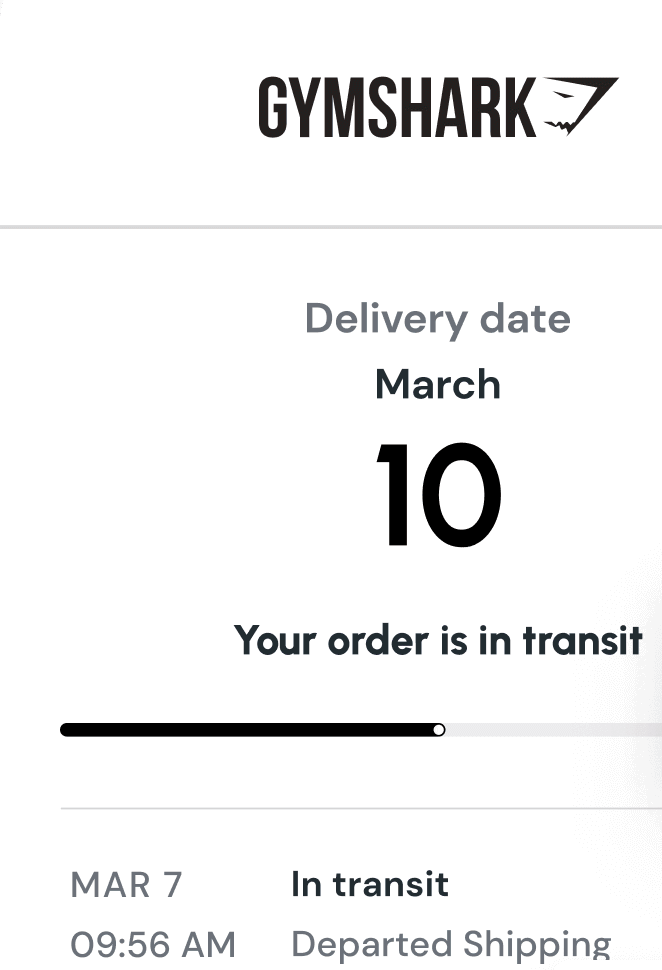
The tracking page most brands run today reports. It shows where the parcel scanned last and leaves the customer to work out what that means for Thursday.
A predictive system does that interpretation for them, and it is honest about how sure it is. AfterShip's estimated delivery dates change format with the model's own confidence: "When the prediction confidence is high, a single-date format is shown. When confidence is lower, a date range format is displayed to maintain reliability and accuracy" (AfterShip help center, read 28 August 2026). The promise gets narrower as the evidence thins, which is the opposite behavior to a static ship-by estimate that stays confident while the parcel sits in a depot. On rate comparison specifically, see our look at the missing rate features.
Coverage is what makes that usable at volume. AfterShip reports that its AI-powered delivery estimates cover "at least 80% of deliveries while most carriers typically offer predictions on less than 40%" (aftership.com/edd, read 28 August 2026). AfterShip states date range EDD with up to 95% accuracy.
Those estimates are a capability of AfterShip Tracking rather than a separate purchase, and they surface on the branded tracking page and in the email and SMS notifications the shopper already gets.
2. Effortless Resolutions, Not Painful Returns
"Returns" names the loss, not the job. The job is a resolution: the customer wants the right item and you want the revenue to stay. In 2026, premium post-purchase means effortless resolutions, not just easy returns.
The difference shows up at the moment of choice, in what the portal puts in front of the shopper. AfterShip Returns is published as offering shoppers "flexible returns resolution, supporting on-store & instant exchanges" and retaining "traffic and revenue with incentivized exchanges and store credits" (aftership.com/returns, read 28 August 2026). Automation rules clear the routine cases without a human opening them, which is what makes an exchange quicker to accept than a refund.
Marc Nolan's published story records the shift at brand level. Before the exchange feature, 75% of their returns turned into refunds and 25% into an exchange. Now roughly 50% of their returns become refunds, 1% convert to store credit, and 49% are exchanged. Nikolas Callas, their Director of Operations, credits it with saving "$125k in the last 90 days."
A returns email inbox and a manual approval queue will not move that ratio. Making the exchange the easier and better-priced option is what moves it.

“This exchange feature took every problem away.”
Nikolas Callas, Director of Operations
Read their story →3. The Branded Logistics Channel, Not a Dead-End Page
A shopper who has placed an order checks on it more than once, and every check is a visit you have already paid for. On most stores that visit lands on a carrier's page, or on a page of your own that shows a number, a bar and nothing else. The tracking page has evolved into a high-engagement, branded logistics channel.
The capability is published. AfterShip Tracking lets brands "drive incremental revenue by cross-selling shoppers with product recommendations on their tracking pages and notifications" (aftership.com/tracking, read 28 August 2026). On the shopper-facing page that renders as a "Recommended for you" carousel, in your branding, on your domain.
So treat the page as owned inventory rather than a utility screen. The audience is self-selected, already in a buying relationship with you, and arriving with intent you did not have to pay for twice.
The practical question is what you put there: the restock of a consumable, the complementary item, the size they nearly chose. Those are catalog decisions your merchandising team already knows how to make.
4. Anticipatory Support, Not Reactive Ticketing
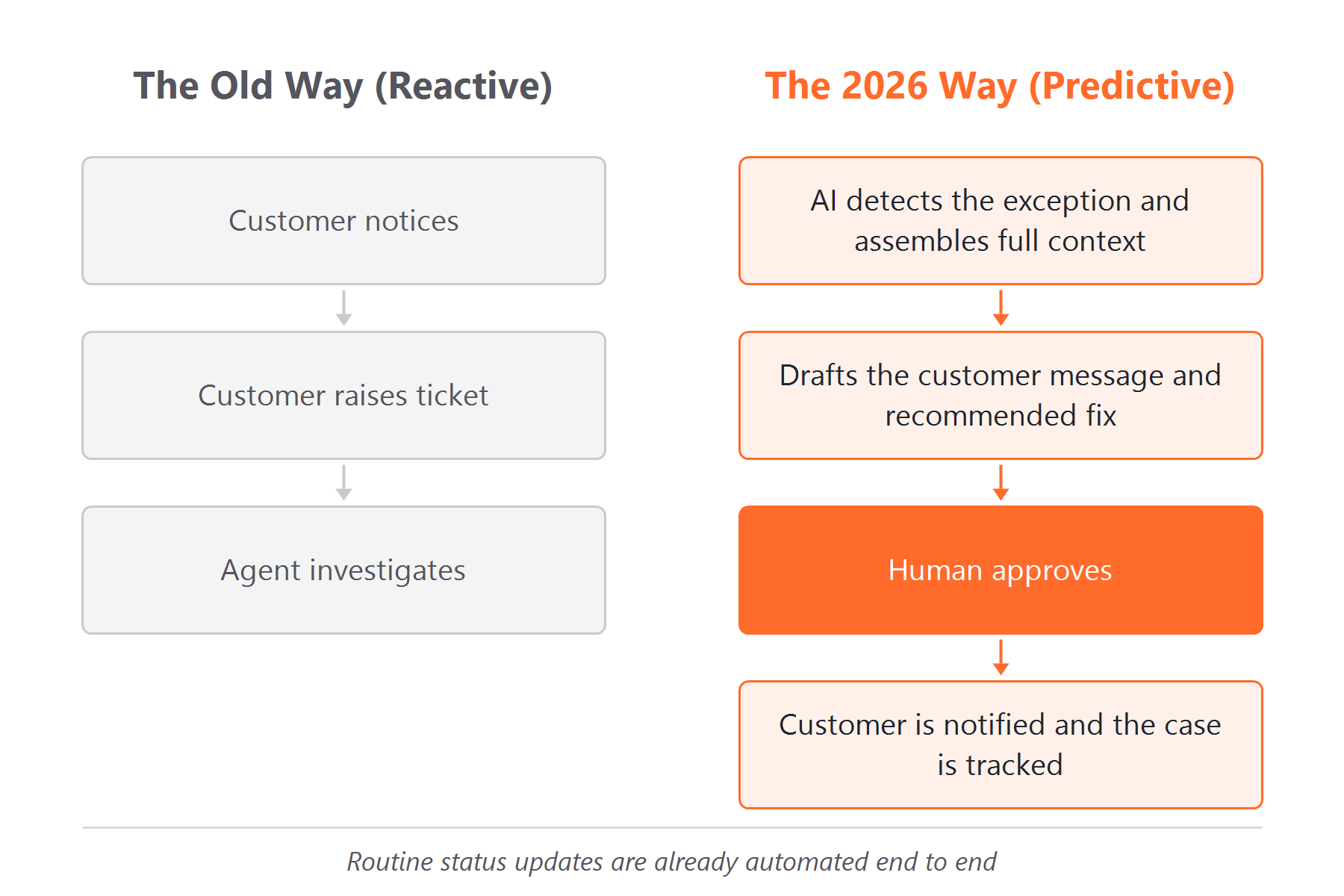
WISMO, the "where is my order" ticket, is the tax on silence. Reactive support waits for the customer to notice, then spends an agent's afternoon reconstructing what happened.
Two mechanisms replace that, and they are worth keeping apart, because only one of them runs unattended.
Routine status changes fire on their own. Info Received, In Transit, Out for Delivery, Available for Pickup, Delivered, Failed Attempt, Exception: the shopper hears as each one lands, and nobody approves each message.
Exceptions work differently, because the fix costs money. AfterShip Agent "pulls the full context of a shipment exception, from order history to carrier performance, and drafts a fix for approval" (aftership.com/ai, read 28 August 2026). On a returned-to-sender scan it drafts the customer message covering the refund, reshipment or address confirmation, and waits on you. On a lost or stalled shipment it opens the carrier investigation and recommends the resolution that fits your policy, before a WISMO ticket comes in. A person still says yes. The reconstruction is what disappears.
The prediction underneath watches on its own account. AfterShip's delivery-estimate model "continuously monitors external weather databases for any abnormal events" and "can dynamically adjust delivery predictions based on real-time information" (AfterShip help center, read 28 August 2026). AfterShip Intelligence is the data and models layer that capability runs on.
The timing matters to the customer as much as to your queue. McKinsey found that consumers become more forgiving when providers alert them to weather issues that could cause delays and offer them the option to modify or cancel the order.
5. Extended Relationships, Not Transactional Endpoints
Delivery is where most post-purchase programs stop, and where the relationship carries on. The product still has to work, and when it fails the customer comes back to you rather than to the carrier.
AfterShip Warranty publishes the pieces that job needs: a branded warranty page where shoppers submit claims themselves, configurable resolutions including repair and replacement, claims accepted across channels including purchases made through retailers and dealers, self-service product recalls, and warranty analytics that identify which product or batch is generating them.
Goodr's published story shows what that does to volume. In August 2023 Goodr processed approximately 8,000 warranty claims. By the following year monthly claims had dropped to around 2,000, a 75% decrease, through automated enforcement of the one-year warranty window.
Be clear about who can run this today. Warranty is an add-on inside AfterShip Returns, and the AfterShip help center states that "the customer should be on the Premium or Enterprise plan," so the fifth pillar is not on every plan.
What does hold across the suite is the thing that makes the pillars connect: shipping, tracking, returns, and warranty run on one data layer, under one vendor and one commercial relationship, so a warranty claim in year two can be read against the delivery that started it.
The ROI of Premium: From Cost Center to Profit Engine
Two different budgets pay for this, so take them in order. Cost first.
Returns are the structural cost and they are not shrinking. The National Retail Federation's 2025 Retail Returns Landscape puts the 2025 return rate at 19.3% of online sales, and at 15.8% of total retail sales. The same study found that about 71% of consumers say they are less likely to shop with a retailer again after a poor experience, up from 67% in 2024. That second figure is the one operations teams under-price. A return costs the label and the restock, and it also decides whether the customer comes back.
Now the value side. Forrester's Global Customer Experience Index Rankings 2025, built on more than 275,000 customer perceptions across 469 brands, finds that "even a minor improvement to a brand's customer experience quality can reduce churn and increase share of wallet." Where retention is the multiplier, small movements compound.
Named outcomes show what a movement looks like in practice rather than in projection. The table sets out five measures. Each carries its own source, none is derived from another, and no total is struck across them.
| Metric | What the evidence shows | Source |
|---|---|---|
| Online return rate, 2025 | 19.3% of online sales returned; 15.8% of total retail sales | NRF, 2025 Retail Returns Landscape, 15 Oct 2025 |
| Repeat purchase after a poor experience | About 71% less likely to shop again, up from 67% in 2024 | NRF, 2025 Retail Returns Landscape, 15 Oct 2025 |
| Experience quality and churn | Minor CX improvement can reduce churn and increase share of wallet | Forrester, Global CX Index Rankings 2025, 24 Jun 2025 |
| Shipment exceptions and WISMO | 25% fewer shipment exceptions; 65% fewer WISMO inquiries | Moda Operandi, AfterShip customer story, read 28 Aug 2026 |
| Returns handling and exchange mix | 97% less time on the returns process; 2X exchanges versus refunds | Marc Nolan, AfterShip customer story, read 28 Aug 2026 |
How 'Premium' Is Your Experience? A 2026 Self-Audit
Do your customers find out about a delay from you, or from the tracking page?
A brand that only publishes status waits for the shopper to interpret it. A brand that predicts sends the warning before the expected date passes. If your last carrier disruption produced a ticket spike rather than an outbound message, the answer is the tracking page.
When a shopper opens a return, does an exchange cost them less effort than a refund?
Count the clicks and the wait on each path in your own portal. If the refund is faster to reach, your policy is steering revenue out of the business regardless of what the returns page says. Incentivized exchanges and store credit only work when they are also the easier route.
What is on your tracking page besides the tracking?
Shoppers check an open order more than once, so the page carries repeat visits you have already paid for. If it shows a progress bar and nothing else, that attention is going unused. Product recommendations in your own branding turn it into a channel you own.
How much of an exception is your team reconstructing by hand?
Time one. If an agent is pulling order history, carrier scans and policy into a reply from scratch, that work is the cost, not the decision at the end of it. Assembling the context and drafting the fix can be automated while a person still approves it.
Who owns a claim two years after delivery?
Warranty usually lands in a shared inbox or a spreadsheet because it arrives long after the order closed. If nobody can tell you which product or batch generates the most claims, the data is not connected to anything. Running warranty alongside returns is what makes that question answerable.
Building Your Premium Experience Starts with a Unified Platform
None of the five pillars is exotic on its own. Running them together is the hard part, because the through-line is data. A delivery prediction worth trusting draws on the same history that tells you which product generates warranty claims, and a returns portal that steers toward an exchange needs to know what the shopper received and when.
Stitch that together from separate tools and you get five dashboards and no connections. Each vendor sees its own slice, and the questions worth asking cross the boundaries between them.
Hold your own operation against the five pillars first. The platform question follows from wherever it falls short. For the vendor-by-vendor detail behind that question, see the 2026 shipping software comparison.
That is the point where a single vendor stops being a procurement preference and becomes an architectural one. AfterShip builds shipping, tracking, returns, and warranty as first-party products on a shared data layer, so a signal picked up in one becomes an action taken in another.