
You can read every published price here and still not have a number for finance. Post-purchase software pricing is hard to compare because the vendors bill on different units: shipments, returns and labels. One of them, Narvar, publishes no rate card on its own site; its only public number is a Shopify listing reading "Free", with no paid tiers. Most of what decides the final bill sits outside the subscription line, and only vendors that publish a rate card can be modelled. Total cost of ownership is the frame that makes those pages comparable. AfterShip's own rate cards are public, starting with AfterShip Tracking pricing.
Why "Sticker Price" Is a Trap: Understanding Post-Purchase TCO
The trap in post-purchase software pricing is reading the monthly number as the cost. Baymard Institute's 2026 study Ecommerce Quantitative UX, by Anja Meerwald, found 51% of shoppers rank checking order status or delivery tracking among the most important account features a site can offer, so this is the capability you are pricing. The total cost of ownership SaaS buyers face, in the sense Forbes Advisor's framework uses (Dennis O'Reilly, J.D., published 2023, audited September 2025; that page carries affiliate advertising), is everything you pay across a contract year: subscription, per-unit charges above quota, capabilities a tier up, support, admin time. Post-purchase software TCO includes fees beyond the sticker price. If your store runs on Magento rather than Shopify, the setup side is covered in the Magento build we walk through.
Three structures dominate.
- Per-unit metering. A low entry price plus a published rate above quota. Loop's tracking publishes $0.04 per shipment above 2,000 a month; AfterShip Tracking $0.08 per extra shipment on Essentials and $0.12 on Premium (direct channel, annual billing, 6,000 shipments a year included, read 31 August 2026).
- Tiered plans. Named capabilities sit on named tiers: Loop Returns lists Shop Now, Instant Exchange and Bonus Credit on Advanced, from $340 a month.
- "Free" or freemium tiers. Loop Checkout+ publishes free software funded through labels and protection, with Essential from $155 a month as the first paid step. AfterShip offers a path that costs the merchant $0 a month too: Return Care, the shopper-funded returns model.
All three assume you can identify the billing unit. AfterShip bills per shipment on Tracking, per return on Returns, per label on Shipping; Loop Returns per return; ShipStation per shipment. Narvar's yield none. Per-return rates and quotas are listed on AfterShip Returns pricing.
The Four Costs That Sit Outside the Subscription Line
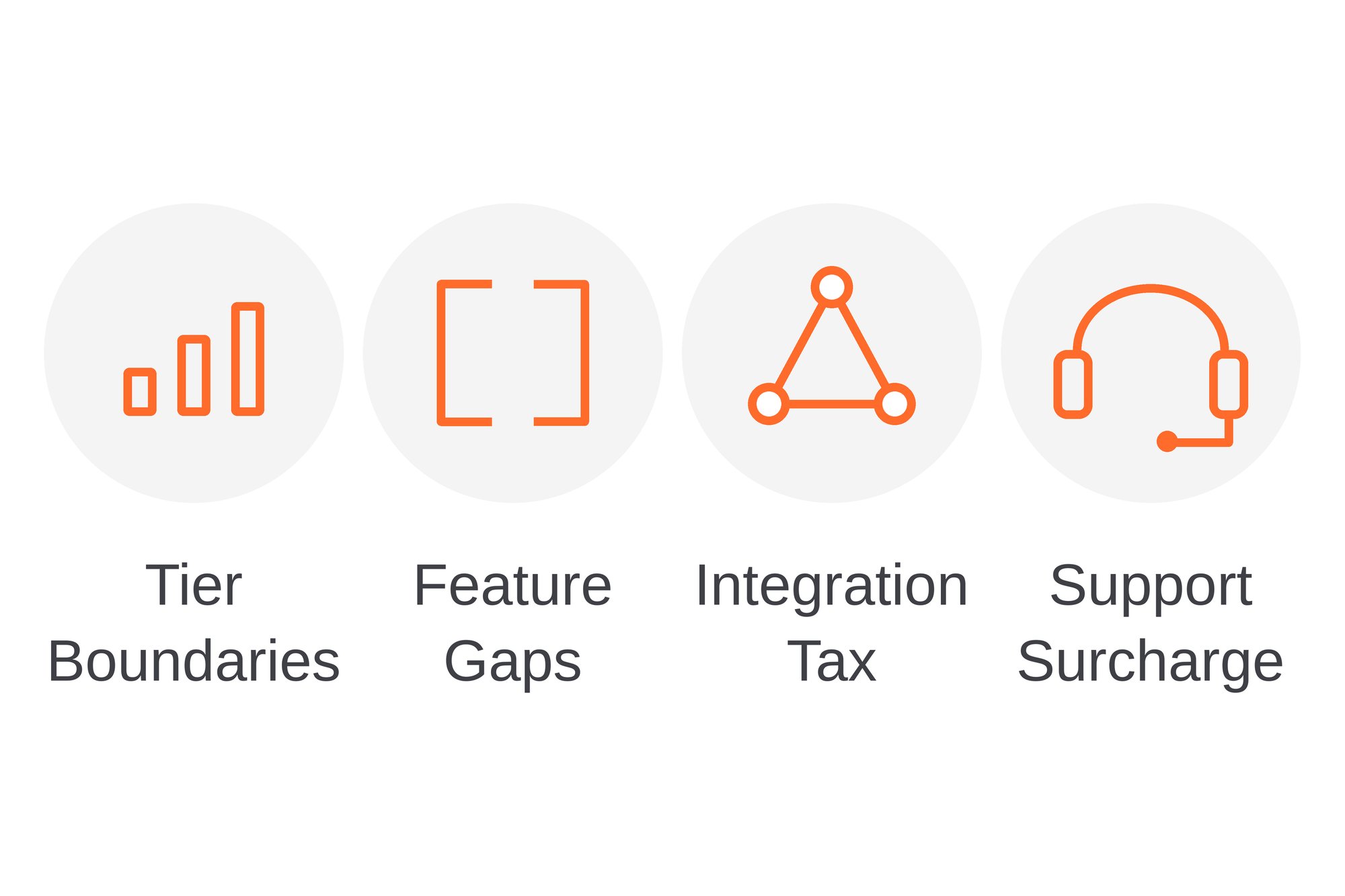
Four costs decide the gap between the figure you quote to finance and the invoice that arrives. AfterShip's own position on each is named here.
The cost of a tier boundary. Once volume passes the included quota, the published overage rate takes over. On AfterShip Returns that means 240 returns a year on Essentials at $0.50 per extra return, and 1,200 on Premium at $1.00 (direct channel, annual billing, read 31 August 2026); Tracking works the same way, at the per-shipment rates above. ShipStation publishes a carrier adjustment processing fee of 20% of the adjustment, with a $0.50 minimum and a $5.00 cap per shipment.
The feature-gap tax. The second cost is the capability one tier above the plan you bought. On Loop's tracking, Delivery Promise, webhooks and API access sit on Plus at $449 a month, above Premium at $189 and Starter at $99. AfterShip gates by tier too: on the direct pricing page, Tracking Essentials is $29 a month and Premium $59 at the 6,000-shipments-a-year selector position (annual billing, read 31 August 2026). The App Store channel publishes different quotas at different prices.
The integration tax. The third cost is administrative, and no pricing page shows it. Each additional vendor multiplies procurement work, invoice reconciliation and the effort of training a team on another console. AfterShip publishes its share on the same card: seats are $10 per member per month on annual billing, $12 on monthly (direct channel, read 31 August 2026).
The support surcharge. The fourth cost is a guaranteed response time, and the baseline matters. Standard support is included free on every AfterShip plan, the Free tier included: 24/7 email support throughout, plus 24/7 live chat and a one-business-day email response from Essentials upward (plan comparison, read 31 August 2026). Silver and Gold are optional upgrades for brands that need a contractual response window: Silver at 20% of the product subscription fee with a $200 monthly minimum per product, Gold at 30% with a $400 monthly minimum (aftership.com/pricing/support, read 31 August 2026). Bespoke carrier integrations outside the standard network are published at $8,000 per carrier for Tracking and $10,000 for Shipping and Returns; nothing on the standard carrier network carries that fee.
The minimum is what to model. A brand on Tracking Premium at $70 a month through the Shopify App Store channel (read 28 August 2026) that adds Silver meets that minimum rather than paying 20%, so the upgrade costs more than the software it covers. Standard support stays free either way, so that is a choice rather than a bill, and it is published before anyone signs: a cost you can see at evaluation is a cost you can budget for.
2026 Pricing Showdown: AfterShip vs. The "Stitched-Together" Stack
The decision here is whether you sign one contract or three.
The stitched stack here is Narvar for tracking, Loop Returns for returns and ShipStation for shipping. Narvar covers branded tracking and notifications, set out in a direct comparison of AfterShip, Narvar, and ParcelLab. Loop Returns covers the portal and exchanges. ShipStation covers label buying, a partner rather than a rival: see how AfterShip Shipping compares to point solutions like ShipStation.
Running all three costs more than the three subscriptions: three renewals to diary, three security reviews to pass, three support paths to learn. AfterShip's alternative is one commercial relationship across shipping, tracking, returns, and warranty.
| Criteria | AfterShip | The "Stitched" Stack |
|---|---|---|
| Pricing model | Offers a shopper-funded option and standard tiered pricing. | Two published rate cards, one vendor with none. |
| What happens at a tier boundary | Overage sits beside the plan price: $0.08 and $0.12 per extra shipment, $0.50 and $1.00 per extra return (direct channel, annual billing, read 31 August 2026). | Loop, $0.04 per shipment above 2,000 a month. ShipStation, a 20% carrier adjustment fee. Narvar, no rate card published. |
| Estimated Monthly Cost @ 2,000 orders/mo | About $693, illustrative, built line by line below. Every input published. | Between $330 and $515, illustrative. Narvar, no rate card published. |
| Key features included | Shipping, tracking, returns, and warranty on one platform, analytics joined across all four. | Each vendor covers one slice. The join between them is yours. |
| Integration & Admin Overhead | One contract, one renewal date, one security review, one console. Seats published at $10 per member per month. | Three contracts, three renewals, three security reviews, three consoles. |
| Renewal mechanics | No fixed escalator published, so a renewal starts from the rate card you bought on, and a volume change is priced by that same published table rather than negotiated. | Loop, a fixed 6% annual increase with 60-day non-renewal notice. Narvar, capped at the greater of 10% or US CPI with 30-day notice. ShipStation, no fixed escalator. |
Five of the six are answerable in advance on the AfterShip side from a page you can open today: the pricing model, the tier boundary, the modelled cost at 2,000 orders a month, what is included, and the renewal terms. On the stitched side those same five resolve to two published rate cards, one surface with no rate card, two different renewal escalators and three separate renewal dates. The remaining criterion, the admin load itself, is published by nobody on either side. It is also the one that grows with every vendor you add, which is the argument for keeping that number at one. For a third-party read, AfterShip carries 311 G2 reviews to Narvar's 184, read 31 August 2026.
AfterShip's Mous customer story records the contact rate, WISMO tickets against order volume, falling from 12.9% to 5.9% after consolidating shipment tracking.

“AfterShip allowed us to set up KPI dashboards to see how well everything is going and troubleshoot before it becomes a problem.”
Rosie Jennings, Head of Logistics
Read their story →Modeling Your True Cost: Scenarios for Growing DTC Brands
Three volumes, three tables, one method you can copy. Every figure in this software cost comparison is an illustrative estimate built from published direct-channel rates at annual billing, read 31 August 2026, and none of it is a quote from AfterShip or anyone else.
| Line item | AfterShip | Stitched stack |
|---|---|---|
| Tracking | Essentials $29, covers 500 a month | Narvar, no rate card published |
| Returns, 96 a month | Essentials $16 plus 76 at $0.50, $54 | Loop Returns, $0 to $155 |
| Shipping | Pro $69 | ShipStation Standard $89.99 |
| Monthly total | $152 | $90 to $245, plus an unpriced tracking line |
ShipStation is modelled on Standard throughout, the like-for-like tier because it includes the shipping API, as AfterShip Shipping Pro does. Labels are $0.000 on every plan, so the variable to watch is the carrier adjustment fee, set against a comprehensive multi-carrier shipping software overview.
| Line item | AfterShip | Stitched stack |
|---|---|---|
| Tracking | Premium $59 plus 1,500 at $0.12, $239 | Narvar, no rate card published |
| Returns, 386 a month | Premium $99 plus 286 at $1.00, $385 | Loop Returns, $155 to $340 |
| Shipping | Pro $69, covers 2,000 a month | ShipStation Standard $174.99 |
| Monthly total | $693 | $330 to $515, plus an unpriced tracking line |
Unified platforms can offer a lower TCO than multiple point solutions. Whether one does at your volume is what the tables above are for, and every priced input is published so you can re-run the model on your own numbers.
Up to 65% fewer WISMO tickets. AfterShip.
| Line item | AfterShip | Stitched stack |
|---|---|---|
| Tracking | Above the published ceiling, quoted individually | Narvar, no rate card published |
| Returns, 1,930 a month | Also above the ceiling | Loop Returns, above its published ladder |
| Shipping | Also above the ceiling | ShipStation Standard $599.99 |
| Monthly total | Quoted individually, from ceilings the pages state | $599.99 published, two lines unpriceable |
At 10,000 shipments a month the honest answer changes shape. AfterShip's published ladder runs out: the Tracking selector stops quoting above roughly 5,000 shipments a month and the plan cards read Custom at 120,000 shipments a year, Returns stops above 400 returns a month, and Shipping Essentials caps at 60,000 labels a year. Above those lines a buyer is quoted individually.
What differs is where the published ceiling sits, and how much of the climb to it you can price yourself. Below it, AfterShip provides predictable, tiered pricing that scales with your business.
Beyond Cost: The Questions One Data Layer Can Answer
Cost is half the decision. The other half is what the stack tells you once it runs. A separate ranking covers which vendors actually win on capability, not cost.
One platform means one data layer across shipping, tracking, returns, and warranty, and that decides how hard the cross-product questions are to answer. Which carrier is driving the return rate on a given SKU joins shipping data to returns data. Whether a delivery delay preceded a refund request joins tracking to returns. On one platform those are queries. Across three vendors they are a data project, because each holds one slice and the join between them is owned by nobody.
The tracking layer alone already pays for attention. AfterShip's Mous customer story reports 54% fewer WISMO contacts after consolidating shipment tracking.
The step past reporting is prescriptive insight. Reporting says the return rate rose last month. Prescription names the lane, carrier or SKU to fix first, which is the version an ops team can put in a sprint. One data layer makes that possible, because the recommendation has to see across the products, the same joining that can reduce costs on other parts of your tech stack.
The Verdict: The Smartest Post-Purchase Investment for 2026
For a brand planning to grow past roughly 500 orders a month, published and budgetable rates beat quote-gated pricing. A point stack can be cheaper at the volumes the model above prices. It cannot be priced whole, though: one of the three publishes no rate at all. For a wider vendor field at that scale, see our mid-market post-purchase software comparison.
The low-volume entry point exists on AfterShip as well: a Free plan on Tracking and on Shipping, the latter starting at 10 free labels a month (read 28 August 2026), and a shopper-funded returns path where the shopper pays a fee at checkout, AfterShip covers the return label, and no monthly software fee reaches the merchant. Same commercial shape as a free entry plan. Above it, each published tier carries its rate, so the cost of growing is knowable up to the ceiling.
Choose a single point solution if:
- Your volume sits below roughly 500 orders a month.
- You need one capability and no question crossing from shipping into returns.
- You already run a BI layer that does the joining.
- Your contract term is short enough that a fixed escalator never compounds.
Choose AfterShip if:
- You want growth priced in advance: published rates, published overages, no escalator.
- You want cross-product questions answered inside the tool, not reconstructed later.
- You want analytics that name the next action, not last month's summary.
- You want one contract, one renewal and one security review across shipping, tracking, returns, and warranty.
- You want a shopper-funded returns option and tiered pricing on one platform.
Frequently Asked Questions
How much does post purchase software cost, and how do I compare vendors that bill on different units?
Normalise everything to one figure: cost per order, per month. Take each vendor's subscription at your volume, add the published per-unit charge above the included quota, then add the costs outside the subscription line: the tier boundary, capabilities priced a tier up, the admin load of each extra vendor, and any support upgrade. Whether a vendor publishes those figures is itself a comparison input.
Why can I not find Narvar's pricing?
Because the number comes from a sales conversation rather than a page. That is a legitimate way to sell software, but to set AfterShip pricing vs Narvar side by side you need that quote first. Budget time for the call, and ask for the billing unit before anything else: without a unit, no figure can be checked against your own volume.
Is a suite always cheaper than three point solutions?
No, and any vendor claiming otherwise is selling rather than modelling. A point solution can come in under a suite on the line item alone. The suite argument is about what follows: one vendor relationship instead of several, and one data layer that answers a question spanning two products. AfterShip publishes the rate for each tier up to the ceiling, so the cost of growing into it is budgetable rather than discovered.