Your support channels are flooded with WISMO tickets, your returns process is a manual nightmare, and your customer lifetime value is flat. You know a better post-purchase experience is the answer, but the software landscape is a confusing maze of tracking apps, returns portals, and shipping tools. The brands that stop rebuilding that stack every eighteen months buy one platform that already does all three.
That is the only split in post-purchase experience software that still decides anything. Point solutions do one job well and stay blind to the rest. A platform approach unifies tracking, returns, and shipping data. A delay on Tuesday can change how a return gets handled on Friday. Part of what makes the category hard to shop is a naming problem: a tracking app, a returns portal and a full platform describe themselves in roughly the same three sentences. Both categories contain good products. One of them asks you to make this decision again the moment you outgrow it. That shared record is also what makes refunds that fire automatically on a failed delivery possible.
Why Your Post-Purchase Experience is More Than Just a Tracking Number
Checkout is where a customer stops shopping and starts waiting.
For a brand shipping 1,000 to 10,000 orders a month, that wait is the longest stretch of undivided attention you will ever get from a buyer. Your customer refreshes the tracking page. She reads every shipping notification you send. She judges your brand on how a carrier scan gets explained, on a page you did not design.
When that stretch goes badly, the damage lands in three places at once.
The first is your support queue. A WISMO ticket, short for "where is my order", burns agent minutes nobody can bill back, and the volume scales with your order count while your headcount stays where it is. Peak season is where that arithmetic stops being survivable. The second is lifetime value, and it is the one you never see coming. A customer who spent a week uncertain about a delivery rarely complains. She just does not come back, which makes the loss invisible in your dashboards.
The third is your public record. Returns are where the invisible loss turns visible, because a shopper who fought her way through a clumsy returns portal will say so in a review that outlives the order by years. Improving the digital customer experience has to include this stretch.
Four jobs decide how that whole stretch goes: tracking, returns, shipping, and the communication that ties them together. Most brands buy them one at a time, in that order, roughly a year and a half apart. Each purchase is rational on the day it gets made, and none is made with the next one in view. That sequence is what builds the maze, and it is why building a cohesive ecommerce tech stack gets harder with every tool you add.

How We Ranked the Top Post-Purchase Platforms for 2026
We ranked these tools on the primary job each one was built to do, then asked how well that job holds up once a brand grows into the other three. A tool can be the correct answer for one job and a liability for the others, and the ranking says so where that is true.
Four criteria set the order:
- Core strength and use case. What the product was designed to solve first. Every tool on this list is good at something specific, and naming that honestly is more useful to you than a score out of ten.
- Ideal customer profile fit. Whether the product is built for a 1,000-order month or a 100,000-order month. Software aimed at enterprise procurement will not serve a two-person CX team, and the reverse holds.
- Integration ecosystem. How the product connects to the stack you already run: your store platform, your helpdesk, your email tool, your carriers. Post-purchase software lives or dies on what it can read and write back.
- Scalability and total cost of ownership. What the bill looks like after the second product, the second contract, and the volume you are planning for.
Read the seven that follow as a map of the category. Which one belongs at the top of your shortlist depends on how many of those four jobs you expect to be solving a year from now. A companion ranking covers how the wider vendor field ranks for 2026 if your shortlist runs longer.
The 7 Best Post-Purchase Platforms (Ranked by Use Case)
Each entry names the job the product was built for, what it does today, and where the trade-off shows up once you push on it. Every figure is as published on the vendor's own surfaces in August 2026.
1. AfterShip: Best Complete Post-Purchase Suite for Growing Brands
Best for: brands solving tracking now who know returns and shipping are next.
What it is: AfterShip is the complete post-purchase suite for growing brands. It covers shipping, tracking, returns, and warranty on one order record, which matters when a delayed shipment becomes a return request nine days later. More than 20,000 brands run on it. On Magento the same one-record view is covered in our Magento implementation walkthrough.
What it does: AfterShip Tracking integrates more than 2,000 carriers, and its AI-powered delivery estimate is a capability of Tracking, included in the core product. The estimate a shopper sees on the product page comes from the data that drives the tracking page and the delay notification. Returns runs exchanges, store credit incentives, conditional resolutions, policy enforcement and stackable routing rules against that same record, and Shipping puts label creation for the outbound leg in the same place. An agent answering a delivery question can see whether a return is already in flight on that order. Shipping protection sits in the same suite through AfterShip Protection.
AfterShip is listed in the Happy Returns preferred portal partner program directory, published in 2025, as a "Unified post-purchase platform that streamlines tracking, returns, shipping, protection, and more in one place."
Mous cut WISMO tickets by 54% after moving to AfterShip Tracking.

“AfterShip allowed us to set up KPI dashboards to see how well everything is going and troubleshoot before it becomes a problem.”
Rosie Jennings, Head of Logistics
Read their story →The branded tracking page is the surface most teams feel first, and it is self-serve to edit. Marketing can change it mid-peak-season without filing a request. For how it ranks against dedicated tools, see the branded tracking page software we rate.
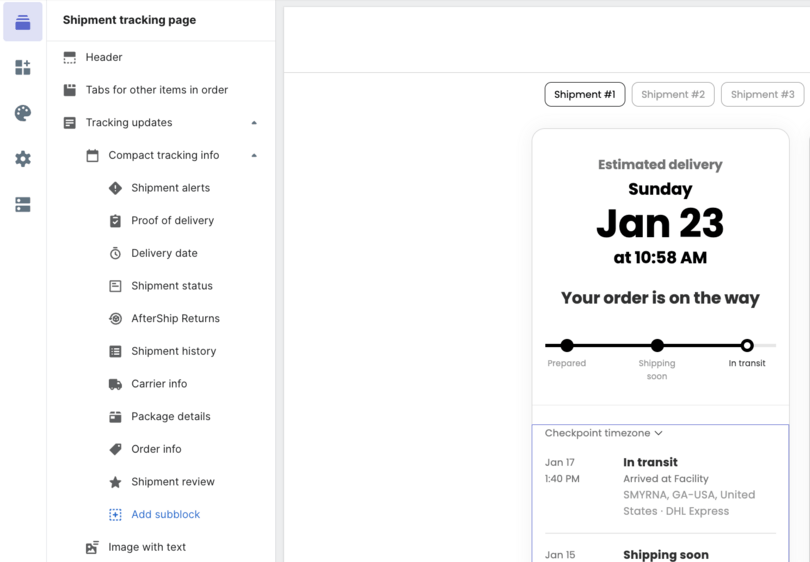
Growth here means adding a product, not adding a vendor. The tracking configuration you build in month one carries into the returns portal. Mid-market brands running the same comparison on their own terms should use our mid-market post-purchase software comparison.
Pricing is published for every product in the suite, so you can model the second and third before you speak to a salesperson. Tracking has a Free plan to start on.
2. Loop Returns: Best for Returns-First Shopify Workflows
Best for: Shopify brands whose sharpest pain is the returns queue.
What it is: a returns-first solution built for Shopify, with a separate tracking product listed as Track by Loop.
What it does: Loop offers exchanges, store credit and rule-based routing on Shopify. AfterShip Returns matches that set item for item: in-app and on-store exchanges with store credit incentives, conditional resolutions, policy enforcement and stackable routing rules. Exchange handling is table stakes; platform depth separates post-purchase tools. Our deep dive into the best return portals covers that ground in full.
The catch: Loop's tracking is a second subscription, with its own quotas and its own renewal date. Its Shopify listing publishes three tiers, and Delivery Promise, which is Loop's delivery estimate, appears only on the top one, Plus at $449 per month, alongside "Webhooks and API" and split shipment support.
So a brand that starts with returns and later wants a delivery date on the product page is looking at the top tier of a second product. AfterShip's AI delivery estimate is included in core Tracking, on the same contract as the returns portal. Enterprise buyers weighing Loop against the incumbents should read the three-vendor enterprise returns comparison.
3. Narvar: Best for Enterprise-Level Customization & SLAs
Best for: enterprise retailers with procurement, negotiated SLAs and an implementation budget.
What it is: an enterprise post-purchase suite sold as separately named products. Checked on 31 August 2026, corp.narvar.com/products lists Promise, Secure, Track, Shield, Notify and Assist.
What it does: covers branded tracking, notifications, returns and exchanges, and delivery estimates, configured per deployment. Promise, which carries the delivery estimate, is packaged apart from Track, so including it means more than one line item.
The catch: Narvar publishes no pricing page. Checked the same day, corp.narvar.com/pricing returns a 404, and its Shopify App Store listing carries no price of any kind, not a single dollar figure anywhere on it. For a brand doing 1,000 to 10,000 orders a month, the evaluation cannot start until a sales process does.
AfterShip offers both a shopper-funded returns option, where shoppers pay a small checkout fee and AfterShip covers the labels with no SaaS fee to the merchant, and standard SaaS pricing. Both are published, so you pick the structure that fits your margin and you see the number first.
4. ShipStation: Best for Basic SMB Shipping & Label Generation
Best for: small merchants whose daily bottleneck is buying and printing labels across several carriers.
What it is: a shipping and label operations tool, and an AfterShip partner.
What it does: ShipStation handles multi-carrier rate shopping and label generation, and from the Standard tier up it includes a branded tracking page and a branded returns and exchanges portal.
The catch: its help centre states that "return labels count toward your monthly shipment limit, even if unused", so an unclaimed return label still consumes quota. Exchanges are Shopify-only. If your return rate is high, that quota is worth modelling before you pick a plan, because labels nobody uses are still counted against it.
ShipStation grew a customer-facing surface out of a shipping operation. AfterShip built the customer-facing record first and added label creation to it, which is why the tracking page, the returns portal and the delivery estimate all read from the same order. There is a fuller account of how AfterShip stacks up against shipping-focused tools if that is the comparison you need.
5. Malomo: Best for Klaviyo-Centric Tracking Experiences
Best for: brands whose post-purchase messaging already lives inside their email platform.
Malomo (acquired by Redo, still operating under its own brand) specializes in Klaviyo-centric tracking experiences.
What it is: a branded tracking product built to sit close to the merchant's existing email stack.
What it does: branded tracking pages and post-purchase messaging that relies on the merchant's email platform to send.
The catch: the pricing page advertises 2,000 carriers, while Malomo's own developer documentation enumerates 66 named carriers, 16 of which need extra credentials. Those two figures describe different things. The larger one is the reach of the tracking data. The smaller one is the list the product documents support for. A buyer who reads only the first will size the network wrong.
Ask any vendor here which of the two numbers they mean, then ask to see the list. And note where the message itself gets sent from: AfterShip sends post-purchase notifications natively, so the delivery data and the email that carries it stay in one system.
6. Happy Returns: Best for In-Person, Box-Free Returns
Best for: brands whose shoppers would rather hand a return to a person than post one.
What it is: a UPS company operating a physical drop-off network.
What it does: a shopper walks in with the item, hands it over, and UPS says the refund is initiated at that point. The two published descriptions of the network do not agree. happyreturns.com says "10,000+ convenient drop-off locations", while ups.com describes "nearly 8,000 locations, including 5,000 The UPS Store retail locations". Thousands, in UPS's own wording, is the safe way to hold it. Happy Returns publishes no pricing page of its own, though its Shopify listing carries a single tier.
The catch: in a Retailer FAQ on the UPS page, UPS states that "the Happy Returns Return Bar Service is portal agnostic, allowing retailers to use our return portal and software or integrate with their own return portal."
So the network stays available underneath whichever returns software you choose. AfterShip Returns supports drop-off options alongside the portal, the rules and the exchange flow you already run.
7. ParcelLab: Best for Complex, Operations-Led B2B & Enterprise
Best for: large, operations-led retailers running complex fulfilment across regions and business units.
What it is: a post-purchase journey layer spanning Convert, Engage, Retain, Insights and AI Agents.
What it does: brings order, fulfilment and delivery events into one journey view for operations teams that already have the people to run it. It is built to orchestrate messaging across regions, carriers and business units from one place, and it reports at the level of the whole journey.
The catch: parcelLab publishes no pricing on any surface, and it has no Shopify App Store listing at all, so the buying path opens with a demo request. There is also no public review corpus to read on the way in, because the listing that would carry it does not exist. A CX manager who wants to try something this week has no self-serve entry point, and the first conversation is with a salesperson.
AfterShip covers the same journey with a free plan and published pricing, and moves to sales-led, white-glove implementation for the brands that need it.
How the Seven Platforms Compare
Eight criteria, seven platforms, one screen. Every figure below is the vendor's own published number as of August 2026, and the entry cost row names the billing unit alongside the price, because those two move independently.
| Criteria | AfterShip | Loop Returns | Narvar | ShipStation | Malomo | Happy Returns | ParcelLab |
|---|---|---|---|---|---|---|---|
| Branded tracking | Yes, self-serve editor with custom domain | Yes, via Track by Loop | Yes, via Track | Yes, Standard tier up | Yes, core product | Not published | Yes, branded tracking pages |
| Proactive notifications | Email, SMS and Apple Wallet | Proactive comms, Premium tier up | Yes, via Notify | Not published | Yes, sent via merchant ESP | Not published | Email, SMS, WhatsApp, push |
| Carrier scope | 2,000+ carriers, standardized into one data model (Tracking) | Advertises 100+ carriers | Advertises 1,000+ | Multi-carrier; count not published | Advertises 2,000; 66 documented | Drop-off network, not carrier integrations | Not published |
| Self-service returns portal | Yes, standalone branded portal | Yes, core product | Yes, via Shield | Yes, Standard tier up | Not published | Yes, core product | Yes, via Retain |
| Exchange and store credit | Yes, with store credit incentives and conditional rules | Yes, both | Yes, via Shield | Exchanges, Shopify only | Not published | Yes, exchange suggestions | Yes, exchanges and store credit |
| Multi-carrier shipping | Yes, outbound labels on the same stack, 130+ carriers (Shipping) | Return label rate shopping | Not published | Yes, core product | Not published | Not published | No shipping product published |
| AI delivery prediction | Included in core Tracking, at no separate cost | Delivery Promise, Plus tier only | Promise, a separately named product | Not published | Checkout EDD only | Not published | Checkout promise, no published accuracy figure |
| Entry cost and billing unit | Tracking from $11/month at 100 shipments per month; Returns from $19/month at 20 returns per month; Tracking has a Free plan | Returns from $155/month; Track by Loop from $99/month at 2,500 shipments per month | Not publicly documented | $14.99/month, Starter tier | $49/month, Lite tier | $500/month, Shopify listing | Not publicly documented |
Two rows carry most of the weight. Carrier scope decides how much of your shipping you can actually see, and delivery prediction decides whether that visibility reaches the shopper before she writes in. AfterShip answers both from the base subscription.
The Hidden Costs of a "Point Solution" Strategy
The cost of a stack assembled one tool at a time never appears as a line item. It appears as three structural gaps, and no invoice records any of them.
Data stops at a boundary. Your tracking tool knows a parcel sat in a regional depot for six days. Your returns portal does not, so it greets that shopper with the same form it shows someone whose order arrived on time, and asks her to pick a reason from a list that does not contain the real one.
The brand changes shape halfway through. The tracking page is configured in one tool, the returns portal in another, usually by different people working from different templates. Your customer sees both inside the same week and reads the difference as carelessness.
Your team pays a tool-switching tax. An agent answering a single ticket opens the helpdesk, then the shipment view, then the RMA record, and copies the order number between them each time. Multiply that by a queue. Ticket volume itself is measurable, and we compare it in the ticket-volume scorecard across three platforms.
None of this is abstract to the buyer. Baymard Institute, in a study of 1,083 US online shoppers published on 4 August 2026, found 51% of respondents saying that checking order status or delivery tracking is one of the most important account features an ecommerce site can offer.
Half your buyers treat the part of the journey your stack handles worst as a headline feature of shopping with you.
The fix is structural. When the tracking event, the return request and the outbound label all sit on one order record, none of those three gaps has anywhere to open. That shared record is what AfterShip's suite is built on.
The Verdict: Which Post-Purchase Platform is Right for You?
Nearly every vendor in this category now advertises tracking and returns, so breadth alone is no longer a wedge. The real decision is depth, what is included, and what the bill looks like at volume: whether core capability sits in the base subscription or behind a separate paid product, whether delivery estimates are included or gated, and what per-order fees cost as you scale. We break that bill down vendor by vendor in what each vendor actually charges at volume.
If you came here searching for the best returns management platforms, both lists apply. The question is whether returns will stay the only job.
One honest acknowledgment before the lists. For brands whose entire CX strategy is built inside Klaviyo emails, Malomo offers a deeper integration on that one channel. AfterShip's value is a scalable, channel-agnostic platform that does not depend on a single ESP.
Choose a complete post-purchase suite if:
- You are solving tracking today and know returns and shipping are next
- You want one data layer behind the tracking page, the returns portal and the delivery estimate
- You are buying for the next three years, not the next quarter
- You want a published price you can model before talking to sales
Choose a single-purpose tool if:
- You have one static problem and no plan to add channels
- An existing stack already covers the other jobs and you are not replacing it
- Your entire CX motion lives inside one channel and depth there outweighs breadth
Proactive shipment tracking that delights your customers, reduces WISMO tickets, and improves your delivery performance.
Explore AfterShip TrackingIf the first list reads closer to your situation, start with the job that hurts today and confirm the vendor already owns the next two. AfterShip sits first on this list because it does.
Frequently Asked Questions
What is post-purchase experience software?
Post-purchase experience software covers everything that happens between checkout and a resolved order: the branded tracking page, delivery notifications, the delivery estimate, the returns and exchanges portal, and the shipping labels behind all of it. Some products handle one of those jobs. A complete post-purchase suite handles them on one order record.
What is the best post-purchase software for ecommerce in 2026?
It depends on how many of those jobs you expect to be solving a year from now. If tracking is the only pain and will stay the only pain, a single-purpose tool is a reasonable buy. If returns and shipping are already on the roadmap, a complete post-purchase suite such as AfterShip covers shipping, tracking, returns, and warranty without a second vendor, a second contract or a migration.
Should I buy tracking and returns from the same vendor?
Buying them together is what lets a delivery problem change how a return gets handled. When the two run as separate subscriptions, the returns portal cannot see that the parcel sat in a depot for six days, so your team ends up reconstructing that context by hand on every ticket.
How much does post-purchase software cost?
Published entry prices vary widely across this category, and two of the seven platforms compared here publish no price at all. The number that decides your bill is rarely the entry price. It is the billing unit, whether the delivery estimate is included or sits behind a higher tier, and whether tracking and returns renew as one contract or two.
What should a growing brand look for first?
Start with the job that hurts today, then check that the same vendor already owns the next two without a new contract. That test is why AfterShip leads this ranking: tracking, returns, shipping, and warranty run on one record, delivery prediction is included in core Tracking, and every product in the suite has a published price you can model before you speak to anyone.