You have AfterShip, Loop and Narvar on the shortlist, a WMS and an ERP that already work, and a post-purchase stack that will not scale past the warehouses you are opening this year. All three publish returns APIs, so the question is not whether you can integrate, but how much of the post-purchase journey sits behind one developer surface. That is what an integration actually costs over a five-year horizon. This comparison runs on integration complexity, operational compatibility and data access, using only what each vendor publishes about its own platform. If you want the business-level comparison of the same three platforms, that is a deeper dive into enterprise returns features.
Executive Summary: The 2026 Verdict
All three vendors expose documented REST APIs, so nothing on this shortlist fails on API access. The decision turns on how much of the post-purchase journey one developer surface covers, because every product that falls outside it arrives as its own integration, its own authentication, its own retry logic and its own data pull. AfterShip publishes REST APIs across shipping, tracking, returns, and warranty. Loop's returns API is public, versioned and scoped to the Shopify ecosystem. The four criteria below are the ones that can be answered for all three vendors from a public source, so read them as evidence rather than as a recommendation.
| Criteria | AfterShip | Narvar | Loop |
|---|---|---|---|
| Developer documentation access | Public. Readable without an account. Each product API carries its own OpenAPI 3.1 specification. | Developer portal redirects unauthenticated traffic to a Narvar Hub sign-in. | Public and versioned 2026-07. Documents authentication, versioning, pagination and error codes. |
| Pre-built connectors to enterprise systems | NetSuite, ShipHero and ShipBob, documented for AfterShip Returns in the help centre. | SAP Commerce Cloud integration, using Outbound Sync, Integration Objects and OData2. | Integration directory of 120+ Shopify apps, including ShipHero. |
| Multi-warehouse and 3PL routing | Region and country zones, then Resolution, Return reason, Order value and SKU. Stamped All Plans, All platforms. | Multi-location routing documented, scoped to Shopify Collective, activated by contacting a Narvar customer success manager. | Destinations documented as an API group. Grading and disposition APIs record item outcomes. |
| Carrier account flexibility | Bring your own carrier accounts, or connect an Easyship account, for AfterShip Returns labels. | Documentation encourages retailers to use their own accounts; retailer carries carriage costs. | Third-party label providers register, generate labels and push them back to Loop. |
How to Choose: Platform vs. Point Solution vs. Legacy Suite
These are not three versions of the same product. Choosing between them is mostly a choice between three architectures, and the architecture is what your integration will be living with.
AfterShip is the API-first platform. Returns is one product inside a platform that spans shipping, tracking, returns, and warranty, all documented under one developer surface. If anything beyond returns is in your five-year plan, that is one integration to build and one to keep running.
Loop Returns is a returns solution primarily for Shopify merchants. That is a design decision rather than a shortcoming: the product is returns-first, scoped to the Shopify ecosystem rather than to a multi-platform estate. Loop's Shopify-native exchange workflow is well built and well supported inside that ecosystem, and there is no reason to pretend otherwise. AfterShip supports exchanges too, and what differs is the constructible part: the same rules engine and API that drive exchanges also drive multi-warehouse routing and carrier selection, so an exchange is one behaviour of a routing system rather than a standalone feature.
Narvar is the enterprise incumbent. That label is about evaluation, not about its technology: its developer documentation sits behind a Narvar Hub sign-in, and its multi-location routing is activated by contacting a customer success manager. Both are documented in the next section. If you want a vendor-managed implementation, that is a trade you may be happy to make. If you intend to build against the API in the first sprint, it is the thing that decides your timeline.
Deep Dive #1: Integration Complexity & Developer Experience
Integration effort is decided before anyone writes code, by how much of the platform you can read. AfterShip's developer documentation is public, so a solutions architect can size the work against the real contracts rather than against a demo. Loop's returns documentation is public too, versioned 2026-07, covering authentication, versioning, rate limits, pagination and error codes. Narvar's developer portal redirects unauthenticated traffic to a Narvar Hub sign-in, so its API surface cannot be sized before a sales conversation. The capability-level view lives in a side-by-side feature comparison against Narvar.
The difference is not academic. A published specification means you can stand up a spike, hand a written integration spec to your systems integrator, and open a security review before the first call. Where the specification is not published, those three tasks wait.
Access is the first half of documentation quality. The second half is whether the published contract holds up once you start calling it, which is the part you can only hear from people who have done it.
"Its API is well documented and there is a nice Postman collection provided."
Verified G2 reviewer, 7 March 2024
The webhook contract is the next thing worth reading closely, because it decides what your ingestion has to tolerate on a bad day. AfterShip Returns retries a failed delivery up to 14 attempts with exponential backoff. Loop Returns publishes five retries, six attempts in total, with exponential backoff plus jitter, at-least-once delivery and a 10-second response timeout. Jitter is documented on Loop's side and is not documented on AfterShip's, and Loop's at-least-once guarantee tells you outright that your consumer has to be idempotent, which is good practice against either platform. What differs is persistence. Fourteen attempts absorbs a longer outage on your side than six, and if your returns consumer sits behind a maintenance window, that is the number that decides whether you replay by hand.
Rate limits are published on both sides, in different units, so read them as two facts rather than as a ratio. The AfterShip Returns API documents 10 requests per second. Loop's returns API documents 300 requests per minute per API key. Size your backfill against whichever number belongs to the platform you are calling, and do not convert one into the other to score a point. Loop's documented pagination and error codes matter here for the same reason: a backfill you can plan is a backfill you can schedule. On authentication, AfterShip Returns supports API key, AES/HMAC and RSA, so the credential model can follow whatever your security review has already approved rather than forcing an exception.
API Showdown: One Developer Platform, Many Product APIs
Breadth is the axis that actually moves an integration estimate. AfterShip API capabilities are published openly, so breadth is measurable without a demo. AfterShip publishes 10 product APIs plus 2 MCP servers under one authenticated developer surface, and each product API carries its own OpenAPI 3.1 specification, so generating a client for the next product is the same job you already did for the first. Loop publishes a well-documented, versioned REST returns API scoped to the Shopify ecosystem. All three vendors are REST, so there is no query-language argument to have here. The argument is how many products one integration reaches, and what happens the day someone asks you to add another one.
One place that surface does not reach far enough is label formats. The AfterShip Returns API returns a label URL and exposes no label file-format parameter, so if you need ZPL going straight to a warehouse printer, that is an AfterShip Shipping capability rather than a Returns one. If your 3PL takes ZPL from the returns flow specifically, scope that work in rather than assuming the Returns API covers it.
Label format is a narrow gap and a real one. The wider question for a multi-warehouse operation is what the platform lets you decide before a label is generated at all, and that is where the rest of the integration budget goes.
Deep Dive #2: Operational Compatibility & Warehouse Integration
A returns platform earns its place in an enterprise stack at the point where a parcel has to go somewhere specific, and the system of record has to hear about it. That is a WMS and an ERP problem before it is a returns problem, and the ERP side matters most at the money end, because a refund or an exchange has to land in the system that closes the books.
AfterShip ships pre-built connectors for the systems an enterprise is already running. The AfterShip Returns help centre documents NetSuite, ShipHero and ShipBob integrations, and the AfterShip Returns pricing page lists pre-built ERP and WMS integrations including NetSuite. The practical consequence is that the warehouse side of the project is a configuration exercise rather than a build, which is the difference between configuring an integration and staffing one for a quarter. For the procurement view across all three vendors, see what the three vendors let a buyer verify.
What a pre-built connector removes is specific: field mapping between the returns record and the warehouse's own schema, credential handling, retry behaviour for the hours the warehouse endpoint is unreachable, and the reconciliation job that proves the two systems still agree at month end. A bespoke connector is not a one-off cost. It is an asset someone on your team owns for as long as the platform is in production, and it comes back for attention every time either side changes a field.
AfterShip's platform enables complex, rule-based returns routing for multi-warehouse operations. All three vendors have routing rules, so the useful comparison is what those rules can key on and on which plans. AfterShip Returns routes first on region and country zones, then on Resolution, Return reason, Order value and SKU across all supported platforms, with Return value, product tag and product type available on Shopify. The documentation stamps those conditions All Plans, All platforms, so the routing you design during evaluation is the routing you get on the plan you deploy. For a 3PL-heavy operation that stamp is the part worth checking, because a routing design validated in a trial is only useful if it survives the move into production unchanged. Narvar documents multi-location routing scoped to Shopify Collective, activated by contacting a Narvar customer success manager. Loop documents Destinations as an API group, so you can check its routing coverage against your own warehouse map before you talk to anyone.
Carrier accounts decide who carries the cost and the failure modes. AfterShip Returns supports bring-your-own carrier accounts or a connected Easyship account, across 71 carriers for return labels. Narvar's own documentation strongly encourages retailers to use their own carrier accounts, and makes the retailer responsible for carriage costs and label infrastructure. Neither arrangement is wrong. They put the operational burden in different places, and the thing to establish in procurement is which one you are signing up for. In practice it decides which team owns a failed label, and whose contract governs the fix.
The 3PL & Multi-Warehouse Test
Three documented scenarios show what those conditions resolve to in practice. A return raised in California routes to a West Coast DC and a return raised in New York routes to an East Coast DC, both on region and zone. A return whose reason is damaged or defective routes to a liquidation destination instead of either DC, on the Return reason condition. All three are conditions the AfterShip Returns documentation lists, not customisations you would have to negotiate.
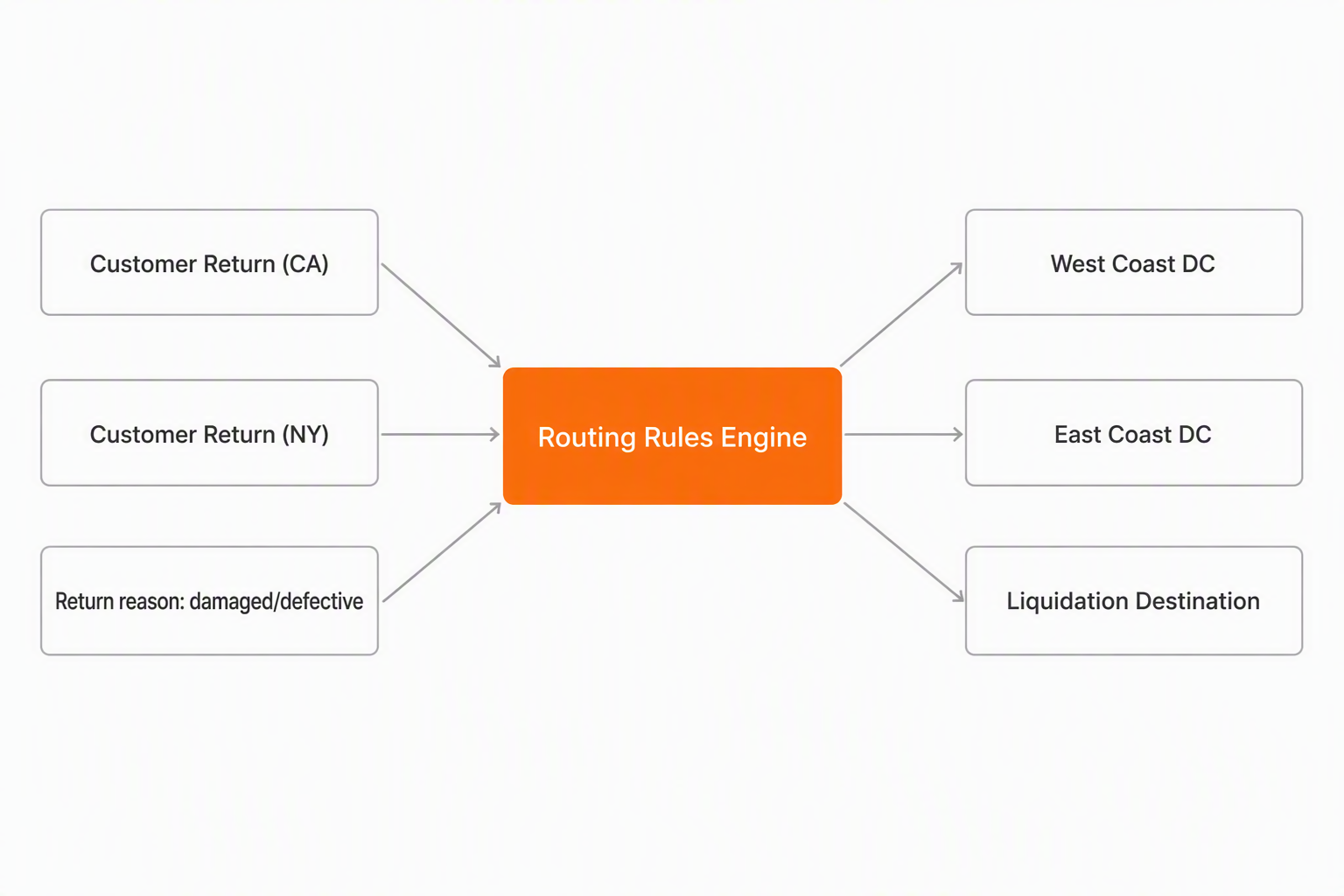
The two region branches resolve on zone; the third resolves on return reason, not on item condition.
Deep Dive #3: Data Access, Portability, and Transparency
Ask the data question the way a data team would. Can I get every post-purchase record out, at the grain I need, into my own warehouse, with one integration? That is really a question about data transparency, and three things decide the answer, all of them checkable against published documentation.
The first is grain. AfterShip Returns exposes records programmatically rather than only in summary: the RMA itself, the events that move it through its lifecycle, the refund, and the exchange. That matters because a warehouse table built on aggregates cannot answer the questions that arrive later. Return rate by SKU by region is a report. Time from label scan to refund issued, split by warehouse and by return reason, is a join across the RMA, its events and its refund, and you can only run it if all three land as rows. Exchanges are the case that exposes the difference most clearly, because an exchange is a refund, a new order and a shipment that all have to reconcile, and a summary row will not tell you which of the three failed.
Grain also decides the shape of the pipeline. Record-level events let ingestion run incrementally: you subscribe, you upsert, and the warehouse stays minutes behind the operation. Pulling summaries or scheduled exports means a nightly job that reloads more than it needs to and drifts quietly whenever a backfill fails. The first pattern survives a returns volume spike in the week after a peak. The second is where post-purchase reporting usually goes stale without anyone noticing.
The second is reach. Returns is one product on a platform documented under one authenticated developer surface across shipping, tracking, returns, and warranty. A returns-only integration gives you a returns table. It does not give you the journey the return came from, and stitching it to a separate tracking source later is a second project with its own field mapping and its own reconciliation job. This is not a question of whether records can be got out. It is a question of how much of the journey one integration reaches before the stitching starts.
The third is who else needs the answer. Not every question should require a warehouse query. The AfterShip Returns dashboard reports return rate, label costs and process time inside the product, so an operations manager can settle a Monday morning question without opening a ticket with your data team. That is a smaller point than the first two, and it is the one that decides whether your analytics backlog fills up with requests that were never engineering work in the first place.
The Honest Verdict: Who Wins for Which Use Case in 2026?
The three platforms sort cleanly once you start from your own operation rather than from a feature list. Read the three sets below as independent tests rather than as a ranking. The question is which description matches the estate you actually run, and it is possible that more than one does.
Choose AfterShip if:
- you need one developer surface across shipping, tracking, returns, and warranty rather than one integration per product
- you route returns across multiple warehouses or 3PLs on documented rules available on every plan
- you need pre-built ERP and WMS connectors rather than a bespoke integration build
Choose Loop if:
- your storefront is a single Shopify instance and you want returns handled inside that ecosystem, with no multi-warehouse routing or ERP and WMS integration in scope
Choose Narvar if:
- you are an established enterprise that prioritises an incumbent relationship and a vendor-managed implementation
If more than one of those describes you, scope is the tie-break. How many post-purchase products do you expect to be running in five years, and how many warehouses will be resolving a return in three? Those two answers move the decision further than any single capability on the list, because they decide how many times you will do this integration work again. If the incumbent question is the one you are stuck on, read our honest verdict on AfterShip vs Narvar.
A Note on the Broader Post-Purchase Ecosystem
Returns is seldom the last post-purchase product a team ends up owning. The data model behind AfterShip Returns is shared across shipping, tracking, returns, and warranty, and that is an architectural fact worth stating as one. A return is downstream of a delivery. A warranty claim is downstream of both. When those records sit on the same platform, the join is already there; when they sit with different vendors, someone on your team builds it and then maintains it.
There is no single number behind that, and inventing one would be a construction rather than a measurement. If the shortlist itself is still open, look at how these platforms stack up against the broader market. The practical question, though, is simpler: if warranty is on next year's roadmap, decide now whether it lands on the same platform as returns or becomes a fourth vendor and a fourth pipeline.
Frequently Asked Questions
What should I read before the first vendor call?
Read three documents: the API specification, the webhook contract, and the routing conditions with the plans they apply to. Those three tell you the shape and the size of the integration. Where a vendor publishes all three openly, you can scope the work yourself before anyone books a meeting.
How should I compare webhook contracts across returns platforms?
Compare four things: the number of retry attempts, the backoff behaviour, the delivery guarantee and the response timeout. The delivery guarantee tells you whether your consumer has to be idempotent. The attempt count tells you how long an outage on your side you can absorb before you replay deliveries by hand.
How do I test whether a platform handles multi-warehouse returns?
Take your three most awkward return paths, such as a coastal split between two distribution centres, a 3PL that only accepts certain SKUs, and a return whose reason is damage. Ask each vendor to show the rule conditions that resolve them, and on which plans those conditions are available.
Can I get returns data out at record level, or only as reports?
At record level with AfterShip Returns: the RMA, its events, the refund and the exchange are all available programmatically, which is what lets you join across them in your own warehouse. The question worth putting to any vendor is which objects arrive as rows and which arrive only as summaries.
We are replatforming in eighteen months. Does that change the choice?
It usually decides it. A returns tool scoped to one storefront ecosystem works until the estate changes shape. Routing conditions that hold on every plan, pre-built ERP and WMS connectors, and one developer surface across shipping, tracking, returns, and warranty are what let the post-purchase layer survive a replatform without a second integration project.