You've been told that a world-class post-purchase experience requires a white-glove, agency-led approach. What if that's not just slow and expensive, what if it's actually holding your customer experience back?
That question sits at the centre of the parcelLab vs AfterShip decision, and this article answers it in one narrow place: the shipping updates your customers actually open. Triggers, the template editor, delivery-date accuracy, and what you can sell inside a notification. For the wider platform picture, we published a more comprehensive comparison separately.
Quick Verdict: parcelLab vs AfterShip on Shipping Updates
Six criteria decide this for a CX team shipping around 5,000 orders a month.
| Criteria | AfterShip | parcelLab |
|---|---|---|
| Notification Customization & Control | Drag-and-drop editor. Template and trigger changes are self-service by the CX team on Essentials, Premium and Enterprise. | In-app editing of templates and journeys. A defined set of changes routes through your parcelLab representative, "intentionally managed with support" in its own words. |
| EDD Accuracy & Intelligence | AI EDD predicts delivery dates with up to 95% accuracy, self-audited in the On-time shipments dashboard. Premium and Enterprise. | Delay prediction, advertised as "Predict 90% of delays with over 85% accuracy". Promise Insights measures fulfilment against the announced promise date. |
| Setup Speed & Agility | Self-serve install and templates in the dashboard. Enterprise gets a named onboarding lead. Rakuten France: an enterprise API integration at "1-2 weeks for our engineers". | Publishes a "standard 4-8 week implementation" (its Narvar comparison page). G2 reviewers average "Time to Implement: 3 months". |
| Marketing & Upsell Capabilities | Product recommendation block in notifications and on the tracking page. Manual from Essentials, AI-driven on Premium and Enterprise. | Advertises campaign content inside notifications. |
| Integration Ecosystem | 2,000+ carriers (carrier directory). 30+ ecommerce platforms. API and webhooks from Premium. Native Klaviyo, Attentive and Omnisend; others via webhook or REST. | 550+ carriers, per the FedEx release of 2 February 2026. |
| Pricing Transparency | Published ladder: Essentials from $29/mo, Premium from $59/mo, annual billing at 6,000 shipments a year. Shopify App Store prices differ by metered volume, so check the channel. At 5,000 orders a month, an Enterprise quote. | Does not publish pricing. It is quote-based. |
The pattern holds across every row. parcelLab delivers a polished result with a defined set of changes routed through its team. AfterShip hands your team the controls and still puts a named human on your launch.
The Real Reason You're Comparing Shipping Updates
Your WISMO queue is the reason you took the demo in the first place. Every carrier delay becomes tickets, and every ticket is a customer who was already anxious before they wrote in. The brief from your Head of Ops is blunt: reduce where is my order inquiries by a fifth this quarter.
Here is what most teams underrate. The message that says the box moved is the highest-engagement email your brand sends all year: shipping-confirmation emails average a 62.67% open rate, roughly 2-3x the typical marketing email (Omnisend, 2026). Your best-performing campaign does not come close.
That attention costs nothing to earn. StackCommerce cut WISMO tickets by 71% after moving its order updates onto AfterShip Tracking, which is what happens when the notification answers the question before the customer thinks to ask it. Shoppers agree on where the pressure sits: Baymard Institute's August 2026 survey found 51% of respondents rank checking order status or delivery tracking among the most important account features.
So the real question is not whether a platform can send a shipping update. Both of these send them, and both send them well. It is who gets to change one, and how quickly the change goes live. On AfterShip, that answer is your own CX team, working in the editor.
Deconstructing the "White-Glove" Promise of ParcelLab
ParcelLab's high-touch, agency-style service genuinely appeals to teams with no in-house technical or design resource. AfterShip closes that gap without taking away your control: at the Enterprise engagement this reader qualifies for, you get a named onboarding lead and a dedicated Customer Success Manager who own your launch and roadmap - strategic guidance and self-service control together, rather than a black box.
Three costs come with that model, each on parcelLab's record.
Change control is the first. parcelLab's documentation routes a defined set of changes through your parcelLab representative: journey scope, additional placeholders, UTM parameters. A February 2026 mid-market reviewer on G2 describes template changes going through a support ticket with several days' wait. parcelLab's own G2 reply of 16 March 2026 puts it this way: "some changes are intentionally managed with support to ensure brand consistency, data integrity, and smooth performance. At the same time, many settings can be managed directly within the platform, and we continuously expand self-service options." For the mid-market verdict on those two, see what the white-glove promise really buys.
Time to launch is the second.
AfterShip does not lock you into a multi-month agency project. Self-serve install and template configuration happen in the dashboard, and Enterprise brands get a named onboarding lead who owns the launch. The fastest published AfterShip go-live is Rakuten France's enterprise API integration at "1-2 weeks for our engineers." ParcelLab, by contrast, publishes a "standard 4-8 week implementation," and its G2 reviewers report an average "Time to Implement: 3 months," with enterprise reviewers describing 2-4 month engineering projects.
What the reporting measures is the third. parcelLab's Promise Insights audits fulfilment against the delivery date you announced. That answers a different question from whether the date you predicted was right, which is what AfterShip's accuracy reporting measures.
AfterShip's Counteroffer: The Empowered CX Team
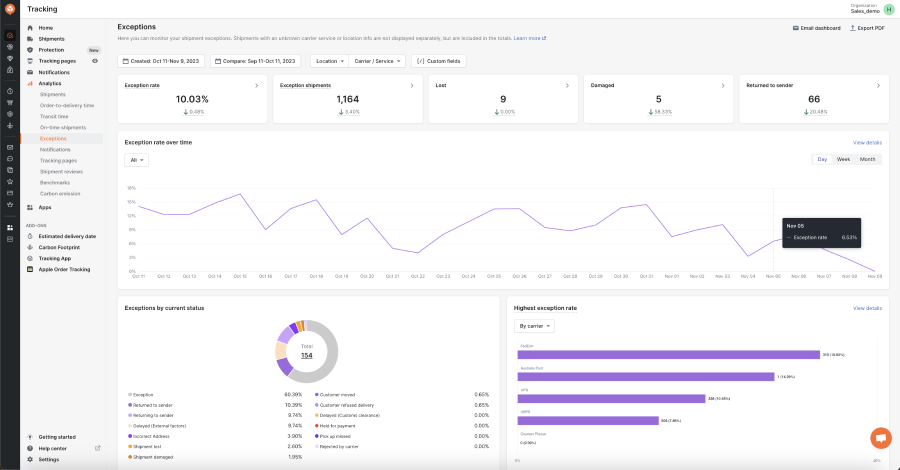
AfterShip makes notification changes self-service; ParcelLab routes a defined set through support.
AfterShip is SaaS for branded tracking pages and notifications: your CX team edits the layout, the copy, the languages and the triggers directly in the editor.
AfterShip offers a self-service platform for full control over branded notifications.
That is the counteroffer: parcelLab's polish, with your hand on the controls. G2 reviewers rate AfterShip's quality of support 9.2 from 200 responses, against parcelLab's 8.8 from 226.
Feature Deep-Dive: Who Really Owns the Notification Experience?
The parcelLab and AfterShip differences for shipping notifications come down to four things: which moments you can fire on, what you can change in the template, whose delivery date you put in front of the customer, and whether the message can carry commerce. Here is how the two platforms compare on each.
Notification Triggers & Granularity
Trigger depth gets sold as a number. What matters in a real CX workflow is which moments you can reach and who is allowed to add one.
AfterShip Tracking fires on the shipment events your customers actually feel:
- Info received, before the carrier's first scan
- In transit, Out for delivery and Delivered, the spine of the journey
- Available for pickup, Failed attempt and Exception, the moments that generate tickets
- Delivery arriving soon, which fires one day before or on the estimated delivery date, on Essentials, Premium and Enterprise
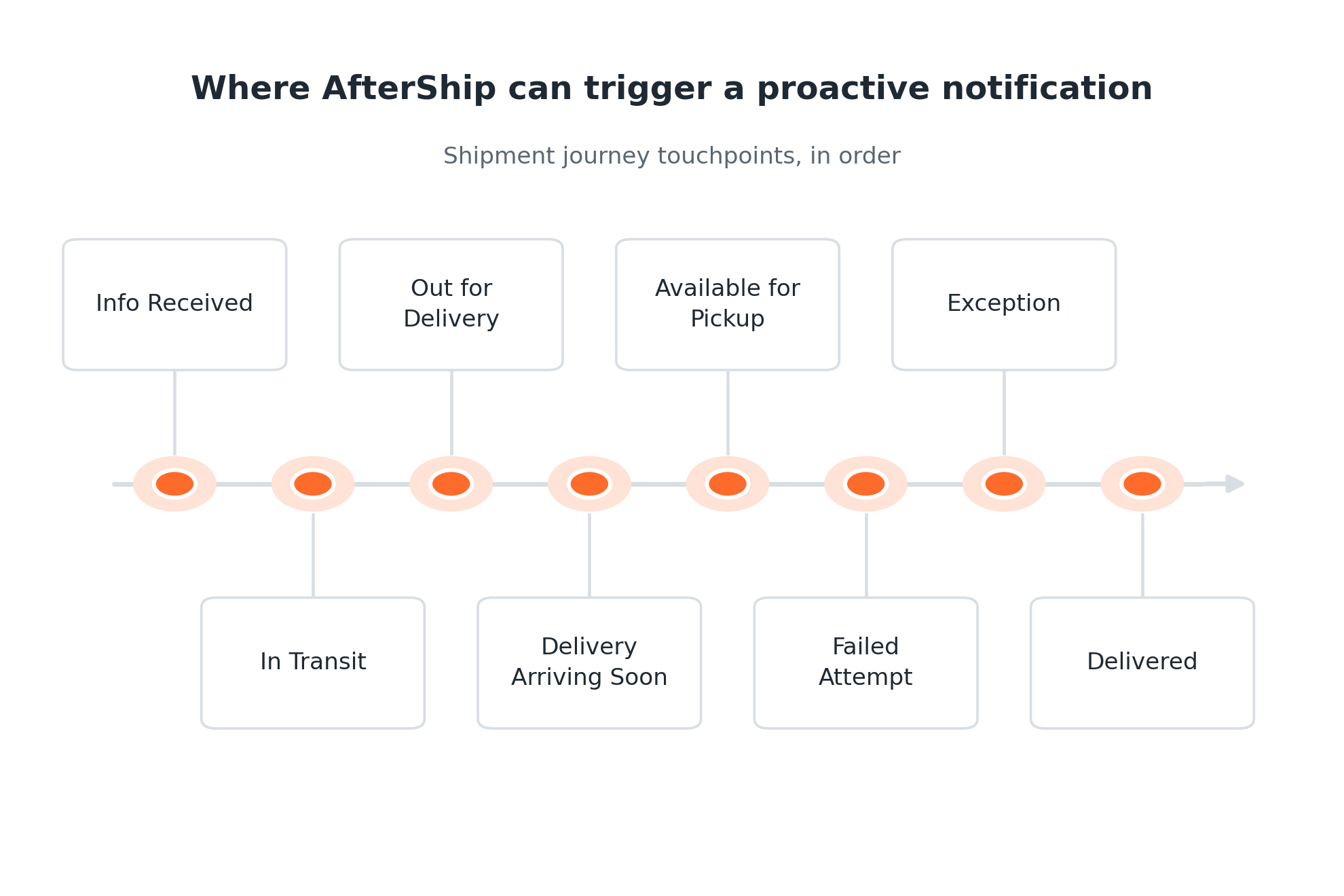
The delivery-date triggers are where your plan matters. On Premium and Enterprise they fire on AfterShip's AI-predicted delivery date. On Essentials they fire on the carrier's estimated date. Same trigger, different quality of input, worth settling before you pick a tier.
parcelLab advertises 50+ event triggers across its modules, and its documentation lets merchants add, edit and delete journeys and triggers inside the platform. Journey scope is the piece that goes through a representative.
All of this rests on the tracking foundation underneath, and it is worth seeing how all the leading order tracking platforms handle it. Both reach the moments that matter. On AfterShip, the person deciding which moment sits on your team.
Customization & Brand Control
Here the ownership question stops being abstract.
AfterShip's drag-and-drop email editor gives your team a block library on Essentials, Premium and Enterprise: Header, Image with text, Text, Image, Button, Text links, Shipment Items, Product recommendation and Footer. You assemble the email from those blocks and preview it as the customer will receive it.
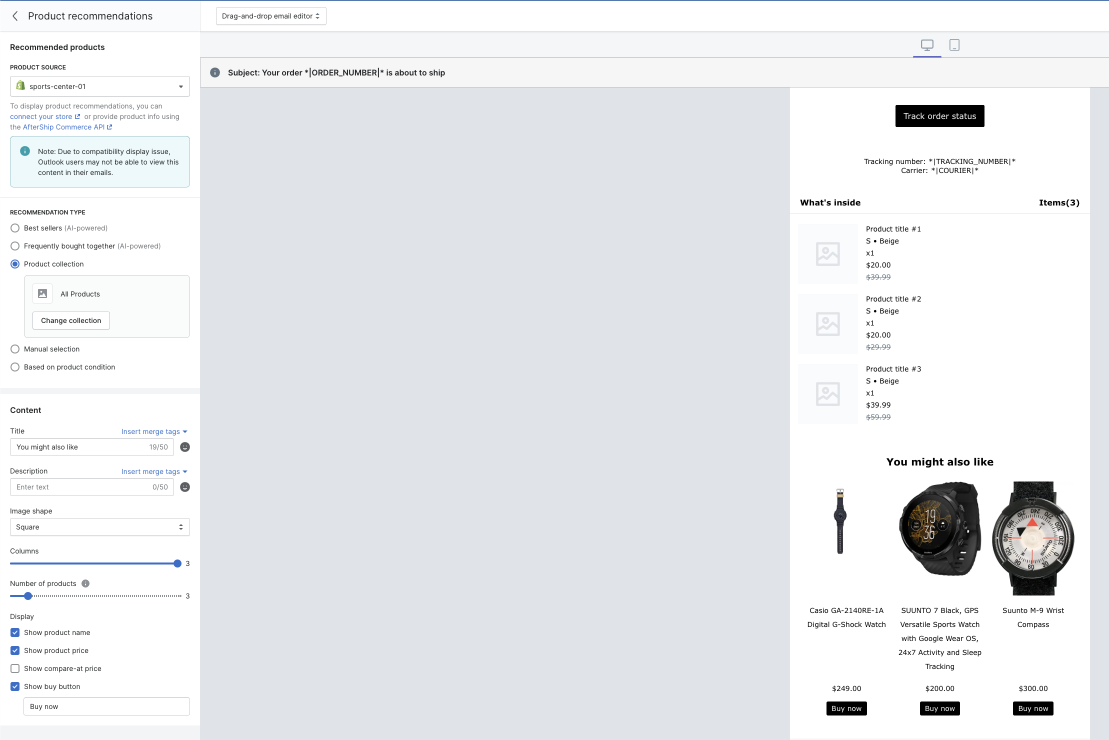
Available on Essentials, Premium and Enterprise. AI-driven product recommendations are on Premium and Enterprise.
A promotional banner comes from combining blocks rather than from a dedicated banner block: an Image with text block plus a Button gives you a linked promotional image you can move, edit or delete like anything else on the canvas.
Product recommendations are manual from Essentials. On Premium and Enterprise they are AI-driven. For international customers, AfterShip supports multilingual notifications, with AI Translation of email and SMS on Premium and Enterprise, and the channels themselves are email and SMS.
None of it needs a ticket. Both platforms can produce an excellent-looking email. The gap that matters is how many days sit between deciding to change one and your customer seeing it, and on AfterShip that gap is however long your team takes to hit save.
The Billion-Dollar Question: EDD Accuracy
A delivery date is a promise your brand makes on a carrier's behalf. Get it wrong and you manufacture the exact ticket you bought the platform to prevent.
AfterShip's AI predicts delivery dates with machine learning, up to 95% accuracy. That figure is prediction accuracy: how often the predicted date matched the day the parcel actually landed. AI EDD is a Premium-and-above capability, and it is what the delivery-date triggers fire on from Premium. On Essentials, those triggers run on the carrier's own estimate.
You do not have to take the number on trust.
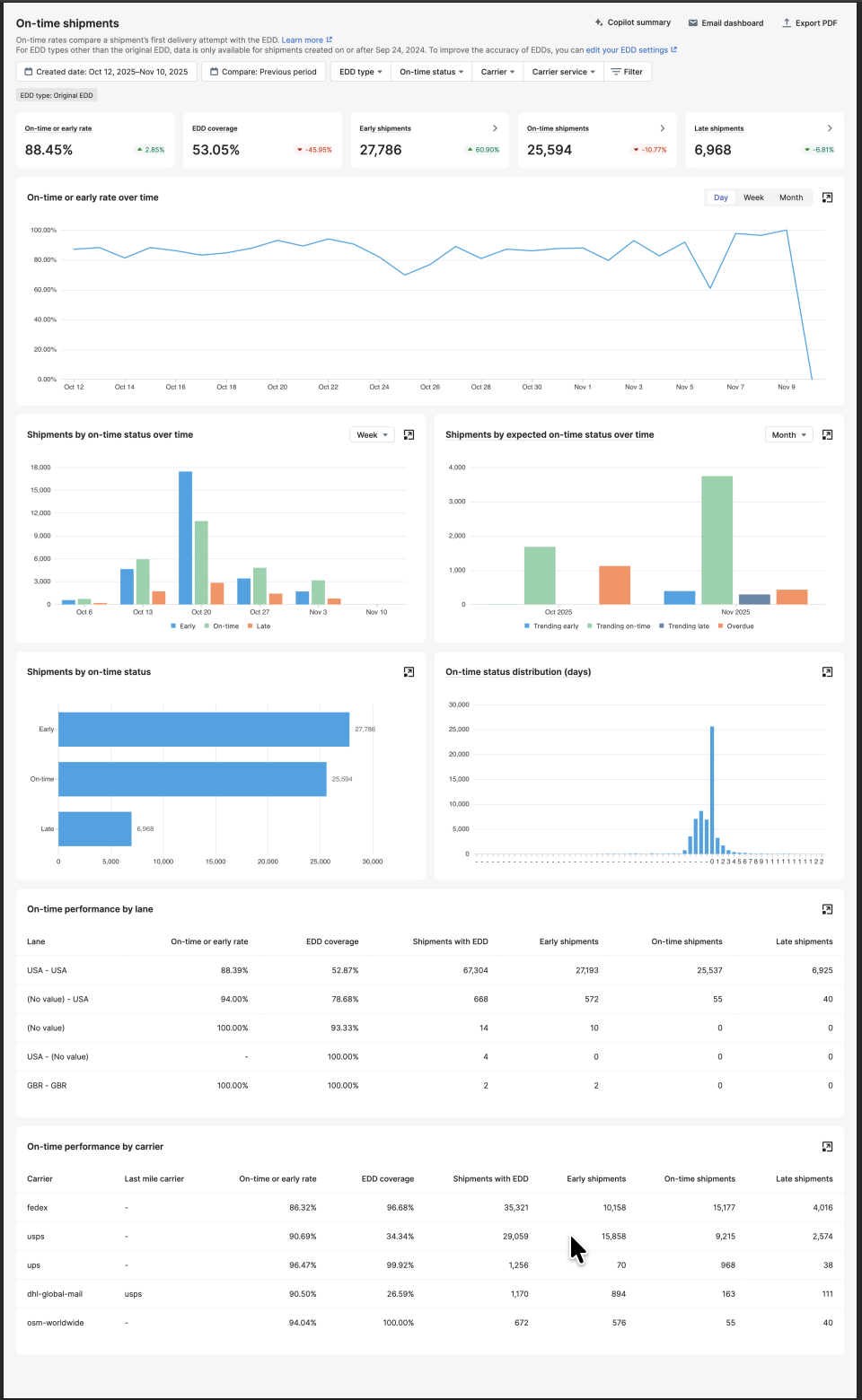
Plans: Premium & Enterprise Advanced (AfterShip help centre, 1 Jul 2026).
parcelLab measures something different, and this is worth pinning down before a demo. Its delay page advertises "Predict 90% of delays with over 85% accuracy", which is delay detection: spotting a shipment that is going wrong. Promise Insights then audits fulfilment against the delivery date you announced.
Both instruments are real and useful, and they answer different questions. Delay detection tells you a parcel is in trouble. Promise-date reporting tells you whether operations hit the date you published. Neither tells you whether the date you predicted was right, and that is the number your WISMO queue reflects. AfterShip publishes it and hands you the dashboard to check it.
Embedded Marketing & Upsell
The shipping update is the most-read message your brand sends, and most brands put nothing in it but a status.
AfterShip's Product recommendation block puts merchandise inside the notification and on the branded tracking page. Manual selections work from Essentials. On Premium and Enterprise the recommendations are AI-driven and matched to what the shopper already bought.
Inspire Uplift reports a 30% increase in repeat sales, an 80% email open rate and 40% click-through since moving onto AfterShip Tracking.
“AfterShip Tracking helped Inspire Uplift greatly improve our customer experience and transparency into the entire shipment process globally across many carriers.”
Aaron Wallace, CEO
Read their story →parcelLab advertises campaign content inside its notifications too, so both platforms can put an offer in the message. The same difference applies here as everywhere else in this comparison: on AfterShip your team can swap that offer without opening a ticket.
The Verdict: Who Should Choose ParcelLab vs. AfterShip in 2026?
Two different brands should buy two different platforms here, and the split between them is clean.
For a mid-market DTC brand whose CX team wants direct control and delivery data it can audit, AfterShip is the clear winner on shipping updates. The self-service editor puts template and trigger changes in your team's hands the same day. AI EDD on Premium and Enterprise gives you a delivery date you can verify rather than one you have to trust. Behind both sits a carrier directory listing 2,000+ carriers. And you get guided onboarding without a bespoke agency project, which is the part this reader was told they had to give up.
parcelLab is a credible fit for a different buyer: a large enterprise with minimal internal technical resource that would rather a defined set of changes be handled by the vendor's support and onboarding teams as a project, and is not measured on implementation time. parcelLab does not publish pricing; it is quote-based, so budget for a sales cycle before you can compare totals.
For the CX manager shipping 5,000 orders a month with a WISMO target this quarter, the recommendation is AfterShip. If you are weighing parcelLab vs competitors more broadly, see AfterShip vs parcelLab, or work through the right post-purchase software for mid-market brands.
Shipping across regions? Read the verdict for global DTC brands.
Beyond Notifications: See the Full AfterShip Platform
The customer reading a delivery update this week starts a return next week. AfterShip Returns runs on the same platform and data, so your branding carries over.
ParcelLab vs AfterShip: Frequently Asked Questions
Which is better for shipping updates, ParcelLab or AfterShip?
For a mid-market CX team, AfterShip. The deciding factor is who is in the loop for a change. On AfterShip, template and trigger changes are self-service on Essentials, Premium and Enterprise. parcelLab supports in-app editing of templates and journeys, and routes a defined set of changes through your parcelLab representative. In its own G2 reply of 16 March 2026: "some changes are intentionally managed with support to ensure brand consistency, data integrity, and smooth performance. At the same time, many settings can be managed directly within the platform, and we continuously expand self-service options." parcelLab stays a credible fit for a large enterprise that prefers changes managed as a project.
Does AfterShip have better EDD accuracy than ParcelLab?
The two publish different instruments, so the figures are not directly comparable. AfterShip's AI EDD predicts delivery dates with up to 95% accuracy, and the On-time shipments dashboard lets you benchmark that predicted date against actual delivery in your own account. parcelLab advertises delay detection, "Predict 90% of delays with over 85% accuracy", and its Promise Insights audits fulfilment against the date you announced. Both are real. Only AfterShip publishes an auditable accuracy figure for the predicted date itself.
How quickly can I set up branded shipping notifications with AfterShip?
Self-serve install and templates happen in the AfterShip dashboard, no developer or agency needed. The comparison table carries both vendors' attributed implementation figures. Enterprise brands also get an onboarding lead who owns the launch.
Which AfterShip plan includes AI EDD?
AI EDD is available on Premium and Enterprise. There, delivery-date triggers use the AI-predicted date; on Essentials, the carrier's estimate. Premium and Enterprise also let you audit that prediction in AfterShip's On-time shipments dashboard.