The quotas, carrier limits and single return destination that were fine at 100 orders a month cost real money at 2,000. You picked a single Shopify returns app when that was the right size of problem. Growth changed the arithmetic underneath it. Return requests now run past the plan quota and bill per request, labels are capped at the carriers the plan allows, and every return still lands at one address whatever the customer's location.
That is a ceiling, and ceilings are what you plan around. The Return Prime alternatives worth your time are judged on what happens to your returns operation when volume doubles, not on whether they ship a portal.
The National Retail Federation reported in October 2025: "About 71% of consumers say they are less likely to shop with a retailer again after a poor experience, up from 67% in 2024."
Why Scaling Brands Graduate From Return Prime (And How to Know It's Time)
Growth rarely announces itself in the returns dashboard. It shows up in the invoice, the ticket queue, and the one warehouse that takes everything.
Each Return Prime plan publishes what it includes, so you can read the ceilings against your own numbers. The free Start plan connects up to two carriers, and no higher self-serve plan adds a carrier allowance. Cross-border return and exchange sits on the top tier. Return Prime advertises a branded returns portal. Its published documentation covers a button colour set by hex code and a banner image, and it publishes no documentation for a logo, fonts, layout, custom CSS or a custom domain.
Four conditions tell you when, and each is yours to check against your own account. Scaling brands outgrow Return Prime due to limited automation and customization.
- monthly return requests are running past your plan's quota and you are paying per additional request
- WISMO tickets about returns are rising
- you need to customise the full returns experience, logo, colours and your own domain, not just a button colour and a banner
- you can't automatically route returns to the right warehouse by destination or zone
That last condition rests on a documentation contrast. Return Prime's published rules approve, reject, refund and create exchange orders. Its documentation shows no action sending a return to a specific warehouse, and multiple return locations are not a routing rule.
Symptoms show up before ceilings do. One merchant running USPS returns, StrapHabit, reported on the Shopify App Store in November 2024 that labels intermittently failed to generate (1.0/5).
You did not choose badly. You outgrew the size of the problem you were solving. For a wider view of what else a returns team can move to, we reviewed the field beyond Shopify apps.
The 5 Best Return Prime Alternatives for Shopify in 2026
Five platforms are worth a serious look at your volume. Each one is ranked on the five things that decide a returns operation once it scales: the automation and rules engine, the branded experience, carrier and cost management, analytics and insights, and platform scalability. Every entry below states what the product is, what it publishes, and where it stops fitting a brand shipping 500 to 5,000 orders a month.
1. AfterShip Returns: Best Overall for Growth & Automation
AfterShip Returns is the best Return Prime alternative for scaling Shopify brands. The four things that break at your volume are configuration here rather than plan limits. For the wider ranked field, see the ranked returns platforms for Shopify brands.
Automation rules sit on one record, so a return's conditions and the action they trigger are evaluated together instead of in separate passes. A policy change in one place stops quietly contradicting a rule somewhere else, and the comprehensive automation rules documentation sets out what each condition can test.
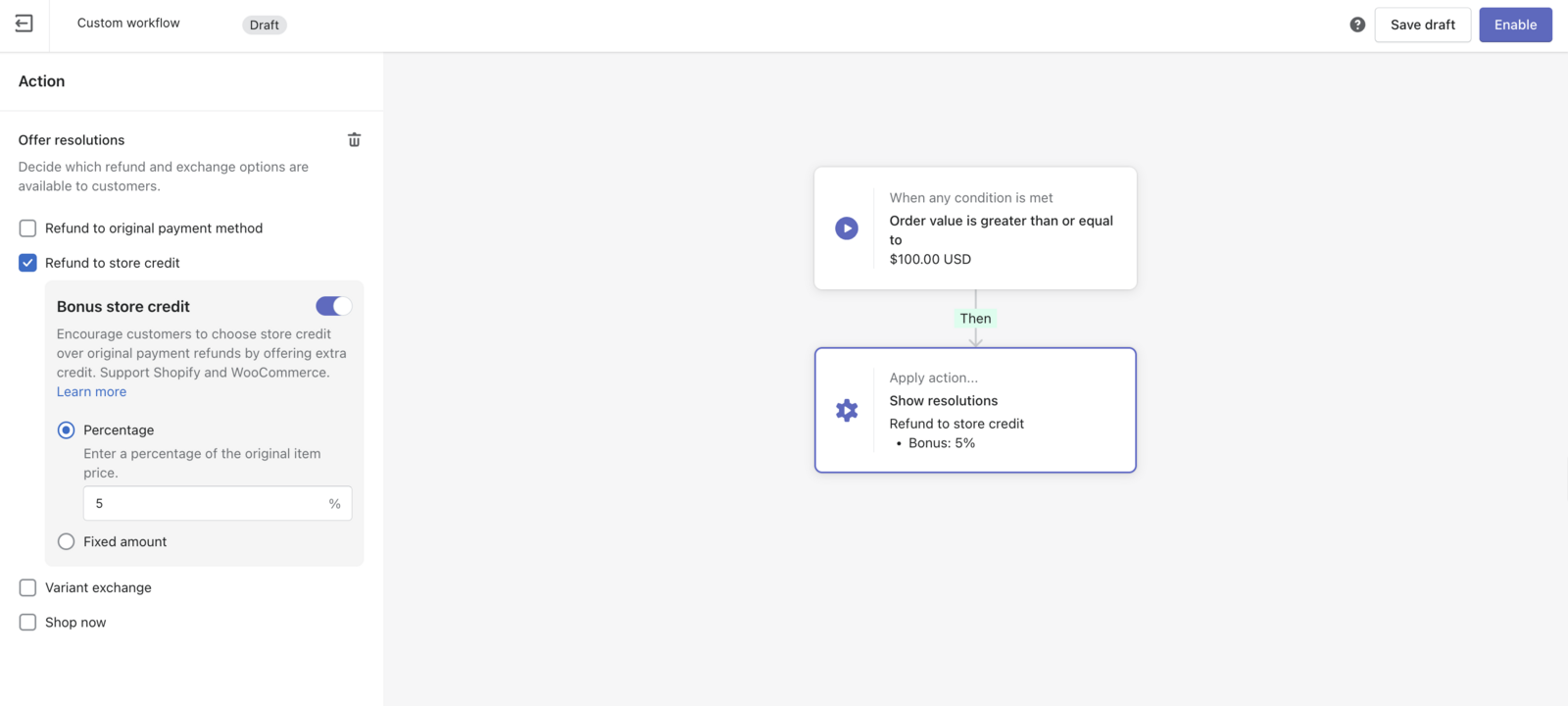
The returns page is served on your own domain, carrying your logo, colours and assets, and it enforces your policy at the moment the shopper opens a request rather than after your team reads one.
Routing is where the single-destination problem ends. Geographic return zones and automatic routing rules send each return to the warehouse that should receive it, with 3 zones on Essentials and unlimited zones on Premium and Enterprise.
Labels draw on 71 carriers worldwide for auto-label generation. Connect up to 3 of your own carrier accounts on Essentials and up to 5 on Premium, with expanded carrier connections scoped during Enterprise onboarding, and pre-negotiated partner rates covering USPS and 40+ other carriers. Shoppers who would rather not print anything have 300K+ drop-off sites.
Returns analytics run on the same data layer as the rest of one suite: shipping, tracking, returns, and warranty. What comes back is prescriptive insight, not another dashboard to read. Warranty claims can close the same way returns do, as the guide to issuing store credit for warranty claims sets out.
The trade is worth stating plainly. AfterShip's paid plans are a line item, and at low return volumes a cheaper single-purpose app is less to pay for. That arithmetic changes once your plan's ceilings start billing you every month.
AfterShip Returns & Exchanges holds 4.7/5 from 1,537 reviews on the Shopify App Store, checked 6 September 2026.
2. Loop Returns: Exchange Workflows on Shopify
If most of your returns are size and colour swaps, the exchange path is the part of the workflow you feel first. Loop runs a returns workflow built around exchanges on Shopify, and its free Checkout+ plan is funded the same way as AfterShip's Return Care, available on Shopify in the US and Australia: the shopper pays a small fee at checkout, the platform covers the return label, and no software fee is charged. AfterShip publishes standard SaaS pricing alongside that option.
Loop's free plan carries a published condition. It is "Eligible for merchants with over 10,000 annual orders." At 500 orders a month you reach 6,000 in a year, so a brand at the lower end of this band does not qualify and evaluates a paid tier instead.
Weighing Loop Returns vs Return Prime as your upgrade path is really a question of which ceiling you hit next. The AfterShip Returns vs Loop Returns comparison runs plan by plan. Both platforms run exchanges, and Loop's setup is simpler for an exchange-only workflow. Simpler for exchanges is a narrower job than running the whole returns operation, which is where a scaling brand ends up, and where AfterShip Returns runs exchanges alongside rules-based routing, multi-carrier labels and returns analytics on one data layer.
3. Happy Returns: A Physical Drop-off Network as the Product
If box-free drop-off is the experience you want to buy, price it as the logistics service it is. Happy Returns sells a physical drop-off network as the product itself. Shoppers hand items over at a Return Bar with no box and no printed label, and the software wraps around that network rather than the other way round. Its Shopify App Store listing describes the network as nationwide and names no country, so read the geography as exactly what the listing says.
Published pricing is a single tier at $500 per month, with "Shipping charges may apply" and a note that external charges may be billed separately from your Shopify invoice (apps.shopify.com/happyreturns, checked 5 September 2026).
At 500 to 5,000 orders a month that is a monthly floor before one label moves, and the network is what the floor buys. If the physical network is not the reason you are switching, AfterShip Returns gives you the returns operation for what that floor costs you.
4. ReturnGO: Rule-Based Exchange and Store-Credit Offers on Shopify
If your policy logic is the complicated part and store credit is how you hold the revenue, a rules-and-credit specialist earns a place on the shortlist. ReturnGO covers configurable return and exchange rules with store-credit offers on Shopify, and it holds 4.8/5 from 401 reviews on the Shopify App Store, checked 5 September 2026.
Its published entry price is $147 per month for 110 returns, at $1.25 per extra return, so you can run it against your own volume before shortlisting it.
What you buy there is a returns product. AfterShip Returns puts the same rule depth and store-credit incentives on the suite's shared data layer, so the returns you process inform the delivery experience that decides how many arrive in the first place.
5. Narvar: Enterprise-Weighted Deployment and Cost
There is a point where a returns platform stops being a purchase and becomes a programme, and it is worth knowing whether you have reached it. Narvar is positioned for enterprise buyers, and its returns product is bought through a sales process rather than from a plan page. Narvar publishes no pricing for its returns product on its own site (checked 5 September 2026), so a mid-market buyer cannot establish scope or cost without entering that process first.
That is a process cost before it is a price. Standard enterprise implementations run six to eight weeks, and longer for complex deployments, which is a different order of commitment from a brand shipping 500 to 5,000 orders a month choosing its second returns app. AfterShip Returns publishes its tiers, so you can size the decision against your own volume without opening a sales conversation to do it.
Feature Breakdown: Return Prime Alternatives Head-to-Head
When you shop for the best returns management software, you are choosing between five products with five different shapes, so judge them on what decides the outcome rather than on feature counts. Return Prime is the sixth column this table does not have. On its Shopify App Store listing the free Start plan caps carriers at two, no higher self-serve plan adds a carrier allowance, cross-border return and exchange is ticked for the top tier only, and Scale is $149.99 per month for 450+ requests at $0.49 per additional request. Read every row against those ceilings. The pattern they expose is one unified data layer with prescriptive insight against point tools stitched together.
AfterShip Returns holds 4.7/5 from 1,537 reviews on the Shopify App Store, checked 6 September 2026. ULTRAVIEW Archery, Inc., about three years in, rated it 5.0/5 in March 2026: it "helped speed up returns, refunds, and exchanges, and made our customer service department more efficient."
| Criterion | AfterShip Returns | Loop Returns | Happy Returns | ReturnGO | Narvar |
|---|---|---|---|---|---|
| Automation & rules engine | Rules plus geographic return zones and automatic warehouse routing, 3 zones on Essentials, unlimited above | Automated return policies and workflows on paid tiers | Policy rules applied automatically; approval granularity not published | Configurable return and exchange rules | Policy automation; rule granularity not published |
| Branded experience | On-brand portal on the merchant's own domain, with logo, colours and assets | Branded portal | Branded portal, English, French and German | Branded portal | Custom branding; controls not published |
| Carrier & cost management | 71 carriers for auto-label generation; connect 3 own accounts on Essentials, 5 on Premium | Carrier rate shopping; free plan covers US and Canada domestic labels only | Drop-off network rather than a carrier count; shipping charges billed separately | Carrier integrations on Shopify | Network scale published, no returns-label carrier count |
| Analytics & insights | Returns analytics on the suite's shared data layer, with prescriptive insight | Returns analytics | Analytics and reporting | Returns analytics | Enterprise reporting |
| Platform scalability | One suite: shipping, tracking, returns, and warranty | Returns and tracking as two subscriptions | Returns and drop-off logistics | Returns only | Several separately named products |
The Verdict: It's Not Just an App, It's Your Growth Strategy
AfterShip provides a full post-purchase platform, not just a returns app. Which of these you should buy comes down to what you are actually buying: a returns product, a logistics network, or the operation that surrounds both. Our returns management solution is built for the third, and AfterShip vs. the competition puts the platforms side by side.
Choose AfterShip Returns if:
- your monthly return requests have passed your plan's quota and the per-request charges are now a line you can see on the invoice
- returns need to reach more than one warehouse, chosen by where the customer and the stock actually are
- the returns page belongs on your own domain, carrying your brand rather than a vendor's
- you want published tiers you can size against your own volume before you talk to anyone
- you are buying the whole post-purchase operation rather than the returns step inside it
Choose Narvar if:
- you are buying as an enterprise, with a formal procurement process and a dedicated implementation team to run it
What changes at volume is operational, and it is specific. Returns route by zone to the warehouse that should receive them. Labels come from a carrier pool wide enough that your plan stops deciding which carrier you use. Returns analytics sit on the same data layer as the delivery experience that produced the return, so the reasons you collect can change what you ship next month. Those three are the distance between processing returns and running a returns operation, and they are what a platform gives you that an app cannot.
Returns automation, warehouse routing by zone, and multi-carrier labels on one data layer.
Book a demoFrequently Asked Questions
What's the main difference between AfterShip and Loop Returns?
Both offer a shopper-funded model, where the shopper pays a small fee at checkout and the platform covers the return label, and both handle exchanges. The difference is scope. AfterShip runs one suite, shipping, tracking, returns, and warranty, on a single data layer, with warehouse routing by zone. Loop runs returns and tracking as two subscriptions, with separate quotas and separate renewals.
Can I automate returns for international orders?
It depends on what each plan publishes. Loop's free Checkout+ plan covers US and Canada domestic return labels only, so international returns sit on a paid tier. On Return Prime, cross-border return and exchange is ticked for the top tier only. AfterShip Returns handles international returns through geographic return zones and automatic routing rules, with 3 zones on Essentials and unlimited zones on Premium and Enterprise.
How much does a scalable returns solution cost?
Read the ladder rather than a headline number. On the AfterShip Returns pricing page, billed annually with the volume slider at its 240-returns-per-year default, Essentials starts at $16 per month including 240 returns a year at $0.50 per extra return, and Premium starts at $99 per month including 1,200 returns a year at $1.00 per extra return. Enterprise is custom. Loop's free Checkout+ plan carries a published condition: it is "Eligible for merchants with over 10,000 annual orders."
Is there a free alternative to Return Prime?
Several vendors publish a free tier, and the question is what funds it. Return Prime's free Start plan includes 5 return requests a month and charges $0.49 for each additional request. Loop's Checkout+ is free software funded by a shopper-paid fee at checkout. AfterShip publishes standard tiers and also offers Return Care on Shopify in the US and Australia, where a shopper-paid fee at checkout covers the return label, so you can choose the model that matches your margin instead of the one your plan dictates.
Replacing a different returns app?
- Coming from ReBound? See AfterShip vs Rebound Returns.
- Moving off Return Magic? Compare Return Magic alternatives and plan the migration.
- Outgrowing Rich Returns? Here is how AfterShip works as a Rich Returns alternative.
- Leaving Return Rabbit? See what AfterShip offers as a Return Rabbit alternative.