Is your returns management platform creating more work than it saves? If you're manually flagging suspicious returns or watching refunds eat the margin you earned on the sale, the question is how much of each order you keep. We compared 6 returns platforms, ReturnGO included, on the features that matter most for growing brands: rules, fraud checks, and price.
The pressure is structural. The NRF and Happy Returns 2025 Retail Returns Landscape estimates that 19.3% of online sales will be returned in 2025. Tightening the policy across the board backfires: Appriss Retail's 2026 benchmark found that 47% of shoppers have refrained from a purchase due to return policy concerns. So the margin has to come from fewer hours spent reviewing requests by hand, fewer risky returns approved, and fewer refunds that could have been exchanges.
For a low-volume store with simple policies, ReturnGO can be enough. Its policy rules pair a resolution with a return method and can automate approvals and refunds. At 1,000 to 50,000 orders a month, though, you're juggling discounted collections, final-sale items, several warehouses and a fraud queue that grows with every sale. That's usually when teams start shortlisting ReturnGO alternatives.
Our takeaway: rules, fraud checks and exchanges are margin you keep, and AfterShip Returns is built to keep more of every order.
The sections below take those three criteria one at a time, starting with a side-by-side summary, and show where AfterShip's returns management platform keeps more margin. If you're still mapping the wider market, our guide to the best ecommerce returns platforms covers the category beyond ReturnGO.
How Do ReturnGO Alternatives Compare Side by Side?
Here's who each platform suits, what it does best and how it charges. Exact prices come later, in the cost section.
| Platform | Best For | Key Strength | Pricing Model |
|---|---|---|---|
| ReturnGO (baseline) | Low-volume stores with simple return policies | Policy rules that pair a resolution with a return method; advertises 25+ eligibility rule types | Subscription-based or usage-based plans |
| AfterShip Returns | Keeping more of every return, for scaling DTC brands from mid-market to enterprise | AND/OR return workflows, routing rules by return zone, auto-selected cheapest carrier, and Happy Returns drop-off inside the portal (US) | Subscription tiers (Essentials, Premium, Enterprise), plus shopper-funded Return Care |
| Loop Returns | Shopify brands that want a returns-first app | Workflows for routing and review, with Bonus Credit for exchanges | Returns subscription or free Checkout+ plan |
| Happy Returns | Brands that want a box-free US drop-off network, also available inside AfterShip Returns | A UPS company; advertises 10,000 Return Bar locations | Not publicly documented; offered through partner portals including AfterShip Returns, or its own portal |
| Narvar Shield | Retailers that buy on quote-based contracts | Fraud prevention combined with eligibility rule enforcement | Quote-based, no public pricing |
| Redo | Brands that want a free returns app with per-unit add-ons | Returns, shipping and tracking platform; location rules route items to Redo's returns centers for grading | Shopper-funded checkout coverage; returns portal listed free |
Which Platform Gives You the Most Control Over Return Rules?
A blanket return policy treats a full-price jacket and a clearance T-shirt the same way, and that is where margin slips. Granular rules let you block final-sale items, offer only store credit on discounted orders, hold high-value returns for inspection and send each SKU back to the warehouse that restocks it. Each rule protects a little margin on one return; across thousands of orders a month, it adds up to your returns P&L.
ReturnGO has a rules layer of its own. Its policy rules add eligibility conditions to a resolution and return method, charge restocking or label fees per rule, and can set approval, exchanges and refunds to automatic. ReturnGO advertises over 25 types of eligibility rules usable in any combination. Loop Workflows can route products to a chosen destination, Narvar says Shield enforces dynamic policies such as shorter windows, and Redo's location rules send items to its returns centers.
AfterShip Returns splits that control across four layers: workflows, eligibility rules, routing rules by return zone, and automations.
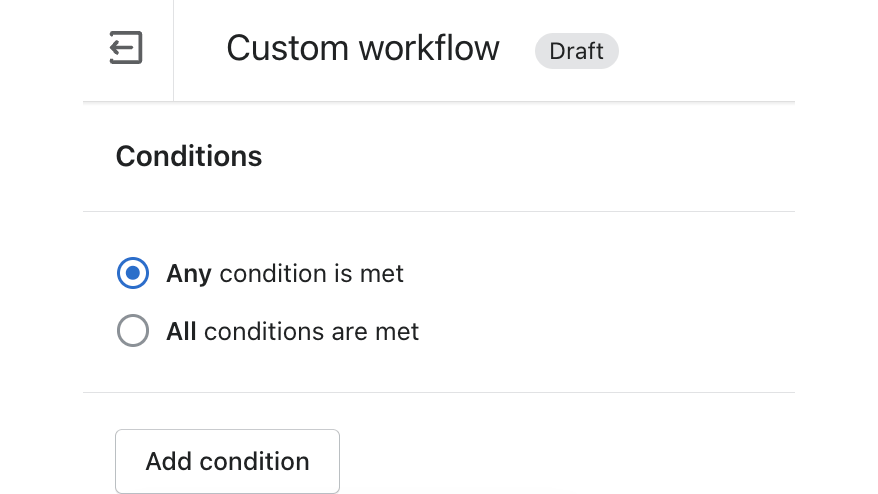
Return Workflows apply conditions on order, product, customer and return data, joined with AND or OR logic. Conditions include order value, discount code, original payment method, product tag, SKU, vendor, return reason, gift return, customer tag and the number of green returns a shopper has already used. That last one caps keep-the-item refunds per customer, while other workflows block final-sale tags, restrict discounted orders to store credit and send high-value returns to manual review.
In Return policy > Workflows, each workflow pairs conditions joined by Any condition is met (OR) or All conditions are met (AND) with one action.
Eligibility rules add a second layer: blocklist emails, product types, tags, SKUs and discounts, with allowlists for exceptions. Holiday or product-specific windows override the general return window when their conditions match.
Routing rules live inside return zones, so each country or region gets its own prioritized rules. A rule can match on customer tag, return reason, return value, product type or SKU, then set the return method (customer's carrier, prepaid label, in-store return or green return) and a fee: free, flat, a % of return value or a % of the estimated label fee. Routing by SKU or product tag sends items to different return locations and keeps products bound for different warehouses in separate requests.
With auto-select the cheapest carrier turned on, AfterShip Returns compares rates across your connected carriers for every label. Auto-approval runs per zone and per shipping method, auto-refunds fire on shipping status and only when every item meets the grades you set, and finished RMAs resolve themselves unless they're flagged for manual review.
Those routes feed a wide network:
- AfterShip-negotiated rates on USPS and 40+ other carriers, at every plan
- 310,000+ returns drop-off locations, with printerless QR drop-off for FedEx, USPS, Royal Mail and Canada Post
- Label-free drop-off at 10,000+ Happy Returns drop-off bars in the US, inside AfterShip Returns
ReturnGO, Loop and Redo also connect to Happy Returns. Routing rules start on Essentials with three zones and go unlimited on Premium and Enterprise, where Return Workflows, auto-refunds and cheapest-carrier selection also sit.
Each workflow carries one action, so a final-sale block on a product tag and a store-credit-only offer for specific discount codes run as two workflows, and both apply to every return request automatically.
Which ReturnGO Alternative Stops the Most Risky Returns?
9% of all returns are fraudulent. That is the finding of the NRF and Happy Returns 2025 Retail Returns Landscape, which projects total US retail returns of $849.9 billion in 2025. Apply that share to your own refund volume and you have the margin that fraud takes back after the sale.
For brands comparing ReturnGO alternatives, fraud is often the leak that grows fastest with volume. The most common patterns pass through as ordinary return requests:
- Wardrobing: an item is worn once, then sent back as unwanted.
- Empty-box returns: the package arrives without the product, or with something lighter in its place.
- Fake tracking IDs (FTID): a tracking number that doesn't belong to the real return is used to trigger the refund.
- Serial returners: shoppers who return far more than they keep. The same NRF report found 45% of shoppers say it's acceptable to "bend the rules" when returning items.
Every platform on this shortlist publishes fraud controls of its own:
- ReturnGO can limit eligibility by a customer's past return requests and cap how often an item is returned. Its portal accepts image and video uploads, item validation (a Pro plan feature) lets warehouse teams inspect and document returns, and instant exchanges place a card hold until the originals come back.
- Loop Returns runs a real-time fraud model built on its in-house AI foundation model, analyzes uploaded photos with AI image recognition, and lists workflows, custom rules and blocklists among its fraud controls.
- Happy Returns (a UPS company) advertises item verification by tag scanning, AI-powered risk scoring and Return Vision fraud audits. Flagged returns have their refunds delayed until a hub audit.
- Narvar Shield can block high-risk returns, require extra verification or adjust refund timelines based on return risk.
- Redo uses AI to review images, customer history and policy rules to recommend, approve or deny returns, and offers customer blocklists.
Flagging risk is table stakes. What separates platforms is how much review work each one takes off your team, and how much evidence stands behind each call.
AfterShip Returns covers the same ground, then goes deeper on detection. Anti-fraud workflows catch wardrobing through return-frequency patterns, empty boxes by comparing the return shipment's weight with the item's, and FTID fraud when the first tracking update predates the return request. A triggered workflow can flag the request for review or add the customer's email to a blocklist, and photos can be made required per return reason on every plan. On Shopify, the Signifyd integration adds a fraud check to every RMA.
The bigger lever is review time. AfterShip's RMA Review Agent checks every return request against 100+ risk indicators, from whether the photo is genuine and matches the stated reason to return history and suspicious IP addresses. It rates each RMA low, medium or high risk and explains why in plain language. Low-risk returns get a recommended next action, and you can turn on automatic flagging for high-risk ones, which suspends their automation rules until someone reviews them.
Each return request gets an AI risk assessment card with its risk level, the signals behind it and, for low-risk returns, a recommended action.
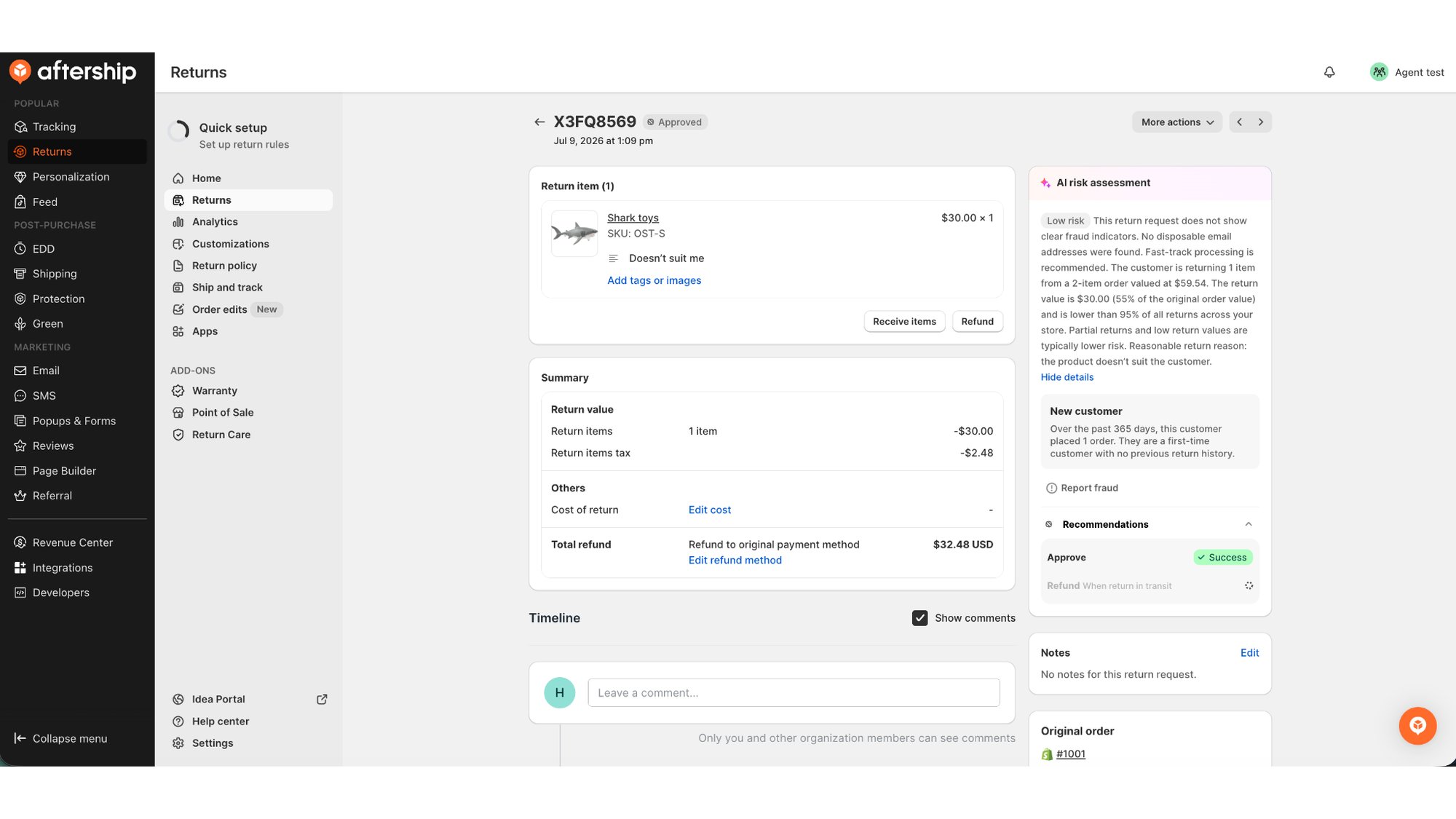
AfterShip's RMA review agent made Naked Wardrobe's return reviews 40% faster. The brand now has 15–20% of its RMAs resolved automatically, so its team spends review time on the returns that carry real risk. AfterShip Returns scores return risk using 16M+ return requests already scored.
The RMA Review Agent is part of the Premium and Enterprise plans for US merchants, and your team keeps the final say: the agent refunds, exchanges or resolves a return only after someone selects Accept, and every assessment and action is logged in the return's timeline.
What Does Each Returns Platform Cost?
Pricing is where ReturnGO alternatives differ most in structure. Most returns platforms use one or more of four models:
- Subscription tiers: a monthly return allowance, with overage charged above it.
- Per-unit pricing: a charge for each order or return processed.
- Shopper-funded: the shopper pays a small fee at checkout, the return label is covered, and the merchant uses the platform at no cost.
- Quote-based: pricing set through a sales conversation, usually for enterprise volume.
Label costs can sit on top of any of these models, so read how each platform bills return labels alongside its plan price.
ReturnGO and AfterShip both offer the shopper-funded model. ReturnGO runs it as Return Guard, which includes full access to the ReturnGO platform.
AfterShip runs it as Return Care: AfterShip handles the labels, and the merchant gets the Premium Returns plan with no subscription fee or usage limits. Across AfterShip merchants, up to 65% of shoppers opt in. Return Care runs on Shopify for merchants in the US, Canada, Australia and the UK.
AfterShip also offers standard SaaS plans for brands that prefer a subscription: Essentials, Premium and Enterprise. Every tier, its included volume and its overage rate are published. Usage above quota is billed at 1.3x the plan's unit price and service keeps running, annual billing saves 18%, and AfterShip offers a 7-day free trial.
Here is each platform's published pricing, checked November 2026:
| Platform | Published pricing (checked November 2026) | Source |
|---|---|---|
| ReturnGO | Premium from $147/month (110 returns included, $1.25 per extra return); Pro from $297/month (300 returns included, $0.90 per extra return); Enterprise custom; Return Guard shopper-funded option; 14-day free trial on Shopify self-service plans | ReturnGO pricing page, Shopify App Store listing |
| Loop Returns | Returns plan from $340/month (up to 1,000 returns annually); Checkout+ free, with eligibility based on order and return volume; 10% bundle discount when combining products | Loop pricing page, Shopify App Store listing |
| Happy Returns | Not publicly documented; offered through partner returns portals, including AfterShip Returns, or its own portal | Happy Returns website |
| Narvar Shield | No public pricing; available through a demo request | Narvar website |
| Redo | Returns free (no subscription, per-return fee or setup cost), with shopper-purchased return coverage; AI exchange recommendations and fraud detection custom-priced; order tracking $0.08 per tracked order | Redo pricing page |
| AfterShip Returns | Essentials from $59/month and Premium from $119/month (100 returns/month); $245 and $499/month at 500 returns; Enterprise custom; overage at 1.3x unit price; annual billing saves 18%; Return Care gives the Premium plan at $0; 7-day free trial | AfterShip Returns pricing page |
AfterShip publishes Essentials, Premium and Return Care pricing, and prices Enterprise around your volume, brands, stores, integrations and support needs. Anti-fraud workflows and the RMA Review Agent come with Premium and Enterprise, and Premium is the plan Return Care unlocks. To match a tier to your return volume, explore our transparent pricing plans.
How Does AfterShip Solve the Core Scaling Pains?
Rules, fraud checks and pricing are covered above. These are the other leaks that open up as return volume grows, and how AfterShip Returns closes each one.
- Problem: Too many returns end in a refund. Solution: AfterShip Returns offers Variant exchange for same-priced or differently priced variants, Shop now with optional extra credit for choosing an exchange, and bonus store credit for choosing credit over cash. AfterShip sees a 2X exchange rate when exchanges are incentivized.
- Problem: Exchanges stall while the original item is still in transit. Solution: Instant exchange ships the new item when the request is submitted, with a hold amount until the return is sent.
- Problem: Shoppers can't find the right replacement. Solution: AI Exchange recommends the most relevant variant or replacement right after the shopper picks a return reason. AI Exchange Recommendations deliver up to a 25% lift in revenue retained through exchanges.
- Problem: In-store returns live in a separate process. Solution: Returns POS handles in-store returns through Shopify POS on the Premium and Enterprise plans, in the same app as online returns.
- Problem: Agents switch tabs to approve a return, and shoppers email to ask where it is. Solution: The Gorgias integration shows return details in the ticket sidebar and lets agents approve or reject RMAs mid-conversation. The Gorgias AI Agent answers "Where is my return?", and Klaviyo receives return events for return-status email flows.
- Problem: Return data is scattered across disconnected tools. Solution: AfterShip Returns shares one record with AfterShip's shipping, tracking, returns, and warranty products, and creates RMAs on 3PLs such as ShipBob and ShipHero when a return is approved.
Which ReturnGO Alternative Is Right for You in 2026?
Rules, fraud checks and exchanges are margin you keep, and AfterShip Returns is built to keep more of every order. For scaling DTC brands that need fewer refunds, fewer risky returns approved and more exchanges, it is the strongest of the ReturnGO alternatives in 2026.
Choose AfterShip Returns if:
- Refunds are your largest margin leak and you want AI Exchange recommending replacements inside the return flow.
- Your team still flags suspicious returns by hand and wants the RMA Review Agent covered above to check each one first.
- You need eligibility and routing rules that stop returns that shouldn't be approved.
- You run several brands or stores and want an Enterprise plan priced around your volume, brands, stores and integrations.
- Your agents live in Gorgias and you want return decisions made there, with an AI Agent fielding return-status questions.
- You sell online and in store, and want a Built for Shopify app that also handles Shopify POS returns.
- You want return data tied to AfterShip's shipping, tracking, returns, and warranty products, and to your 3PL in ShipBob or ShipHero.
Another tool may fit if:
- Your store still fits the low-volume case described in the intro.
- Your team buys returns software only through an enterprise demo and quote: Narvar sells Narvar Shield that way, and AfterShip prices its Enterprise plan the same way.
- You want returns sent to Redo's own returns centers for inspection and grading, which its return location rules route to.
- You want a drop-off network on its own: Happy Returns, a UPS company, runs Return Bar locations, and AfterShip Returns offers the same Happy Returns drop-off inside its app.
AfterShip Returns is a ReturnGO alternative built to keep more of every order: it helped Marc Nolan cut the share of returns ending in a refund from 75% to roughly 50%, saving $125K in revenue in 90 days.
Replacing a different returns app?
- Moving off Return Prime: Return Prime alternatives
- Comparing Rebound: AfterShip vs Rebound Returns
- Moving off Return Magic: Return Magic alternatives
- Moving off Rich Returns: Rich Returns alternative
- Moving off Return Rabbit: Return Rabbit alternative
To see how other platforms compare with AfterShip directly, read our review of AfterShip Returns alternatives.
A demo is the quickest way to check AI Exchange, Return Workflows and the RMA Review Agent against your own return policy.
Returns automation that enhances the returns and exchanges experience, reduces costs, and retains more revenue.
Book a demoFrequently Asked Questions About ReturnGO Alternatives
Which ReturnGO alternative is best for fraud checks?
AfterShip Returns. It pairs eligibility rules with an RMA Review Agent that hands only the risky returns to your team, as the fraud section above details.
How easy is it to move from ReturnGO to AfterShip?
AfterShip Returns connects to Shopify, Magento, WooCommerce, BigCommerce, Wix, Salesforce, NetSuite and other platforms, so you keep your current storefront. You rebuild your ReturnGO rules as Return Workflows, covered in the rules section. A 7-day free trial lets you try the setup before you buy.
Does AfterShip integrate with Gorgias and Klaviyo like ReturnGO does?
Yes, on the Premium and Enterprise plans. ReturnGO connects to both tools too, and With AfterShip, agents approve or reject returns from the Gorgias sidebar and Klaviyo receives return events for status flows, as the scaling-pains list above shows.
Does AfterShip offer free returns funded by shoppers?
Yes, through Return Care, the shopper-funded model explained in the pricing section. Stores on Return Care get the Premium Returns plan at no cost, so you can offer free returns with AfterShip covering the labels.