You are comparing carrier rates by hand and watching shipping cost climb faster than orders. ShipHero is a warehouse management system and Shippo is a multi-carrier shipping app; they solve different problems, and your problem calls for a shipping app. The deciding question is which carrier carries each order and at what cost, and that carrier decision is the layer AfterShip Shipping is built for.
Most ShipHero vs Shippo comparisons line the two up feature by feature, which assumes they compete for the same budget. They do not. One runs the four walls of a warehouse. The other decides which carrier carries the box once it is packed. Work out which costs you money, and the software choice makes itself.
ShipHero vs. Shippo: The Core Difference in One Sentence
A warehouse management system runs the warehouse, and a multi-carrier shipping app runs the carrier decision.
Gartner's definitions make that concrete. A warehouse management system runs warehouse operations, including packing and shipping. Packing, shipping and manifesting sit among the category's mandatory features, in a feature set updated in May 2026. Multi-carrier shipping software selects the carrier and manages carrier rates. The multicarrier parcel management definition, updated in June 2026, puts integration with WMS and TMS first on its mandatory list.
Whichever order you search it in, shippo vs shiphero, the useful question is which problem is costing you money first. For most brands shipping 1,000 to 10,000 orders a month, it is the carrier decision rather than the shelf.
When to Choose a WMS Like ShipHero
Some bottlenecks live inside the four walls. If several of these describe your week, the warehouse comes first:
- Inventory is spread across bins and shelves
- Pick error rates are high enough that reships and refunds show up in your margin
- Picking and packing has grown complex
- You employ warehouse staff whose shifts and productivity need managing
- Stock sits in multiple locations and has to be allocated between them
That is the job a warehouse management system does, and it is the category ShipHero sits in. ShipHero does not run warehouses. It spun its fulfillment business out as a separate company, LVK, and sells the software. It publishes no price on its own site.
A warehouse management system also packs and ships. That is why the split between the two categories is not about shipping. It is about what decides which carrier carries the box.
When a Shipping App Like Shippo Is the Right Choice
The other bottleneck starts once the box is packed. If several describe your week, the carrier layer is the problem to solve first:
- You want carrier choice beyond the single negotiated set your store platform hands you
- You are rate shopping by hand on every order that does not fit the default service
- Labels are created one at a time when they could be created by rule
- You sell on a marketplace or wholesale channel whose orders never flow through your store
This is the multi-carrier shipping app category, and Shippo is one of the apps in it. At that volume it is the more common of the two needs.
Decision Framework: Which Problem Is Your #1 Bottleneck?
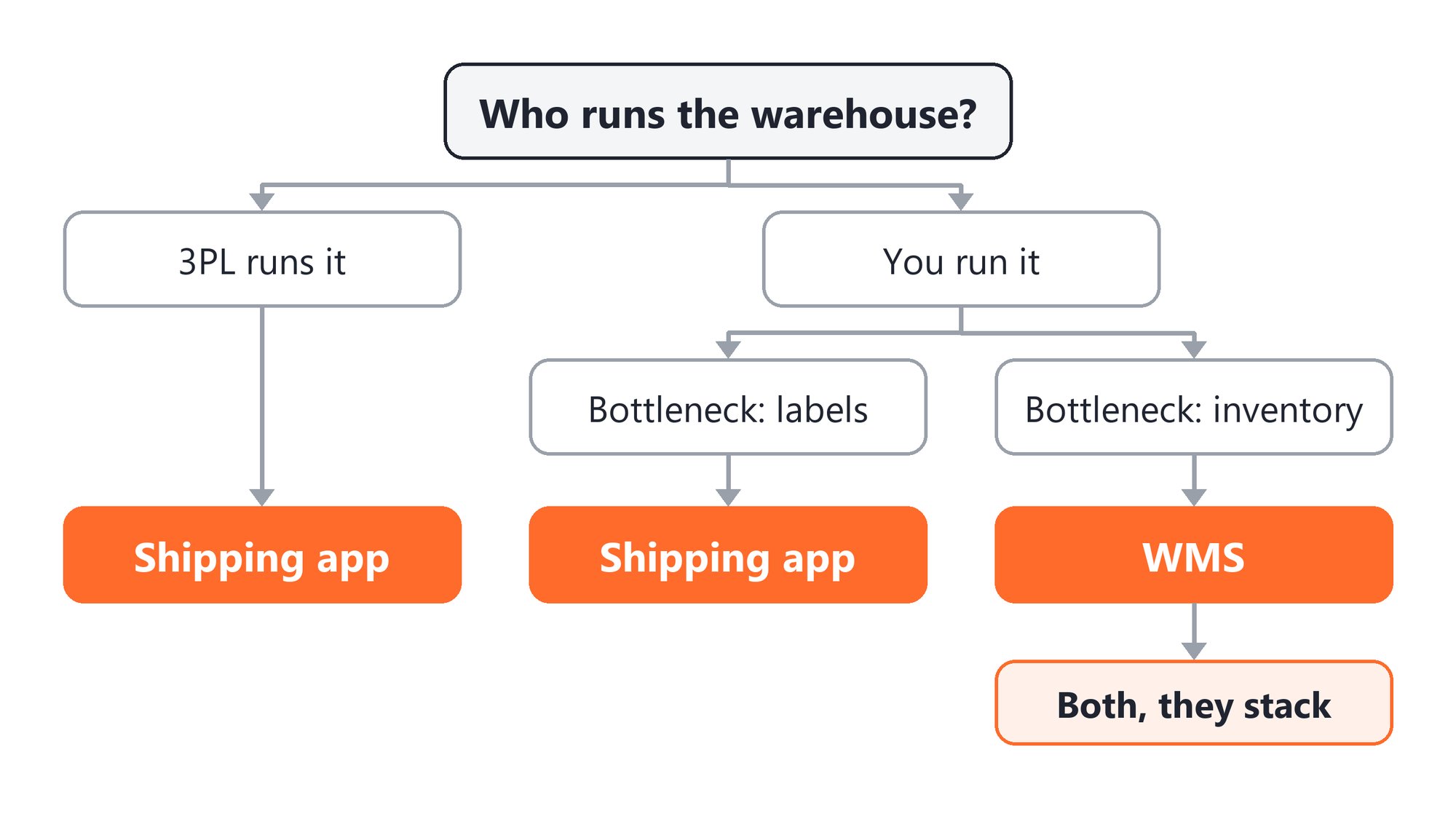
The WMS vs shipping app question is really four questions, in order.
First, who runs your warehouse? If a third party logistics provider does, it already runs a warehouse management system on your behalf, and the shipping and post-purchase layer is the only live question left.
Second, if you run it yourself, name the bottleneck. Is it labels, meaning the carrier decision and its cost, or knowing what is on the shelf?
Third, if it is labels, ask which app, and on what criteria. That is the next section.
Fourth, if it is inventory, you need a warehouse management system. That does not close the carrier question, because a warehouse system ships the box using whatever carrier logic you give it. This answer stacks rather than forks: you need both layers, and you still choose the carrier layer on its own merits.
So, You Need a Shipping App. Is Shippo the Best Choice?
Three questions decide this purchase at your volume: what selects the carrier on each order, what the rules cost you, and what the subscription costs at your label count.
On the first two, Shippo compares rates, automates label creation with rules, and puts branding on tracking pages and notification emails from its Pro tier up, per Shippo's published pricing.
The third question turns on what each vendor makes public, including ShipHero pricing. AfterShip and Shippo both publish self-serve price ladders a buyer can read without a sales call; ShipHero, as a WMS, publishes none.
| Pricing published | Shape | |
|---|---|---|
| AfterShip Shipping | Yes | A Free plan at 10 labels per month on the Shopify App Store listing; the pricing page itself starts at Essentials from $9/mo at 1,200 labels/year, then Pro from $69/mo at 24,000 labels/year and Enterprise custom, as of September 2026. Monthly or annual, 18% off annual, so a buyer can start free and move up a published ladder without a sales call. |
| Shippo | Yes | Free Starter up to 30 labels/mo, Pro from $17/mo (1-200 labels/mo, up to 10,000/mo with $0.08 per label beyond), Premier "Contact us". |
| ShipHero | No | No price on its own site; editions (Standard, 3PL, Enterprise) are "Contact Us". |
An Introduction to AfterShip Shipping: The Smarter Alternative
Which leaves the carrier question: what selects the service on each order. AfterShip Shipping is a Shippo alternative built around that decision. As an intelligent shipping hub, it reaches 130+ carriers in one integration, with label generation across over 87 carriers.
The mechanism is Smart Carrier Recommendation, and it runs on all plans. It excludes services with a high exception rate for that origin and destination, using AfterShip tracking data. It states why a service was recommended. And it re-evaluates every shipment against current exception data for that origin and destination, so the recommendation moves as the lane moves.
AfterShip Shipping vs. Shippo: A Head-to-Head Comparison
You now have the three criteria. The rows below compare the two on those criteria and the layers around them, and each row names the product that delivers it.
| Criteria | AfterShip products | Shippo |
|---|---|---|
| Rate shopping and carrier reach | Compare live rates and delivery times across carrier services, with 130+ carriers behind one integration and label generation across over 87 (AfterShip Shipping). Parity on rate comparison itself. | Rate comparison on all tiers. Carrier accounts connected individually from a published carrier list. |
| Automation rules | Automated shipping rules on Pro and Enterprise; up to 10 rules below Enterprise. Smart Carrier Recommendation runs on all plans and needs no rule configuration. | Automations on all tiers, including the free Starter tier; Shippo publishes no rule cap. |
| Branded post-purchase experience | Delivered by AfterShip Tracking (a separate product and subscription): branded tracking pages and proactive notifications. | Branded tracking pages and notification emails from the Pro tier up. |
| Returns integration | Delivered by AfterShip Returns (a separate product and subscription): a shopper-facing returns portal with automation. | Return labels on all tiers, at label level rather than a branded shopper portal. |
| Analytics and reporting | Both platforms report. Shipping's own prescriptive output is the recommendation rationale: it states why a service was chosen, on all plans. Deeper delivery and exception analytics measured against actual outcomes are delivered in AfterShip Tracking (a separate product and subscription). | Reporting and analytics on all tiers. |
See a Personalized Demo before you decide.
Both platforms automate carrier selection with rules. Shippo offers automations on every tier, including its free Starter tier, and AfterShip Shipping offers shipping automation rules on Pro and above.
A growing brand is not buying a rule counter. It is buying a connected data layer, where the label and the branded tracking page run off one order record through the documented Shipping-to-Tracking sync, AfterShip Tracking being a separate product on a separate subscription, and where the carrier choice is prescriptive, with AfterShip Shipping stating why each service was recommended.
Smart Carrier Recommendation reads AfterShip tracking data, and Mous shows what that data does for a carrier decision. Mous compared carrier performance and cost in one place using AfterShip Tracking, a separate subscription, and changed carriers on what it found. AfterShip's published Mous story reports an 82% decrease in shipping transit times via logistical insights.
If you are weighing more than these two, our guide to a smarter alternative to Shippo covers the wider field.
The AfterShip Advantage: Why a Connected Post-Purchase Platform Wins
AfterShip Shipping is one of AfterShip's shipping, tracking, returns, and warranty products. That matters as you grow, because the label is not the last thing a customer sees.
The connection is a shared order record: the label and the branded tracking page run off one record through the documented Shipping-to-Tracking sync. AfterShip Tracking and AfterShip Returns are separate products on separate subscriptions, and no data flow from Shipping into a returns portal is documented.
StackCommerce reduced WISMO tickets by 71% using AfterShip Tracking, alongside greater than 99% shipment tracking visibility.
eMarketer forecast in 2025 that DTC share of US retail eCommerce has plateaued at around 19% and stays flat through 2028, with rising customer acquisition costs among the reasons. Margin has to come from the operations stack.
The Verdict: ShipHero for Warehouses, AfterShip for Growth-Focused Shippers
AfterShip Shipping and Shippo both automate carrier selection with rules. Brands move when carrier performance and carrier reach through one integration start to matter, and AfterShip Shipping is the specialist choice then.
Choose AfterShip Shipping if...
- You want carrier performance built into the selection, which is what Smart Carrier Recommendation does on all plans
- You want reach through a single connection: 130+ carriers in one integration, with label generation across over 87
- You want to price your next tier before you commit: see AfterShip's pricing, from a Free plan on the Shopify listing to Essentials and Pro
Choose ShipHero if...
- You need bin-level inventory control
- You need pick-path optimisation
- You need warehouse labour workflows
AfterShip is not a warehouse management system, and it does not manage bin locations or picking paths. If that is your bottleneck, the warehouse system is the right purchase, and it still needs a carrier layer on top of it, which is where AfterShip Shipping sits.
Multi-carrier shipping software that compares carrier services for each order and recommends one, with the reason.
Start Optimizing Your ShippingFrequently Asked Questions
What is the difference between Shippo and ShipHero?
ShipHero is a warehouse management system: software that runs warehouse operations such as picking, packing and shipping. Shippo is a multi-carrier shipping app: it compares carrier rates, creates labels and automates label rules. If your bottleneck is the warehouse floor, you need the first. If it is the carrier decision, you need the second. If it is both, the two stack.
Is ShipHero a shipping company?
No. ShipHero sells warehouse management software. It does not run warehouses and it does not carry parcels. It spun its fulfillment business out as a separate company, LVK, a third party logistics provider whose network runs on ShipHero. ShipHero publishes no price on its own site.
Can I use Shippo and AfterShip Tracking at the same time?
Yes. On Shopify, Shippo writes the tracking number to the Shopify order when it creates the label. AfterShip Tracking, which is a separate plan, imports fulfilled Shopify orders and tracks each shipment from there. The Shopify order is the handoff between the two.
Is AfterShip better than Shippo?
It depends on what decides your carrier choice. Both compare carrier rates, and both offer automation rules. AfterShip Shipping adds Smart Carrier Recommendation on all plans, which uses AfterShip tracking data to exclude services with a high exception rate on that lane and states why it recommended a service, and it reaches 130+ carriers in one integration.