Switching your WMS or 3PL breaks the customer-facing half of your operation before the warehouse half stabilizes: tracking links die, delivery estimates lose their history, and returns stall. The fix is ordering. Put an independent post-purchase layer in front of the backend first, so the customer experience stops depending on which system is running behind it. Then migrate.
The best ShipHero alternatives depend on your WMS or 3PL needs. Ordering matters more than usual here, because you first have to know which company you are actually leaving. ShipHero today sells warehouse management software. The fulfillment business some brands are leaving became a separate company, LVK, in 2023, and LVK still runs on ShipHero's WMS. So a brand can leave one without leaving the other.
The Real Risk of Switching: A Broken Customer Experience
Your warehouse team plans the cutover in detail. The customer-facing systems tend to get planned last, and they are the ones your buyers actually touch. Here is what goes wrong, roughly in the order customers notice it.
- Delivery estimates lose their history. A new backend arrives with no record of how your old one actually performed, so the dates your storefront promises are guesses again until fresh data accumulates.
- Tracking links break. Old tracking URLs stop resolving, and customers who bookmarked one or saved a confirmation email land nowhere. Support hears about it before you do.
- Notifications go silent. Proactive updates stop during cutover, and the tickets arrive instead. A few quiet days is enough to turn a patient customer into a support contact.
- Returns become a black hole. In-flight returns straddle two systems. Refunds stall, agents cannot see where a parcel sits, and the customer chases you for money they already expect back.

The Fix: Decouple Your CX From Your Backend Operations
The mechanism is simple enough that you can check it yourself during a vendor call. Carrier events belong to the carrier, not to the warehouse system. A post-purchase layer that subscribes to carrier data directly keeps working through a backend swap. A layer that inherits its events from the backend does not, because when the backend goes, the event feed goes with it.
Weigh built-in backend tracking against a dedicated layer early, because that choice decides how much of your customer experience survives the cutover.
AfterShip is not a warehouse management system. You will still need to choose a backend operations partner. What AfterShip does is make that choice safer and more reversible, because the layer your customers actually see does not move when the warehouse does.
AfterShip decouples customer experience from backend logistics. The suite covers shipping, tracking, returns, and warranty. Each product is billed separately, and AfterShip integrates with any WMS or 3PL via API.
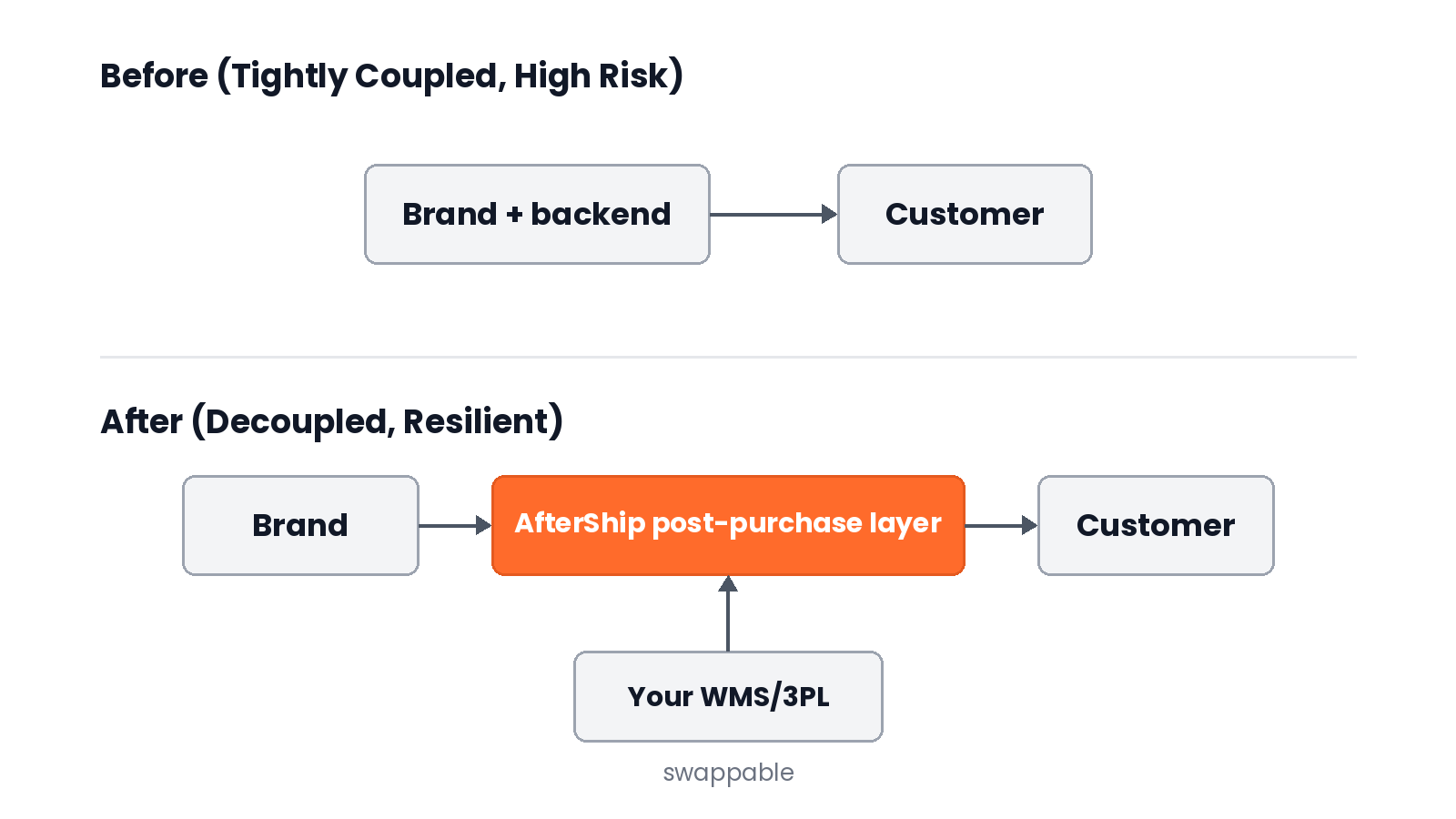
Step 1: Stabilize Your CX with AfterShip (Before You Migrate)
Do this while you are still on ShipHero, before you have chosen a replacement. Stand up AfterShip Tracking and AfterShip Returns now, so that by the time the backend changes, your branded tracking pages, notifications and returns portal have been live long enough that your team knows how they behave.
AfterShip integrates directly with your existing ShipHero setup, and you can connect your ShipHero account to AfterShip Returns the same way.
AfterShip's published customer story on Dr. Squatch describes a brand that fulfills orders through third-party logistics providers, and a fulfillment team that cross-references AfterShip's delivery data against what its 3PLs report, using the platform as an independent audit layer rather than taking carrier data at face value.
On how the brand tunes what shoppers see, Will Edwards, senior strategic operations manager at Dr. Squatch, says: "At the end of the day, brands want a consistent experience with the flexibility to make minor tweaks here and there."
Consistency is what a backend change puts at risk, and it is what you can secure first. Stabilize your CX with AfterShip before migrating from ShipHero. AfterShip is trusted by 20,000+ brands, and its tracking app is certified Built for Shopify.
Step 2a: Replacing ShipHero the Software - WMS Alternatives
Once the layer is live, choosing a ShipHero WMS alternative narrows to a smaller and more testable question. The right WMS for mid-market brands is the one that fixes the specific reason you are leaving, and G2 or Capterra reviews are a sensible place to do your own due diligence on each shortlisted vendor.
Extensiv. The risk this one changes is inventory accuracy across locations. Extensiv fits brands whose inventory or multi-node complexity is the reason they are leaving in the first place, which makes it the entry to test first if your mis-picks and stock discrepancies trace back to how your current system models locations. Your tracking pages, notifications and returns portal do not move when you move to it.
NetSuite WMS. It targets fragmentation across finance and operations, and the risk it introduces is scope. NetSuite WMS is published as an add-on module inside NetSuite, licensed on an annual subscription with a one-time implementation fee, so this is an ERP decision rather than a like-for-like swap. Budget and timeline follow the ERP program, while the customer-facing layer stays exactly where it was.
Deposco. Here the risk is running brand and 3PL operations on separate systems. Deposco spans brand and 3PL operations under one suite, and publishes customer-level shipment tracking scoped to the shipments Deposco itself runs. For branded tracking pages, its own partner directory points merchants at a specialist provider, so the shopper-facing layer is a separate decision either way.
AfterShip integrates with all three via API, so the CX layer stays consistent whichever one you pick.
Step 2b: Replacing the 3PL - LVK and Other Fulfillment Alternatives
If you searched for a ShipHero 3PL alternative, the company you are actually leaving is LVK, and the shortlist is other fulfillment providers. The criteria that matter are the ones in choosing the right 3PL partner, applied to your own order profile. Node count, service levels and the carriers each provider actually uses are where the differences show up when you compare any 3PL for mid-market brands.
ShipBob. The risk this one changes is single-node transit times. ShipBob is a multi-node fulfillment network, and it now ships its own branded tracking page, TrackBob, which is ShipBob-hosted and tied to ShipBob fulfillment. If you keep your own post-purchase layer, your tracking page stays yours whether or not a provider offers one.
Flexport, which absorbed Deliverr. The pressure here is delivery-speed badging across marketplaces. Flexport offers Fast Tags and Shop Promise for 2-day and 3-day delivery speeds, and support for 50+ platforms and marketplaces including Shopify, Amazon, Walmart and Target. The badge belongs to the channel; the tracking experience after the click stays with your own layer.
Regional 3PLs. A regional provider can fit a narrow profile: a concentrated regional customer base, oversized or heavy goods, or a strong local-delivery component. The usual objection is carrier coverage, and that is where the layer earns its place. AfterShip covers 1,700+ carriers worldwide in one integration, regional carriers included, so moving to a regional provider rarely means losing tracking coverage.
How the Post-Purchase Layer Holds Through the Switch
You need a way to judge the post-purchase tools bundled with the backend you are leaving. Judge them the way you would judge any vendor, on published scope. PostHero is ShipHero's shipment tracking and carrier performance dashboard, and the Return Portal is its shopper-facing returns flow. Both are scoped to a ShipHero account.
| Criterion | ShipHero's own post-purchase features | AfterShip Experience Layer |
|---|---|---|
| Carrier Network Coverage | PostHero tracks 5 named carriers (USPS, UPS, FedEx, DHL eCommerce, Shippo), US accounts only | 1,700+ carriers worldwide in one integration, the same list before and after your migration |
| Branded Experience Control | PostHero is merchant-facing only; the separate Return Portal brands by color, text and language | Brand-controlled tracking page and returns portal, carrying your logo, your domain and your own marketing content |
| Proactive Notification Logic | Fires triggers into Klaviyo workflows | First-party branded notifications across email and SMS, with AI-powered delay alerts that fire before the customer asks |
| Returns Portal Customization | Branding scoped to color, text and language; exchanges route to the merchant team | Branded self-service portal with automation rules, and exchanges completed in the portal rather than handed back to your team |
| Delivery Estimates | PostHero predicts delivery for US accounts | AI-powered delivery estimates, up to 95% accuracy, trained on 4.4B+ shipments, covering at least 80% of deliveries where most carriers predict on under 40% |
| Analytics & Insights Granularity | Carrier performance reporting inside one provider | Centralized across every carrier and every backend you run, before and after a migration |
| Reliability During Migration | Post-purchase data is tied to the ShipHero account | Subscribes to carrier events independently, so the layer survives a backend change |
| Prescriptive Insight | Reports what happened | Recommends what to do about it |
Sources: ShipHero's PostHero page and Return Portal help articles; AfterShip's carrier directory and AI EDD page. Checked September 2026. PostHero also excludes orders placed through ShipHero's Public API.
Put three questions to any bundled post-purchase tool before you rely on it. Where does the tracking page live, on your domain or the vendor's? Which carriers does it cover, and what happens to a shipment moving on one outside that list? And does it cover orders placed through the API, or only orders created in the interface? AfterShip answers all three the same way the day before a migration and the day after, because it holds its own carrier feed and its own branded surfaces.
The Final Verdict: Build a Resilient Stack, Not a Risky Monolith
Count which one describes more of your operation.
Choose AfterShip as your post-purchase layer when...
- you are mid-migration, or expect another backend change within three years
- you run or plan more than one fulfillment node or 3PL
- your carrier mix reaches past your backend's native list or outside the US
- you need post-purchase analytics that survive a backend change
- you need carrier and delivery performance measured in one place, so a backend that underperforms is visible before customers report it
- the economics stop working once volume, carrier mix and exception handling each sit in a different tool
ShipHero's native post-purchase tools fit when...
- you are single-node and your carrier mix sits inside PostHero's five
- you do not need a shopper-facing branded tracking page
- one contract and one support queue matter more than depth in any single layer
- your post-purchase needs stop at reporting, and your team acts on the report itself
If most of your answers landed in the first list, settle the layer before you sign anything else, and hold it to enterprise-grade reliability and security.
Frequently Asked Questions
Is ShipHero still a 3PL?
No. ShipHero sells warehouse management software. It launched a fulfillment arm in 2019 and spun that business out as a separate company, LVK, in 2023, and its own About page now says it powers warehouses instead of running them. LVK still runs on ShipHero's WMS, so the two decisions are separate: a brand can change fulfillment provider and keep the software, or change the software and keep the provider.
What are the main reasons brands leave ShipHero?
Usually because the business has changed shape since the system was chosen. A contract comes up for renewal and prompts a review. Order volume or SKU count grows past the scale the current setup was chosen for. A second warehouse or a 3PL joins the operation. Or finance moves the company onto an ERP and the fulfillment stack follows. Each of those is a backend decision, and the sequencing question is the same in all four: settle the post-purchase layer first, then move the backend.
How long does a WMS migration take, and what drives the cost?
ShipHero's landing page states that deployment ranges from two to twelve weeks, depending on operational complexity, the package selected, and partner team responsiveness. Treat that as the software timeline, and add your own inventory count, cycle counts and staff training on top. Pricing across this category is quote-based, so the useful question is what moves the quote: order volume, SKU and inventory complexity, the number of integrations you carry, and how much of the work your internal team absorbs.
Can AfterShip replace ShipHero's shipping features?
For label generation, rate shopping and multi-carrier shipping, AfterShip Shipping covers the same ground. The scope differs elsewhere. ShipHero pairs its shipping tools with the warehouse operations they sit on, while AfterShip pairs shipping, tracking, returns, and warranty on one post-purchase stack. So if you expect another backend change within the life of this decision, AfterShip is the side of the stack that does not have to move with it.