You've narrowed your shipping software to Shippo, ShipStation and ShippingEasy. All three print discounted labels and email your shoppers tracking updates. What none of them documents is an alert to your shopper when a parcel stalls or a delivery fails, and that is where "where is my order?" tickets come from.
That gap is the real decision in front of you. At 100 to 1,000 orders a month, all three handle the label work, and within a month or two the printing stops being the thing you think about. The tickets do not stop. Every stalled parcel your shopper discovers on their own arrives in your inbox as a question. Search for the best multi-carrier shipping software 2026 has to offer, or the cheapest shipping software for small business 2026, and the same three names come back.
So this comparison of Shippo vs ShipStation vs ShippingEasy is built around one question the broader shipping software market rarely asks: what does your customer see when the parcel goes wrong?
Shippo vs. ShipStation vs. ShippingEasy: The 30-Second Verdict
The criterion that decides this comparison is what reaches your shopper after the label is printed. The table below runs all four tools across the six criteria that matter at 100 to 1,000 orders a month.
| Criterion | Shippo | ShipStation | ShippingEasy | AfterShip |
|---|---|---|---|---|
| Free entry | Free Starter, up to 30 labels/mo | No free plan; 30-day trial | Free Starter, 25 shipments/mo | Shipping: 10 labels/mo on its Shopify App Store listing |
| Price at 500 orders/mo | Pro $29/mo billed monthly | Starter $39.99/mo; Standard $89.99/mo | Basic $29.99/mo | Shipping Essentials $35/mo; Tracking and Returns billed separately |
| Automation rules | Every plan, unlimited | Basic on Starter; unlimited rule types on Standard | Universal feature, every plan | Shipping: Pro and above, up to 10 rules below Enterprise |
| Branded tracking page | On Pro | On Standard | On paid plans | Tracking: branded page; own domain on Premium |
| Shopper returns portal | Return labels, no shopper portal | Portal, RMA and exchanges on Standard | Merchant creates the label | Returns: self-service page, exchanges on Essentials |
| Alert when a parcel stalls | Not documented | Not documented | Not documented | Tracking: exception and failed-attempt alerts from Essentials |
Every price is the monthly billing state at the volume shown. AfterShip Tracking and AfterShip Returns are separate subscriptions from AfterShip Shipping.
Most of these rows come down to which plan you land on. The last one does not: on a stalled parcel, all three label tools read identically.
StackCommerce published its own AfterShip Tracking result on exactly that row.

“AfterShip's shipment tracking is pretty amazing stuff. And I think the 71% drop in WISMO tickets is due to us providing that tracking visibility to our customers.”
Deryck Lim, Sr. Operations Manager
Read their story →The Bake-Off: Which One Fits Your Situation
Which one fits your business comes down to three questions: how many labels you print a month, whether you want the returns portal inside the shipping tool, and whether you plan to market from your shipping data. If the shortlist has already narrowed to ShipStation vs ShippingEasy for Shopify, the split is the returns portal against the marketing add-on.
If you ship under 30 labels a month: Shippo.
Shippo's free Starter plan covers up to 30 labels a month. Automation rules run on every Shippo plan, including that free one, so routing logic is not something you buy your way into later.
Cross 30 labels and you move to Pro. Pro is $19 a month billed monthly for 1 to 200 labels, $29 a month for 201 to 500, and $54 a month for 501 to 1,000. Branding on the tracking page and on shopper emails starts on Pro.
Under 30 labels a month, Shippo costs nothing and still gives you rules. Between 200 and 1,000, you are paying by band, and the band you sit in is the number to check before you commit. Etsy names Shippo as one of its two US shipping integrations.
If you need order rules and a returns portal in one shipping tool: ShipStation.
ShipStation's Standard plan adds branded tracking and a returns portal. Those arrive together on one plan, which is what makes this a single-bill route for shipping and returns.
Starter runs $29.99 a month at 100 shipments and $39.99 a month at 500, with basic automations. Standard is $89.99 a month at 500 shipments, and that is where the branded tracking page, the branded emails, unlimited automation rule types and the self-service returns and exchanges portal all switch on.
Your call is which plan, at your volume. If basic automations cover your order flow, Starter is your line item. If you want the returns portal and the full rules engine, you are budgeting for Standard. Etsy names ShipStation as its other US shipping integration.
If you want email campaigns from your shipping data: ShippingEasy.
ShippingEasy's free Starter plan covers 25 shipments a month, and Shipping Rules are a universal feature on every plan, the free one included.
Paid plans run $19.99 a month for 26 to 200 shipments, $29.99 a month for 201 to 500, and $49.99 a month for 501 to 1,500, and they upgrade automatically as your volume rises. Budget for the step before it lands.
The marketing piece is priced separately. Email campaigns and review requests are the Customer Marketing add-on, from $14 a month for 5,000 emails, so running campaigns off your shipping data is a second line item on top of the shipping plan. Two limits worth knowing: ShippingEasy does not support Etsy stores, and it is owned by ShipStation Global, the same parent as ShipStation.
The Gap: Nobody Tells Your Shopper the Parcel Stalled
Your shopper finds out that a parcel stalled by going to look, and then they ask you about it.
All three of these tools email your shoppers tracking updates, and all three can brand those emails on a paid plan. ShipStation can also hold the shipment confirmation email until the first carrier scan, which is a scheduling setting for when the first email goes out. None of the three documents an alert that fires when a shipment hits an exception or a delivery attempt fails.
The reason is structural. In a label tool the tracking page is somewhere the shopper goes, and the label, the tracking page and the return each sit on their own data. Nothing in that arrangement is watching one shipment record closely enough to notice an exception and act on it. When one record carries all three, an exception can trigger a message instead of waiting to be discovered.
That silence has a price at the front of the funnel too. Baymard's checkout-abandonment research puts 20% of abandonments on delivery being too slow and 13% on a return policy that was not satisfactory.
A delivery that goes wrong does not stay a delivery problem.
63% of shoppers who experienced a delivery problem took some form of action that had negative consequences for the retailer or delivery company. (Descartes and SAPIO Research, 2024)
Closing that gap takes a layer that watches the shipment record and speaks to the shopper first.
What a Post-Purchase Layer Adds
AfterShip adds shopper exception alerts and self-service returns beside your label tool. Those pieces add up to a complete post-purchase platform, and your label stack stays where it is.
Tell the shopper before they ask.
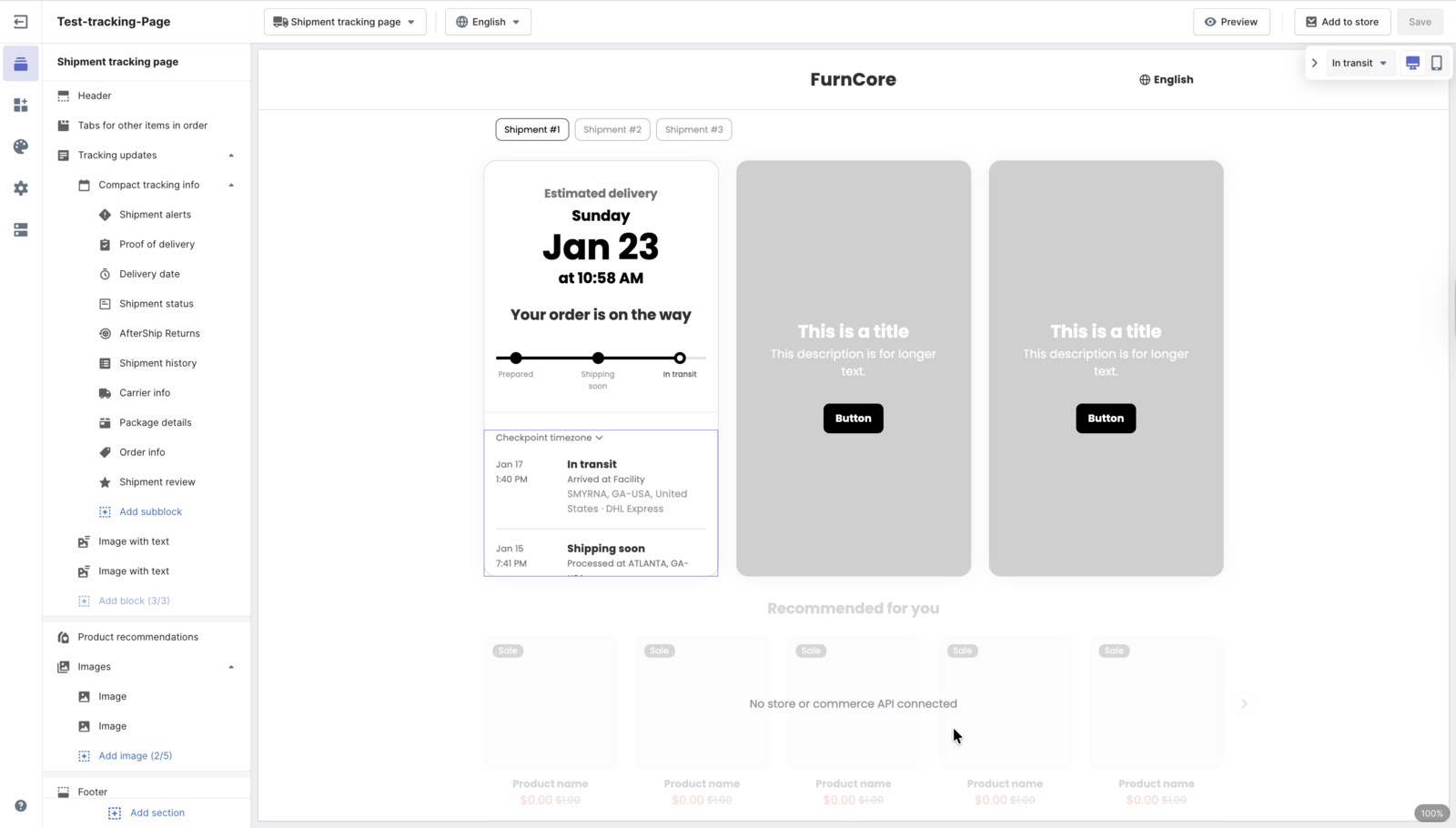
AfterShip Tracking's notification flows carry exception and failed-attempt triggers from the Essentials plan, alongside the ordinary milestones. The shopper hears that a parcel stalled from you, on the day it stalls.
Premium adds revised and missed delivery-date alerts, an AI-predicted delivery date on the product and checkout pages of a Shopify store, and a branded tracking page on your own domain. That changes where the shopper lands when they go looking.
Let the shopper handle the return.
AfterShip Returns gives shoppers a self-service returns page with eligibility and routing rules, and advanced exchanges and refunds to Shopify store credit arrive on Essentials.
ShipStation's Standard plan also has a returns portal, with RMA and exchanges. Both let a shopper open a return without emailing you.
Depth is where they separate. Eligibility rules that read the order, routing rules that send each item to the right destination, and an exchange that can settle into Shopify store credit decide how many of those returns finish without a human, and how many end as an exchange instead of a refund.
One set of shipment data.
The suite is shipping, tracking, returns, and warranty. Each is a separate subscription, and each writes to the same shipment record, so a label, a tracking event and a return are one object rather than three.
That is what makes the exception trigger possible, and it works in the other direction too. AfterShip Shipping's Smart Carrier Recommendation, available on all plans and off by default, excludes carrier services with a high exception rate for a shipment's origin and destination, using AfterShip tracking data.
Delivery history from the parcels you already shipped picks the carrier for the next one.
What It Costs at 100, 500 and 1,000 Orders a Month
Shippo, ShippingEasy, and AfterShip Shipping each offer a free entry plan - AfterShip's comes through its Shopify app listing rather than its pricing page; ShipStation instead gives a 30-day free trial with no free tier. Shippo's free Starter covers 30 labels a month, ShippingEasy's covers 25 shipments a month, and AfterShip Shipping's Shopify App Store listing covers 10 labels a month.
Past the free tier, AfterShip Shipping's monthly billing runs $11 a month at 100 labels, published on both its pricing page and its Shopify App Store listing, then $35 at 500 and $47 at 1,000. Tracking and Returns are separate subscriptions. AfterShip Tracking on the Shopify App Store is free for 50 shipments a month and $11 a month for 100. AfterShip Returns starts at $19 a month for 20 returns.
All figures monthly, at the same volumes: Shippo Pro $19 at 100 labels and $29 at 500; ShipStation Starter $29.99 at 100 shipments and $39.99 at 500, with Standard $89.99 at 500; ShippingEasy $19.99 at 100 shipments and $29.99 at 500. At 1,000, Shippo Pro is $54, ShippingEasy $49.99 and ShipStation Starter $79.99.
On label count alone, AfterShip Shipping sits in the same band as the others. What you pay for on the AfterShip side is the customer-experience layer that Tracking and Returns add.
Plan fees are one half of the cost question. The other half is calculating real-time shipping rates at checkout.
All four tools run automation rules. Shippo and ShippingEasy include them from their free plans; AfterShip Shipping gates them at Pro and caps at 10 rules below Enterprise. If free label-routing rules are the whole purchase, start there. The case for AfterShip is what happens after the label.
Our Final Verdict: How to Choose in 2026
Which list you belong in depends on what your shopper should experience.
Choose AfterShip if:
- you want your shopper told when a parcel hits an exception or a delivery attempt fails, which starts on AfterShip Tracking's Essentials plan
- you want an AI-predicted delivery date on your product and checkout pages, which is on Tracking's Premium plan
- you want shoppers to open and resolve their own returns with exchange and store-credit rules, on AfterShip Returns Essentials
- you want to keep the label tool you already run and add this beside it
Choose Shippo, ShipStation or ShippingEasy if:
- you ship under 30 labels a month and Shippo's free Starter plan covers you
- you would rather have order rules and a returns portal bundled inside the label tool itself than run a dedicated returns product beside it, which is what ShipStation's Standard plan offers
- you want email campaigns built from your shipping data, which ShippingEasy sells as a paid add-on
All of it sits beside the label tool you just chose, not instead of it.
Proactive shipment tracking that delights your customers, reduces WISMO tickets, and improves your delivery performance.
Book a demoFrequently Asked Questions (FAQ)
Which is cheaper, Shippo or ShipStation?
Shippo, at every volume in this comparison. On monthly billing, Shippo Pro is $19 at 100 labels against ShipStation Starter at $29.99 for 100 shipments, and $29 at 500 against $39.99. Shippo also has a free Starter plan covering 30 labels a month, where ShipStation has no free tier. That comparison holds at Starter only. ShipStation's Standard plan, which is where its returns portal sits, is $89.99 a month at 500 shipments.
Does ShipStation or Shippo have better integrations?
On the integration that most often decides it for a small US seller, they are level: Etsy names Shippo and ShipStation as its two US shipping integrations. ShippingEasy does not support Etsy stores. Past that, compare each vendor's own integration list against the channels and carriers you actually sell and ship through, because the answer is specific to your stack.
What is the best alternative to ShipStation for Shopify stores?
For label printing, Shippo and ShippingEasy are the two alternatives to ShipStation in this comparison, and your monthly volume picks between them. For a Shopify store the more useful move is often to keep the label tool and add the post-purchase layer beside it. AfterShip Tracking and AfterShip Returns run as separate subscriptions alongside whichever label tool you already use, so changing what your shopper sees does not require changing label vendors.
Do Shippo, ShipStation and ShippingEasy tell customers when a delivery is late?
All three send your shoppers tracking updates, and all three can brand those emails on a paid plan. ShipStation can hold the shipment confirmation email until the first carrier scan, which is a scheduling setting for when that first email goes out. What none of the three documents is an alert that fires when a shipment hits an exception or a delivery attempt fails. AfterShip Tracking carries exception and failed-attempt triggers from its Essentials plan.