This is the third piece in our BFCM countdown series. The 90-day plan is in the BFCM playbook, and the case for a September start is in the creator outreach timeline.
In early September a marketer posted in r/TikTokshop with a familiar problem. Four weeks into a new job, they've been asked to sign 100 creators within a week. More than 300 invites went out, four or five creators came in, and the shop still had no GMV. The community's diagnosis was that a new shop with no sales history and no reviews gets ignored, and that "signing 100 creators" is a headcount, not a result.
Sellers ask the same question every September: how many creators do I need for TikTok Shop BFCM? A useful answer has three parts: how many creators need a qualifying video live before the campaign window opens, what those videos will cost in samples, and how many creators you have to reach to get there. You reach that number by subtracting the creators you already have, then working the gap through three ratios. This article walks through both, with the assumptions behind them, and ends with everything you need to build your own calculator in a spreadsheet.
Which creators are you counting?
"100 creators" means one of three different things, and the gap between them is where sample budgets disappear:
- Creators who accepted an invite. Accepting takes one tap in the app and commits the creator to nothing.
- Creators who posted qualifying content on time. TikTok treats a free-sample collaboration as complete when a linked video stays live for at least 3 days, or a LIVE pins the product for more than 10 minutes, within 14 days of delivery (sample setup guide). For BFCM you add your own cutoff: the video is live before the campaign window opens, assumed around November 11 until TikTok announces 2026 dates, with enough runway to test it and put spend behind it.
- Creators who drove orders. This is the number your P&L cares about. You can model it from your own conversion history, but treat it as a scenario, not a guarantee.
For planning purposes, use the second definition: creators who posted qualifying content on time. Count by unique creator, so one creator with one sample and at least one qualifying video counts once. Track extra videos and LIVEs separately. The rate that matters is on-time post rate, the share of delivered samples that produce a qualifying post before your cutoff. A video that goes live on November 25 can still sell during the campaign, but it arrives too late to test or amplify.
How many creators do you need? The backward calculation
Suppose you want 50 creators with a qualifying video live before the window opens.
Start with the creators you already have. If 40 posted about your products in the last 90 days and half of them post again on time once re-briefed, that covers 20 of the 50. Creators who have responded to you, contacted you, or featured your products are "connected" in TikTok's terms and do not count against your outreach quota (quota rules). That makes them the cheapest content in the plan. Keep this group on its own line, because creators who post again tell you nothing about what a new sample yields.
That leaves a gap of 30 new creators, and three ratios turn the gap into an outreach number. The values below are planning assumptions for a shop with sales history and a free sample on offer. TikTok publishes no benchmark for any of them. Creator inboxes are fuller from September to November, so your real rates may come in lower. Plan with these, then replace them with your wave-one numbers.
- 5% of unconnected creators reached accept the Target Collaboration invite
- 50% of those who accept request a sample and receive it before your cutoff
- 60% of those who receive it post a qualifying video before the window opens
Plug in the numbers: 30 ÷ (0.05 × 0.5 × 0.6) = 2,000 unique creators to reach. That means 100 acceptances, 50 samples delivered, and 30 on-time posters, so ship a few extra samples to cover loss and late arrivals. If on-time posting comes in at 30% instead of 60%, the same 2,000 creators produce 15 posters.
A shop with no sales history should plan on a first ratio closer to 2%. New shops receive a one-time Starter's Pack of 1,000 outreach opportunities, and at 2% that yields 20 acceptances, 10 samples delivered and 6 on-time posters. Closing a gap of 30 would take 5,000 creators reached, which a new shop does not have quota for in the weeks left. The workable plan for a cold shop is a smaller target. Spend the first September weeks getting the shop off zero (first orders, first reviews) so the acceptance rate moves before the quota is spent.
The funnel plans content supply and sample spend. Sales are a separate model built from your own conversion history, treated as a scenario rather than a guarantee, and a shop with no history has nothing to model yet. A TikTok Shop operator on X on September 3 argues that Shop results ride on a few outlier videos and cannot be forecast reliably. That is true of the outcome, and it is a reason to plan the inputs harder, because every week of September buys another cohort of your own numbers before the window opens.
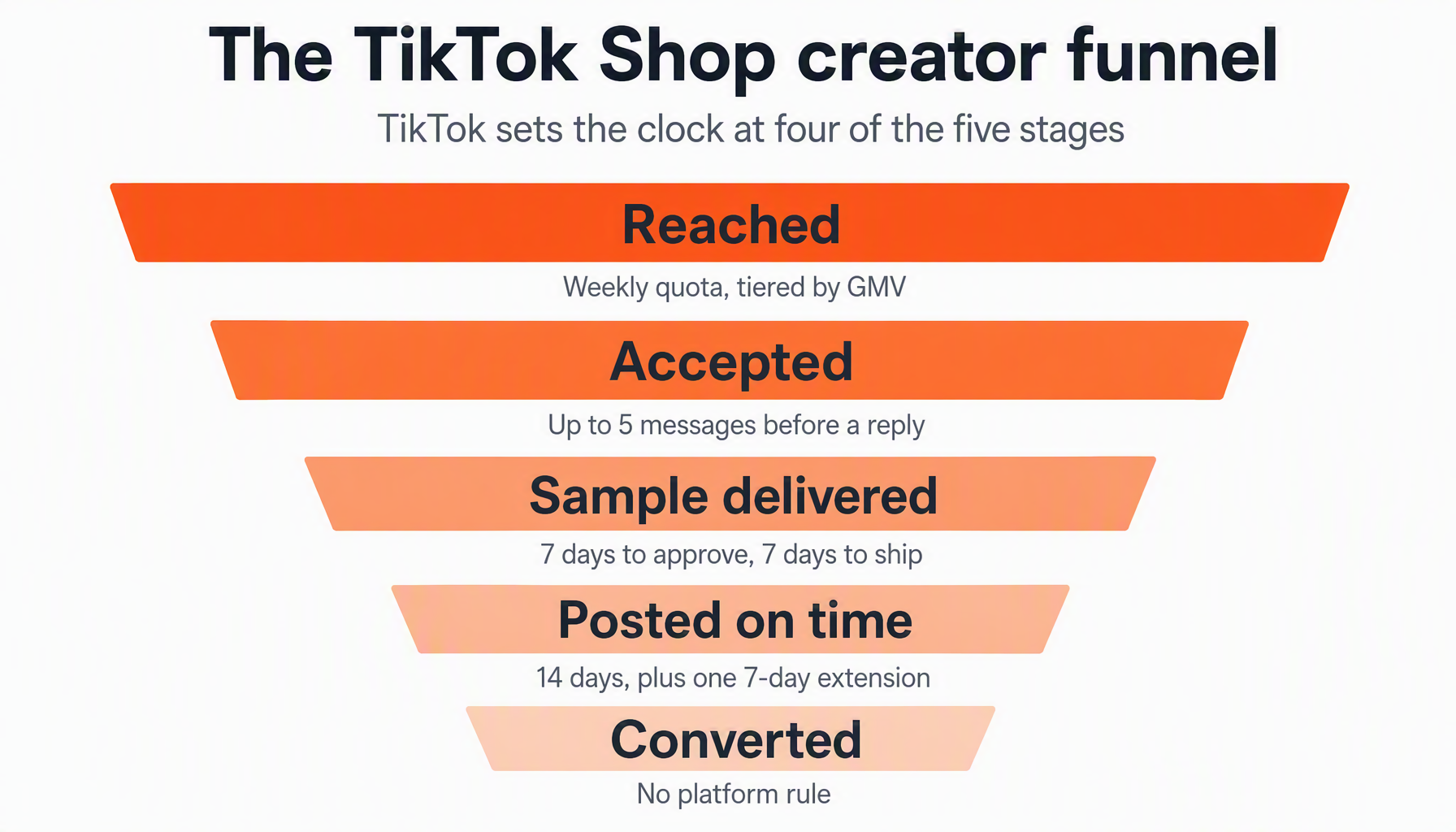
How the TikTok Shop creator funnel works, stage by stage
TikTok governs the clocks at four of the five stages. What you control is the list, the offer, and how fast you move inside each window.
| Stage | Platform rule | What decides it | Your lever |
|---|---|---|---|
| 1. Reach | Weekly quota tiered by past-30-day GMV, shared by invites and messages; connected creators exempt; one Starter's Pack of 1,000 for new shops (quota rules); up to 50 creators per invite (setup guide). | How many unconnected creators you can touch before the next refresh | List quality; quota is spent per creator |
| 2. Accept (invite) or reply (message) | Up to 5 messages to an unconnected creator in a week before they reply (quota rules). | What the creator sees on your product card: sales history, reviews, free sample | Your shop's sales history and the offer itself |
| 3. Sample delivered | 7 days to approve a request, 7 days to ship after approval (sample setup guide). | Your approval speed, and whether the creators you invited pass your own approval bar | Same criteria for the invite list and for approvals |
| 4. Posted on time | 14 days from delivery; the creator can request one 7-day extension before it expires or appeal once if the sample is faulty; a miss lowers their fulfillment rate, visible to sellers (Sample Integrity Policy). | Whether the creator had time to use the product, and liked it | Ship early, brief clearly, check at day 14 |
| 5. Converted | No platform rule | Product, price, content, stock, and which videos the algorithm pushes | Model from your own history; put ad spend behind winners |
Update the three ratios only from creators who have passed their full window, which is 14 days plus a possible 7-day extension. A creator who received a sample last week is not a miss yet.
Where the creator funnel leaks
Stage 2 is decided by your product card. Another seller posted in late August that 100-plus targeted invites to micro-creators on a two-sale shop got zero replies, and a creator in the same thread explained why: they receive well over 100 invitations on a busy day, look once a month, and skip anything without sales momentum or ads behind it. An agency-side TikTok Shop manager on LinkedIn calls this the 0-GMV creator paradox and says acceptance rises several-fold once the card shows velocity. That figure is one agency's unmeasured claim, but the direction matches every seller thread above.
Stage 3 leaks when the invite list and the approval bar disagree. A creator thread from late August describes the pattern: the brand invites, the creator requests the sample, and the brand declines or goes silent. Each one is quota spent to make a detractor. An agency on LinkedIn on September 8 put the fix simply: if approval only accepts one type of creator, do not invite the others.
Stage 4 leaks when the creator runs out of time. A creator on X on September 2 complained that samples arrive with too little time to use the product, and that they will not recommend something they do not like. That is a stronger argument for shipping early than the 14-day clock itself.
What closing the gap costs
Sample cost per on-time posting creator is sample spend divided by on-time posters. At a landed sample cost of $18, the base case and its two alternatives compare like this.
| Scenario | Reached | Samples delivered | On-time posters | Sample spend | Per on-time poster |
|---|---|---|---|---|---|
| Base (5% accept, 50% delivered, 60% on time) | 2,000 | 50 | 30 | $900 | $30 |
| More reach, same rates | 3,400 | 85 | 51 | $1,530 | $30 |
| Same reach, 65% delivered, 75% on time | 2,000 | 65 | 49 | $1,170 | $24 |
Better fulfillment saves quota and lowers the unit cost, and it still means 15 more samples and $270 more than the base. For most small shops quota is the binding constraint, so the third row is the one that is actually available. At 30% on-time posting the base case costs $60 per poster.
Sample cost is only part of the cost. Add your own time, shipping, samples that are lost or late (budget by samples shipped rather than delivered), and commissions later; the full ledger is the next article in this series. The base case also sets the workload. It means 100 accepted creators to correspond with, 50 sample decisions and 50 shipments each inside a 7-day window, 50 posting clocks, one follow-up per creator, and a weekly quota decision. That is manageable for one wave, and the waves start to overlap in October.
When you measure what the samples returned, keep affiliate GMV and GMV Max GMV apart. Product GMV Max reporting includes organic and affiliate orders for the promoted products (Product GMV Max), so adding the two totals counts the same orders twice.
How to run outreach waves from here
The week-by-week plan is in the outreach timeline. The funnel adds five rules to it.
- Build the creator target list to your approval criteria. If you would not ship this creator a sample, do not invite them.
- Send in batches and follow up once by message. TikTok allows up to five messages to an unconnected creator in a week before they reply, and one follow-up is usually enough.
- Approve requests within a couple of days even though TikTok allows seven, and ship the same week.
- At day 14, check rather than close the file. The creator may have requested a 7-day extension or appealed a faulty sample, and sellers are not notified of extensions, so confirm the new date and re-slot the creator.
- Report the funnel weekly by unique creator: reached, accepted, delivered, posted on time, converted. Replace the spreadsheet calculator's assumptions after wave one.
The Creator Funnel Calculator
No interactive tool needed here, this is eight inputs and four lines of arithmetic. Build it in a spreadsheet with your own numbers and the plan updates itself every week.
What you enter:
- Weeks until your campaign window opens
- Your weekly unconnected-creator quota
- Existing creators and their repeat-post share
- Your three ratios (acceptance, delivery, on-time post)
- Landed sample cost and expected loss/late rate
- Your target number of creators with a qualifying video live before the window opens
What it works out:
- The gap between your target and existing creators
- Creators to reach
- Reach per week against your quota
- Sample spend
Once you have wave-one numbers, drop them in and replace the assumptions above.
What this looks like at scale
A spreadsheet handles one wave. In October, approval windows, shipping windows, posting clocks and extensions run for different creators at once, quota resets weekly, and every new video needs a performance read before you decide on ad spend.
AfterShip Affiliates runs both halves of this funnel in one place. On the outreach side it covers creator discovery, Target Collaboration and direct-message invites within your TikTok quota, scheduled follow-ups, and reply and acceptance rates per wave (outreach workflow). On the sample side it covers request review with an approve or reject recommendation, delivery status, a countdown against each creator's posting deadline, and a funnel from requested to posted to sales.
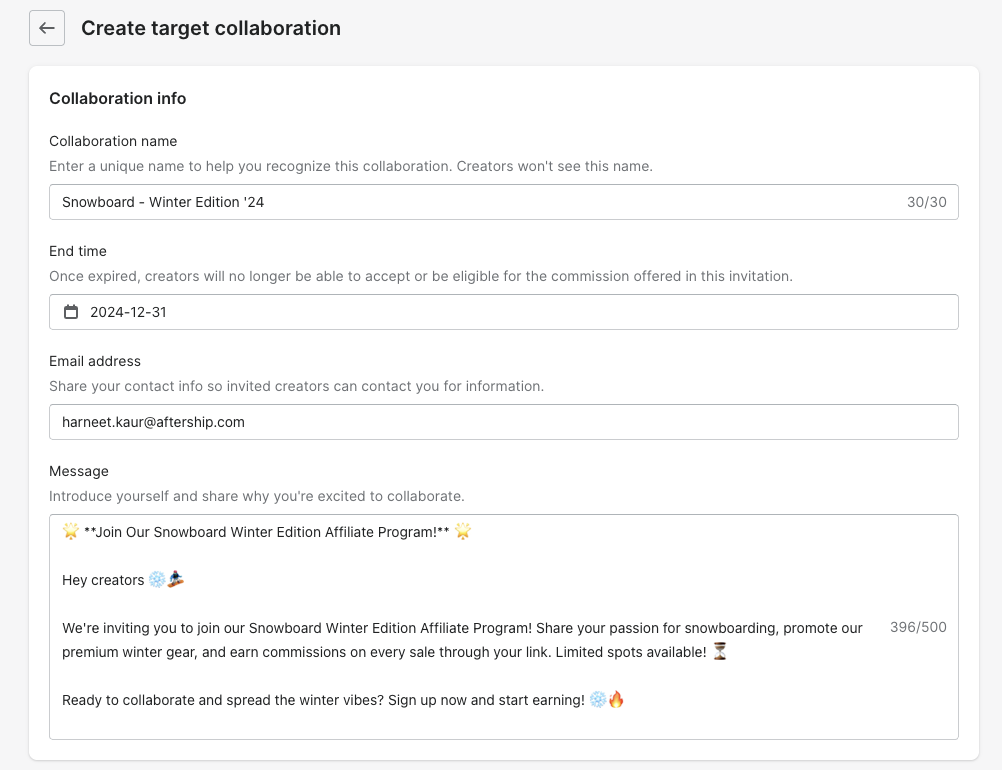
The weekly numbers this article asks for come out of those two screens. Disclosure: AfterShip Affiliates is a paid product, and everything above can be done in Seller Center and a spreadsheet.
Find the TikTok Shop creators who will actually sell your products, reach them at scale, and track every dollar of GMV they drive.
Book a demoFrequently Asked Questions
How many creators do I need for TikTok Shop BFCM?
Work backward from a target for creators with a qualifying video live before the campaign window opens, assumed around November 11, 2026, pending TikTok's announcement. Subtract the existing creators who will post again, divide the gap by your acceptance rate, sample delivery rate and on-time post rate, and check the result against your weekly quota and sample budget. In the worked example, a gap of 30 at 5%, 50% and 60% means reaching 2,000 creators and delivering 50 samples.
What acceptance rate should I expect on Target Collaboration invites?
TikTok publishes no benchmark, and seller threads show new shops near zero. Plan with 2% for a shop without sales history and 5% for a shop with sales and a free sample on offer, expect lower in peak season, and replace both after the first wave.
How many creators can I invite on TikTok Shop?
Your outreach quota is tiered by past-30-day GMV, refreshes weekly every Sunday, and is shared between Target Collaboration invites and instant messages. Connected creators do not count against it, new shops get a one-time Starter's Pack of 1,000, and each invite can include up to 50 creators. Check your quota in Affiliate Center before you plan a wave.
What happens if a creator misses the 14-day posting window?
Before it expires the creator can request one 7-day extension, or file one appeal if the sample is faulty. After that the sample is overdue and the creator's fulfillment rate drops, which sellers can see. Sellers are not notified of extensions, so check at day 14 and confirm the new date.
Can I add affiliate GMV and GMV Max GMV to measure what my samples returned?
No. Product GMV Max reporting includes organic and affiliate orders for the promoted products, so the sum counts the same orders twice.
Do I need software to run the creator funnel?
Not for a single wave. When waves overlap in October, AfterShip Affiliates handles outreach (creator discovery, Target Collaboration and direct-message invites within your quota, scheduled follow-ups, reply and acceptance rates) and samples (request review with an approve or reject recommendation, delivery status, a countdown against each creator's posting deadline, and a requested-to-posted-to-sales funnel).