The notifications are going out on schedule. Order confirmed, shipped, in transit, out for delivery. The tickets keep arriving anyway.
That is the problem worth solving, and most post-purchase tools are not built for it. They treat "where is my order" as a communication gap, so they send more communication. A shopper who writes in has rarely heard nothing. Usually they heard something, checked the delivery date they were given, and found it had quietly stopped being true.
So the question in this comparison is not which platform sends more. It is which one gives a shopper a date worth believing on day one, names the problem before they notice it, and puts enough context in front of your agent to close the ticket in a single reply.
Accuracy against activity. The two platforms sit on opposite ends of that line.
The Real Cost of WISMO Isn't Just Your Time
Every support team already knows what WISMO is: a shopper asking where their order has got to, usually before anything has gone wrong.
It is also a smaller share of your queue than the folklore suggests. The share most often quoted for WISMO has no traceable source behind it, and the figures that do have one are more modest and more useful. Gorgias, looking across more than 12,000 brands, puts "where is my order" at 18% of all tickets. Yuma, across more than 100,000 tickets from more than 100 brands, puts it at 16%. Which platform actually moves that number is set out in AfterShip vs Narvar vs Malomo on WISMO tickets.
Call it a sixth of the queue. That sounds survivable until you price it in hours.
About 108 agent hours a month. Illustrative model, every assumption shown:
- 20,000 orders a month at a 12% WISMO contact rate: 2,400 WISMO tickets a month
- Mous's published 54% reduction: about 1,296 tickets deflected a month
- About 5 minutes handling per ticket: about 108 agent hours a month
- Gartner assisted-channel median of $13.50 per contact: about $17,500 a month
Gartner, 1 February 2024, median cost per contact for assisted channels. The public abstract does not disclose sample size.
Two things about that model matter more than the arithmetic. The 54% is Mous's published result, not an average to plan around. And the hours line is the one that survives a sceptical reading, because it holds whatever your true cost per contact turns out to be.
108 hours is most of a full-time role. That is the number your COO is actually asking about when they ask whether the queue justifies another hire.
None of it moves if the underlying date is wrong. Accurate delivery dates reduce "where is my order" (WISMO) tickets. So the thing to evaluate is which platform can produce a date the shopper will trust, and what it does when that date changes.
Wonderment (now Loop Tracking)'s Approach: Proactive Notifications Through Your ESP
Wonderment (acquired by Loop, now Loop Tracking) built its following in exactly the stack this reader already runs. Setup is Shopify-native, the Klaviyo integration is deep, and the model is event-based: a carrier scan lands, an event fires, a message goes out.
For a team already working in Shopify and Klaviyo, three things are fast:
- Installation and tracking page setup happen inside Shopify, with no developer time.
- Shipment events map into Klaviyo flows the marketing team already builds and owns.
- Triggers fire off carrier scan data, so timing follows the parcel rather than a schedule.
Then the architectural detail that decides how much of this reaches a shopper. Loop Tracking does not compose or send the message itself. Its own product page describes the channel as "your preferred email & SMS provider". Wonderment, now Loop Tracking, sends tracking notifications through the merchant's own ESP.
You feel that in two places. Every notification becomes a second subscription and a second template system, maintained by whoever owns the ESP rather than whoever owns delivery. And the coverage is uneven: three of Loop's fourteen shipment events reach only Klaviyo and Sendlane, and the delivery date revision event is one of the three.
Loop's proactive stall alert has the same shape. It waits four days by default, then fires into an ESP rather than to the shopper.
The event that tells someone their delivery date has moved is the one most likely to stop a ticket forming. Under this model it reaches them only if the brand is on one of two platforms, and only after a second system has been configured to send it.
AfterShip's Approach: An Accurate Promise, and the Exception Before the Question
AfterShip starts one step earlier than the carrier scan. The delivery date is predicted before the shopper has anything to worry about, and the exception is named the moment the parcel stops behaving.
Coverage is where that shows up first. AfterShip AI predicts delivery dates covering over 80% of shipments. Most carriers offer a prediction on fewer than 40% of deliveries, which means a tracking experience built on carrier estimates alone leaves the majority of orders with no date at all, or with a date the merchant has quietly invented.
Those uncovered orders are the ones that generate tickets. A shopper with no date checks the page twice, then writes in. A shopper holding a date they were told to trust does neither, right up until the date slips.
This is also why the surface matters. A date on the product page and on the tracking page sets an expectation the shopper carries into the wait. A "shipped" email confirms something they already assumed and answers nothing about when. The first is a promise. The second is a receipt.
When the promise does break, the useful response is to say so in specific terms, early, and to whoever is affected. That is a different job from forwarding a carrier scan, and it is the job the rest of this comparison turns on.
Head-to-Head: Wonderment vs AfterShip for WISMO Deflection in 2026
Seven criteria, chosen because a CX lead would have to defend each one to a COO. Feature counts and carrier totals are absent on purpose, since neither predicts whether a ticket forms.
| Criteria | Wonderment (Loop Tracking) | AfterShip |
|---|---|---|
| How WISMO is prevented | Event-triggered notifications sent when a carrier scan lands | An accurate delivery promise set before the question forms, plus a named exception when it happens |
| Delivery estimate | Delivery Promise, sold in Loop's quote-only enterprise tier | AI EDD, trained on 4.4 billion shipments, covering 80%+ of deliveries against under 40% coverage for typical carrier estimates |
| EDD alerts, and where they sit | No published equivalent below the enterprise bundle. The delivery-date-revision event reaches Klaviyo and Sendlane only | Delivery arriving soon: Enterprise. Estimated delivery date revised and estimated delivery date missed: Premium and above |
| Exception detail | No public sub-status taxonomy. Nearest public equivalent is a 10-value Shopify Flow status list | Nine documented parent statuses with a published exception vocabulary, normalised across carriers |
| Where notifications are composed | In the merchant's own ESP. Loop's page: "your preferred email & SMS provider" | In-platform, across email and SMS |
| What the agent sees in the ticket | Zendesk listing names an immediate shipment status view and a link to the branded tracking page, and names no delivery estimate and no event history. Gorgias publishes no field list. 10+ Zendesk installs | Zendesk app publishes a 15-field list including estimated delivery date, delivered date, detailed event messages and delivery sub-status. Gorgias listing names status, EDD and carrier information. 100+ Zendesk installs |
| After the WISMO ticket | Pre-fulfilment order editing: add items, remove items, quantity and address changes. Cancellation, discount codes and promo codes appear nowhere in Loop's documentation | Order Edits, generally available on Premium and above: seven shopper actions including add discount code and cancel order, plus cancellation rescue |
Feature Deep Dive: Why an Accurate Delivery Promise Beats Another Email
Three rows in that table describe the delivery estimate, and they are the rows that decide the rest.
AfterShip owns the model. AI EDD is trained on data from over 4.4 billion shipments and publishes up to 95% accuracy. It is part of AfterShip Tracking rather than a tier a merchant negotiates their way into.
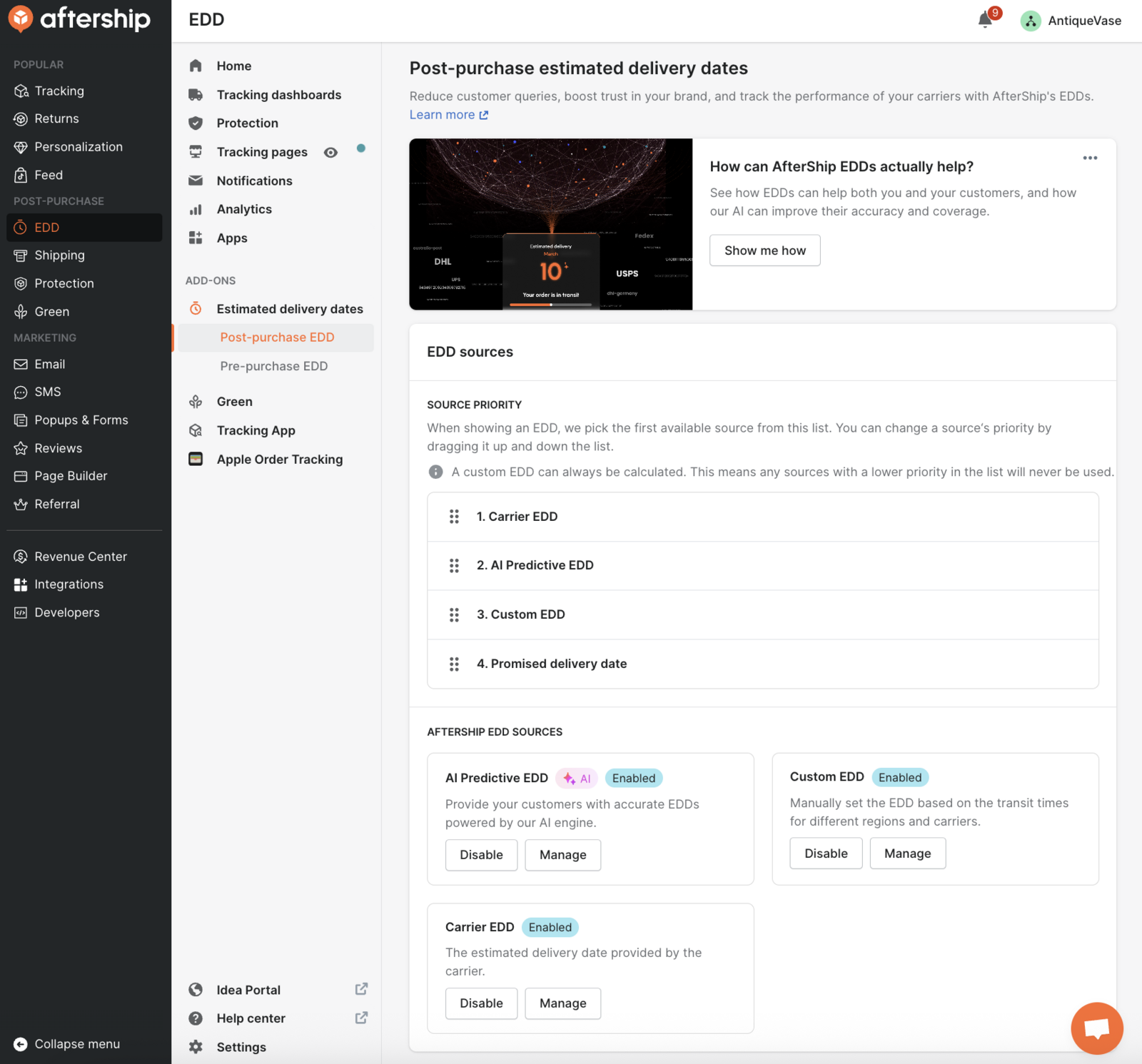
Loop sells the equivalent capability, Delivery Promise, inside a quote-only enterprise tier. A mid-market brand evaluating tracking on a published plan is evaluating a product without it.
On accuracy, Loop's own published position is the fairest thing to quote. Loop's product page states: "Estimates are 90% accurate and calculated nightly using historical delivery data within our AI model." Its help centre qualifies that figure: "Our analysis shows a typical accuracy rate of 87 - 92%, depending on the merchant and their shipping volume." That is a reasonable range, honestly disclosed. Loop names the input itself, historical delivery data, which is thin exactly where a brand needs it most: new lanes, new carriers, peak season, the first international push.
A model trained across billions of shipments does not have that problem, because the merchant's own volume is a small input rather than the whole dataset.
Set the percentages aside. The question a CX lead should ask is who generates the date, on what evidence, and whether the answer arrives on the plan they are actually buying.
Feature Deep Dive: Granular Triggers and the Exception Vocabulary
Notification triggers are worth checking by name rather than by count, because what decides a queue is whether the specific alert you need actually exists.
The five that matter to a WISMO queue:
- Delivery exception, when the parcel hits a problem in the network.
- Failed attempt, when the courier tried and could not deliver.
- Available for pickup, when the parcel is waiting somewhere the shopper has to go.
- Estimated delivery date revised, when the promise moves.
- Estimated delivery date missed, when the promise has already broken.
Estimated delivery date revised and estimated delivery date missed sit on Premium and above. Delivery arriving soon sits on Enterprise. The two triggers that set and reset a shopper's expectation are on the tier a mid-market brand actually lands on, which is the split as it stands today.
Underneath the triggers is the vocabulary. AfterShip normalises carrier events into nine documented parent statuses, each with published sub-statuses, so "delayed (customs clearance)" and "delayed (extreme weather)" and "held for payment" are distinct things an agent and an automation can both act on. Loop publishes no sub-status taxonomy. Its nearest public equivalent is a ten-value Shopify Flow status list: enough to fire something, not enough to say what happened.
Two limits belong in the open here. AfterShip's in-store pickup notifications sit on the Enterprise plan and are quoted per contract, though the shipment status, EDD and exception triggers this queue actually runs on are not behind that add-on. And the sub-statuses added in March 2026 apply only to shipments tracked on or after 27 March 2026, with no backfill, so a brand switching now builds that history forward rather than seeing old shipments re-coded.
Feature Deep Dive: What Your Agent Actually Sees in Gorgias and Zendesk
Deflection has a ceiling. Some shoppers write in regardless, and for those tickets the metric is first reply time, which is decided by what loads next to the conversation.
AfterShip's Zendesk app publishes a fifteen-field list. It includes the estimated delivery date, the delivered date, detailed event messages and the delivery sub-status, which is where the granularity above becomes something an agent can read. The Gorgias listing names status, estimated delivery date and carrier information, and supports automated replies carrying that order information. Both matter for the same reason: an agent who has to open a carrier site in a second tab is an agent whose first reply is measured in hours rather than minutes.
The Wonderment (Loop Tracking) Zendesk listing names an immediate shipment status view and a one-click link to the branded tracking page. It names no delivery estimate and no event history. Gorgias publishes no field list for it.
The gap is the difference between an agent who can answer "where is it" and an agent who can answer "when will it arrive, and why is it late", which is the answer that actually closes the ticket.
Install counts point the same way: AfterShip's Zendesk app shows 100+ installs against 10+ for Wonderment.
StackCommerce's published results show WISMO tickets down 71% year over year, alongside 99% shipment tracking visibility. The second figure is what produces the first, since an agent can only answer from data the platform captured in the first place.
The Verdict: Which Tool Kills WISMO Tickets Faster?
Wonderment (Loop Tracking) is a sound choice for a brand that lives inside Shopify and Klaviyo. Setup is quick, shipment events land in flows the marketing team already owns, and for a team that wants tracking activity feeding tools it has already built, it does that job well.
That fit holds as long as the delivery date is not the thing you are trying to fix.
For a mid-market DTC brand that wants WISMO to stop forming rather than to be answered faster, AfterShip is the recommendation. Three things decide it, none of them a case-study percentage.
AfterShip generates the delivery promise from a model it owns and trains on its own shipment data, which is what keeps it steady in the lanes where a merchant's own history is thinnest. Loop's equivalent is available only by enterprise quote, outside the plan a mid-market brand is actually buying.
The exception vocabulary is documented and normalised rather than passed straight through, so an agent and an automation act on the same named reason instead of interpreting raw carrier text.
And the two triggers that set and reset a shopper's expectation sit on a published self-serve plan. When a ticket arrives anyway, it reaches the agent with the delivery date and the event history already in view.
None of this needs a migration to test. Ask both vendors the same two questions: where does the delivery date come from, and which plan is it on. The answers separate the two products faster than any feature list will.
If you want to go past the criteria used here, a full feature and pricing breakdown covers the wider platform comparison.
AfterShip sets the date before the carrier does, and keeps setting it when the date moves. That is what stops the ticket forming.
Beyond WISMO: One Platform, One Contract
WISMO is not the only queue the delivery date feeds. "Change my order" lands in the same inbox, almost always before the warehouse has touched anything.
AfterShip Order Edits is generally available on Premium and above. It gives a shopper seven actions on their own order, including editing the shipping address, swapping products, adding a discount code and cancelling, plus cancellation rescue that redirects a shopper into the right edit flow rather than letting the order go. Those are tickets that never open, taken off the same queue and the same team.
Returns and Shipping run on the same platform, under one contract, against the same tracking data. That means one vendor to manage, one renewal to defend, and the same set of order facts behind every conversation your team has after checkout.
For teams building the business case, a deeper dive into reducing WISMO is the natural next step.
Proactive shipment tracking that delights your customers, reduces WISMO tickets, and improves your delivery performance.
Book a demoWonderment vs AfterShip: Frequently Asked Questions
Does Wonderment still exist, or is it Loop Tracking now?
No. Wonderment was acquired by Loop and now ships as Loop Tracking. Loop's own site confirms the change. You may still see it listed on the Shopify App Store as Track by Loop.
Do more notifications mean fewer WISMO tickets?
Not on their own. A shopper writes in when the date they were given stops being true. The lever is the accuracy of the promise and how early the exception reaches them, rather than the number of messages sent.
What does my Gorgias or Zendesk agent see when a WISMO ticket arrives?
With AfterShip, the ticket loads with the estimated delivery date, the delivered date, the event history and the delivery sub-status beside the conversation, so the agent can answer without opening a carrier site in another tab.
Is an accurate delivery date included, or is it a paid upgrade?
AfterShip AI EDD is part of AfterShip Tracking rather than a separate purchase, and the triggers that revise a date or flag a missed one sit on a published self-serve plan. Loop sells its Delivery Promise inside a quote-only enterprise tier, so on the plan a mid-market brand actually buys, AfterShip is the one shipping a delivery promise.