Wonderment built its reputation on proactive shipping notifications that fired inside Klaviyo. Then Loop bought it. If you are evaluating Wonderment alternatives in 2026, you want tracking data that holds up as your brand grows.
Why Your Tracking App Stops Scaling (And It's Not Your Klaviyo Flows)
First, the naming, because it changes what you are comparing: Wonderment is now Loop Tracking, following Loop's acquisition announcement on 10 December 2024. Everywhere below, Wonderment means Loop Tracking.
Most teams assume the problem is the notification layer. It usually isn't. Your Klaviyo flows are fine; the data feeding them is what runs out of road.
Three things change at once as a brand scales, and each lands on the tracking layer rather than the messaging layer. Volume rises, so a small share of ambiguous scans becomes a real ticket queue. Carrier mix diversifies, so the regional carriers you added last quarter behave nothing like the national carrier your estimates were tuned on. Store count rises, so tracking becomes something you manage per storefront instead of once.
Watch for these four symptoms, all of them data problems wearing a messaging costume:
- Delivery estimates drift as lanes diversify, degrading on exactly the routes where customers are least patient.
- International expansion opens coverage gaps, and orders on newly added carriers arrive with thinner, later scan data.
- Exceptions surface inconsistently by carrier, so "stuck in transit" means different things on different lanes and CX cannot write one macro for it.
- Tracking is administered store by store, so nobody can answer "which carrier is worst this month" across the business.
The date is what shoppers actually read: Baymard's benchmark found that 41% of sites don't provide a delivery date, leaving users to work it out from a shipping speed instead. If the estimate is unreliable, the fix is upstream of the flow. See also the best branded tracking apps for Shopify and this guide to using delivery analytics to reduce WISMO.

How We Ranked These Wonderment Alternatives
Five criteria, all operational:
- Tracking-data depth. Direct carrier integrations and normalized delivery events, not statuses scraped from a carrier's public page.
- Delivery-date accuracy, and where it sits on the plan ladder. An estimate that lives only on a vendor's top tier is not a feature you have; it is one you can buy later.
- Branded experience. Whether the tracking page is genuinely yours, and how much you can change without a developer.
- Notification and automation power. Trigger depth, and how cleanly triggers reach the tools you already run.
- Platform scalability. Tracking-only bolt-on versus unified suite; single store versus many.
Carrier count is deliberately not one of our criteria, because published carrier figures in this category span an order of magnitude and none is independently audited. More on that under the comparison table.
The 5 Best Wonderment Alternatives for DTC Brands in 2026
This ranking is opinionated and scoped to a scaling Shopify brand with more than one carrier and a CX team already feeling the WISMO load.
1. AfterShip — Best overall for data-driven CX and operations
AfterShip tracks across 1,700+ carriers with direct integrations and normalizes their checkpoints into a standard set of delivery statuses, so "out for delivery" and "exception" mean the same thing on every lane. That normalization is what makes consistent macros, comparable carrier scorecards and worldwide triggers possible.
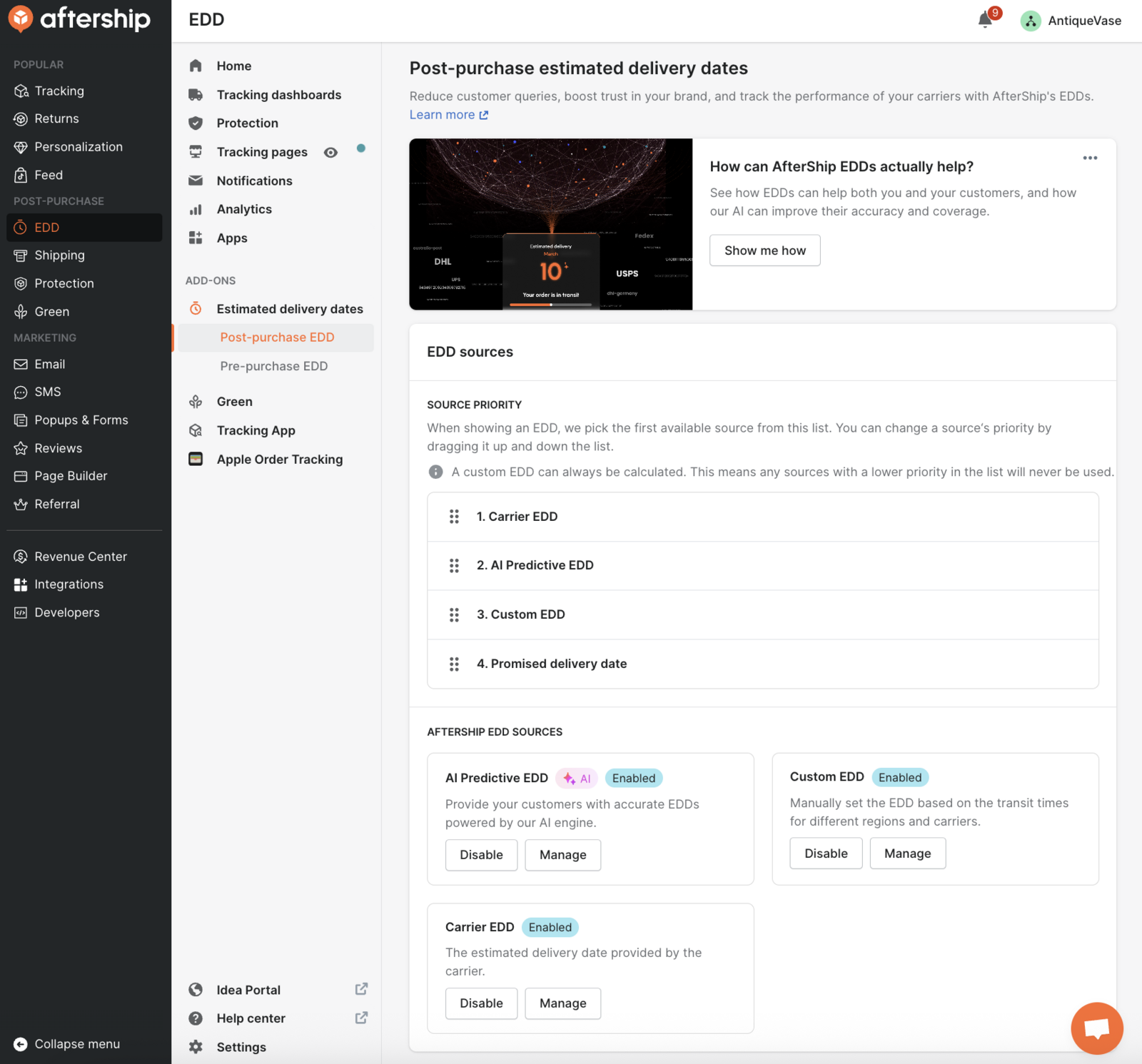
The delivery-date engine is trained on 11B+ shipments and reaches up to 95% EDD prediction accuracy, covering 80%+ of deliveries, against under 40% coverage from most carriers' own estimates.
AfterShip shows a carrier-sourced delivery date on every plan, including Free, and upgrades it to an AI-modeled delivery window calibrated to your lane performance from the Premium plan up. Its pre-purchase delivery date — on product, cart and checkout pages — is included from Premium up. Loop's equivalent, Delivery Promise, sits on Loop's top Order Tracking tier, Plus, at $449 a month.
Switching to AfterShip does not cost you your Klaviyo post-purchase flows. AfterShip Tracking integrates with Klaviyo at the flows-and-events layer (Basic and Advanced), so your shipment triggers — confirmed, in transit, out for delivery, delivered, exception — keep firing your Klaviyo automations, now powered by deeper, more accurate tracking data. The Advanced integration requires Premium or above, and the events land where Klaviyo's post-purchase flow documentation expects them.
The real difference is the unified post-purchase platform. With AfterShip, Shipping, Tracking, Returns, Warranty, Order Edits and more all run on one organization with shared delivery data connecting the full post-purchase journey. So a return is scored against the delivery history that generated the WISMO ticket, driving deeper analysis to improve performance. See how AfterShip compares with Loop.
Multi-store setups are a plan-placement question on both platforms. On Loop, multi-store means separate accounts and context-switching at every tier. On AfterShip, a two-store brand starting on Premium manages each store's tracking separately, and running several storefronts from one AfterShip organization — multiple brands, regions and teams, each with their own workspace and reporting across all of them — comes with the Enterprise plan.
Pricing is a volume slider, not a flat ladder. Essentials starts at $11 a month for 100 shipments; at 500 shipments it is $35, with Premium at $70 ($29 and $59 on annual billing). At 2,000 shipments, Essentials is $109 and Premium $239.
Best for: teams looking to unify post-purchase across CX, operations, and shopper experience on one connected platform and data layer.
Case study callout: "How Dr. Squatch achieved 94% EDD accuracy and 32% tracking page CTR with AfterShip" — 94% on-time EDD accuracy across 99.98% of orders, a 31.89% tracking page CTR, and $32,978 in Q1 2026 revenue attributed directly to the branded tracking page.
2. Malomo (now part of Redo) — Best for marketers living in Klaviyo
Malomo is the closest thing to a like-for-like Wonderment replacement, and it earns that honestly. Built for marketers who think in flows and segments, it treats the tracking page as a merchandising surface, ships pre-built Klaviyo flows, and integrates directly with Attentive, Postscript and other ESPs. If retention rather than operations owns your post-purchase programme, it will feel familiar fast.
It also followed the same path Wonderment did: Malomo became part of Redo on 19 January 2026 and still sells under its own brand. Published plans start at $49 a month for 1,000 shipments; Redo separately publishes order tracking at $0.08 per tracked order. More on what the Redo acquisition means for Malomo.
The limitation is the one that pushes brands off Wonderment. It is a notification layer, and a good one, but the carrier-level history and exception normalization you need to manage delivery performance is not what the product is for.
Best for: Klaviyo-centric retention teams wanting a tracking page that markets.
3. Narvar — Best for enterprise compliance and scale
Narvar is the incumbent enterprise procurement teams already know, and for a global retailer with security reviews and regional entities, that familiarity has value. Narvar Promise advertises 95%+ delivery date accuracy; Narvar Notify advertises 40+ purpose-built messages.
Two things before budgeting. Promise and Notify are sold separately, so delivery dates and messaging are two line items. And Narvar publishes no pricing: every number comes from a sales conversation. The only attributable public cost signal is G2's reviewer comparison data, which reports Narvar as more expensive than AfterShip; that is the reviewers' comparison, not ours.
The Shopify footprint is thin: Narvar publishes one app, a returns app with 18 reviews, and its tracking products are not sold through it. Enterprise capability, bought through an enterprise motion rather than an install.
Best for: large retailers needing compliance scale more than speed.
4. CWILL Order Tracking (formerly ParcelPanel) — Best budget option for Shopify
Be clear about this one: it is not a weak product. CWILL Order Tracking holds 5.0/5 from 2,878 reviews and carries the Built for Shopify badge, as does AfterShip; Loop Tracking does not. Its Essential tier is $11 a month for 200 orders, the same entry price as AfterShip Essentials at double the quota, and pre-purchase delivery dates arrive on its $59 plan for 2,000 orders. For a brand under a few hundred orders a month, it is a genuinely good answer.
The trade-off we can defend is platform scope, not quality. There is no returns, shipping or warranty layer on the same data, so as you grow the architecture becomes the constraint rather than the product: returns in a second tool, shipping in a third, no shared delivery history. You outgrow it structurally, not because it stopped working.
Best for: cost-sensitive Shopify brands needing tracking and nothing beyond it.
5. Route — Best for brands prioritizing package protection
Route, Protection and Tracking by RouteApp LLC is a different category wearing a similar label: free to install, 4.1/5 from 330 reviews, 4.5/5 from 114 on G2, and its own G2 categories are Shipping Insurance and E-Commerce Tools, not Package Tracking.
If lost and damaged parcels are your dominant post-purchase cost, that model can pay for itself. Two trade-offs come with it. A third-party consumer brand enters the post-purchase surface most DTC teams want to own. And Route's revenue comes from protection sold to shoppers rather than from the tracking product, so it is reasonable to expect the tracking experience to develop in service of that.
Best for: brands whose biggest post-purchase leak is claims, not WISMO.
Wonderment Alternatives Compared at a Glance
| Criterion | AfterShip | Malomo (Redo) | Narvar | CWILL Order Tracking | Route | Loop Tracking (ex-Wonderment) |
|---|---|---|---|---|---|---|
| Core function | Post-purchase data platform | Notification layer | Enterprise post-purchase suite | Shopify tracking point solution | Shipping protection + tracking | Notification layer inside a returns platform |
| Delivery date, post-purchase | All plans (carrier-based); AI-modeled from Premium | Not published | Narvar Promise, sold separately | Post-purchase EDD, from the $11 plan | Listed app feature; tier not published | Yes |
| Delivery date, pre-purchase (product/checkout) | Premium and Enterprise | Not published | Narvar Promise, sold separately | Pre-purchase EDD, from the $59 plan | Not published | Delivery Promise, Plus $449/mo |
| Published accuracy figure | Up to 95%, covering 80%+ of deliveries | Not published | 95%+ (Narvar Promise) | Not published | Not published | >90% (Loop Promise page) |
| Klaviyo integration | Basic + Advanced (Advanced from Premium) | Direct ESP integration, pre-built flows | Listed integration on the returns app | Listed integration, from the $59 plan | Not published | Listed integration |
| Multiple storefronts | One org, reporting across stores (Enterprise) | Not published | Enterprise contract | Not published | Not published | Separate accounts |
| Unified platform | Tracking, Returns, Shipping, Warranty in one organization, one data layer | Tracking; returns via Redo | Tracking, returns, messaging as separate products | Tracking only | Protection + tracking | Tracking and Returns as two subscriptions |
| Shopify App Store | 4.7/5 (1,302) · Built for Shopify | - | Returns app only, 4.6/5 (18) | 5.0/5 (2,878) · Built for Shopify | 4.1/5 (330) | 4.2/5 (67) · no badge |
| Entry price | Essentials from $11/mo (100 shipments); $35/mo at 500 | $49/mo for 1,000 shipments | Not published | $11/mo for 200 orders | Free to install | Starter $99/mo, up to 2,500 shipments |
Pricing and ratings verified 15 August 2026. AfterShip prices are volume-based; figures shown at the stated shipment volumes.
Why there is no carrier-count row. Published carrier figures in this category span an order of magnitude, and none is independently audited. We rank on data depth instead (direct carrier integrations and normalized delivery events), and print a carrier figure only for our own product, where we can point at the source.
The Verdict — When to Move From Wonderment to AfterShip
If Loop Tracking is doing the job (one storefront, a stable domestic carrier mix, notifications firing when they should), stay. "Our tracking app got acquired" is not on its own a reason to move.
Move when one of these becomes true, because each of them is a data problem that a notification layer cannot solve:
- You are expanding internationally and your current carrier footprint no longer covers the lanes you are selling into.
- You need a delivery date before checkout, on the product page and in the cart, and not only on the tracking page after the order is placed. On Loop, that capability is Delivery Promise on the Plus plan at $449 a month; on AfterShip it is included from Premium up.
- Delivery exceptions read differently on every carrier, and your CX team is maintaining per-carrier workarounds instead of one process.
- You are running more than one storefront and want carrier performance across the whole business in one view.
- You want tracking and returns on one data layer rather than two subscriptions with separate quotas and separate renewal dates.
The verdict: the two most-searched Wonderment alternatives are both tracking specialists folded into returns-first platforms: Wonderment into Loop in December 2024, Malomo into Redo in January 2026. That tells you where those roadmaps point. Tracking depth is accumulated, not acquired, and AfterShip's is the deepest in this comparison: 14 years of carrier data and 11B+ shipments is not a feature you bolt on. If tracking data is what your CX, retention and operations teams all act on, move to AfterShip — the platform that treats post-purchase data as the product rather than the on-ramp.
Frequently Asked Questions
What is the best alternative to Wonderment for Shopify?
For scaling Shopify brands, AfterShip. It combines direct carrier integrations with a standard set of delivery statuses, shows a carrier-sourced delivery date on every plan including Free, and runs tracking, returns, shipping and warranty in one organization on one data layer. Cost-sensitive brands under a few hundred orders a month should look at CWILL Order Tracking instead.
Is Wonderment now called Loop Tracking?
Yes. Loop announced its acquisition of Wonderment on 10 December 2024, and the product is now sold as Loop Tracking. Loop Tracking and Loop Returns remain two separate subscriptions, each with its own quota and renewal.
Is Malomo owned by Redo?
Malomo became part of Redo on 19 January 2026 and continues to sell under the Malomo brand. Published Malomo plans start at $49 a month for 1,000 shipments, and Redo separately publishes order tracking at $0.08 per tracked order.
AfterShip vs Malomo: which is better for tracking?
Malomo is the stronger fit for Klaviyo-centric retention teams who want the tracking page to work as a marketing surface. AfterShip is the stronger fit when operations needs the same data: broader direct carrier integrations, normalized exception handling, and delivery-date modeling trained on 11B+ shipments at up to 95% accuracy across 80%+ of deliveries.
Which Wonderment alternatives show a delivery date before checkout?
AfterShip shows a pre-purchase delivery date on product, cart and checkout pages from the Premium plan up. Loop's equivalent, Delivery Promise, sits on Loop's top Order Tracking tier, Plus, at $449 a month. Narvar offers it through Narvar Promise, sold as a separate product with no published pricing.