You have had the demos. You have the feature grids. What you do not have is a number, and that is not an accident.
Anyone weighing Malomo vs Narvar for a Shopify Plus brand is really weighing two go-to-market strategies. Malomo is Redo's tracking product, acquired by Redo in January 2026, and it now arrives attached to a portfolio Redo gives the merchant for free. Narvar sells post-purchase as separately named products and publishes no price for any of them. Both compete in the wider field of branded tracking apps for Shopify.
Both will show you a tracking page. Neither will hand you a number you can put in a budget.
At 5,000 to 50,000 orders a month, the tracking page is not what decides this. The commercial model is: who pays, what gets published, and what the bill does when your volume triples.
The Short Answer
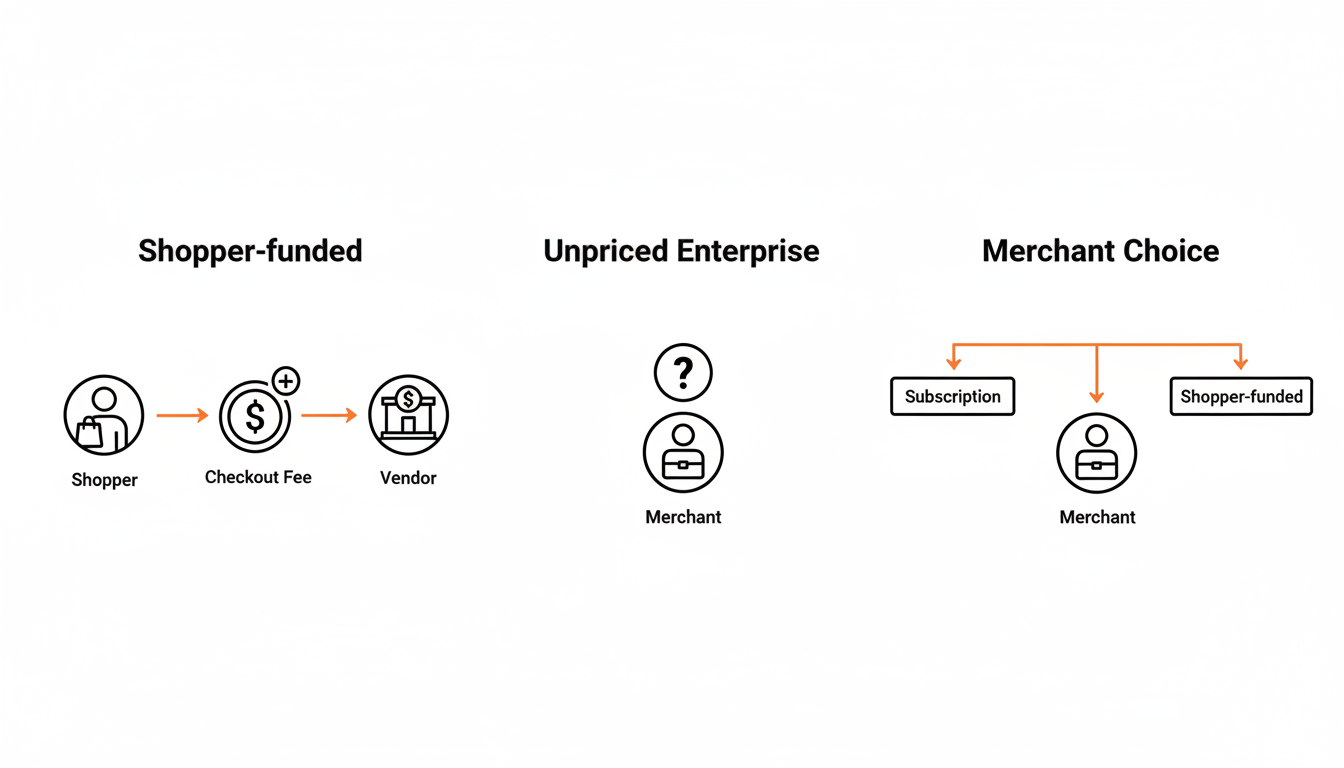
Three vendors, three ways of getting paid.
- Malomo, now part of Redo. A fixed monthly subscription to the merchant, sold beside a returns portfolio the merchant gets free because the shopper pays a fee at checkout.
- Narvar. Separately named post-purchase products with no published price at any volume. Your number arrives after a sales cycle.
- AfterShip. A published pricing ladder with a named volume where quoting begins, and the only one of the three that sells both a merchant-paid subscription and a shopper-funded option.
Your evaluation is not wrong. Feature grids are how this category gets sold, and both vendors have built good ones. But you still have no number, for two different reasons: Malomo publishes tiers that stop below where you start, and Narvar publishes nothing at any volume. Only one of those is opacity.
Malomo and Narvar, Head to Head
Both of these products are good at something specific, and it is worth being precise about what.
Malomo's strength is the ESP. Its integration recipes run across five email and SMS platforms, and a brand running its post-purchase messaging inside one of them will find that depth hard to replicate. Since the acquisition it also arrives with Redo's returns, warranties and shipping already sold alongside it.
Narvar's strength is operating history. It has the longer record with large retailers, several of them on Shopify, and its own track product page advertises a self-serve tracking page editor.
Narvar publishes no price on any public surface. That is a fact about how they sell, not a criticism of what they sell.
AfterShip is not an email marketing platform. AfterShip Email and SMS are post-purchase and transactional, driven by tracking events and the tracking page, and they do not replace a general ESP. A brand whose entire post-purchase strategy lives inside its ESP will find Malomo's recipes deeper.
What AfterShip puts up instead is tracking, returns and delivery estimates running on one platform, with a published price attached to them.
These five criteria are the ones that actually decide it at your volume.
| Criteria | Malomo (Redo) | Narvar | AfterShip |
|---|---|---|---|
| Shopify Plus depth | Built as a Shopify tracking product, now sold inside Redo's portfolio. Multi-store and market-localisation specifics not publicly documented. | Runs post-purchase across systems that reach past Shopify. Shopify-specific multi-store depth not publicly documented. | Multiple Shopify stores connect to one AfterShip account. Tracking pages localise by market across 34 languages. Post-purchase surfaces run through Shopify's order-status page. |
| Tracking and CX | Integration recipes across five email and SMS platforms. Publishes a carrier total measured differently from a native integration count. | Advertises a self-serve tracking page editor on its own track product page. Publishes a carrier total measured differently from a native integration count. | 1,700+ native carrier integrations. Email and SMS notifications for shipment milestones from AfterShip Tracking Essentials. Tracking page logo and colours at AfterShip Tracking Essentials; layout control, custom CSS, custom statuses, multiple pages and your own domain at AfterShip Tracking Premium. |
| Returns: native capability and who funds it | Redo lists Returns, Claims, Warranties, Shipping and Reclaim as free to the merchant and states it covers the cost of return labels (Redo's pricing page, read 14 August 2026). The portfolio is free to the merchant because the fee lands on the shopper at checkout. | Returns app lists as Free on the Shopify App Store. Narvar publishes no price for the platform it leads into. | AfterShip Returns runs on the same data layer as Tracking, so return windows anchor to verified carrier delivery events. Sold as a merchant-paid subscription, with a shopper-funded option available. The merchant chooses the model. |
| Platform scope | Tracking, plus Redo's returns, claims, warranties, shipping and reclaim. | Separately named post-purchase products spanning tracking, delivery estimates, returns and customer support. | Tracking, Returns and AI EDD on one platform and one data layer, with Warranty available on AfterShip Returns Premium. |
| Commercial model and TCO | Two separate offers from the same owner. Malomo's own subscription tiers: Lite $49/mo for 1,000 shipments, Starter $189/mo for 4,000, Growth from $400/mo (Malomo's pricing page, read 14 August 2026). Redo Order Tracking is priced separately at $0.08 per tracked order (Redo's pricing page, read 14 August 2026), which scales linearly with volume. | No published price at any volume, on any public surface (Narvar's site, read 14 August 2026). The number arrives at the end of a sales cycle. | Published ladder to 5,000 shipments a month: AfterShip Tracking Essentials $239/mo, AfterShip Tracking Premium $579/mo on monthly billing; $199 and $479/mo on annual billing. Above that the page switches to Custom and Contact sales. At higher volumes AfterShip Tracking is custom-quoted at this volume (AfterShip Enterprise): volume-based pricing with a dedicated CSM, SLA and multi-store management. |
What Each Model Actually Costs You
Three vendors, three funding models. Here is what each one does to a budget at your volume.
Redo prices order tracking at $0.08 per tracked order (Redo's pricing page, read 14 August 2026). That number is linear. Ten times the volume is ten times the bill, with no volume relief written into the published rate.
Malomo's own tiers are a different offer from the same owner, and the two should not be read as one. Malomo sells a fixed monthly subscription: Lite at $49 a month for 1,000 shipments, Starter at $189 a month for 4,000 shipments, and a Growth plan from $400 a month above that (Malomo's pricing page, read 14 August 2026). Which of the two commercial offers a new buyer signs in 2026 is documented on no public surface.
Narvar publishes nothing at any volume. Your number arrives at the end of a sales cycle, after you have already spent the calendar time to get it.
AfterShip Tracking pricing is published on a ladder you can read before you take a call. At 5,000 shipments a month that is AfterShip Tracking Essentials at $239 a month on monthly billing, or AfterShip Tracking Premium at $579 a month on monthly billing, with annual billing bringing those to $199 and $479 a month (AfterShip's pricing page, read 14 August 2026). Above that the page switches to Custom and Contact sales. At 20,000 and at 50,000 shipments a month AfterShip Tracking is custom-quoted at this volume (AfterShip Enterprise): volume-based pricing with a dedicated CSM, SLA and multi-store management.
One caveat before you take those figures to a spreadsheet. Your operation is measured in orders a month and the pricing slider counts shipments a month, so a brand at 5,000 orders will usually sit a stop higher than it expects. The published ladder reaches the floor of your range exactly. Most of your range is quoted.
Free returns software is not free. It is funded by a fee charged to your shopper at checkout.
Redo lists Returns, Claims, Warranties, Shipping and Reclaim as free to the merchant, and states that it covers the cost of your return labels (Redo's pricing page, read 14 August 2026). The portfolio is free to you because the fee lands on your shopper at checkout. Narvar's returns app lists as Free on the Shopify App Store, and Narvar publishes no price for the platform it leads into. Either way the software has a payer. With Redo it is your customer. With Narvar it is you, at a number you cannot see yet.
Count that cost properly and it stops looking like zero. A checkout fee is a conversion cost and a brand-trust cost, and a variable shopper fee is harder to forecast than a fixed line in a budget. The objection here is not revenue share as a category, because AfterShip sells a shopper-funded option too. It is that the other two each give you one model to take or leave.
AfterShip sells Returns as a merchant-paid subscription, and a shopper-funded option is available alongside it. You pick which one your shoppers experience.
What that choice buys, beyond the funding question, is one vendor, one integration and one data layer across tracking and returns.
The Platform Case for Shopify Plus
Running tracking with one vendor and returns with another means two integrations, two data models and two shopper experiences to keep in step. It also means the delivery clock and the returns clock are set by different systems.
On one platform they are set by the same system. AfterShip Returns reads from the same data layer as Tracking, so return windows anchor to verified carrier delivery events rather than the date the order was placed. A shopper whose parcel arrives a week late does not quietly lose a week of their return window.
For a Shopify Plus operation, that consolidation shows up in three concrete places. Multiple Shopify stores connect to one AfterShip account. Tracking pages localise by market across 34 languages (AfterShip help centre, 25 June 2026). Post-purchase surfaces run through Shopify's order-status page, rather than through checkout scripting that Shopify has deprecated.
Mous cut WISMO tickets by 54% with AfterShip Tracking (aftership.com/customers, read 14 August 2026).
Two other names on that page carry different kinds of proof. Chris Ormonde, Operations Director at Gymshark: "AfterShip has allowed Gymshark to grow our carrier network and enabled Gymshark's customer service team to have full visibility on all customer orders in one easy-to-use platform." Mejuri runs four AfterShip products at once: Tracking, Returns, AI EDD and Warranty.
What these three establish is straightforward: tracking, returns, delivery estimates and warranty run on one vendor, and you can verify that before you sign anything.
Branded Tracking That Cuts WISMO
AfterShip Tracking runs on 1,700+ native carrier integrations, counted as carriers it integrates with directly. Check that list against your own carrier mix before you sign. The question that decides coverage at your volume is narrower than a headline total: whether your regional carriers, your international lanes, and the last-mile partners your 3PL hands off to are each natively integrated, because those are the shipments that go dark.
Email and SMS notifications for shipment milestones start at AfterShip Tracking Essentials.
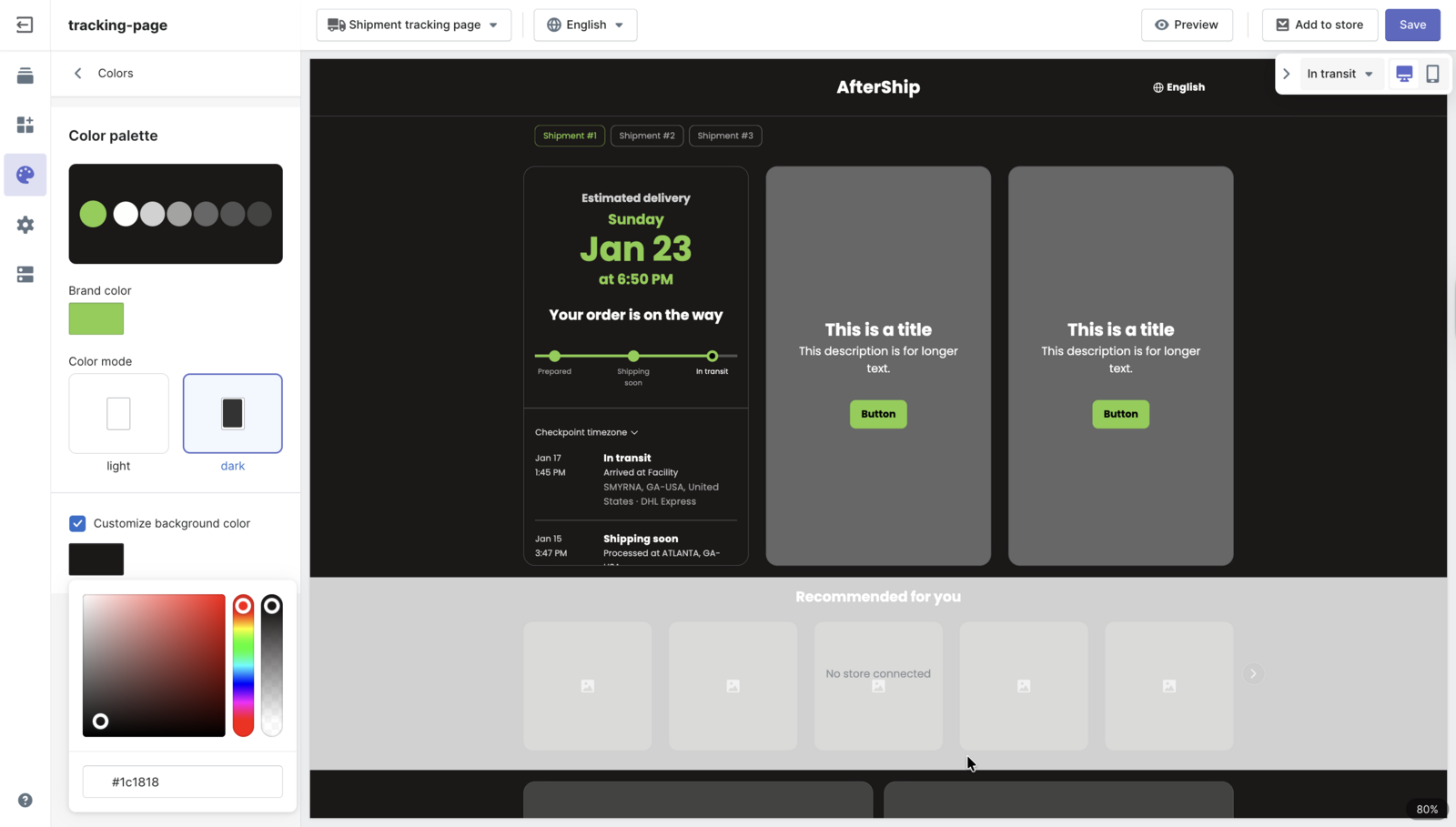
The tracking page is editable by the merchant. Logo and colours come with AfterShip Tracking Essentials. AfterShip Tracking Premium adds layout control, custom CSS, custom shipment statuses, multiple branded pages and your own domain.
StackCommerce reduced WISMO tickets by 71% with AfterShip Tracking (aftership.com/customers, read 14 August 2026).
The Problems You Will Have Next Quarter
Tracking answers the question your shopper asks first. Two more arrive behind it, and both cost more to solve late.
The first is returns volume. At your scale the decisive part sits underneath the portal, in the rules that decide which requests clear on their own and which reach a person.
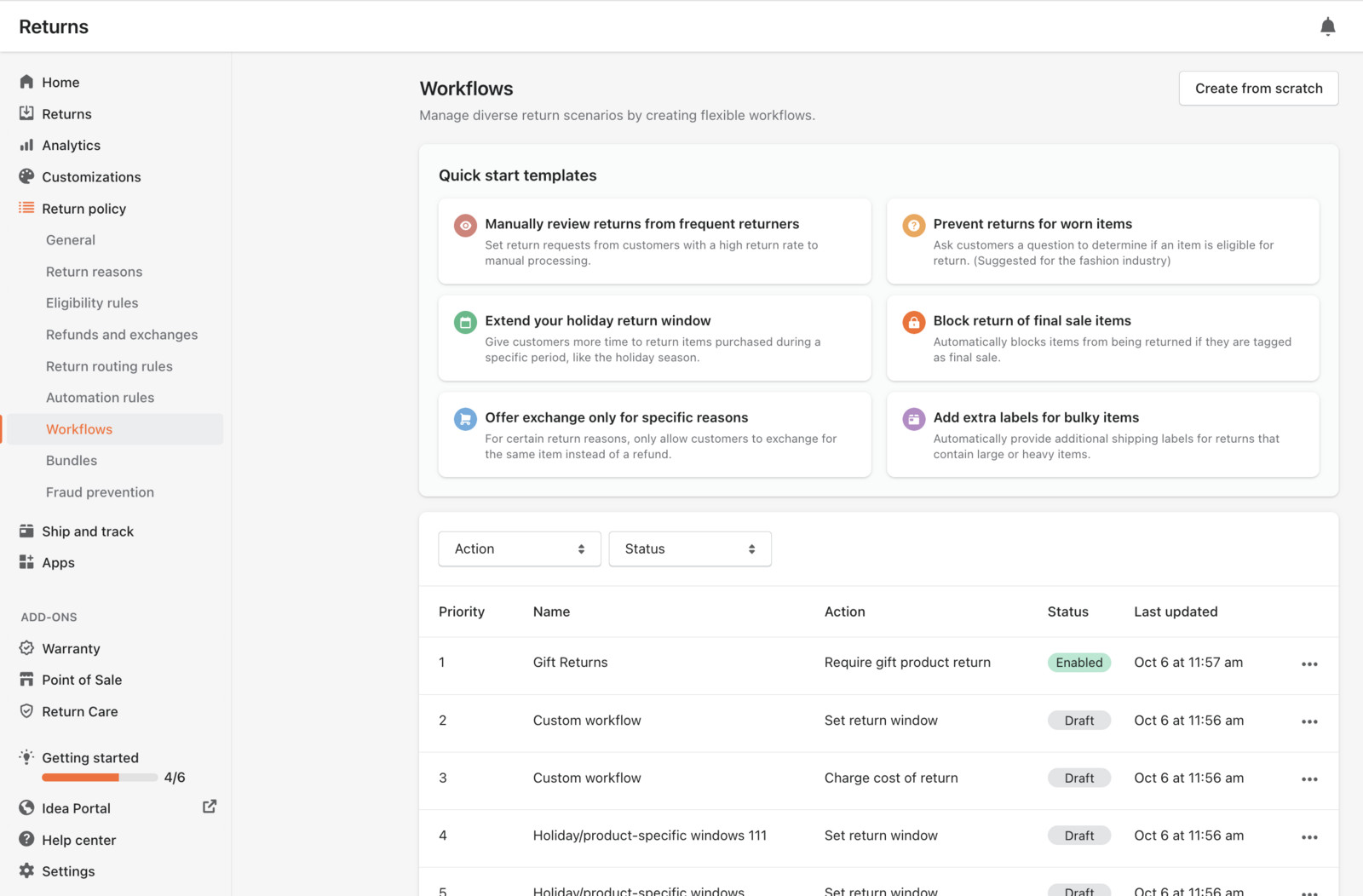
- Auto-approval switched on per return zone and per return shipping method, so requests that meet your policy clear without a queue.
- Conditional workflows keyed on conditions including return request reason, customer tags, order value and product type, available on AfterShip Returns Premium and Enterprise.
- Resolutions set per workflow: refund to the original payment method, refund to store credit with optional bonus credit, variant exchange, and Shop now.
How that compares against Loop and Narvar on the returns side is covered in a unified returns and tracking experience.
The second is the delivery date you show before the order exists. AfterShip AI EDD covers at least 80% of deliveries, while most carriers typically offer predictions on less than 40%, a figure published on how AfterShip predicts delivery dates. It is available on AfterShip Tracking Premium and above.
The estimate appears on the product and cart pages, while the shopper is still deciding. A date shown at that moment can change whether the order happens at all.
Final Verdict for Shopify Plus in 2026
Three routes, all written for a Shopify Plus brand doing 5,000 to 50,000 orders a month.
- Choose Malomo and Redo if you want your returns programme funded by a fee on your shopper, and either Redo's per-order tracking rate or Malomo's subscription tiers fit the volume you are heading toward.
- Choose Narvar if you have the procurement runway for an unpriced enterprise cycle, and your post-purchase has to run across systems that reach past Shopify.
- Choose AfterShip if you want a published price, one data layer across tracking and returns, and the choice of who pays for the returns programme.
Each of those is a real operating model. The one that survives a budget review is the one whose numbers you can read before the call.
Proactive shipment tracking that reduces WISMO tickets and improves your delivery performance.
Book a demoMalomo vs Narvar: Frequently Asked Questions
Which is better for Shopify Plus, Malomo or Narvar?
It depends on the commercial model you want to sign. Malomo publishes subscription tiers and arrives as Redo's tracking product, alongside a returns portfolio the merchant gets free because the shopper pays a fee at checkout. Narvar publishes no price at any volume and suits a brand with the procurement runway for an enterprise cycle and systems reaching past Shopify.
How much does Malomo cost after the Redo acquisition?
Malomo publishes fixed monthly subscription tiers on its own pricing page. Redo separately lists Order Tracking on a per-tracked-order rate. They are two different commercial offers from the same owner and should not be read as one, and no public surface documents which one a new buyer signs.
Does Narvar publish pricing?
No. Narvar publishes no price for its post-purchase products on any public surface, at any volume. A brand evaluating Narvar gets its number at the end of a sales cycle rather than before one.
Is AfterShip a good alternative to Malomo and Narvar?
For a Shopify Plus brand at this volume, yes. AfterShip publishes a pricing ladder you can read before taking a call, runs tracking, returns and AI delivery estimates on one platform and one data layer, and sells returns as either a merchant-paid subscription or a shopper-funded option, so the merchant decides who pays.