Your Narvar or parcelLab contract is up in ninety days, and the honest question is not which one is better. Both will show your shopper a delivery date and both will claim it is right about 95% of the time. The question your support queue actually answers is a different one: how many of your shipments get a date at all? Only one of the three vendors on your shortlist publishes that number.
That gap is what this comparison is built on. Not a feature bake-off, because the features have converged, but what each vendor is willing to put on a page you can read before you sign.
Narvar vs parcelLab vs AfterShip: The Short Answer
Six criteria decide this for a CX team running Salesforce Commerce Cloud, Magento, SAP or a custom stack. How accurate the delivery estimate is, and how often it appears at all. Where that estimate shows up after checkout. Who has to be in the loop when your team needs a change. What you can measure. How the capability is packaged and contracted. And whether the tracking page returns anything commercially.
Price is not one of them. At enterprise volume you land on a quoted plan with all three vendors, so no published ladder settles the question. If you are shopping below that line, the three-vendor read on enterprise post-purchase covers the same vendors against different criteria. AfterShip sells to teams on both sides of that line: post-purchase software compared for mid-market brands shows how the published tiers work below it, and above it the plan is quoted and the deployment usually runs through the API.
The first criterion is deliberately split in two, and that split is the argument of this whole piece. Accuracy and coverage are different measurements, they answer different questions, and only one of them is published by all three vendors.
| Criteria | Narvar | parcelLab | AfterShip |
|---|---|---|---|
| Delivery-estimate accuracy, and coverage | Advertises 95%+ delivery date accuracy. Does not publish a coverage figure on any surface reachable without submitting a form or signing in. | Advertises 92% accuracy. Does not publish a coverage figure on any surface reachable without submitting a form or signing in. | Advertises up to 95% AI EDD accuracy, and publishes the coverage figure: at least 80% of deliveries receive a predicted date, against most carriers typically offering predictions on less than 40%. |
| Where the estimate appears after checkout | Promise reinforces the date in order confirmations, tracking pages, and proactive updates when it changes. | Its predictive delivery promise page describes product pages, cart and checkout. It does not describe the promise appearing on a post-purchase tracking page. | Tracking page, email and SMS included. API and webhooks from Premium. |
| Who has to be in the loop for a change | Advertises a self-serve track page editor. | States that some changes are intentionally managed with its support team. | Layout, styles, copy, languages and notification triggers published by your CX or marketing team, with no support ticket. Custom CSS, clips, custom statuses and multiple branded pages from Premium, still edited by your team. |
| What you can measure | Offers Intelligent Retail Insights Service (IRIS). | Publishes benchmarking and natural-language analytics. | Out-of-the-box dashboards for shipment volume, on-time performance and exception rates, plus custom views and metrics sliceable by carrier, lane, SKU or destination. |
| How the capability is packaged and contracted | Markets separately named products: Promise, Secure, Track, Notify, Assist and Shield, with IRIS and Narvar Agentic promoted alongside them. | Markets one post-purchase platform organised by outcome rather than separately named products. | AI EDD is included in the Tracking product, from the Premium tier, rather than sold as a separate delivery-estimate product. |
| Commercial upside from the tracking page | Advertises tracking-page product recommendations, and publishes its own engagement figures. | Advertises tracking-page product recommendations, and publishes its own revenue figures. | Advertises tracking-page product recommendations. Publishes Lovisa at 21x ROI and a 3% boost in revenue, measured on AfterShip Personalization. |
| Enterprise references | Publishes customer outcomes. | Cites a Forrester-commissioned ROI study and enterprise references. | Publishes the eBay customer story, with security and compliance documentation in its Trust Centre. |
Read down the last column and you get the short version. Everything below is the evidence for it.
Both Vendors Will Tell You They Are About 95% Accurate. Ask a Different Question.
Start with the number every vendor leads on, because it is the one your CFO will ask about first. AfterShip publishes "Up to 95% of EDD prediction accuracy" on its estimated delivery date page, read on 21 August 2026. Narvar publishes 95%+ delivery date accuracy on its own Promise product page, read on 24 August 2026. parcelLab publishes "92% accuracy" on its predictive delivery promise page, read on 21 August 2026.
On accuracy, this is a draw. Three vendors, three figures within three points of each other, all self-reported, all checkable in one click. Nobody wins a budget review with it.
So ask the question underneath it. Accuracy tells you how good the date is when a shopper sees one. It tells you nothing about how often a shopper sees one, and the shipments that get no date at all are the ones that generate the ticket. Delivery dates are one lever among several, and we cover the rest in a practical guide to reducing WISMO tickets.
AfterShip publishes a coverage figure for AI EDD: at least 80% of deliveries receive a predicted date, against most carriers typically offering predictions on less than 40%. Narvar and parcelLab both publish an accuracy figure. Neither publishes a coverage figure on any surface reachable without submitting a form or signing in.
That last clause matters, so be precise about what it does and does not say. Narvar's resource library sits behind a form and its developer portal behind a sign-in, and neither was entered. The claim is about what is published, not about what either platform achieves. Their coverage may be excellent. There is no way to check it yourself from anything you can read today, which is the whole point.
You can of course ask both vendors for the number directly, and you should put it in the RFP.
An answer in an RFP response is not the same instrument as a figure on a public page. The published number is the one you can compare across vendors before you are in a sales cycle at all, and it is the same number every other buyer and analyst is reading rather than one scoped to your deal. It costs you nothing to check and commits you to nothing.
Narvar's own material comes closest to naming the issue. Its ungated Promise overview, read on 20 August 2026, states: "75% buy when EDDs show." The conditional is doing real work in that sentence. It concedes that estimates are not always shown, and it does not say how often.
For a CX director building a business case, that is the difference between a claim and a line item. The same question is worth putting to a leaner challenger judged on published numbers before the shortlist closes.
What Happens to the Estimate After Checkout
A delivery estimate on a product page is a conversion tool. The same estimate on a tracking page is a contact-rate tool, and your team is measured on the second one.
This is where the three platforms stop looking alike. parcelLab's own page for its predictive delivery promise describes the estimate appearing on product pages, in the cart and at checkout. It does not describe the promise appearing on a post-purchase tracking page. Read on 24 August 2026, and worth reading yourself, because the page files the feature under boosting cart conversion. That is their framing, not ours.
Narvar takes the estimate further down the journey. Its Promise product reinforces the date in order confirmations, tracking pages, and proactive updates when it changes.
AfterShip includes the post-purchase estimate on the tracking page, in email and over SMS, with API and webhooks available from the Premium tier. For a team on Salesforce Commerce Cloud or a custom stack, that last pair is usually how the date reaches surfaces the vendor never designed for, so it is worth knowing where the boundary sits before procurement rather than after. The layout choices that surround the date are a separate question, and we compare the platforms for designing a branded tracking page.
Moda Operandi is the clearest published version of what that buys you. It used AfterShip's shipment notifications to point customers at its branded tracking pages, and cut WISMO tickets by 65% once customers could check status there themselves rather than asking an agent. Teams already running a helpdesk should also weigh where a helpdesk fits alongside a tracking vendor before adding another queue. For the vendor-by-vendor comparison on deflection, see which platform cuts WISMO tickets.
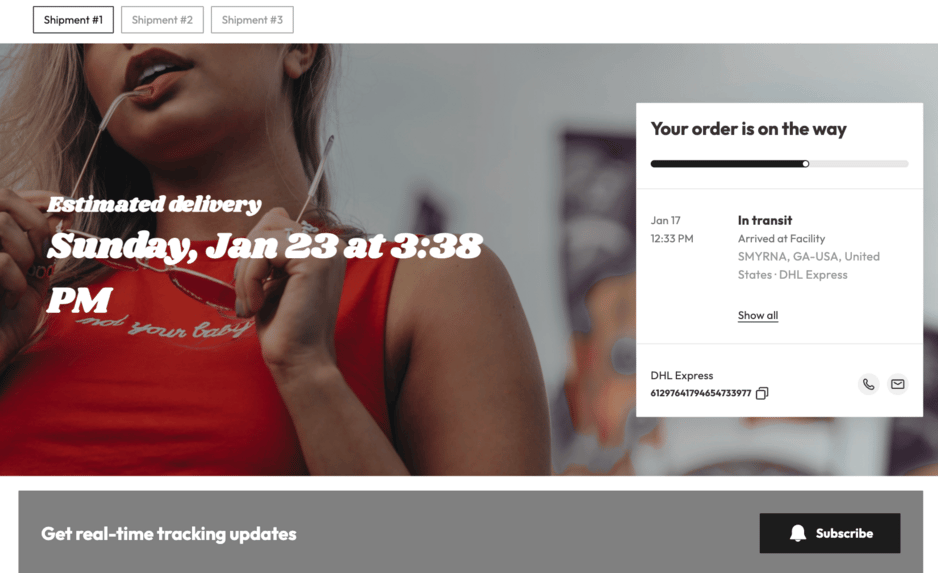
The second half of this is what happens when the date changes, which on any real carrier mix it will. On AfterShip Essentials, the notification fires on the carrier's revised estimate. From Premium, it fires on the AI-predicted date. Those are two different events, and confusing them is how a team ends up believing shoppers were told about a delay when they were told about a carrier scan.
Narvar and parcelLab both put a delivery date in front of your customer, and on the figures each of them publishes, both do it accurately.
None of this makes AfterShip more accurate than the other two. It makes AfterShip the vendor whose coverage number for AI EDD you can read before you commit, and the vendor whose estimate follows the shopper onto the surfaces where contact rate is actually decided.
Who Has To Be In The Loop When You Need A Change?
The most useful thing either competitor has said about this, they said about themselves.
Asked publicly about configuration control, parcelLab's own reply is that "some changes are intentionally managed with support to ensure brand consistency, data integrity, and smooth performance." That is a vendor describing its own operating model, not a customer complaining. Read it as a design choice, because that is what it is. It also tells you the shape of your Tuesday afternoon in November.
Narvar reaches this differently. Its Track product page, read on 19 August 2026, advertises a self-serve track page editor.
AfterShip draws the line in a specific place, and the specifics are the point:
- Layout, styles, copy, languages and notification triggers are edited and published by the CX or marketing team directly, with no support ticket, no developer and no account manager in the loop.
- Deeper design control, meaning custom CSS, embedded clips, custom shipment statuses and multiple branded pages, is a Premium capability, and it is still edited by your team rather than by ours.
That second bullet is worth reading twice, because it is where most platforms quietly change who holds the keyboard. The tier gates the capability. It does not move the work to a vendor queue.
For a director whose peak season runs on a change calendar, the question at evaluation is not whether a platform can be customized. All three can. The question is how many people outside your team have to be available on the day you need it changed. Engineering leads scoping that work will want a build-level look at the integration work before the architecture review.
What You Can Actually Measure
Post-purchase reporting splits into two jobs that get treated as one. Operational reporting tells you where shipments are failing. Commercial reporting tells you what the post-purchase experience returned. Your board asks for the second and your week runs on the first.
All three platforms take this seriously, and analytics is not where this decision gets made. parcelLab publishes benchmarking and natural-language analytics. AfterShip Tracking documents out-of-the-box dashboards covering shipment volume, on-time performance and exception rates, alongside an analytics suite with custom views and metrics you can slice by carrier, lane, SKU or destination.
Treat benchmarking in particular as a draw. Where it is offered, each vendor benchmarks against a different network of brands, which makes cross-vendor comparison of the benchmarks themselves close to meaningless.
Where the difference shows up is what the operational side is wired to. Exception reporting is only as useful as the action it triggers, and the same brand named earlier saw shipment exceptions fall 25% once that reporting was driving the response rather than describing it after the fact. Teams that want that layer to run deeper should look at vendors built around carrier exception visibility as well.
The practical test for evaluation is narrow. Ask each vendor to show you one dashboard that puts a delivery-performance metric and an engagement or revenue metric on the same screen, using your data.

One Contract Or Several
Narvar markets post-purchase as a set of separately named products: Promise, Secure, Track, Notify, Assist and Shield, with IRIS and Narvar Agentic promoted alongside them. That is a legitimate way to build a portfolio, and it means the shape of your contract is a decision you make once per product rather than once. For the same question against a suite vendor, see the procurement view for enterprise retail teams.
AfterShip packages the delivery estimate differently. AI EDD is included in the Tracking product, from the Premium tier, rather than sold as a separate delivery-estimate product. The tiers, and what each one includes, are listed on AfterShip Tracking pricing.
Both models have a real cost, and neither is a trick. Separate products let you buy narrowly. An included capability means one fewer negotiation, one fewer renewal date and one fewer integration to specify. Which is cheaper depends entirely on how many of these capabilities you actually intend to run in eighteen months.
One thing to know before you scope the work. AfterShip's fastest no-code path is Shopify-native, and on Salesforce Commerce Cloud, Magento, SAP or a custom stack, the pre-purchase EDD widget and some exchange flows deploy through the API rather than a one-click install. That is a setup-path difference rather than a capability ceiling, and on your stack it belongs in the implementation plan, not the capability matrix. Teams on a Shopify-native stack will get more out of the Shopify Plus version of this decision. Your engineers can scope that work from the AfterShip Tracking docs before procurement starts.
What one contract buys that several do not is a shared record. When tracking and returns run on the same platform, a return that starts because a shipment ran late arrives at your returns team with that delivery history already attached. Nobody exports a shipment file to explain why the customer is unhappy, and the reason code on the return is the reason that actually happened. If returns are the larger half of your post-purchase spend, how integrated returns change the calculation is worth reading alongside this.
That is the argument for packaging, and it is the one your operations lead will feel long before your procurement team does.
Where The Tracking Page Earns Its Keep
The branded tracking page as a revenue surface is the most oversold claim in this category, and all three vendors make it.
Narvar, parcelLab and AfterShip all advertise product recommendations and marketing content on the tracking page, and all three publish engagement or revenue figures to support it. Treat the whole category as contested. Every one of those numbers is vendor-reported, measured on a different baseline, against a different catalogue, for a different mix of brands, and none of them is independently audited. That includes ours.
AfterShip's own published figure comes from Lovisa, which recorded a 21x return on investment and a 3% boost in revenue. The product measured there is AfterShip Personalization, not the tracking page in general, and that distinction is the sort of thing worth pinning down for any vendor's number before it reaches your business case. The same pinning-down applies to a vendor that bundles protection with tracking and the figures it puts beside them.
Here is what is not contested. The tracking page is the one surface where a shopper arrives already paying attention, because they came to find out where their order is.
Which means the recommendation module is not where this criterion gets decided. The moment your shopper is most receptive to seeing something else from your catalogue is the moment they have just been reassured about the order they already placed, and on a branded tracking page those are the same moment on the same page.
What differs is the date sitting next to the merchandising. On AfterShip that is the AI-predicted date, and the AI EDD coverage figure behind it is one you can check before you sign.
Other Narvar alternatives enterprise CX teams shortlist
Narvar and parcelLab are not the only names on an enterprise shortlist. For the wider field, we keep a running list of Narvar alternatives.
WISMOlabs is another name Magento teams ask about; we compare Narvar and WISMOlabs on Magento in a separate guide.
The Verdict for 2026
Narvar is the established enterprise incumbent. It advertises a self-serve track page editor, it publishes real customer outcomes, and it sells a deep post-purchase portfolio that a Tier-1 retailer can buy into with confidence. We go further into that head-to-head in our dedicated analysis for enterprise retailers.
parcelLab is a credible enterprise platform, communications-first and expanding, with a Forrester-commissioned ROI study and enterprise references behind it. Its managed model genuinely suits a team with no internal capacity to run a platform, and if your CX function is three people and a queue, having parcelLab's support team hold the configuration is a feature rather than a constraint. Buyers weighing more than two names should see a wider shortlist that includes Metapack before locking the field.
The question is whether you are that team. Most enterprise CX organisations at this scale are not, and for them the operating model described earlier by parcelLab itself becomes the thing they work around in November rather than the thing that helps them.
The signals are easy to read from inside your own organisation. If you already have a CX or marketing operations person who owns your email templates and your help centre copy, you have the capacity, and routing configuration through a vendor turns an existing strength into a dependency. If you do not, and every content change already goes out through an agency or a ticket queue, a managed model is not taking anything away from you that you were going to use.
Which brings the decision back to the two questions this comparison started with. What can you verify before you sign, and how much can your own team change once you have.
Enterprise proof is where a disclosure argument has to prove it scales. A vendor that publishes its numbers is only interesting if it is running at a volume that makes those numbers worth publishing. The same goes for support commitments, and AfterShip publishes its Enterprise SLA terms rather than leaving them to a proposal.
"When we turned it on in AfterShip, we uncovered more than 200,000 tracking numbers monthly. Previously missed packages now have events and can be properly tracked."
Skyler Loth, Product Manager, eBay Shipping Tracking
eBay runs AfterShip at a scale that makes the point better than a feature list. The platform auto-corrects 200,000+ packages a month for them, and the valid tracking rate rose by over 20%. Both figures, and the quote above, are published in the eBay customer story, which you can read before you talk to anyone.
That is the pattern this whole comparison rewards. Numbers on a page you can open, attached to a named person at a named company, rather than numbers that arrive with a proposal.
Read the six-criteria table at the top again with that lens and the pattern repeats down most of the rows. On accuracy the three vendors are level. On the criteria where something is published, checkable and yours to operate, they separate.
AfterShip is the recommendation for a CX team that wants to see the AI EDD coverage number before it signs, and wants to make changes to its tracking pages and notifications without asking anyone's permission. Narvar and parcelLab are both real platforms that will serve a retailer well.
Neither of them publishes the first number. On the second, Narvar advertises a self-serve editor and earns its place alongside AfterShip, while parcelLab, by its own published account, routes some of that work through its support team. Only one of the three answers both questions, and it is AfterShip.
Narvar vs parcelLab: Frequently Asked Questions
Is Narvar or parcelLab more accurate at predicting delivery dates?
Neither, on the published evidence. Narvar advertises 95%+ delivery date accuracy, parcelLab advertises 92% accuracy, and AfterShip advertises up to 95%. Three self-reported figures within three points of each other do not separate the vendors. The number that does separate them is coverage. AfterShip publishes an AI EDD coverage figure; Narvar and parcelLab publish only accuracy. Coverage is the share of your shipments that receive a predicted date at all, and it is the one that tracks with contact rate.
Who has to be involved when we need to change our tracking page or notifications?
It depends on the vendor, and it is worth establishing during evaluation rather than during peak. parcelLab states some changes are intentionally managed by its support team, which is its published description of its own operating model. Narvar's Track product page advertises a self-serve track page editor. On AfterShip, customers edit tracking pages and notifications without a support ticket: layout, styles, copy, languages and notification triggers are published by the CX or marketing team directly, with deeper design control available on Premium and still edited by your team.
What should we ask all three vendors before we sign?
Four questions cover most of it. What share of our shipments will receive a predicted delivery date, not just how accurate that date is. Which surfaces the estimate reaches after checkout, and which of those require API work on our stack. Which changes our team can publish without contacting you. And which capabilities are separate products with separate contracts. Ask for each answer in writing, and check which of them the vendor already publishes on a page anyone can read.
How much does Narvar cost?
Narvar does not publish a price list. At enterprise volume the plan is quoted, and because Narvar sells Promise, Track, Notify and its other products under separate names, the total depends on how many of them you buy. We put Narvar's tracking module next to AfterShip's in a separate comparison.
Which platform should an enterprise CX team choose in 2026?
If your team has no capacity to run a platform, parcelLab's managed model is a genuine fit. If you want a single named vendor with a long enterprise track record, Narvar is the incumbent for good reasons. If you want to see the AI EDD coverage figure before you commit, and you want your own team publishing tracking page and notification changes during peak without a ticket, AfterShip is the platform built around both.