Your outbound shipping runs itself. Returns still arrive as email threads, hand-made labels and refund decisions taken one at a time, which is why Shiptheory vs Returnly looked like the right search to run.
It was a fair search, but it has two problems. Returnly closed in 2023, and Shiptheory's returns product is built around the parcel: the portal, the rules and the label. What decides your outcome is what happens after the parcel comes back, meaning whether each return ends as a refund, an exchange or store credit, and how much of that your team still handles by hand.
What Actually Happens After a Parcel Comes Back
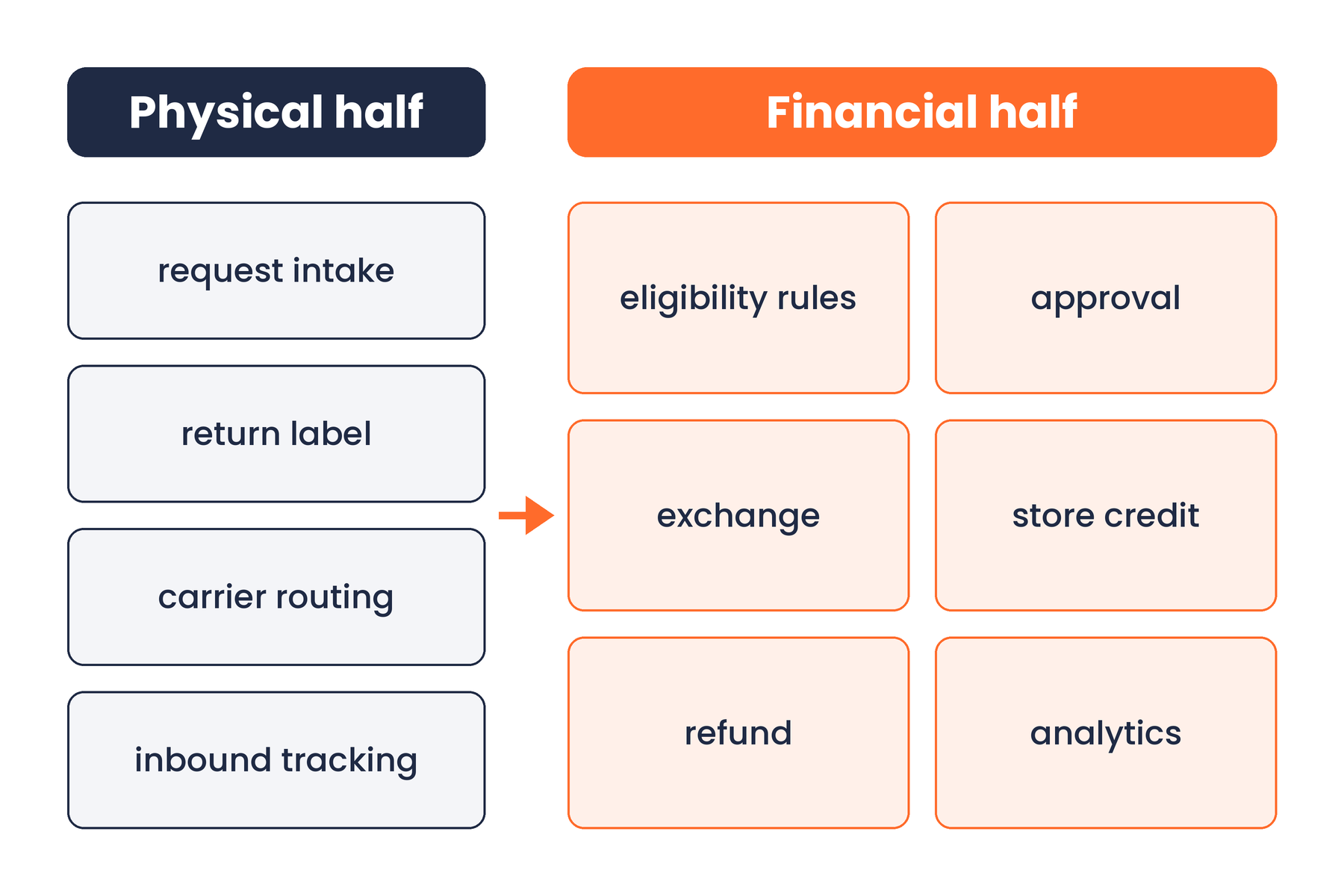
A return looks like one job from the outside. Inside your operation, it is two.
The first half is physical. A shopper asks to send something back, the request is checked, a return label is created, a carrier collects or accepts the parcel, and the parcel is tracked back to your warehouse. Each step costs staff time when it runs by hand. Outbound shipping software already books carriers and prints labels, so extending it to incoming parcels is a natural step.
The second half is financial. Once the item is on its way back, someone decides what the shopper receives: a refund, an exchange for another size or product, or store credit. Eligibility and approval rules sit on top of that decision, and the analytics built on it show you why items come back in the first place.
Returns platforms resolve refunds, exchanges and store credit, not just return labels.
Take a shopper returning shoes a size too small. A refund sends the money back and ends the sale. An exchange ships the next size and keeps it, and store credit holds the value in your store for a later order.
That financial half is where revenue is kept or lost. At 1,000 to 10,000 orders a month, the split between those outcomes matters far more than how each label was printed.
This is why a dedicated returns platform is its own category, separate from shipping software that also handles returns. For the full evaluation checklist, see a complete guide on how to choose the right platform.
What Happened to Returnly, and Why the Search Leads Here
If Returnly is the returns name you remember, your memory is accurate for its time. The search simply points at a product that no longer runs.
Returnly was a returns platform that shut down in October 2023. It was acquired by Affirm in 2021, as Affirm announced in April that year, and it was widely used by Shopify merchants. In July 2023, Affirm said it would divest the business and sunset the platform by early October, and its merchants were migrated to Loop Returns.
The platform went offline on 1 October 2023.
The name persists because parts of the web have not caught up. At least one software review listing still shows Returnly as though it were live, so it keeps turning up in comparisons like this one.
Returnly merchants did not choose the timing of their move. They had a few months to rebuild their portal, rules and policies on another platform, in the middle of normal trading.
For anyone now weighing Returnly alternatives, that history is the practical lesson. Your shortlist needs a platform that will still exist, and still be developed, at your next renewal. Ask each vendor how long its returns product has been in market, how often it ships updates, and whether returns is a core product or a side feature.
Where Shiptheory's Returns Product Stops
If you already ship outbound through Shiptheory, the obvious question is whether its returns product can take the manual work off your team. Its documented scope covers the physical half of a return.
According to Shiptheory's returns page and its help centre, the Shiptheory returns product provides:
- A branded customer portal where shoppers request returns, customisable with your logo, colours and custom CSS.
- Rules by return reason that route each return to a specific carrier and service, and can charge the shopper for some reasons. The shopper sees a booking fee you set plus a GBP 1.50 platform fee added by Shiptheory, and you reclaim the collected fees by emailing Shiptheory within three months.
- Approve and reject decisions made with the return reason, any photos the shopper attached, and the customer's order and returns history on screen.
- Return labels across its supported return carriers, including Royal Mail Tracked 24 and Tracked 48 Returns with QR code options, Evri, DPD Return to Shop and InPost.
- Monthly returns reports, downloadable as CSV.
Two plan facts apply. The Returns Shop is not included on Shiptheory's two lowest plans, and its return labels cover orders that Shiptheory already holds.
Then there is the financial half. Across Shiptheory's returns page, its help articles and its own help-centre search, no exchange, store-credit or gift-card capability is documented, and no mechanism for Shiptheory to issue the shopper's refund. In practice, your team issues each refund in your store platform and arranges any exchange by hand: a new order, a stock check and a second shipment.
That half is where the remaining manual work sits, and where each return either keeps its revenue or sends it back to the shopper.
AfterShip Returns for a UK or EU Brand
On intake, reason-based rules, approvals and UK return labels, AfterShip Returns covers the same ground. The difference is what happens once a return is approved, which is the half your team currently resolves by hand.
Shoppers start in a branded self-service returns portal that detects their language and currency automatically, on every plan. That matters for a brand selling into several European markets from one store.
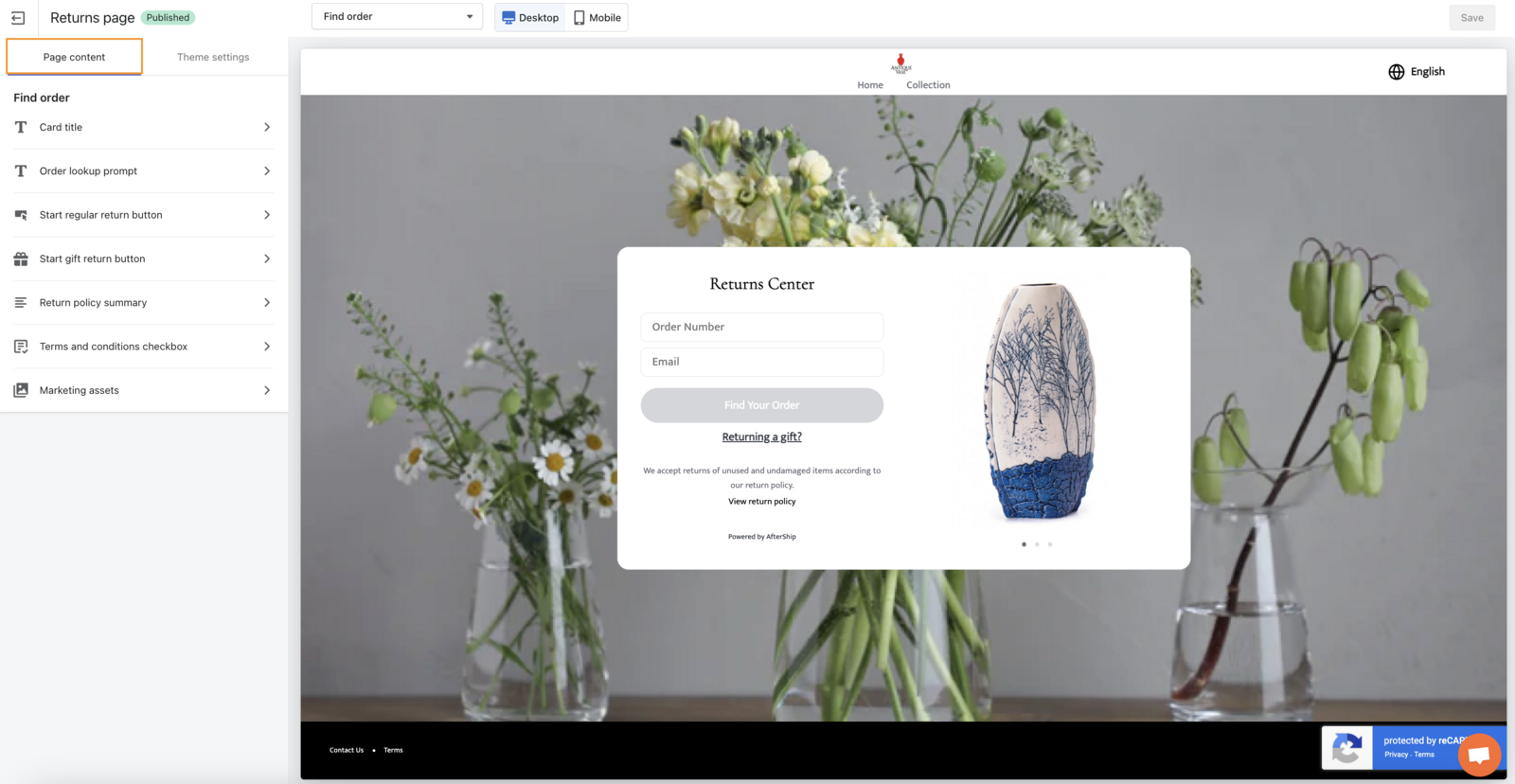
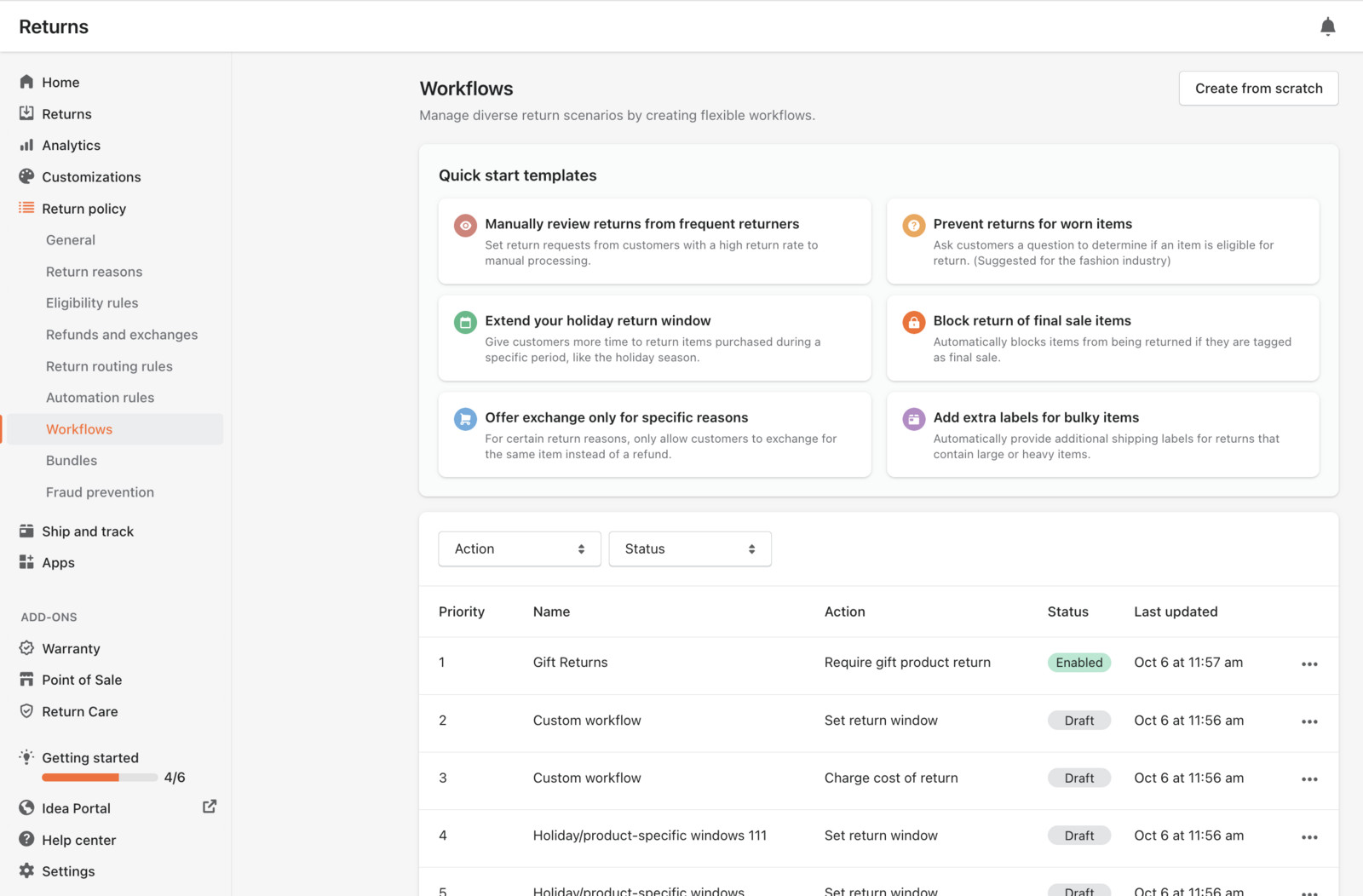
Behind the portal, workflow and routing rules decide what each return is allowed to become, with advanced workflows on the Premium plan. From there, AfterShip Returns resolves the return financially:
- Exchanges, including variant exchanges, exchanges for other products in your catalogue, on-store exchanges and instant exchanges.
- Store credit and bonus store credit, so a shopper has a reason to keep the value in your store.
- Return fraud controls that flag unusual return frequency and weight discrepancies.
- Returns analytics covering return reasons, label costs and processing time.
A shopper sending back a jacket can choose the next size up in the portal, and AfterShip Returns creates the exchange order automatically once the return is on its way back. Nobody on your team re-keys an order.
The outcome shows up in hours and revenue. At Marc Nolan, a men's dress shoe brand, returns work fell from roughly 35 hours a week to about one hour, a 97% reduction. In the brand's customer story, Nikolas Callas, Director of Operations, says: "This exchange feature took every problem away. It’s also saved a lot of revenue." He puts the figure at "$125k in the last 90 days." AfterShip publishes a 50% reduction in returns processing time and 50% revenue retained with exchanges on its Returns product page.
Choosing the ecommerce returns software UK shoppers will actually use comes down to carriers they already know. AfterShip Returns generates return labels automatically with 71 carriers worldwide. By name, that includes:
- Evri across its UK services, with 10,000+ drop-off locations
- Royal Mail Tracked 24 and Tracked 48
- InPost and DPD UK Parcel Return To Shop
- GLS Shop Returns across Austria, Belgium, Germany, Denmark and Luxembourg
- PostNL in the Netherlands and Poste Italiane in Italy
- A Pro Carrier returns service covering 30 countries, including Ireland, France and Spain
QR code returns, where shoppers drop off without printing a label, are mostly domestic. Separately, Royal Mail runs its own Tracked Returns service for retailers: a returns portal where shoppers produce their own labels, with a 24 or 48 hour service.
Ease of use is what merchants tend to notice first. Lucini London, a UK store, gave AfterShip Returns five stars in a Shopify App Store review on 25 June 2024: "Very easy to use... love the way it can suggested new items to exchange instead of a refund." That second point is the financial half at work, with the portal steering the shopper toward keeping the sale.
Head-to-Head on the Criteria That Decide This
For a scaling UK or EU brand, six criteria settle the Shiptheory vs Returnly question once Returnly is set aside: the self-service portal, automation rules, UK and EU return-label carriers, exchanges and store credit, returns analytics, and platform and plan fit. The table compares AfterShip Returns with the Shiptheory returns product you may already have.
| Criteria | AfterShip Returns | Shiptheory returns product |
|---|---|---|
| Self-service portal and branding | Branded self-service portal that auto-detects shopper language and currency on every plan, with exchanges and store credit offered in the same flow | Branded customer portal with your logo, colours and custom CSS |
| Automation rules for approval, routing and resolution | Workflow and routing rules by condition, with advanced workflows on Premium, auto-created exchange orders and return fraud controls on frequency and weight | Rules by return reason set carrier, service and charges; approve or reject with order history |
| UK and EU return-label carriers | Evri, Royal Mail Tracked 24 and 48, InPost, DPD UK, GLS, PostNL, Poste Italiane and a multi-country Pro Carrier returns service | Royal Mail Tracked 24 and 48 Returns, Evri, DPD, InPost and other integrated carriers |
| Exchanges and store credit | Variant, catalogue and on-store exchanges, instant exchanges, store credit and bonus store credit to keep the value of each return in your store | Not documented on Shiptheory's returns pages or help centre |
| Returns analytics | Analytics on return reasons, label costs and processing time, so you can fix the causes of returns as well as process them | Monthly returns reports, downloadable as CSV |
| Platform and plan fit | Its own subscription on Essentials, Premium or Enterprise, Built for Shopify, with Return Care available on Shopify in selected markets | Included from the Saturn plan upward; runs on orders shipped through Shiptheory |
The first three rows describe work both tools can do. The last three decide what each return is worth: whether it ends as an exchange or store credit, and whether you can see why it happened.
For brands weighing Shopify returns automation, AfterShip Returns holds a 4.7 rating from 1,541 reviews on the Shopify App Store (read 23 September 2026), with the Built for Shopify badge, and 4.3 from 12 reviews on G2. If Returnly is still your reference point, you can Compare AfterShip directly with Returnly's features, or take a closer look at which of the two was better for handling exchanges.
Carrier coverage is the last test. With the UK and EU carriers covered above, AfterShip Returns reaches shoppers in the UK, continental Europe and beyond from one account.
The Verdict
With Returnly gone, platform longevity is part of this decision. Shiptheory is an excellent outbound-shipping tool, especially for UK carrier automation. Outbound shipping and reverse logistics are different jobs, though, and revenue is kept or lost in how each return is resolved.
AfterShip Returns is a paid subscription, and its shopper-funded Return Care option runs on Shopify in selected markets. The standard subscription still delivers the automation, exchange resolution and analytics a shipping tool does not, and the Marc Nolan result above is the payback evidence. For a wider shortlist, see our top picks for 2026.
Choose Shiptheory's returns product if:
- you already ship through Shiptheory on a plan that includes its Returns Shop
- your returns process ends at intake, approval and a label on orders Shiptheory already ships
- refunds are the outcome you want, and exchanges or store credit are not part of your policy
Choose AfterShip Returns if:
- you want returns to end in exchanges, store credit or bonus credit instead of refunds
- you need workflow and routing rules backed by return fraud controls
- you want return labels generated automatically with the UK and EU carriers named above
- you want a portal that detects shopper language and currency on every plan
- you want analytics on return reasons, label costs and processing time
AfterShip is the specialist choice when analytics, automation depth, revenue-retaining resolution and multi-region carrier coverage start to matter.
Returns automation that enhances the returns and exchanges experience, reduces costs, and retains more revenue.
Book a demoFrequently Asked Questions
Can Shiptheory handle my returns?
For the physical half of a return, yes. Shiptheory's Returns Shop provides a branded portal, rules by return reason, approvals and return labels on orders Shiptheory already ships. It is not included on Shiptheory's two lowest plans; the cheapest plan that includes it is Saturn, at GBP 99 a month billed annually. Exchanges, store credit and refund issuing are not documented on its returns pages or help centre.
Is Returnly still available?
No. The platform shut down on 1 October 2023, two years after Affirm acquired it in 2021, and its merchants moved to other returns platforms.
Which UK and EU carriers can AfterShip Returns generate return labels with?
In the UK, AfterShip Returns generates return labels with Evri, Royal Mail Tracked 24 and Tracked 48, InPost and DPD UK Parcel Return To Shop. In the EU, it covers GLS Shop Returns in Austria, Belgium, Germany, Denmark and Luxembourg, PostNL in the Netherlands and Poste Italiane in Italy, plus a Pro Carrier returns service covering 30 countries. QR code returns are mostly domestic.
What does AfterShip Returns cost?
AfterShip Returns is billed as its own subscription. Essentials is $16 a month billed annually, with $0.50 per extra return. Premium is $99 a month billed annually, with $1.00 per extra return. Enterprise is priced on request. Merchants on Shopify in selected markets can also add Return Care, a shopper-funded option.
Do I need AfterShip Tracking as well to track a return?
No. Return and exchange tracking is included in AfterShip Returns, so your shoppers and your team can follow every return back to your warehouse without a second subscription.