You are looking at AfterShip vs Wonderment, which means you are asking the right question: how much of the post-purchase experience do you really want to own? Is it just the notification, or is it the entire journey?
That framing matters more than any feature list, because these two products are not the same kind of thing. One is a notification specialist that feeds shipment events into the marketing stack you already run. The other is a post-purchase platform that carries tracking, returns and shipping on one contract. Only one of them is still the right answer once post-purchase stops being a single job.
Here is the verdict, then the evidence.
The Short Answer: AfterShip vs Wonderment
| Criteria | AfterShip | Wonderment (Loop Tracking) |
|---|---|---|
| Best For | Shopify DTC brands scaling past a thousand orders a month that want tracking, returns and shipping under one vendor. | Small brands living inside Klaviyo that need shipment events feeding flows they already own. |
| Core Function | Composes and sends milestone notifications in-platform, across email and SMS. | Detects the shipment event and passes it to the merchant's own email and SMS provider. |
| Platform Scope | Tracking, returns, shipping and analytics on one platform, on one contract. | Tracking. Returns are a separate Loop product with its own listing and its own contract. |
| Pricing Model | Priced on shipment volume, across published tiers. | Shipment volume across three published tiers on the Shopify App Store listing. |
| Key Limitation | SMS is charged separately, metered in credits by message segment and destination country. | Cannot send the notification itself, so an email service provider is a second permanent subscription. |
If your requirement is shipment events feeding flows you already run, and nothing beyond that, Wonderment (Loop Tracking) covers that scope: tracking events, a branded tracking page, and integrations into the tools you already send from. What sits outside it is worth knowing before you sign. Returns are a separate Loop product on a separate contract with its own full feature and pricing breakdown, and its delivery estimate sits in its top tier.
If you see post-purchase as one brand experience, and returns, shipping or delivery estimates are anywhere on next year's roadmap, AfterShip is the platform built to still be the right answer in eighteen months.
The difference is not polish. It is scope, and it is which plan each capability sits on.
What is Wonderment (now Loop Tracking)? The Transactional Notification Specialist
Wonderment (acquired by Loop, now Loop Tracking) is a Shopify-native tracking app built for one job: getting shipment events out of Shopify and into the tools you already send from.
The naming is worth a sentence, because you will meet three versions of it. Loop's Wonderment marketing site now redirects to a page headed "Wonderment is now Loop Tracking!", the Wonderment help centre is still live under the branding "Track by Loop (formerly Wonderment)", and the Shopify App Store lists the app as Track by Loop while the developer field still reads Wonderment. Loop announced the acquisition in December 2024.
Now the part that decides most of this comparison. Wonderment, now Loop Tracking, sends tracking notifications through the merchant's own email provider. Loop's own product page states it directly: "With Tracking, you can send shipping notifications through your preferred email & SMS provider." The Shopify listing says the same thing in marketing language, promising that you can "send branded shipping update notifications from Klaviyo, Postscript, Slack, and more". The app detects the shipment event. Something you pay for separately writes the message and delivers it.
That architecture is deliberate. Loop Tracking is built to feed the stack a Klaviyo-centric brand already operates:
- 14 documented shipment events, including ETA Changed, Shipment Stalled, Attempted Delivery and Delivery Error
- Klaviyo and Attentive integration, so events land in flows your team already maintains
- A branded tracking page
- Shopify-native setup for that one job
What is AfterShip? The Complete Post-Purchase Suite
AfterShip is a unified platform for tracking, returns, shipping and analytics.
Four pillars, each of which a growing brand buys eventually as it sets out to build a complete post-purchase experience:
- Tracking. Branded tracking pages across 1,700+ global carriers, with automatic carrier detection and correction.
- Returns. A self-service branded returns portal, in the same platform and on the same contract.
- Shipping. Multi-carrier label generation and rate shopping.
- AI EDD. Predictive delivery dates, on the Premium plan.
Three details you can verify without taking our word for any of it. AfterShip adds orders to Apple Wallet from Shopify order status pages, tracking pages, emails and SMS notifications. AfterShip is the only tracking service provider that is an official UPU Consultative Committee Member, the regulatory authority of the world's post offices. And AfterShip Order Tracking carries Shopify's Built for Shopify badge, which the Track by Loop listing does not.
MyDeal cut pre-delivery and WISMO tickets by 25% using AfterShip Tracking.
The pillars matter less individually than they do together, because one data layer underneath tracking, returns and shipping is what turns four tools into one operation. Which is what the comparison below actually measures.
Feature Showdown: Where the Platforms Overlap and Diverge
The criteria below are the ones a Shopify operator actually weighs when the WISMO queue starts growing faster than the order book: who composes the message, where the delivery estimate lives, what happens when a customer wants to change something, and how much of the journey arrives on one contract.
| Criterion | AfterShip | Wonderment (Loop Tracking) |
|---|---|---|
| Who sends the notification | Composed and sent in-platform, email and SMS, across every shipment milestone | Triggered only. Loop's own page: 'you can send shipping notifications through your preferred email & SMS provider', so the merchant also pays an ESP |
| Notification channels | Email and SMS on paid tiers, plus Apple Wallet passes across paid tiers | Whatever the merchant's ESP supports. Loop documents 14 shipment events that fire into the merchant's own tools |
| Delivery estimate | AI EDD, covering at least 80% of deliveries where most carrier estimates cover under 40%. Recalculates for holidays, weather and traffic, with street-level prediction and SKU-based rules | Delivery Promise, 'calculated nightly using historical delivery data'. Loop advertises 90% accuracy; Loop's own help centre says 'a typical accuracy rate of 87 - 92%, depending on the merchant and their shipping volume' |
| Where the delivery estimate sits | Premium, a published self-serve plan | Plus, $449 a month on the Shopify App Store listing, alongside webhooks and API |
| Order editing before fulfilment | Order Edits, GA since July 2026: change address, swap variant, change quantity, add an item, apply a discount code, cancel, plus cancellation rescue that reroutes a cancel attempt into the matching fix | Loop's Order Editing documentation covers adding items, removing items, quantity changes and address changes, and where it discusses discounts they are existing order attributes recalculated when an order is edited rather than a code a shopper applies during the edit, per Loop's own Order Editing help article, checked 16 August 2026 |
| Returns | Self-service branded returns portal in the same platform, on one contract | Sold separately as Loop Returns, its own product and its own contract |
| Shipping labels | AfterShip Shipping, multi-carrier label generation and rate shopping | Not part of Loop Tracking. The Track by Loop listing enumerates what each of its three tiers includes, and multi-carrier label generation is not among them |
| Tracking page | Branded page on Essentials; fully customisable page plus custom domain on Premium | Branded page with native basic product recommendations. Loop documents that it does not provide support for custom JavaScript or other tracking-page development except for Plus-plan users |
| Contract | Monthly or annual, 18% annual discount, self-serve to 2,000 shipments a month | Standalone tracking is month-to-month, a real advantage. Every other Loop plan requires an annual contract |
| Deployment | 30+ named platforms and integrations | Shopify-native, plus a Loop-hosted page and an unnamed headless/API path that Loop's own doc routes through its team |
| Platform credentials | Built for Shopify badge; the only tracking provider that is an official UPU Consultative Committee Member; up to 50 new carriers added monthly | No Built for Shopify badge on either Loop app |
Read down the table and a pattern shows up that no individual row explains. Among the best branded tracking apps for Shopify, the capabilities a growing brand needs next are the ones Loop places furthest from where a growing brand starts.
The Platform Gap: What You Miss by Choosing a Point Solution
Think of it as instrumentation against infrastructure. A notification tool reads what the carrier reports and tells your customer about it. A post-purchase platform owns the road the parcel travels: what you promised at checkout, what happens when that promise slips, what the customer does when the item is wrong, and what your ops team learns from all of it afterwards. Better instrumentation on a road you do not own is still a ceiling, and you will meet it in five specific places.
A disjointed returns experience
AfterShip provides tracking and returns in one platform; Loop sells them as two.
That means one branded experience, one set of policies, one contract and one renewal, against a returns portal bought separately as Loop Returns, with its own subscription and its own integration work. For a shopper, the difference shows up as a single journey from order confirmation through delivery to exchange, in your brand's typography, with no handoff to somewhere that looks like a different company. For your CX team it shows up as one place to look when a customer asks why a parcel arrived damaged and what happens next.
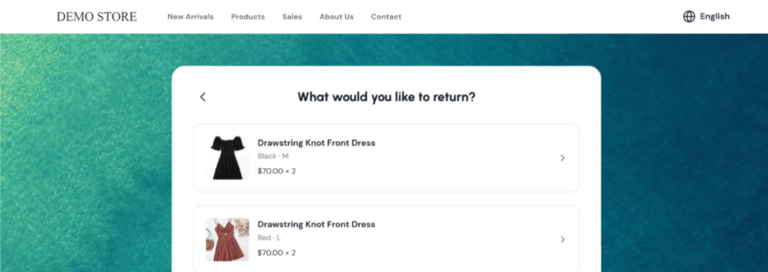
One branded journey from order to exchange, on the same platform and the same contract as the tracking page.
No control over shipping costs
A tracking app tells you what a carrier did. It does not change what you paid the carrier to do it.
AfterShip Shipping generates multi-carrier labels and rate-shops them, putting the outbound leg inside the same platform that tracks it and takes the return. Carrier choice stops being an annual spreadsheet decision and becomes something you tune per lane, with delivery data from the tracking side showing which carrier is failing which route.
If label generation lives outside your tracking vendor, that loop stays broken: the system that knows how your carriers performed has no say in which one gets picked.
A delivery promise you do not own
Start with coverage, because it is the number that decides whether a delivery date appears at all. AfterShip AI EDD covers at least 80% of deliveries while most carriers typically offer predictions on less than 40%. A promise you can only make on a minority of orders is not a promise your checkout can lean on.
Then look at how each estimate is produced. Loop's Delivery Promise, in Loop's own words, produces estimates "calculated nightly using historical delivery data within our AI model". AfterShip AI EDD recalculates in flight for holidays, weather and traffic, predicts to street level, and lets you set SKU-based rules and carrier service-type mapping. A nightly batch and a live recalculation answer different questions when a storm closes a hub on a Tuesday afternoon.
Loop is reasonably careful about accuracy. Its Delivery Promise page advertises "90% Delivery date accuracy", its FAQ says the product will "predict delivery dates with roughly 90% accuracy", and its help centre gives the fuller version: "a typical accuracy rate of 87 - 92%, depending on the merchant and their shipping volume." That range is the useful line, because it tells you the number moves with your volume and your carrier mix.
Set accuracy aside. The gap that decides the purchase is where each capability sits. AI EDD is on AfterShip Premium, a published self-serve plan. Loop places Delivery Promise on Plus, its top tier, alongside webhooks and API access. Two brands of identical size can buy both products and only one of them gets a delivery estimate without an upgrade conversation.
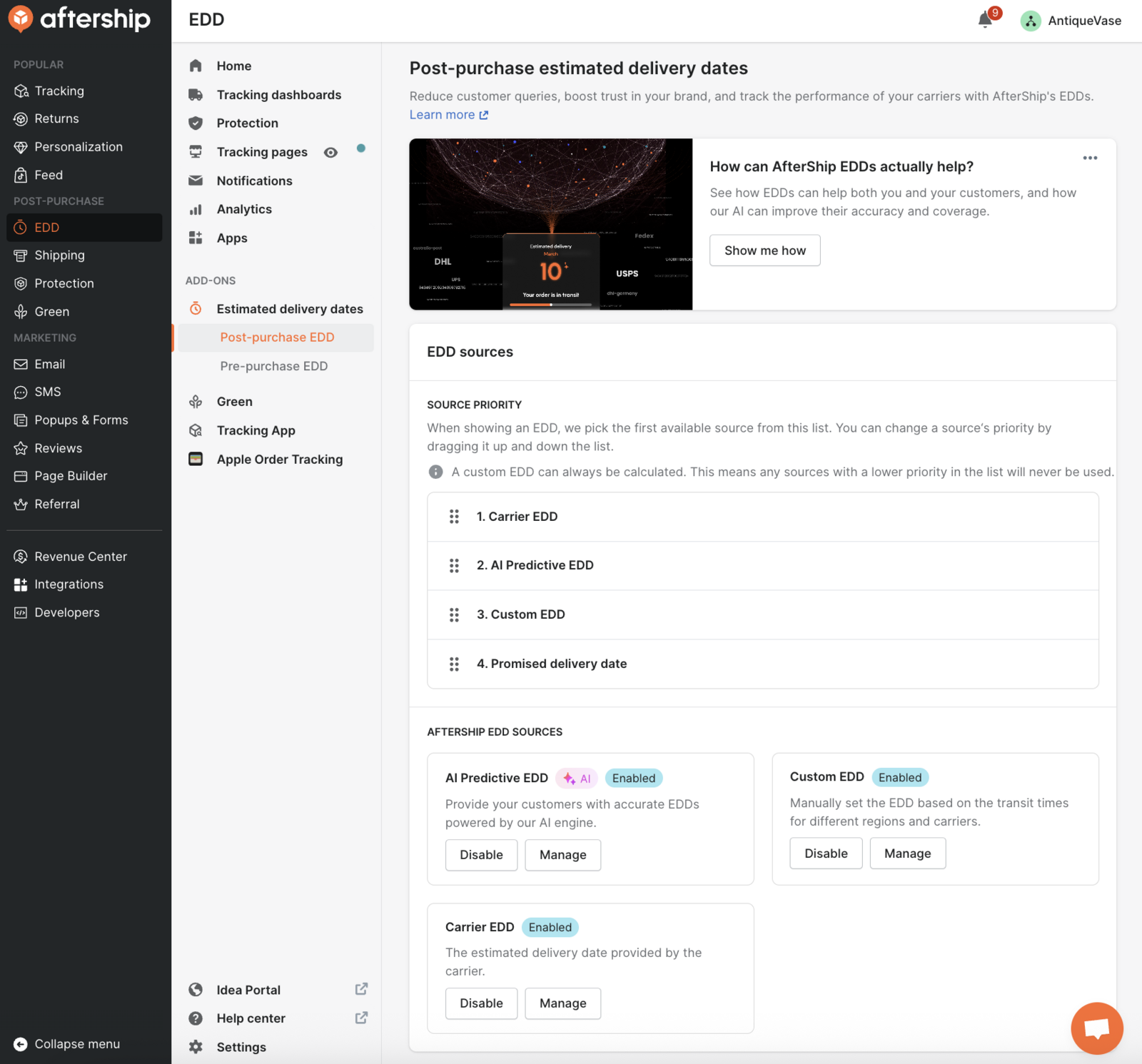
AfterShip lets the merchant decide which delivery estimate a shopper sees, and in what order the sources are tried.
Lack of operational insights
Carrier statuses are coarse and inconsistent, so orders disappear into an "in transit" black hole and nobody can say which of them are actually stuck. Aggregate dashboards hide it, because a healthy-looking on-time rate can be one failing carrier on one lane averaged away by everything else.
AfterShip's analytics surface exists to answer that. It normalises the most granular set of carrier substatuses in the industry into one model, so a delay in Ontario and a delay in Yorkshire mean the same thing in your reporting. It gives order-level drill-down, so you can open the individual orders that stalled and see exactly where each one stopped. And it compares carrier performance across your whole network, which is what turns a delivery-promise decision from a guess into a calculation.
A notification tool is not built for this work. But when your ops lead asks which carrier to drop before peak, the answer has to come from somewhere.
Order Edits
Order Edits is the only capability in this comparison that lets the shopper change their own order between checkout and fulfilment.
AfterShip Order Edits has been generally available since July 2026, on Premium and above, on both Tracking and Returns, and the shopper drives it: change the address, swap a size or variant, change quantity, add an item, apply a discount code, or cancel. Choose cancel and AfterShip rescues the order: when a shopper picks one of the cancellation reasons, AfterShip redirects them to the corresponding edit flow, so a wrong-size cancellation becomes a size swap instead of a refund.
Loop documents order editing too, and the comparison is worth making precisely. Loop's own Order Editing documentation covers adding items, removing items, quantity changes and address changes, and where it discusses discounts they are existing order attributes recalculated when an order is edited rather than a code a shopper applies during the edit, per Loop's own Order Editing help article, checked 16 August 2026.
That difference is small on a feature grid and large on a P&L, because every cancellation you convert into an edit is revenue that was already in the building.
Pricing and Value: What Each Platform Actually Costs in 2026
There is nothing left to model here. Both vendors publish their tracking prices, Loop's via Track by Loop on the Shopify App Store, so what follows is a straight comparison at two volumes, verified August 2026. Note the unit before you read it: both companies price on shipments a month, and your order count is not the same number.
| Shipments per month | Essentials, monthly | Essentials, annual | Premium, monthly | Premium, annual |
|---|---|---|---|---|
| 500 | $35 | $29 | $70 | $59 |
| 2,000 | $109 | 18% below the monthly figure | $239 | 18% below the monthly figure |
AfterShip Order Tracking, from aftership.com/pricing/tracking. All figures billed monthly except the annual columns. Verified August 2026.
| Plan | Price | What it adds |
|---|---|---|
| Starter | $99 a month | Up to 2,500 shipments a month; Klaviyo, Postscript and Attentive integrations |
| Premium | $189 a month | Onboarding, advanced reporting, Shopify Flow, Gorgias |
| Plus | $449 a month | Delivery Promise, webhooks and API, split-shipment support |
Track by Loop, from the Track by Loop listing on the Shopify App Store. All figures billed monthly. The listing also carries a per-shipment charge above 2,000 shipments a month. Verified August 2026.
Two sentences do most of the work.
Entry against entry at 2,000 shipments a month: $109 for AfterShip Essentials, billed monthly, against $99 for Loop Starter, billed monthly on the Track by Loop listing on the Shopify App Store, checked August 2026. That is close enough to parity that we will say so plainly. Then the qualifier that matters: Loop Starter cannot send an email or an SMS at all, while AfterShip Essentials includes milestone email in the plan.
Feature-matched at 2,000 shipments a month: $239 for AfterShip Premium, billed monthly, against $449 for Loop Plus on the Shopify App Store listing, checked August 2026. Feature-matched because Loop gates Delivery Promise, webhooks and API access to Plus, while AfterShip includes AI EDD, API and webhooks at Premium. At 500 shipments a month the same match is $70 for AfterShip Premium, billed monthly, against $449 for Loop Plus on that same listing. The monthly basis matters on our side: aftership.com/pricing/tracking defaults to the annual view, which shows $59 a month at 500 shipments a month.
Two disclosures before you take those figures at face value. Email is included in the AfterShip plan, with no per-send charge. SMS is charged separately, metered in credits by message segment and destination country, so a United Kingdom send costs several times a United States one. Budget for it, and price it from the credit calculator.
Overage is published on both sides and worth reading with its quota attached. AfterShip charges $0.08 per extra shipment on Essentials and $0.12 on Premium once you pass the quota your tier includes. Those rates describe going over a quota, and they are not how either platform prices a larger business. Above roughly 2,000 shipments a month the published ladders stop describing what you would pay. Loop adds a per-shipment charge on its listing and AfterShip moves to Custom on every tier, so no figure here is the one a larger brand ends up on.
The cost that appears in neither table is the second subscription, since Loop Tracking triggers the notification and something else has to send it. Whatever your email service provider charges, that line renews alongside Loop's, every month, for as long as you send.
The Final Verdict: When to Choose AfterShip vs Wonderment
Two honest things before the recommendation.
Wonderment (Loop Tracking) is good at its job. A polished tracking page, a genuinely deep event model, tight Klaviyo integration and a fast Shopify-native setup. If your goal is to trigger more email from flows your team already owns, it does that well, and nothing above has argued otherwise.
Loop is also more flexible on contract than we are at the entry point. Standalone Loop Tracking is month-to-month, while AfterShip quotes above roughly 2,000 shipments a month. In fairness to the full picture, Loop's own FAQ adds that every other Loop plan requires an annual contract, so that flexibility is specific to buying tracking on its own.
Choose Wonderment (Loop Tracking) if you are small, you live inside Klaviyo, your email service provider is already doing the sending, and nothing else in post-purchase is on your roadmap. If you are still shortlisting notification specialists, AfterShip vs Malomo (now part of Redo) covers the other main contender in that category.
Choose AfterShip if you are scaling past a thousand orders a month, you see post-purchase as one brand experience, and you want the platform to still fit in two years. The delivery estimate arrives on a published self-serve plan instead of a top-tier upgrade conversation. The returns portal is on the same contract as the tracking page. The order can be fixed by the shopper before it ships. And the analytics underneath sit on the same data layer as the tracking and returns they explain, so carrier performance, exception patterns and return reasons are read together instead of in three separate tools.
Proactive shipment tracking that delights your customers, reduces WISMO tickets, and optimizes your delivery performance.
Book a demoMaking the Switch: Migrating from Wonderment to AfterShip
Budget about half a day of notification setup. No re-platforming, no data migration project, no freeze on the store.
- Install AfterShip and configure the tracking page and notifications. Branded page, automatic carrier detection, and the milestone notifications you want going out.
- Rebuild your Klaviyo flows. Klaviyo flows bind to specific metric names, so a flow built on Wonderment's events needs rebuilding on AfterShip's. Remapping will not do it. The shortcut most brands take is skipping the rebuild altogether: AfterShip has a native email editor with prebuilt notification templates, so milestone email can be composed and sent inside AfterShip and the Klaviyo scaffolding Loop Tracking required can be retired.
- Deactivate Loop billing once your notifications are live and you have watched a few orders run end to end. Standard onboarding comes with the paid plans, and Enterprise adds a dedicated customer success manager, so the work does not have to sit entirely with your team.
One thing worth knowing before you start. There is no automated import of historical shipments, and none is positioned as a migration feature. Tracking accrues forward from install, so run both for a week if you need continuity in your reporting.
Frequently Asked Questions
Is Wonderment the same as Loop Tracking?
Yes. Loop acquired Wonderment and announced it in December 2024, and the product is now Loop Tracking. Loop's Wonderment marketing site redirects to a page headed "Wonderment is now Loop Tracking!", and the Wonderment help centre remains live under the branding "Track by Loop (formerly Wonderment)". On the Shopify App Store the app is listed as Track by Loop, with Wonderment still shown as the developer.
How does Wonderment (Loop Tracking) pricing work?
Loop publishes three tracking tiers on the Track by Loop listing on the Shopify App Store: Starter, Premium and Plus. Delivery Promise, webhooks and API access are gated to the top tier, and the listing carries an additional per-shipment charge above 2,000 shipments a month. The current figures, with their billing basis and the date checked, are in the pricing section of this article.
Can Wonderment send tracking notifications on its own?
No. Loop's own product page states that "With Tracking, you can send shipping notifications through your preferred email & SMS provider", so Loop Tracking detects the shipment event and the merchant's email service provider composes and delivers the message. AfterShip works differently: milestone email is composed and sent inside the platform and is included in the plan, with SMS metered separately in credits.
Does Wonderment include a returns portal?
No. Loop sells returns as a separate product, Loop Returns, with its own subscription and its own contract. AfterShip provides tracking and returns in one platform, so a self-service branded returns portal sits alongside the tracking page on the same plan, the same contract and the same renewal.
Which plan do I need to get estimated delivery dates?
On AfterShip, AI EDD sits on the Premium plan, which is published and self-serve. On Loop, Delivery Promise sits on Plus, its top tier, alongside webhooks and API access, per the Track by Loop listing on the Shopify App Store.
How hard is it to switch from Wonderment to AfterShip?
Budget about half a day. Klaviyo flows bind to specific metric names, so flows built on Wonderment's events need rebuilding on AfterShip's; remapping will not do it. Many brands skip that work entirely, because AfterShip has a native email editor with prebuilt notification templates and can send milestone email itself. There is no automated import of historical shipments, so tracking accrues forward from install.
Is AfterShip or Wonderment better for a Shopify store?
For a Shopify brand scaling past a thousand orders a month, AfterShip. It composes and sends the notification itself, its delivery estimate arrives on a published self-serve plan, the shopper can change the order before it ships, and returns, tracking and shipping arrive on one contract. On the Shopify App Store, Track by Loop carries no Built for Shopify badge, while AfterShip Order Tracking does.