Do you bet on the ecosystem-native tool you might outgrow in 18 months, or commit to the enterprise giant with a quote-only contract and a three-month implementation?
That implementation figure comes from Narvar's own customers: G2 puts their user-reported "Time to Implement" at three months, an average drawn from real user reviews.
Most comparisons of Loop Returns and Narvar hand you a feature grid and leave the decision sitting with you. This one gives you a verdict, written for the person who has to defend it to leadership: the eCommerce director or head of operations at a Shopify Plus brand whose returns process stopped scaling somewhere on the way up, and who now feels it in margin and in the support queue.
It also puts a third name on the shortlist, because the two-way choice is most of what makes this decision hard.

At Shopify Plus scale, the returns platform decision is a business case you have to defend to leadership.
The Executive Summary: What Each Platform Is Actually For
Three platforms, three different jobs. Here is what each one is built around, and where each one asks something of you in return.
| Platform | Best For | Core Strength | Core Weakness | Pricing Model |
|---|---|---|---|---|
| Loop Returns | Smaller Shopify brands whose main goal is converting refunds into exchanges | A returns-first solution built for Shopify, with a polished returns portal and the Shop Now exchange flow | Carrier access runs through shipping service providers rather than direct integrations, and International Lite is the lower of its two international tiers | Published tiers with a free entry plan, and an annual contract on the paid returns plans |
| Narvar | Large enterprises running logistics across multiple non-Shopify platforms | A broad post-purchase suite across Promise, Secure, Track, Notify, Assist and Shield on the IRIS data layer | A sales-gated buying cycle with no published price | Narvar publishes no pricing. Evaluating it requires a sales conversation |
| AfterShip Returns | Scaling Shopify Plus brands that need enterprise-grade control without an enterprise buying cycle | Built for Shopify status, plus granular automation rules, per-plan carrier entitlement of 3, 5 and unlimited, and Returns, Tracking and Shipping on one contract | On published list prices, Loop is cheaper across this reader's volume range, because Premium includes 100 returns a month and charges for each return above that | Published Essentials and Premium tiers, plus a negotiated Enterprise arrangement built on a committed volume or a platform fee rather than an uncapped per-return meter |
Read the last row first. It is the one most Shopify Plus shortlists never get to.
The Shopify Plus Dilemma: Why You Are Forced to Choose Between Native Simplicity and Enterprise Power
Loop and Narvar are not competing on the same idea of what a returns platform is for.
Loop built for one platform and one job. It is a returns-first solution built for Shopify, and its product scope follows that focus. Narvar built for scale across many platforms, regions and modules, selling to retailers whose estate was never going to be a single storefront. Narvar also ships a free Shopify returns app, so Shopify support is a given. The question is what each platform was designed around. Widening the field past those two, we rank the options in which alternative actually delivers on returns.
Each design has a failure mode, and you can usually feel which one you are living with.
Choose the specialist and the risk is product. It is how much of your returns management logic the tool carries as your policies get more specific by product, by destination, by customer. Choose the enterprise platform and the risk is procurement instead. Most brands outgrow the systems they launched on long before they have the appetite to run an enterprise buying process to replace them.
Neither risk is theoretical at your volume. That is why the shortlist keeps narrowing to these two names, and why it usually stops there.
It should not. The real shape of this decision is a trilemma, not a choice: the ecosystem-native specialist you might outgrow, the enterprise legacy generalist you have to buy like enterprise software, and a third position most Shopify Plus shortlists skip entirely. A modern platform built for DTC growth that carries enterprise-grade control without the enterprise buying cycle.
You do not have to choose between a tool you will outgrow and one that is overkill. That third position is AfterShip Returns, and the rest of this comparison sets out where it earns the shortlist.
Deep Dive: Loop Returns, the Returns-First Solution built for Shopify
Loop earned its position on Shopify, and an honest comparison has to start by saying so.
The returns portal is polished. Shoppers move through it without stopping to work out what to do, which is most of the battle in self-service returns. Shop Now, Loop's exchange flow, has a real record of turning refund requests into replacement orders.
Three things worth crediting plainly:
- A returns portal shoppers complete without contacting your support team
- Shop Now, an exchange flow with a track record of converting refund intent into a new order
- A free entry tier that carries real returns volume before you commit to a paid annual plan
Being built around one platform and one event also pays off in setup time. Loop's defaults are opinionated because they only ever had to serve Shopify returns, so a small team gets to a working configuration quickly.
Where that focus shows its edges is one layer further down, in how Loop reaches the carriers behind each return method.
Return method is where a returns policy meets reverse logistics. It is also where shoppers decide whether to buy in the first place.
46% of shoppers abandon purchases when retailers do not offer convenient return methods. That finding comes from the 2025 NRF and Happy Returns Retail Returns Landscape, a survey of 2,006 US consumers who returned an online purchase in the past 12 months.
Offering those methods at all depends on carrier access.
Loop's cross-border footprint is published and it is substantial: 478 return lanes across 67 origin countries and 30 destination countries, with 31 carrier connections including UPS, DHL Express, FedEx and USPS.
Loop reaches those carriers through shipping service providers rather than through direct integrations, and its International Lite tier is the lower of its two international tiers. For an operations team, the practical question is how much of your carrier logic you hold directly, and how much of it sits with an intermediary you did not select.
For domestic returns running on a single policy, that arrangement is invisible.
It becomes visible when the policy starts branching. Final sale behaves one way, high-value another, a damaged item a third, and each branch has to resolve to a specific carrier and a specific return method in a specific country. The more conditions your policy carries, the more you care about who owns the connection underneath it.
Deep Dive: Narvar, the Enterprise Powerhouse
Narvar has been running post-purchase for large retailers since before most of this category existed, and the scale is not in question.
- 1,500+ global brands and roughly 2B packages a year
- A carrier network Narvar publishes as 1,000+
- A post-purchase suite spanning Promise, Secure, Track, Notify, Assist and Shield, on the IRIS data layer
- A free Shopify returns app whose track page editor is self-serve
That final point deserves emphasis, because older comparisons of these platforms get it wrong. A Shopify team can edit the Narvar track page themselves.
Breadth like that solves a real problem. A retailer running several storefronts across several regions, with different carriers and different service expectations in each, needs one post-purchase layer that holds all of it. Narvar built for exactly that buyer, and the suite reflects it.
The difficulty for a Shopify Plus operator sits in the buying process.
Narvar publishes no pricing, so evaluation opens with a sales conversation instead of a page you can read at your desk. The API documentation sits behind a login wall, which means your engineering team cannot scope the integration until you are already inside that conversation. Add the three-month implementation noted at the top of this article, and the evaluation itself becomes a project with a timeline and an owner.
At the scale Narvar was built for, that process is proportionate. A retailer buying post-purchase for a multi-platform estate is buying something genuinely complicated, and the diligence matches the purchase.
A Shopify Plus brand is a different shape of buyer. One platform. One storefront. An operations lead who wants to change a return rule on a Tuesday afternoon and see it live the same day, without opening a procurement cycle to do it.
That is the space between these two platforms: the specialist that asks you to accept its carrier arrangement as your policy grows, and the enterprise suite that asks you to buy like an enterprise before you can start. It is the space AfterShip Returns was built to occupy, and the next section sets out what it actually does there.
AfterShip Returns: The Scalable Platform for Shopify Plus
The third position has to do two things at once. It has to behave like a Shopify-native tool for the team using it every day, and it has to hold up when the returns operation stops being simple. That is the bar for the rest of this section.
The Shopify-Native Experience You Expect
AfterShip Returns installs directly into Shopify and works against your orders, variants and customer records without a middleware layer sitting in between. You build a branded, self-service returns portal in a visual editor, so a CX or marketing lead can change the layout, the copy and the resolution options without filing a ticket.
Through Shopify Flow, AfterShip Returns can hold the fulfillment of an exchange order and release it automatically once your conditions are met.
That solves an expensive and unglamorous problem. Brands running third-party fulfillment apps routinely see exchange orders picked and shipped before the original item has come back, and holding the release closes that gap without anyone watching a queue.
AfterShip Returns holds Built for Shopify status, which neither Loop Returns nor Narvar does. At enterprise volume the three-way comparison is in AfterShip, Narvar and Loop on enterprise returns.
The Enterprise-Grade Control You Need
Automation rules are where a returns operation stops being manual. A rule watches for a trigger, checks the conditions you set, and applies an outcome without anyone opening the request by hand.
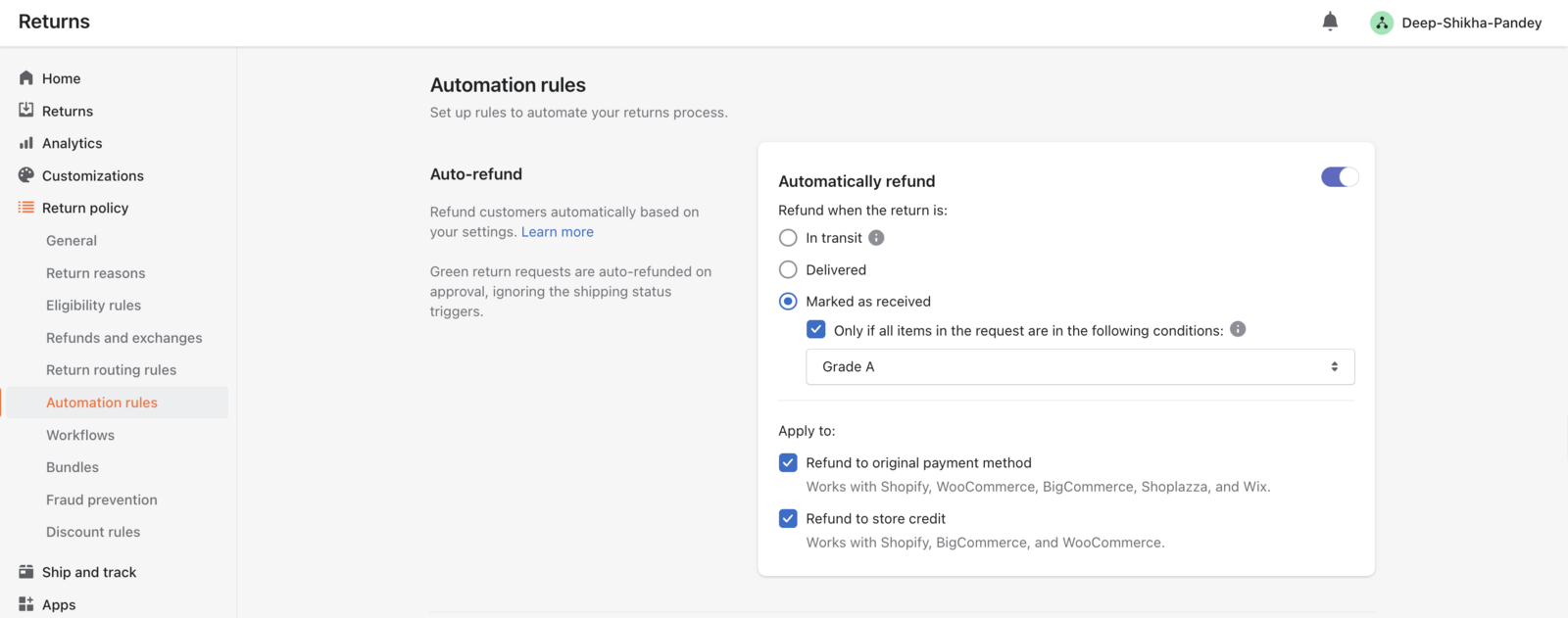
An auto-refund rule in AfterShip Returns, triggered on marked as received, conditioned on item grade, resolving to the original payment method or store credit.
AfterShip Returns generates return labels across 69 carriers. Per-plan entitlement is published: 3 carriers plus pre-negotiated rates on Essentials, 5 carriers plus pre-negotiated rates on Premium, and unlimited carriers plus custom discounted rates on Enterprise.
Returns route to distribution centers, public warehouses, repairing centers and third-party vendors, so a brand handling repairs separately from restocking does not need a parallel process to do it.
Now the part a business case has to survive.
On published list prices, Loop is cheaper than AfterShip Returns across this reader's entire volume range, because Premium includes 100 returns a month and charges for each return above that. That is worth stating plainly.
It is also the wrong number to build a decision on at this volume. A brand processing several hundred returns a month is not buying a published tier. Enterprise is a negotiated platform arrangement built on a committed volume or a platform fee, which takes the uncapped per-return meter out of the equation. It carries unlimited carriers, custom workflows and API rate limits, SSO and SAML, dedicated onboarding and a named CSM.
Returns, Tracking and Shipping also come from one vendor under one commercial arrangement, against two point tools with separate quotas and separate renewals, or an enterprise suite of separate products. AfterShip Tracking adds 1,700+ carriers of read-only tracking coverage, and AfterShip Shipping covers 130+.
Return Care is a free tier carrying all Premium features, shopper-funded returns, return labels handled by AfterShip, and revenue share.
The headcount effect is the line finance usually underestimates. Every rule that resolves a return without a human touch removes a step from somebody's day, and at a few hundred returns a month those steps add up.
Head-to-Head Feature Comparison for Shopify Plus
Seven criteria, each chosen because it changes the answer for a Shopify Plus operator. Two of them are commercial, and those are usually the rows that decide a renewal.
| Criteria | Loop Returns | Narvar | AfterShip Returns |
|---|---|---|---|
| Shopify Integration Depth | Shopify-native returns portal | Ships a free Shopify returns app with a self-serve track page editor | Holds Built for Shopify status. Direct Shopify integration, with Shopify Flow used to hold and auto-release exchange orders |
| Automation & Rules Engine | Workflow rules with a polished configuration experience | Shield, which Narvar advertises as returns and exchanges management focused on fraud mitigation | Granular conditional rules: a trigger, the conditions you set, and an outcome applied without manual review |
| Carrier Network & Flexibility | Ship By Loop, with 31 carrier connections reached through shipping service providers | Publishes 1,000+ carriers | Per-plan entitlement of 3, 5 and unlimited carriers, with pre-negotiated or custom discounted rates, across 69 carriers for return-label generation |
| International Returns Management | 478 return lanes across 67 origin countries and 30 destination countries. International Lite is the lower of its two international tiers | Platform-agnostic global reach | 310,000+ returns drop-off locations, covering 95% of customers worldwide |
| Branded Experience & Customization | Polished branded returns portal | Self-serve track page editor | Branded returns page built in a visual editor, changed by your own team without a ticket |
| Unified Platform Value | Returns and tracking sold as separate subscriptions, with separate quotas and separate renewals | A suite of six separate products plus the IRIS data layer | Returns, Tracking and Shipping on one contract. Returns 69 carriers, Tracking 1,700+ read-only tracking coverage, Shipping 130+ |
| Total Cost of Ownership | 60-day non-renewal notice, an automatic move to the appropriate higher tier the following billing cycle, and a 6% annual increase on the completion of each term | Publishes no pricing and no contract terms | 12-month auto-renewal, a 30-day notice period, and no fixed annual uplift |
If you want to go deeper on either matchup, we publish a detailed breakdown of AfterShip Returns vs Loop Returns, and you can see how we stack up against Narvar.
Row 7 is the one to take into the leadership meeting.
The 2026 Verdict: Which Returns Platform Wins for Your Brand?
Which is better, Loop or Narvar? It depends entirely on the shape of your business, and for a scaling Shopify Plus brand the better answer is a third one.
Choose Loop Returns if your returns operation is straightforward and your main goal is converting refunds into exchanges. It is a returns-first solution built for Shopify and it does that job well.
Choose Narvar if you are running logistics across multiple non-Shopify platforms and you have the procurement capacity to buy and implement enterprise software on its own terms.
Choose AfterShip Returns if you are scaling on Shopify Plus and need both at once. Four things carry that recommendation: the Shopify integration depth described above; the contract terms in row 7; the Enterprise entitlements described earlier; and what the platform does for a brand once it is running.
The shift shows up in the numbers, as footwear brand Marc Nolan found: its resolution mix moved from 75% refunds and 25% exchanges to roughly 50% refunds, 49% exchanges and 1% store credit, and time spent on the returns process fell by 97%.

“This exchange feature took every problem away. It's also saved a lot of revenue, $125k in the last 90 days.”
Nikolas Callas, Director of Operations
Read their story →Getting Started with AfterShip Returns
Switching returns platforms mid-year is the part that stalls most of these decisions, and the caution is reasonable.
Returns run every day, and a poor cutover shows up in the support queue within hours.
The returns portal, the automation rules and the routing destinations are all configured in the AfterShip admin, which puts the work with your operations team and keeps it off the engineering backlog. At Shopify Plus volume, the onboarding scope and the named CSM are agreed as part of the Enterprise conversation, so you go into the switch knowing exactly who you are working with.
Returns automation that enhances the returns and exchanges experience, reduces costs, and retains more revenue.
Book a demoFrequently Asked Questions
How long does it take to migrate from Loop Returns or Narvar to AfterShip Returns?
AfterShip does not publish a standard migration timeline, and any vendor quoting one before seeing your configuration is estimating. What actually drives it is the number of return policies you run, how many routing destinations and carrier accounts are in play, and which systems downstream of returns need reconnecting. Scope those three first and the timeline follows from them.
Will my existing return policy rules carry over?
A policy expressed as a trigger, a set of conditions and an outcome maps directly onto AfterShip Returns automation rules, so the work is translating structure you already have rather than designing it again. The migration exercise is mostly a chance to retire the rules you stopped using.
Do I need developer resources to set up AfterShip Returns?
The returns portal, the automation rules and the routing destinations are configured in the AfterShip admin, so the day-to-day setup sits with your operations or CX team. Developer involvement comes in where you are connecting systems beyond Shopify, such as an ERP, a WMS or a third-party fulfillment app.
Which returns platform is best for a Shopify Plus brand?
It depends on where your operation is heading. If returns are simple and exchanges are the goal, a returns-first tool built for Shopify covers it. If you run several non-Shopify platforms, an enterprise suite fits the estate. For a brand scaling on Shopify Plus that needs Shopify-native operation and enterprise-grade control at the same time, AfterShip Returns is the one that holds Built for Shopify status, publishes its contract terms, and puts Returns, Tracking and Shipping on a single commercial arrangement.