The 30-Second Verdict: Who Wins for Enterprise Returns in 2026?
Your returns are costing you more than just the refund. They're costing you in siloed data, developer time spent on integrations, and a disjointed customer experience. You've shortlisted AfterShip, Narvar, and Loop to fix your returns process, but you might be asking the wrong question. The best choice for 2026 isn't the best returns tool; it's the platform that eliminates the hidden costs of a fragmented post-purchase stack.
For an enterprise team weighing AfterShip vs Narvar vs Loop, the short answer is AfterShip. That is AfterShip's own read, built from Narvar's and Loop's public pages (checked 4 November 2026) and AfterShip's documentation, each linked in the tables below.
It is the only one of the three with robust data and a mature product experience across the entire post-purchase journey, inclusive of returns, tracking, shipping, AI-based estimated delivery dates, and warranty, all from a single account. That said, each platform earns its shortlist spot, and the difference comes down to scope. Here is the skim-level read for the executive who wants the answer before the analysis.
| Platform | Best For | Platform Scope | Price-to-Value |
|---|---|---|---|
| AfterShip | Enterprise brands that want one post-purchase platform and the best total cost of ownership | Returns, Tracking, Shipping, AI EDD and Warranty in one account; broadest multi-platform reach | Published plan ladder to Enterprise; highest value through consolidation |
| Narvar | Fortune 500 brands prioritizing a premium branded tracking experience, and any HIPAA-required vertical | Tracking-heavy enterprise CX suite with returns as a secondary product | Premium, quote-based, enterprise-only |
| Loop | Shopify-only brands whose returns do not need multi-warehouse routing, bundle logic, or non-Shopify channels | Shopify and Shopify Plus only; returns-first solution | Strong value for Shopify, returns and tracking sold as two separate subscriptions |
Sources: aftership.com (/pricing/returns, /returns, /tracking, /trustcentre), Narvar's and Loop's public product and security pages, and the Shopify App Store listings for all three, checked 4 November 2026.
Narvar still owns the premium enterprise tracking experience, and it is the only one of the three that offers HIPAA. Loop remains a solid choice for Shopify brands whose returns policies stay inside one warehouse and one platform. AfterShip wins on post-purchase platform consolidation combined with robust capabilities to serve brands at scale, and the market signal backs it up: its Returns product alone holds a 4.7-star rating across 1,544 Shopify App Store reviews and carries Shopify's Built for Shopify badge. Judged purely on how smooth the returns flow feels to a DTC shopper, the platforms rank as we set out in which platform delivers the smoothest returns for DTC brands.
Why Comparing 'Returns Features' Is the Wrong Approach for Enterprise
At enterprise scale, the platform you buy matters more than the feature checklist you compare.
Most RMS evaluations start as a feature bake-off: who has instant exchanges, who has store credit, who has the cleaner portal. Judged that way, all three look close, and you end up deciding on price or polish. The real cost driver isn't a missing feature. It's the operational overhead of running returns, tracking, shipping, and notifications across separate vendors.
Picture the brand you actually run: 10,000 to 50,000 orders a month, a VP who wants a recommendation this quarter, and a current setup that already leaks support tickets and labor hours. Bolting a best-of-breed returns tool onto that stack doesn't stop the leak. It adds one more vendor to manage, one more integration to maintain, and one more dataset that never reconciles with the others.
Total cost of ownership, the full cost of running a tool beyond its sticker price, is where point solutions quietly get expensive. A returns tool solves one step. A post-purchase platform connects the whole journey. The gap between those two shows up not on the invoice, but in the engineering and CX hours your team spends holding the seams together.
That distinction is the entire decision. AfterShip brings together Tracking, Returns, Shipping and more on the industry's largest post-purchase data layer, under one account and one contract. Loop runs returns and tracking as two separate subscriptions with two renewals to manage. Narvar splits the same capabilities across discrete products, each carrying its own line item.
The hidden taxes of that fragmentation land on the teams you can least afford to slow down:
- Developer hours spent building and maintaining integrations between each vendor.
- Vendor management overhead: multiple contracts, renewals, and security reviews to run in parallel.
- Fragmented data, where returns, tracking, and shipping never resolve into a single view.
- Inefficient cross-sells, because the exchange flow and the tracking page never share context.
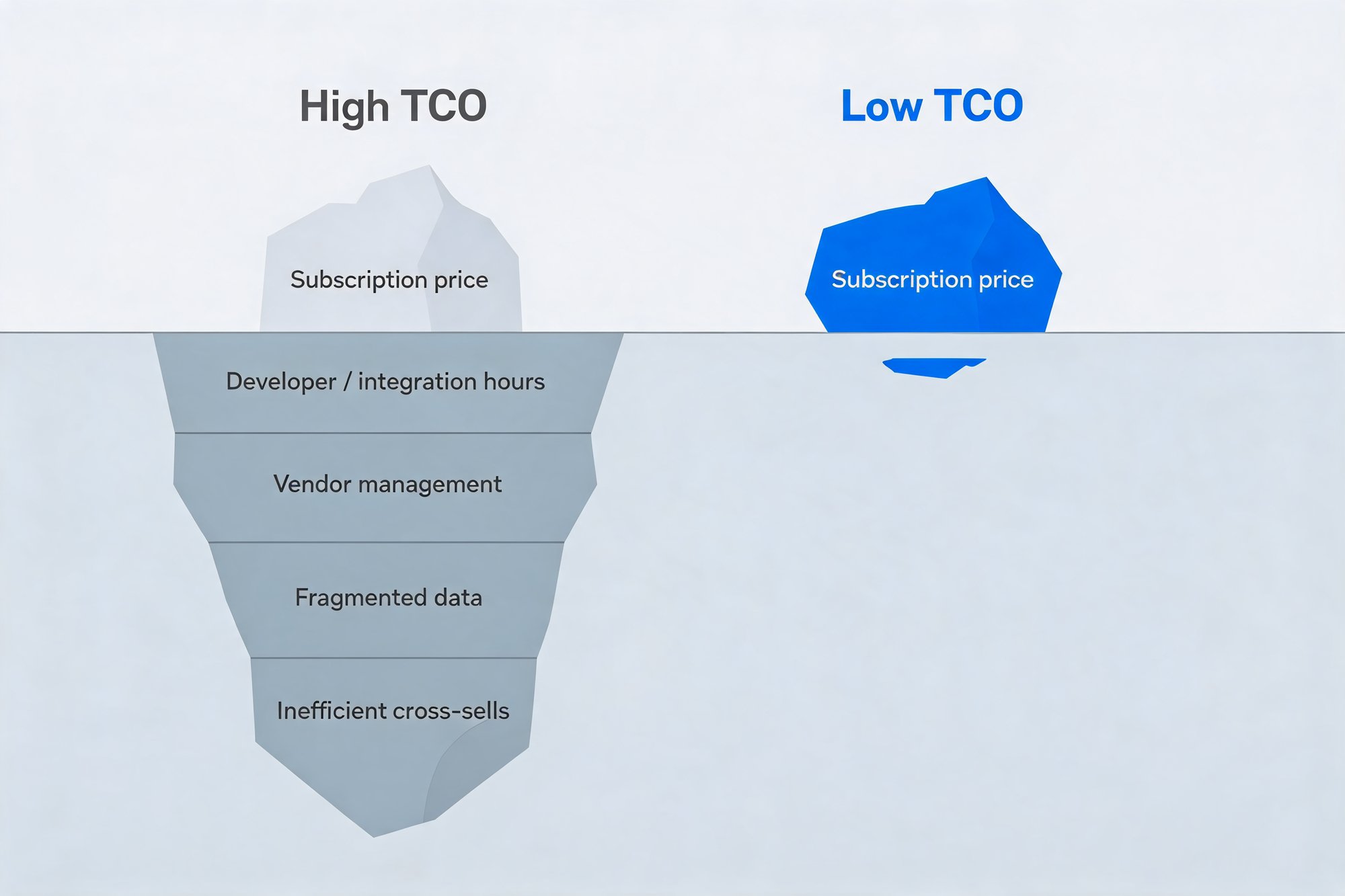
So before you score features, score architecture. For enterprise returns management in 2026, the platform that removes vendors from your stack will almost always beat the one that adds another. That is the lens the rest of this comparison applies.
Head-to-Head: AfterShip vs. Narvar vs. Loop on Core Capabilities
Judged one criterion at a time, the three platforms separate quickly: AfterShip works best when platform scope and automation are a priority, Narvar is built for premium tracking, and Loop is most mature in returns management for less complex brands. Scored on ticket volume instead of capability breadth, a different third name enters, as we show in the ranking that scores platforms on deflection rate.
The matrix below rates all three on the five criteria that actually move an enterprise returns decision. If AfterShip is already ruled out, see how Loop and Narvar stack up head to head on the same criteria.
| Criteria | AfterShip | Narvar | Loop Returns |
|---|---|---|---|
| Platform Scope | Returns, Tracking, Shipping, AI EDD, and Warranty in one account. Returns integrates natively with 25 commerce and ops platforms including Shopify, BigCommerce, Magento, WooCommerce, Salesforce, Amazon and eBay. | Tracking-led enterprise CX suite; returns is a separate product (Shield). | Shopify and Shopify Plus only; most mature in returns for brands without multi-warehouse or bundle complexity. |
| Returns Automation & Logistics Control | Native routing rules with unlimited return zones on Premium and Enterprise, partial returns from bundles, gift returns, and allowlist/blocklist branching; return fraud management from Premium. | Branded returns portal with exchanges, store credit, and fraud prevention in Narvar Shield; rule depth for multi-warehouse routing, multi-label, and bundle/GWP branching is not publicly documented. | Branded returns portal; Bonus Credit is its signature feature. Bundle returns constrained; multi-warehouse limited. |
| Carrier Network & Cost Optimization (returns reverse-logistics only) | Pre-negotiated rates on USPS and 40+ other carriers at every tier; connect your own carrier accounts 3 / 5 / 31+ from Essentials to Enterprise; label-free Happy Returns drop-off on every tier. | Bring-your-own-carrier: connect your own carrier accounts; no platform pre-negotiated rates. | Named list of 16 carriers with pre-negotiated rates via Ship by Loop. |
| Enterprise Readiness | SOC 2 Type II, ISO 27001, GDPR, published on the AfterShip Trust Centre; contractual uptime and response-time SLAs on Enterprise, set out in the Enterprise SLA. Open, published API documentation, with custom rate limits on Enterprise. SOC 2 is company-level; Returns-scoped report on request. | SOC 2, GDPR; uniquely offers HIPAA on a separate tier. API documentation gated behind an enterprise contract. | SOC 2, GDPR, CCPA; publicly documented API. ISO 27001, HIPAA, and a published uptime SLA are not listed on Loop's security page. |
| Total Cost of Ownership | One platform, one contract; consolidation lowers TCO. Published ladder from Essentials to Premium, then Enterprise on a custom quote. Return Care offsets return-shipping cost for eligible merchants. | Discrete products with core capabilities (EDD, fraud, shipping protection) sold as paid add-ons; quote-based. Fragmentation raises total cost. | Returns and tracking sold as two separate subscriptions, with two renewals to manage. |
Sources: aftership.com/pricing/returns, aftership.com/returns and aftership.com/trustcentre; Narvar's and Loop's public product, pricing and security pages; checked 4 November 2026. The HIPAA, SOC 2 Type II and ISO 27001 rows for AfterShip are published on the Trust Centre.
Three patterns hold across every row: AfterShip covers more of the journey, Narvar prices more of it as separate products, and Loop does less of it but does the Shopify slice exceptionally well. Swap Loop for Returnly and the same criteria produce a different answer, which we give in the honest verdict for DTC brands on that pairing. For a direct look at how AfterShip and Returnly handle exchanges, see our two-way comparison.
The atomic grid: one row, one answer
The matrix above is a judgement. This grid is not — every cell is a published Yes, No, or Not documented, so procurement can lift it straight into a scoring sheet.
| Capability | AfterShip | Narvar | Loop Returns |
|---|---|---|---|
| Multi-warehouse / zone routing | Yes — 3 zones on Essentials, unlimited on Premium and Enterprise | Not documented | Limited |
| Partial return from a bundle | Yes (Premium and Enterprise) | Not documented | Constrained |
| Gift returns / gift-with-purchase handling | Yes — gift returns on every tier | Yes — gift returns and gift cards listed | Not documented |
| Rules by product tag or customer value | Yes — eligibility rules plus allowlist and blocklist by customer, product or SKU | Yes — customer blocklists listed | Yes |
| Connected carrier accounts per tier | 3 / 5 / 31+ (Essentials / Premium / Enterprise) | Bring your own; no published tier limit | Named list of 16 carriers |
| Platform pre-negotiated return rates | Yes — USPS and 40+ others, every tier | No | Yes, via Ship by Loop |
| Publicly documented API | Yes — Returns API docs | No — gated behind an enterprise contract | Yes |
| HIPAA | No (merchants on the API can limit what data is sent to AfterShip) | Yes, on a separate tier | Not listed |
| SOC 2 Type II | Yes — company-level, per the Trust Centre; Returns-scoped report on request | SOC 2 published | SOC 2 published |
| ISO 27001 | Yes — per the Trust Centre | Not listed | Not listed |
| Published uptime SLA | Yes — contractual on Enterprise | Not published | Not listed |
| Commerce platforms supported | 25 platforms for Returns | Enterprise integrations, no published count | Shopify and Shopify Plus only |
In the tracking criterion the number that matters is coverage: AfterShip Tracking spans 2,000+ carriers, up from the 1,300–1,400 still quoted in third-party comparisons, and AfterShip publishes that it adds up to 50 new carriers a month.
On Shopify and Shopify Plus
Loop's strongest argument is that it is Shopify-native and AfterShip is not. The Shopify App Store is the one place where that claim can be checked rather than asserted. All three listings, read on 4 November 2026:
| On Shopify | AfterShip Returns & Exchanges | Narvar Return and Exchange | Loop Returns & Exchanges |
|---|---|---|---|
| Built for Shopify badge | Yes | No | No |
| App Store rating | 4.7 | 4.5 | 4.6 |
| Review count | 1,544 | 21 | 450 |
| Works with Shopify POS | Yes — native in-store returns and exchanges for online orders | Yes | Not listed |
| Shopify Plus | Supported, alongside 24 other commerce platforms | Supported | Shopify and Shopify Plus only |
| Listing languages | English, German, French, Spanish, Italian | English | English |
The honest reading: on the one Shopify-native quality signal Shopify itself issues, AfterShip holds it and Loop does not. Where Loop is genuinely narrower is scope, not quality — it runs on Shopify and Shopify Plus and nowhere else, which is an advantage if that is your whole business and a ceiling if it is not. Where AfterShip is more than one app is by design: Tracking, Returns, Shipping and Warranty are separate products on one account and one data layer, not one monolithic install. For a Shopify-native enterprise the same three separate differently, as we set out in the returns verdict for Shopify Plus.
Criterion 1: Returns Management & Automation
On core returns automation, the three are closer than the marketing implies, and the real separation shows up in reach and rule depth, not the portal itself.
All three give you a branded portal, automated labels, refunds, exchanges, and routing rules, including Loop's returns portal.
AfterShip's separation is in rule granularity and logistics control. Return zones and routing rules are unlimited from Premium up, eligibility rules can be set by price, category, condition and days since purchase, allowlists and blocklists work at the customer, product or SKU level, and a single item can be returned out of a bundle without sending the whole set back. For an ops team writing policies that differ by SKU, region, and customer tier, that depth is the difference between a rule engine and a workaround. Exchange logic separates the field further, and we rank which Narvar rivals handle exchanges best on that measure. For the AI layer that sits on top of those rules, see AfterShip AI for post-purchase teams.
The bigger enterprise differentiator is platform reach. AfterShip Returns integrates natively with 25 commerce and ops platforms, Shopify, BigCommerce, Magento, WooCommerce, Salesforce, Amazon and eBay among them. Loop runs on Shopify and Shopify Plus only, which is ideal if you are Shopify-native and limiting if you are not. Narvar's returns product is built for enterprise.
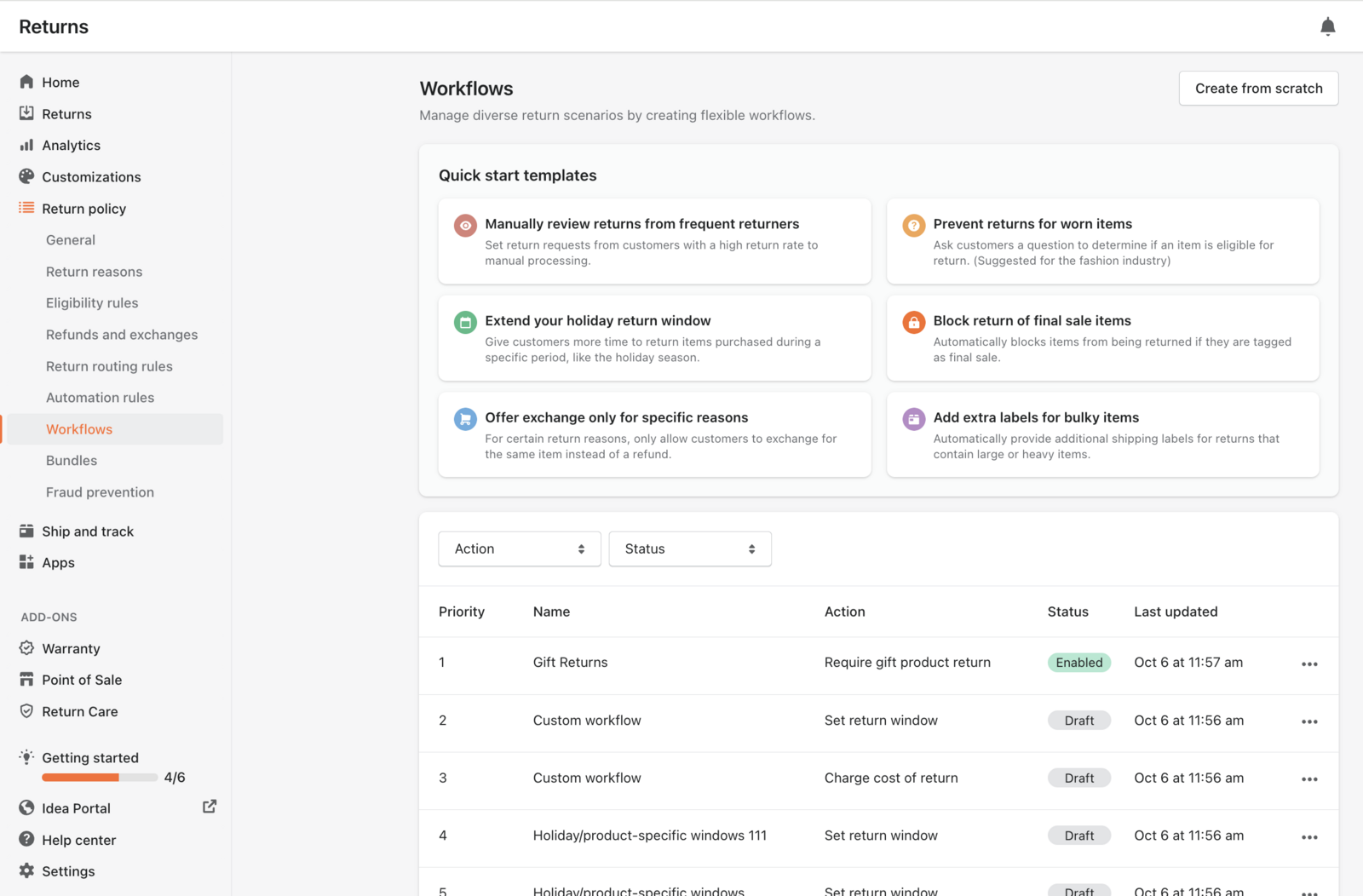
If your operation spans multiple warehouses, bundled SKUs, or non-Shopify channels, this is exactly where a single-purpose returns tool starts charging you in manual workarounds. Those costs rarely show up at evaluation time; they surface in month three, when a new policy needs an exception the tool cannot model.
Criterion 2: Carrier Network & Reverse Logistics Control
On reverse logistics, the right question is rate control, not raw carrier count.
A long carrier list means little if you still negotiate every rate yourself. At enterprise volume, what moves cost is whether your return labels draw on pre-negotiated rates and whether the drop-off network actually reaches your customers. Two platforms with identical carrier lists can have very different per-return economics. The line item that grows with volume is the label cost, not the length of the carrier roster.
AfterShip publishes pre-negotiated rates on USPS and 40+ other carriers on every plan tier, so the savings do not depend on your own carrier contracts. What scales by tier is how many of your own carrier accounts you can connect: 3 on Essentials, 5 on Premium, and 31 or more on Enterprise, with custom discounted rates negotiated through AfterShip's enterprise carrier program. Label-free, box-free drop-off through the Happy Returns Return Bar network is included on every tier.
Loop publishes a transparent list of 16 named carriers, with pre-negotiated rates available through Ship by Loop.
Narvar takes a bring-your-own-carrier approach: you connect your own carrier accounts rather than drawing on platform-negotiated rates, because Narvar does not provide pre-negotiated platform rates.
Before you compare any numbers, pressure-test the model with three questions:
- Are return-label rates pre-negotiated by the platform, or do you bring your own carrier contracts?
- How many carriers can you connect on your plan tier, and what does adding one cost mid-contract?
- Does the drop-off network cover where your customers actually live?
The structural point stands: pre-negotiated, tier-based carrier access lowers reverse-logistics cost without turning carrier setup into a procurement project. Drop-off density is the other half of that equation, which is what changes when Happy Returns joins the shortlist. If you are replacing a dedicated reverse-logistics vendor rather than a returns portal, we compare Optoro alternatives for reverse logistics separately.
Criterion 3: The End-to-End Customer Experience (Tracking & Notifications)
This is the criterion where Narvar earns its reputation, and where AfterShip's single-platform design pays off.
Narvar built its name on a premium, heavily branded tracking experience, and we break down how Narvar's tracking compares with AfterShip's in a separate guide. For enterprise brands that treat the tracking page as a marketing surface, that polish is real and worth acknowledging. Loop entered tracking more recently, adding it by acquiring Wonderment in 2024, so its tracking layer is newer and still maturing alongside its returns core. Widen the tracking field one vendor further and you get parcelLab and Narvar seen from the AfterShip side.
AfterShip's advantage is connection, not just a cleaner page. Because returns, tracking, and notifications run on one platform, a single exchange flows from return initiation, to the outbound tracking of the replacement item, to the proactive update that tells the shopper it shipped, with no three-tool handoff in the middle. That continuity is hard to replicate by wiring point solutions together. The help center walks through setting up instant exchanges in AfterShip Returns.
On the tracking side specifically, AfterShip's notification engine runs more than 33 workflow triggers, and its tracking layer spans more than 2,000 carriers, so delivery updates stay accurate across regions. The result is fewer "where is my order" tickets feeding back into your support queue.
This shows up in public reviews, too. On Capterra, one returns lead who moved off Loop pointed to pricing as the deciding factor, while another buyer chose AfterShip for greater platform flexibility and stronger support than Loop.
For brands that see post-purchase as one continuous experience rather than a set of separate tools, that unified design is the differentiator that survives contact with peak season.
Criterion 4: Platform Extensibility & Integrations (API & ERPs)
At the integration layer, the gap comes down to access: what is open, what is gated, and what is included by default.
AfterShip publishes its API openly, with documentation you can read before you sign anything. Loop also documents its API publicly. Narvar gates its API documentation behind an enterprise contract, so you often cannot evaluate the integration surface until you are already in a sales cycle. On AfterShip, returns webhooks and the Returns API are available from the Premium tier, with custom rate limits sized to your peak volume on Enterprise. For a team that wants to prototype against the API before signing anything, open documentation is itself a buying signal.
Enterprise readiness is where a hard requirement can settle the decision on its own. AfterShip publishes SOC 2 Type II, ISO 27001, and GDPR on its Trust Centre, and offers contractual uptime and response-time SLAs on Enterprise under the Enterprise SLA. That SOC 2 Type II certification is company-level; a Returns-scoped report is available on request rather than assumed. Narvar publishes SOC 2 and GDPR and, uniquely among the three, offers HIPAA on a separate tier for regulated verticals. AfterShip does not offer HIPAA; merchants working through the API can limit what data is sent to AfterShip, but that is a mitigation, not a certification. Loop publishes SOC 2, GDPR, and CCPA; ISO 27001, HIPAA, and a published uptime SLA are not listed on Loop's security page. Procurement teams scoring Narvar on these same requirements will want the enterprise retail verdict on Narvar.
If your roadmap leans on open APIs, ERP connections, or a compliance line item, this is where the platform-versus-point-solution gap turns into a procurement reality. And if a vertical you serve touches protected health information, the HIPAA question alone can decide the vendor before any other criterion is scored.
Criterion 5: Exchanges and Revenue Retention
This is the capability the buyer actually asked about, and the one most comparisons describe least.
A return you convert into an exchange is revenue you keep. AfterShip's exchange set is laid out plainly on its pricing page, and so are its gaps. Variant exchanges, refund to store credit, bonus store credit (offering more credit than the cash refund, to pull the shopper back into the catalogue) and gift returns run on every tier, including Essentials. The higher-value mechanics start at Premium: Instant exchanges, which ship the replacement before the return arrives back; Instant refunds, which release the refund as soon as the shopper ships; Shop now, which swaps a refund for store credit plus a fresh purchase in one flow; Exchange on store, which puts the exchange inside the shopper's normal browsing experience; AI-powered exchanges, which surface higher-AOV or better-fit options at the moment of return; and Stripe checkout for paying the difference inside the portal.
The gap worth stating: the whole instant-exchange and shop-now layer is a Premium-and-above capability. On Essentials you get exchanges, but the mechanics that do most of the retaining are not there.
Narvar's Shopify listing names exchanges, replacements, store credit, gift cards and gift returns, and its marketing leads on converting refunds into exchanges. Loop's signature feature is Bonus Credit, and its exchange flow is the reason Shopify brands shortlist it. All three can turn a refund into an exchange; the separation is how much of the flow is automated and where it lives.
What that is worth in practice, from a named AfterShip customer rather than an estimate: Marc Nolan's Director of Operations, Nikolas Callas, reports that the exchange feature saved the brand $125,000 in a single 90-day period. That number is theirs, published in the Marc Nolan customer story, not a modelled projection. The full exchange and store-credit feature set is on the AfterShip Returns product page, and the help centre documents setting up instant exchanges.
The TCO Breakdown: Uncovering the Hidden Costs in 2026
The sticker price is the smallest number in a returns decision; the cost that compounds is the return volume you cannot see at signup.
Start with the industry baseline. In 2025, 19.3% of online sales were returned, and that rate is the multiplier that turns your order volume into a returns bill. A brand at 10,000 orders a month is looking at roughly 23,000 returns a year; at 50,000 orders a month, roughly 116,000.
AfterShip publishes its ladder, which means you can place yourself on it before you talk to anyone. Prices checked on the AfterShip Returns pricing page on 4 November 2026.
| Returns per year | Plan | How it is priced |
|---|---|---|
| Up to ~240 (under 100/month) | Essentials | From $16/month, 240 returns included, $0.50 per extra return |
| ~1,200 (100–400/month) | Premium | From $99/month, 1,200 returns included, $1.00 per extra return |
| Above ~4,800 (400+/month) | Enterprise | Custom quote — priced on your total volume within AfterShip. Carrier accounts and SLA are not pricing inputs |
| Any volume, eligible merchants | Return Care | Consumer-funded return protection. Open to US Shopify merchants; further eligibility is confirmed with Sales |
Read the last two rows together, because that is where an enterprise decision actually sits. Once real return volume runs past the Premium cap, the $1 overage is the signal, not the answer: Enterprise is priced on your total volume within AfterShip rather than per return, and AfterShip positions it for global brands doing 400+ returns a month. There is no published per-return reference point for Enterprise, so the honest move is to size it with AfterShip Sales rather than anchor on a number that will not match your volume. For the Narvar side of the same question, which is quote-based with no published ladder at all, see the AfterShip and Narvar comparison.
Return Care is worth a separate line because it is frequently misread as a free plan. It is consumer-funded return protection: shoppers pay a small fee at checkout to unlock free returns later, which offsets the return-shipping cost that would otherwise come out of your margin. It is open to US Shopify merchants, and further eligibility is confirmed with Sales.
Those are still the visible costs. The fees that never reach an invoice are the engineering hours spent maintaining connectors between separate vendors, the parallel contracts and renewals, and the reporting that never reconciles across tools. Consolidate the stack onto one platform and those lines collapse toward zero.
Totaled honestly, the cheapest subscription rarely wins. The lowest total cost of ownership does.
Narvar alternatives for returns: where Loop, Happy Returns and AfterShip fit
If you are replacing Narvar rather than renewing it, the three alternatives solve different problems. Loop fits a Shopify-centric brand whose priority is converting refunds into exchanges. Happy Returns, a UPS company, fits brands whose shoppers want box-free, label-free drop-off at Return Bar locations across the US. AfterShip fits an enterprise that wants returns, tracking and shipping on one data layer, with pre-negotiated return labels and the Happy Returns network available as an integrated drop-off option.
Other Narvar alternatives worth a look
Four more names come up in Narvar renewal conversations. Each solves a narrower problem than "returns platform" implies. All checked 4 November 2026.
- Happy Returns (a UPS company). The drop-off network, not the software, is the product: Happy Returns publishes 10,000 Return Bar locations for box-free, label-free returns. Pick it when physical convenience is the thing your shoppers are asking for; it sits alongside a returns platform rather than replacing one, and AfterShip integrates it on every tier. See how Narvar, Loop and Happy Returns compare and the direct Happy Returns comparison.
- Redo. A broad post-purchase platform spanning returns, order tracking, shipping, marketing and payments, which acquired branded order-tracking vendor Malomo. Redo publishes a 4.9 rating across 1,300+ reviews and says it serves 5,000+ brands. Pick it when you want a single vendor across marketing and post-purchase and are comfortable buying from a younger, faster-moving platform.
- Swap. A global commerce platform — cross-border duties and tax, shipping, returns and checkout protection — that says it powers 1,000+ global businesses. Pick it when cross-border is the hard part of your returns problem rather than rule depth. For a straight shipping-protection comparison, see Narvar and Route weighed against AfterShip.
- Shopify's built-in returns. Free, already in your admin, and genuinely sufficient for a small catalogue with one warehouse and a simple policy. It has no exchange logic beyond the basics, no multi-warehouse routing, and no bundle handling — which is exactly the set of gaps that pushes a growing brand onto one of the platforms above.
One name you may still see on shortlists is Returnly. It is gone: Affirm announced in 2023 that it would sunset the platform, and it can no longer take new returns. If you are still comparing against it, our Returnly comparison explains what replaced it.
Switching from Narvar Shield or Loop
If you are moving off Narvar Shield or Loop, the two questions that actually set your timeline are contract timing and export scope.
Start with the contract. Most enterprise returns contracts renew annually with a notice window, so the date you need to work backwards from is the notice deadline, not the renewal date. Give yourself room to run the evaluation, security review and procurement inside that window rather than against it.
Then scope what moves. What transfers depends on two things: what your current platform can actually export, and how many tools AfterShip is replacing. A brand consolidating returns, tracking and notifications has more to migrate than one swapping a returns portal alone. Return policies, eligibility rules, carrier accounts and notification templates are rebuilt rather than lifted, and that rebuild is usually the longest task in the project — it is also the natural moment to retire the rules nobody remembers writing.
On shipments, the practical split is this: active and recent shipments can be moved into the new platform so tracking continuity holds, while returns already in flight in the old system are usually best completed there. Trying to migrate half-finished RMAs mid-flow creates reconciliation work that nobody wants during peak.
Plan a parallel run of roughly 30 days, with both systems live and traffic shifting gradually, so you catch policy edge cases on real returns before the old platform goes dark. Anyone quoting you a blanket timeline without seeing your export and your rule set is guessing.
For the mechanics, AfterShip publishes the Narvar-to-AfterShip transition guide for Klaviyo users, and the "What switching actually involves" section of Narvar alternatives compared walks through the same sequence in more detail.
The Final Verdict: Your Recommendation for Q3
For a Q3 recommendation, the decision narrows to one question: how much of the post-purchase journey do you want to run from a single contract?
Choose AfterShip if you want one platform to operate returns, tracking, shipping, and delivery estimates from a single account, the widest reach across Shopify and non-Shopify storefronts, and the lowest total cost of ownership once real return volume is in the model. For most teams running this evaluation, that consolidation is the recommendation, and the operational efficiency compounds as you scale.
Choose Narvar if you are a Fortune 500 brand where a premium, white-glove branded tracking experience is the priority and budget is secondary, or if you operate in a vertical that requires HIPAA.
Choose Loop if you are a Shopify or Shopify Plus brand whose returns do not need multi-warehouse routing, bundle logic, or non-Shopify channels. If Loop is the frontrunner, weigh it directly against AfterShip in the Loop comparison for Shopify returns teams.
For an enterprise team weighing AfterShip vs Narvar vs Loop, the platform that unifies returns, tracking, shipping, and delivery estimates into one account remains the most defensible enterprise returns management recommendation you can put in front of your VP this quarter. Teams looking specifically for a better returns experience have a wider field, compared in the best returns experience of 2026.
Returns automation that enhances the returns and exchanges experience, reduces returns-related costs, and retains more revenue.
Get started freeFrequently Asked Questions
Which is best for enterprise returns: AfterShip, Narvar, or Loop?
AfterShip is the best fit for brands that want one platform for returns, tracking, shipping, and AI delivery estimates with the lowest total cost of ownership. Narvar suits Fortune 500 brands prioritizing a premium branded tracking experience, and any vertical that requires HIPAA. Loop suits Shopify and Shopify Plus brands whose returns do not need multi-warehouse routing, bundle logic, or non-Shopify channels.
What are the best Narvar alternatives for returns?
The shortlist depends on what you are replacing. AfterShip if you want returns, tracking, shipping and warranty on one account and one contract. Loop if you are Shopify-only and exchange conversion is the priority. Happy Returns if box-free, label-free drop-off across its 10,000 Return Bar locations is what your shoppers are asking for. Redo if you want marketing and post-purchase from one younger platform. Swap if cross-border duties and tax are the hard part. Shopify's own built-in returns is free and enough for a small catalogue with one warehouse and a simple policy.
Does Narvar integrate with Shopify?
Yes. Narvar publishes a free Narvar Return and Exchange app on the Shopify App Store, launched in August 2021, which works with Shopify POS, Shopify Flow, Shopify Admin, Gorgias, Klaviyo, NetSuite, Recharge, ShipHero and Tapcart. As of 4 November 2026 it holds a 4.5 rating from 21 reviews, is listed in English only, and does not carry Shopify's Built for Shopify badge. By comparison, AfterShip Returns & Exchanges holds the Built for Shopify badge with a 4.7 rating from 1,544 reviews.
Can Narvar handle carrier-agnostic drop-off returns?
Narvar's Shopify listing names QR codes and in-store returns among its return options, and Narvar takes a bring-your-own-carrier approach rather than supplying platform-negotiated rates, so the drop-off options you can offer depend on the carrier accounts you connect yourself. If a carrier-agnostic, box-free drop-off network is the requirement, that is the specific gap we cover in our guide to the best Narvar alternatives for the returns experience.
How does Happy Returns compare with Narvar?
They solve different halves of the problem. Narvar is returns and tracking software: a branded portal, exchange flows, store credit and fraud prevention. Happy Returns, a UPS company, is primarily a physical drop-off network — it publishes 10,000 Return Bar locations for box-free, label-free returns, plus item-scanning fraud checks at drop-off. Brands commonly run a returns platform and plug the Happy Returns network into it rather than choosing one over the other; AfterShip includes label-free Happy Returns drop-off on every plan tier.
What is Narvar Shield?
Narvar Shield is Narvar's returns product, sold separately from its tracking and messaging products. It covers the branded returns portal, exchanges, store credit and fraud prevention. The practical consequence for a buyer is that returns, tracking and the add-on capabilities around them (such as delivery estimates and shipping protection) arrive as discrete products with their own line items, which is the fragmentation cost this comparison keeps returning to.
What happened to Returnly?
Returnly was shut down. Affirm, which had acquired it in 2021, announced in 2023 that it would sunset the platform, and it no longer accepts new returns. If Returnly is still on your comparison sheet, it is a legacy entry rather than a live option.
How much does Narvar cost?
Narvar does not publish a price list; pricing is quote-based and enterprise-oriented, with core capabilities such as delivery estimates, fraud prevention and shipping protection sold as paid add-ons on top of the base product. Our AfterShip and Narvar comparison page covers what that means for a total-cost model.
When does AfterShip Returns move from Premium to Enterprise pricing?
Premium is built for 100 to 400 returns a month and includes 1,200 returns a year from $99/month, with $1 per additional return. Enterprise is where AfterShip positions global brands doing 400+ returns a month, and the pricing basis changes rather than just the number: Enterprise is priced on your total volume within AfterShip, not per return, and carrier accounts and SLA are not pricing inputs. At that tier a single AfterShip contract covers returns, tracking, shipping, and AI delivery estimates on one data layer, where Loop bills returns and tracking as two separate subscriptions and Narvar sells its capabilities as separate per-product line items.